From the Ottawa Citizen:

Canadian archeologists in Turkey have unearthed an ancient treaty written in cuneiform that could have served as a model for the biblical description of God’s covenant with the Israelites.
The tablet, dating from about 670 BC, is a treaty between the powerful Assyrian king and his weaker vassal states, written in a highly formulaic language very similar in form and style to the story of Abraham’s covenant with God in the Hebrew Bible, says University of Toronto archeologist Timothy Harrison.
Although biblical scholarship differs, it is widely accepted that the Hebrew Bible was being assembled around the same time as this treaty, the seventh century BC.
[…]
Harrison’s dig at Tell Tayinat revealed tens of thousands of items last summer, including the tablet. It measured 43×28 centimetres, with 650 and 700 tiny lines of script — and was smashed to pieces. Still, at least the pieces were all in one place. Dozens of similar smashed tablets were scattered.

Assyrian vassal treaties have been studied for a century and compared and contrasted with biblical documents, especially the book of Deuteronomy.  As the article says, some scholars believe that Deuteronomy is composed in the style of an Assyrian vassal treaty, which would date this “book of Moses” to the 7th century.  Other scholars find that Deuteronomy has more similarities with Hittite vassal treaties from the Late Bronze Age (1500-1200 BC), which would comport with the biblical dating of the book and not require that it be a fraud, pious or otherwise. 

Kenneth Kitchen has done (and continues to do) significant work on the subject.  In On the Reliability of the Old Testament, he wrote:

Sinai and its two renewals—especially the version in Deuteronomy—belong squarely within phase V, within 1400-1200, and at no other date. The impartial and very extensive evidence (thirty Hittite-inspired documents and versions!) sets this matter beyond any further dispute. It is not my creation, it is inherent in the mass of original documents themselves, and so cannot be gainsaid, if the brute facts are to be respected (pp. 278-88; emphasis original).

The implications of this debate are very significant, and I look forward to Kitchen’s future publication.  And everyone can be grateful for the outstanding work by Harrison and the Tayinat team.  An earlier version of this article includes a close-up photo.

HT: Paleojudaica

Update: The University of Toronto press release can be read here. The 2009 Seasonal Report for the Tayinat Archaeological Project is here (pdf).  Thanks to Joe Lauer for the links.

Share:

A Turkish newspaper reports that the government will fund the restoration of a 1st century A.D. lighthouse from Patara.  I wouldn’t believe everything you read in the article, but if it was built very early in the reign of Nero, it is possible that the apostle Paul saw it on his visit mentioned in Acts 21:1-2.  (Nero reigned from 54 to 68, and Paul’s visit was in approximately 57.)

The Turkish government has allocated a budget to restore an ancient lighthouse, believed to be the world’s oldest.
Culture and Tourism Minister Ertuğrul Günay said Wednesday that his ministry would grant 800,000 Turkish Liras for the restoration of Nero’s Lighthouse, discovered four years ago in the ancient city of Patara, located near today’s Mediterranean town of Gelemiş in Antalya province.
[…]
The lighthouse has been dated to around A.D. 60 because the name of Nero, the Roman emperor at the time, was found on significant remnants of the circular inscription that surrounded the structure.
[…]
The team came across the ruins of the historical lighthouse, which stands 60 meters from the sea today, during excavation work done in Patara in 2005. “It was covered under an 11-meter high sand dune,” Işık told daily Milliyet at the time. “We had to remove approximately 3,000 truck loads of sand to uncover it. But it should be restored, or we will lose it forever.”
[…]
“The world’s oldest lighthouse was known to be the one in Lacaruna, Spain,” Işık said. “The lighthouse we have found is 60 years older than the one in Spain. It has ancient Hellenistic features. The bronze inscriptions indicate that this was a monument of the roman period.”
Işık said they believed the lighthouse was destroyed by a tsunami because a human skeleton was found among the ruins. The skeleton could have belonged to a lighthouse keeper who was trying to escape a tsunami but was crushed under the lighthouse’s stone blocks, she said.

The full article is here.

HT: Explorator

Patara lighthouse, tb062306068 Patara lighthouse.  Sea is just visible on right.
Share:

The headline above reflects the article’s story, but I think a better English word for the discovery would be “synagogue.”  Traces of many Jewish synagogues have been found in Turkey and this is likely just another.  The word “temple” is sometimes used to refer to a worship building, without intending to specify a singular structure such as that in Jerusalem.

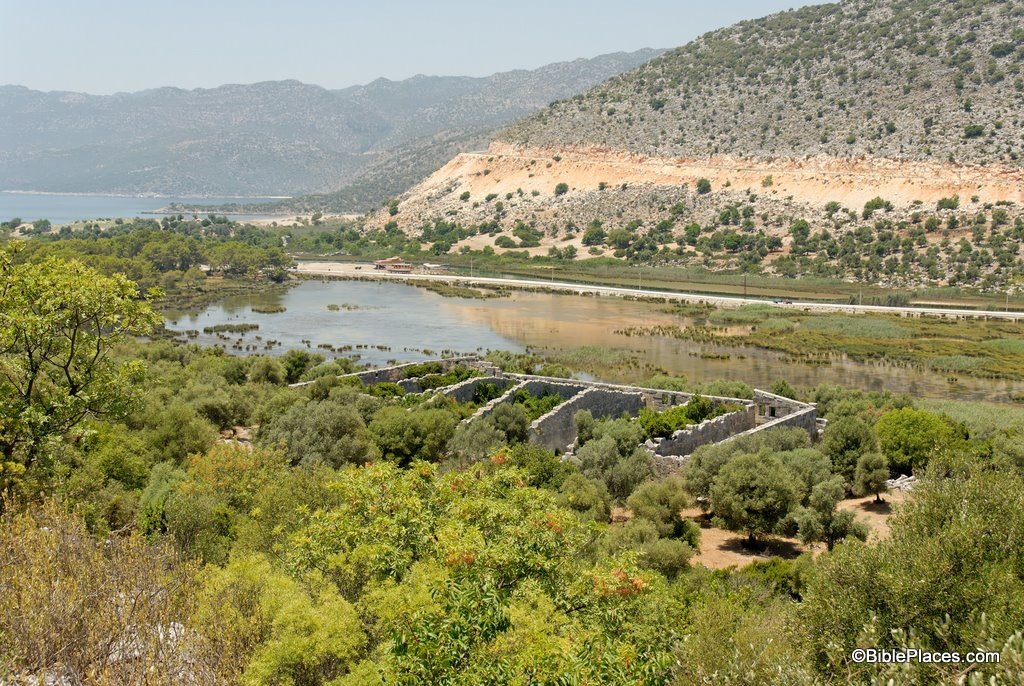
The location of the discovery is interesting to New Testament readers for another reason: Paul visited this place.  A search of the NT won’t reveal any references to Andriake/Andriace, but this was the name of the port of Myra, where Paul changed ships on his way to prison in Rome (Acts 27:5-6).

From Today’s Zaman:

Ongoing excavations at the ancient port city of Andriake in Lycia — located in Antalya’s Demre district — have uncovered a centuries-old Jewish temple.

Site chief Dr. Nevzat Çevik, an archaeology professor at Akdeniz University, told the Anatolia news agency that his team believes the temple is from around the third century. Located on a choice spot facing the sea, the temple was likely built following a law instituted in 212 that allowed Jews the right to become Roman citizens, Çevik said.

The find is important as it is the first archaeological trace of Jewish culture found in Lycia. “For the archaeological world, the world of science and particularly for Lycian archaeology and history, we’re facing an important find here. It’s the first remnant of Lycian Jewish culture we’ve found,” Çevik said, describing the find. “When we first discovered the temple, we weren’t sure what it was, but after continuing to dig, the archaeological findings and particularly the first-quality marble slabs that we found were evidence for us that they were part of a Jewish temple.”

The finding came as a great surprise, the archaeologist said, and the team is continuing to work excitedly. “To encounter remnants of Jewish culture for the first time has caused great excitement. We’re adding another layer to what we know of Lycian culture — now that we know that there was a Jewish presence in Lycia as well, we can follow this path and better understand other finds,” he explained.

As part of the temple find, the team located a menorah and pieces inscribed with traditional Jewish symbols and figures. Çevik also noted the importance that the find would eventually have for tourism in the region.

Andriace Hadrian's granary near harbor, tb062406329ddd

Andriace harbor with well-preserved granary of Hadrian in foreground (2nd century A.D.)

HT: Paleojudaica

UPDATE (10/8): The story is covered by the Jerusalem Post.

Share:

The tablets may be “part of a possible archive.”  From a press release from the University of Toronto:

Excavations led by a University of Toronto archaeologist at the site of a recently discovered temple in southeastern Turkey have uncovered a cache of cuneiform tablets dating back to the Iron Age period between 1200 and 600 BCE. Found in the temple’s cella, or ‘holy of holies’, the tablets are part of a possible archive. The cella also contained gold, bronze and iron implements, libation vessels and ornately decorated ritual objects.
“The assemblage appears to represent a Neo-Assyrian renovation of an older Neo-Hittite temple complex, providing a rare glimpse into the religious dimension of Assyrian imperial ideology,” said Timothy Harrison, professor of near eastern archeology in the Department of Near and Middle Eastern Civilizations and director of U of T’s Tayinat Archaeological Project (TAP). “The tablets, and the information they contain, may possibly highlight the imperial ambitions of one of the great powers of the ancient world, and its lasting influence on the political culture of the Middle East.”
Partially uncovered in 2008 at Tell Tayinat, capital of the Neo-Hittite Kingdom of Palastin, the structure of the building where the tablets were found preserves the classic plan of a Neo-Hittite temple. It formed part of a sacred precinct that once included monumental stelae carved in Luwian (an extinct Anatolian language once spoken in Turkey) hieroglyphic script, but which were found by the expedition smashed into tiny shard-like fragments.

The press release continues here.

HT: Joe Lauer

Share: