A rare gold bead was discovered by a teenage volunteer in excavations on the “Pilgrimage Road” leading from the City of David to the Temple Mount.

Israel’s driest winter in 60 years ended with a week of heavy rainfall throughout the country. The recent rains filled Herod’s pools at the Tower of David Museum in Jerusalem. If you look at the photos, you’ll see that “filled” is a bit generous, but there is water where there usually is not.

“An extraordinary physical reconstruction of a Nabataean woman who lived in the Arabian peninsula more than 2,000 years ago has gone on display to the public.”

“Inside el-Janab Cave near Nablus, archaeologists have found first-ever solid evidence of Muslims fleeing Mongol forces sweeping through the Levant in 1260.”

The Book & The Spade is celebrating a remarkable 40-year run with an anniversary celebration in a live webinar on Wednesday, featuring Scott Stripling, a reflection back on the last four decades of biblical archaeology, and some prize giveaways.

Chandler Collins has posted the second issue of the Jerusalem Tracker, with an extensive roundup of news publications, and media related to Jerusalem from the last six months.

King Jehoram of Israel, the son of Ahab and victim of Jehu, is the subject of Bryan Windle’s latest archaeological biography.

In part 3 of Teaching The Text’s series on Ruth, Brad Gray explores the early encounters between Ruth and Boaz.

Volume 14 of the open-access e-journal Negev, Dead Sea and Arava Studies has been published. The articles are in English, Hebrew, and French.

New release: The Bible and Music, by James F. McGrath. Free download in several formats.

HT: Agade, Arne Halbakken, Explorator
Share:

A new study confirms that the name of David is indeed written on the Mesha Stele.

Smithsonian Magazine profiles Michael Langlois, an unusual scholar who identified many “Dead Sea Scroll” forgeries in various private collections around the world. More recently he has confirmed the reading of “David” on the Mesha Stele.

A BAS Dig Scholarship recipient describes his experience excavating at Khirbat al-Balu’a, a Moabite site in Jordan.

Flashfloods in Petra caused the evacuation of 1,700 tourists and locals.

Egyptian archaeologists believe they have uncovered the tomb of a queen from the 18th dynasty in Luxor.

Ten mummified crocodiles were found in an Egyptian tomb.

Three men were arrested in Aswan for trying to steal a 10-ton statue of Ramses II.

“An ancient wooden sarcophagus that was featured at the Houston Museum of Natural Sciences was returned to Egypt.”

“There’s a good chance you were told ancient Egyptians pulled chunks of brains out through the nose. Experiments suggest there was a much easier way to do this: scrambling the brains.”

Middle East Eye posts several dozen interesting and annotated satellite images of Egypt.

In recent episodes on the GTI Tours Podcast, Jerrell Jobe discusses Egypt’s significance in Scripture, and Matt Bach identifies some “hidden gems” in Israel.

“As of March 2023, ‘Atiqot will become a thematic journal, publishing volumes dedicated to specific topics related to the archaeology of Israel from the protohistoric to Ottoman periods. The journal will be published in English only, both online (Open Access) and in print.” Themes of future issues include:

  • `Atiqot 112: Ancient Hoards, Caches, and Deposits
  • `Atiqot 113: The Archaeology of Purity and Impurity
  • `Atiqot 114 (March 2024): Wine and Drinking Habits in Antiquity
  • `Atiqot 115 (June 2024): Rural Life in the Southern Levant
  • `Atiqot 116 (September 2024): Cult and Religion
  • `Atiqot 117 (December 2024): Burials and Burial Practices

HT: Agade, Joseph Lauer, Arne Halbakken, Gordon Dickson, Ted Weis, Wayne Stiles, Mondo Gonzales, Alexander Schick, Charles Savelle, Keith Keyser, Explorator

Share:

Israel HaYom surveys the history of Shiloh along with the present quest to discover the location of the tabernacle. Scott Stripling believes he knows the location but is not sure he’ll ever be able to prove it.

“Archaeologists announced Tuesday the discovery of a 1,200-year-old estate in Israel’s southern Negev desert, boasting unique underground structures that allowed its owners to overcome the searing summer heat.”

Nathan Steinmeyer takes viewers to excavations at Tel Shimron in a 4-minute video that is the second in a series on excavating in the Bible lands. Tel Shimron is one of the largest sites in the Jezreel Valley region.

Archaeologists are excavating a fortified village in Samaria that existed at the end of the Bar Kochba Revolt. You can see a drone video of the site here and more information and photos here.

Writing for The Jerusalem Post, Aaron Reich’s article claims to provide “everything you need to know about the Church of the Holy Sepulchre.” It’s a decent introduction.

The oldest synagogue in Jerusalem is a non-rabbinic form of Judaism known as Karaism. Daniel J. Lasker has written a book about the subject, and his post on the ASOR Blog gives an introduction.

“Between the former rains (in autumn) and the latter rains (in spring) Israel receives all its rainfall. Except for this week, when it rained in summer!”

Ferrell Jenkins reports on a recent visit to Taanach.

There is a campaign to turn Hebron Road in Jerusalem into a “pedestrian-friendly space with cafes, bike paths, and more.”

Rejuvenation podcast: “Dr. Jodi Magness, the outstanding archaeologist, prolific writer and excellent educator, joins Eve Harow to talk about her renewed decade long excavation at the ancient Jewish village of Huqoq in the Galilee.”

Zoom lecture on Sept 15: “Flavians in Galilee (67 CE): Their Aims and Activities,” by Steve Mason

The Fall 2022 issue of Biblical Archaeology Review includes articles on Diaspora Jews living in Jerusalem in the 1st century, the lethal capabilities of slings, and the location of Magdala.

HT: Agade, Arne Halbakken, Joseph Lauer, Explorator, Paleojudaica

Share:

“An archaeological study of the floor under the Church of the Holy Sepulchre will be possible for the first time, after a two-year undertaking to repair and restore its pavement stones got underway in an inaugural ceremony on Monday.”

Turkish officials deny the report that Turkey will be returning the Siloam Inscription to Israel. The Jerusalem Post explains the history of this significant artifact.

The discovery of a thousand charred linseed at Tel Burna (Libnah?) has led to the suggestion that the economy of the Shephelah greatly changed after Sennacherib’s invasion.

A carved stele from the 4th millennium was lost in the storage area of the Israel Museum, but now after five years of restoration, it has been put on display for the first time.

Leen Ritmeyer’s post on Capernaum includes a number of beautiful reconstruction drawings.

Ferrell Jenkins is back in Israel and shares a photo of a sunrise over the Sea of Galilee.

A rare March snowfall blanketed Jerusalem and parts of Israel in white this week.

Andrew Lawler’s article for Scientific American on the history of excavations in Jerusalem would have convinced me not to read his book. (I did read it, and it’s much better than some of the revised history he presents here.)

A recent study concluded that “Evangelical Christian travelers would prefer to visit Israel on a trip led by a well-known Christian leader or Bible teacher.”

Video from the 2022 Azekah Conference is now online. You can listen to all seven talks in 1.5 hours.

New release: Excavating the Evidence for Jesus: The Archaeology of Christ and the Gospels, by Titus Kennedy (Harvest House, $25)

On sale at Faithlife: 30 Days in the Land with Jesus: A Holy Land Devotional, by Charles H. Dyer ($5.99).

I am back for part two of “The Babylonian Destruction of Jerusalem” on Digging for Truth (25 min). In this episode I talk about the extensive evidence of the 586 BC destruction, including numerous discoveries in the last five years.

HT: Agade, Joseph Lauer, G. M. Grena, Explorator

Share:

Excavations at the “altar site” on Mount Ebal have uncovered an ancient amulet with Hebrew writing. There’s more about it in this lecture by Scott Stripling (beginning at about 34:38).

Zvi Koenigsberg recounts some of his story in working with Adam Zertal on the Mt. Ebal excavation, and the conclusion of the account provides more information about the recently discovered amulet.

Archaeologists are investigating a group of asphalt-coated skulls discovered in a cave in Nahal Hemer near the Dead Sea.

A 5th-century Byzantine church has been opened in Gaza after a three-year restoration project.

The Israeli government is allocating $3 million toward the preservation of archaeological sites in Judea and Samaria, with half of that allocated to reconstruction work at Sebastia (the ancient city of Samaria) and a significant amount to the winter palaces at Jericho.

Ruth Marks Eglash writes about the $50 million renovation project underway at Jerusalem’s Tower of David Museum, including the discovery that Suleiman’s Old City walls have no foundation.

Bryan Windle’s top 3 reports in biblical archaeology this month include two related to Egyptian pharaohs, a discovery on Mount Ebal, and a discoveries from a Jerusalem toilet.

Chris McKinny and Kyle Keimer discuss the geography of Judges in the latest episode of the Biblical World podcast.

Israel’s Good Name reports on a university trip to the site of Doq above Jericho and the Good Samaritan Museum. He includes many photos.

James Strange reflects on his work as an archaeologist and recent discoveries at Magdala. The story includes a 30-minute video interview.

Zoom webinar on Feb 10: “Tel Rehov: A Major Bronze and Iron Age City in the Jordan Valley,” with Amihai Mazar, Nava Panitz-Cohen, Nota Kourou, Naama Yahalom-Mack, and Robert Mullins.

Zoom webinar on Feb 20: “Excavations at Tel Gezer: A Personal Story,” with Sam Wolff.

I don’t think I’ve ever seen a media blitz like that carried out by Andrew Lawler, author of Under Jerusalem. His latest story is on Christianity Today’s website.

There is something special about hiking in Israel.

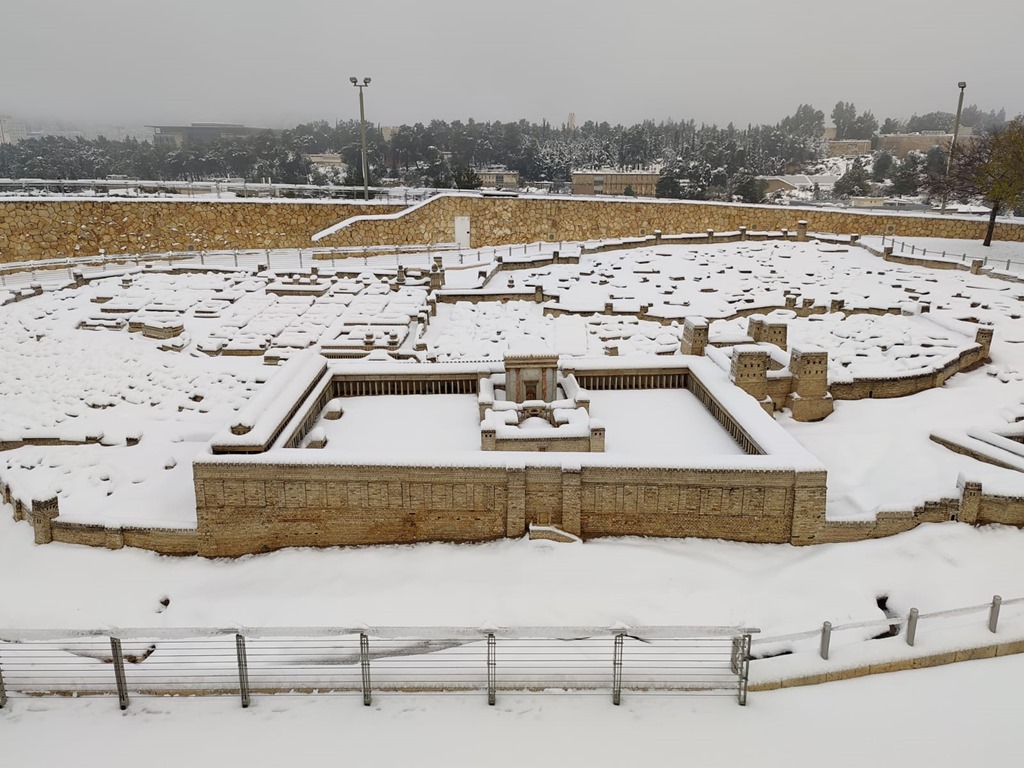
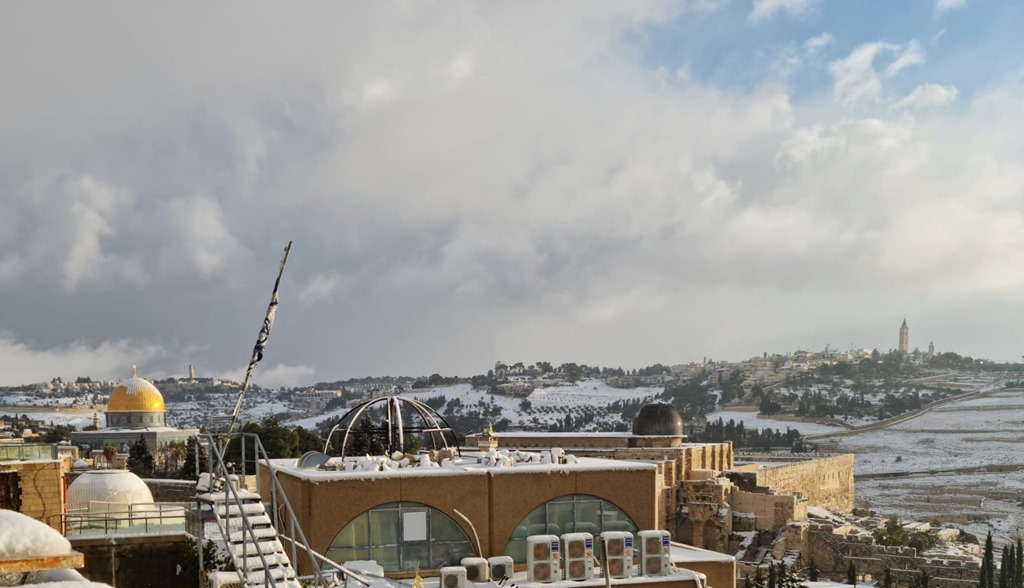
Snow fell in Israel this week, from the Golan Heights to the hills around Jerusalem. The Times of Israel has photos. Haaretz (premium) has more.

HT: Agade, Joseph Lauer, Arne Halbakken, Keith Keyser, Charles Savelle

Jewish Quarter snow

Snow in the Jewish Quarter and on the Mount of Olives. Photo by Miriam Siebenberg

BA6EAF83-6D81-4D2B-9E01-2387334F8571

Jerusalem model at the Israel Museum. Photo by a museum guard.

Share:

Archaeologists discovered a massive gateway near Persepolis that was built by Cyrus in honor of the conquest of Babylon.

A large-scale production brewery was found in Abydos, Egypt.

“The discovery of a rare ‘mud mummy’ from ancient Egypt has surprised archaeologists, who weren’t expecting to find the deceased encased in a hardened mud shell.

A CT study indicates that Pharaoh Seqenenre Taa II (558-1553 BC) died on the battlefield.

A researcher studied tomb reliefs and conducted dozens of experiments in order to discover how the ancient Egyptians baked bread.

A UNESCO jobs program is helping to restore Byzantine sites in Jordan.

Carl Rasmussen shares photos of Aizanoi in Turkey, where one of the best-preserved temples of the ancient world is located.

Greece Is lists the top 10 archaeological finds in Greece in 2020.

The Paphos Archaeological Museum in Cyprus has reopened after four years of renovations and delays.

Smithsonian Magazine: Iraq’s Cultural Museum in Mosul is on the road to recovery.

“The Encyclopædia Iranica Online is now freely accessible at Brill’s Reference Works Platform.”

5,000 photographs of Arabia taken by Sir Wilfred Thesiger between 1945 and 1950 have been digitized by the Pitt Rivers Museum.

“Excavating the History of the Bible: What Archeology Can Teach us About the Biblical World”—hosted by Dr. Andrew Mark Henry has launched on YouTube. The first episode provides an intro to biblical archaeology. The second is on the Canaanites.

A rare snowstorm covered Athens and its acropolis with several inches of snow.

HT: Agade, Ted Weis, Arne Halbakken, Keith Keyser, Explorator

Share: