(Post by A.D. Riddle)

I recently saw an announcement for a brand new volume by David Chapman and Eckhard Schnabel that collects together all extra-biblical texts relevant to understanding the trail and crucifixion of Jesus. The book is entitled The Trial and Crucifixion of Jesus: Texts and Commentary. It caught my eye because I find Schnabel’s writing to be very thorough and helpful. Several books on crucifixion, in fact, have appeared in the last few years from the same publisher.

Chapman, David W.
2008 Ancient Jewish and Christian Perceptions of Crucifixion. Wissenschaftliche Untersuchungen zum Neuen Testament 2. Reihe 244. Tübingen: Mohr Siebeck.  [Republished by Baker Academic, 2010.]

The bulk of this volume is devoted to an inductive study of the ancient sources regarding crucifixion with an eye to understanding the way in which Jews perceived crucifixion. Here Chapman discusses ancient texts from various types of literature that can be described as Jewish (e.g., the Apocrypha, Josephus, Philo, rabbinics, etc.). Chapman’s survey reveals a variety of perceptions from martyrdoms to scandalous punishments for brigands and rebels…Concerning the primary sources, it seems that Chapman has not missed any significant extant material….Although acknowledging the existence of various methods and devices, [Chapman] is not claiming that Jesus died on a pole (or other device); rather, he says crucifixion could take place in a number of ways…The goals of crucifixion included torture, shame, and death. How the cross looked or what shape it was in was not the main concern. (Review by Joseph D. Fantin.)

Samuelsson, Gunnar.
2013 Crucifixion in Antiquity: An Inquiry into the Background and Significance of the New Testament Terminology of Crucifixion. 2nd ed. Wissenschaftliche Untersuchungen zum Neuen Testament 2. Reihe 310. Tübingen: Mohr Siebeck.

This work is a semantic study of the Greek words typically translated “crucify” or “crucifixion.” Prior to its release, popular media tried to create controversy out of the book’s “sensational” claim that the Greek terms do not refer specifically to crucifixion, but only generally to suspension.

Gunnar Samuelsson investigates the philological aspects of how ancient Greek, Latin and Hebrew/Aramaic texts depict crucifixions. A survey of the texts shows that there has been too narrow a view of the “crucifixion” terminology. The various terms do not only refer to “crucify” and “cross.” They are used much more diversely. Hence, most of the crucifixion accounts that scholars cite in the ancient literature have to be rejected, leaving only a few. (From the publisher’s website.)

Cook, John Granger.
2014 Crucifixion in the Mediterranean World. Wissenschaftliche Untersuchungen zum Neuen Testament 327. Tübingen: Mohr Siebeck.

This work, originally conceived as a revision of Hengel’s work on the subject, is in some ways a response to Samuelsson. It casts a wider net by investigating Greek, Latin, Hebrew and Aramaic texts, as well as pictorial representations and archaeological evidence. A very brief summary can be found at the Bible and Interpretation website.

To understand the phenomenon of Roman crucifixion, the author argues that one should begin with an investigation of the evidence from Latin texts and inscriptions (such as the lex Puteolana [the law of Puteoli]) supplemented by what may be learned from the surviving archaeological material (e.g., the Arieti fresco of a man on a patibulum [horizontal beam], the Puteoli and Palatine graffiti of crucifixion, the crucifixion nail in the calcaneum bone from Jerusalem, and the Pereire gem of the crucified Jesus [III CE]). This evidence clarifies the precise meaning of terms such as patibulum and crux (vertical beam or cross), which in turn illuminate the Greek terms [e.g., σταυρός, σταυρόω and ἀνασταυρόω] and texts that describe crucifixion or penal suspension. It is of fundamental importance that Greek texts be read against the background of Latin texts and Roman historical practice. The author traces the use of the penalty by the Romans until its probable abolition by Constantine and its eventual transformation into the Byzantine punishment by the furca (the fork), a form of penal suspension that resulted in immediate death (a penalty illustrated by the sixth century Vienna Greek codex of Genesis). Cook does not neglect the legal sources — including the question of the permissibility of the crucifixion of Roman citizens and the crimes for which one could be crucified. In addition to the Latin and Greek authors, texts in Hebrew and Aramaic that refer to penal suspension and crucifixion are examined. Brief attention is given to crucifixion in the Islamic world and to some modern forms of penal suspension including haritsuke (with two photographs), a penalty closely resembling crucifixion that was used in Tokugawan Japan. The material contributes to the understanding of the crucifixion of Jesus and has implications for the theologies of the cross in the New Testament. The relevant ancient images are included. (Abstract from author’s Academia.edu page.)

Chapman, David W., and Eckhard J. Schnabel.
2015 The Trial and Crucifixion of Jesus: Texts and Commentary.
Wissenschaftliche Untersuchungen zum Neuen Testament 344.
Tübingen: Mohr Siebeck.

The purpose of this comprehensive sourcebook by David W. Chapman and Eckhard J. Schnabel is to publish the extra-biblical primary texts that have been cited as relevant for understanding Jesus’ trial and crucifixion. The texts in the first part deal with Jesus’ trial and interrogation before the Sanhedrin, and the texts in the second part concern Jesus’ trial before Pilate. The texts in part three represent crucifixion as a method of execution in antiquity. For each document the authors provide the original text (Hebrew, Aramaic, Greek, Latin, etc.), a translation, and commentary. The commentary describes the literary context and the purpose of each document in context before details are clarified, along with observations on the contribution of these texts to understanding Jesus’ trial and crucifixion. (From the publisher’s website.)

Table of Contents

Part 1. The Jewish Trial before the Sanhedrin (E. J. Schnabel)
          1.1 Annas and Caiaphas
          1.2 The Jurisdiction of the Sanhedrin
          1.3 Capital Cases in Jewish Law
          1.4 Interrogation of Witnesses
          1.5 The Charge of Blasphemy
          1.6 The Charge of Being a Seducer
          1.7 The Charge of Sorcery
          1.8 Abuse of Prisoners
          1.9 Transfer of Court Cases
Part 2. The Roman Trial before Pontius Pilatus (E. J. Schnabel)
          2.1 Pontius Pilatus
          2.2 The Jurisdiction of Roman Prefects
          2.3 The crimen maiestatis in Roman Law
          2.4 Reports of Trial Proceedings
          2.5 Languages Used in Provincial Court Proceedings
          2.6 Amnesty and Acclamatio Populi
          2.7 Abuse of Convicted Criminals
          2.8 Requisitioning of Provincials
          2.9 Carrying the Crossbeam
          2.10 Titulus
Part 3. Crucifixion (D. W. Chapman)
          3.1 Crucifixion, Bodily Suspension, and Issues of Definition
          3.2 Bodily Suspension in the Ancient Near East
          3.3 Barbarians and Crucifixion according to Graeco-Roman Sources
          3.4 Suspension and Crucifixion in Classical and Hellenistic Greece
          3.5 Jewish Suspension and Crucifixion
          3.6 Victims of Crucifixion in the Roman Period
          3.7 Suspension and Crucifixion in Hellenistic and Roman Palestine
          3.8 Methods and Practices of Bodily Suspension in the Roman Period
          3.9 Crucifixion Terminology Applied to Earlier Traditions
          3.10 Perceptions of Crucifixion in Antiquity
          3.11 Reception of the Christian Message of the Crucified Messiah

Share:
(Post by A.D. Riddle)


Have you ever needed a map for teaching or for a class paper, but cannot find just the right map that you want on the web? Bible Mapper may be the answer to your problem.

Last month, David Barrett released Bible Mapper 5. “Bible Mapper is a fully interactive, highly accurate Bible mapping system that helps you quickly and easily create customized maps of the Holy Lands or study a particular period and aspect of Bible history.”

Having used previous versions of Bible Mapper, the things that impress me most about Bible Mapper are:

  • The accuracy of the data.
  • The degree of customization possible.
  • The wide area of coverage: from India and Uzbekistan in the east, to Portugal and Morocco in the west; from Great Britain in the north, to Ethiopia and Somalia in the south.
  • The maps you create with Bible Mapper are copyright free and may be used in papers, lectures, websites, and publications.

The key features new to version 5 are:

  • Create high resolution maps of Jerusalem (the Jerusalem Ordnance map of 1876 is also able to be overlaid on the terrain).
  • Upload your custom objects or styles to a repository to share with other registered users, or restrict access to yourself for easy import into other maps.
  • Import basic KMZ/KML data (points, lines, areas, etc.) created by other software (e.g., Google Earth) and customize it on your map.

I find that last feature to be especially convenient. For more information, visit the Bible Mapper website, read Mark Hoffman’s review, or read Todd’s review of version 4 on this blog.

Bible Mapper may be downloaded for free. Most features of the program are available to unregistered users, so you can give it a try. A registration key ($37) is required to use the program’s advanced features and to save maps that you create.

When you open the program, Bible Mapper looks like this.

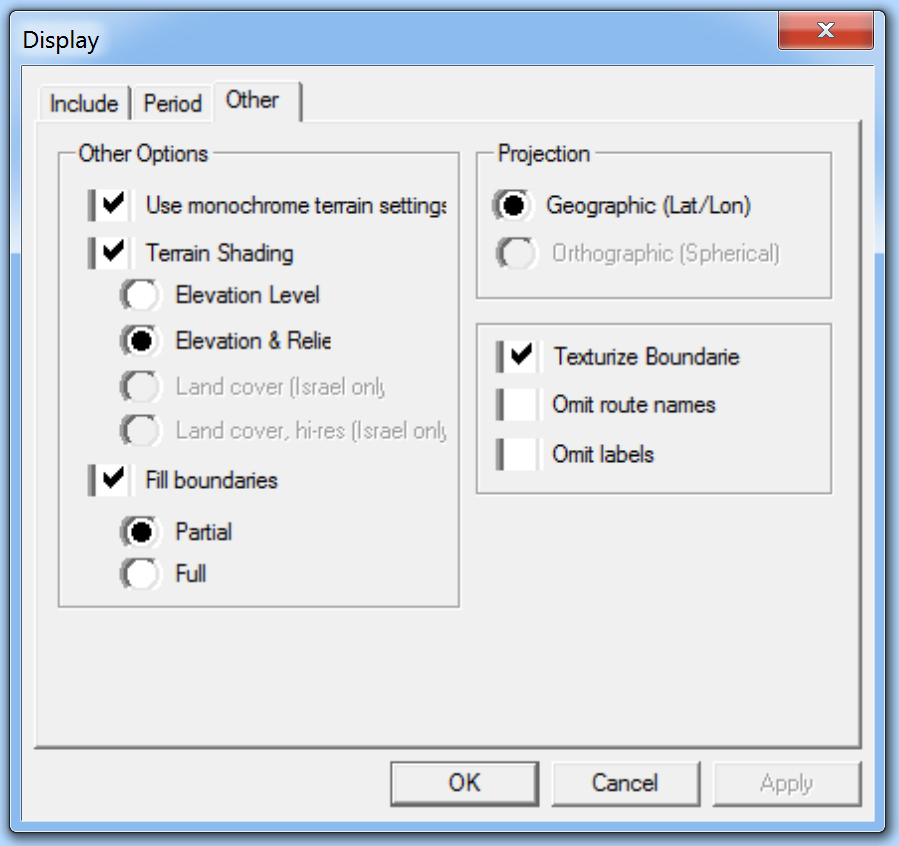
Bible Mapper allows you to choose between colorized terrain (above), or a monochrome appearance (below).

The “Tools” menu allows you to calculate distances between places, find a site, or obtain coordinates for a site.

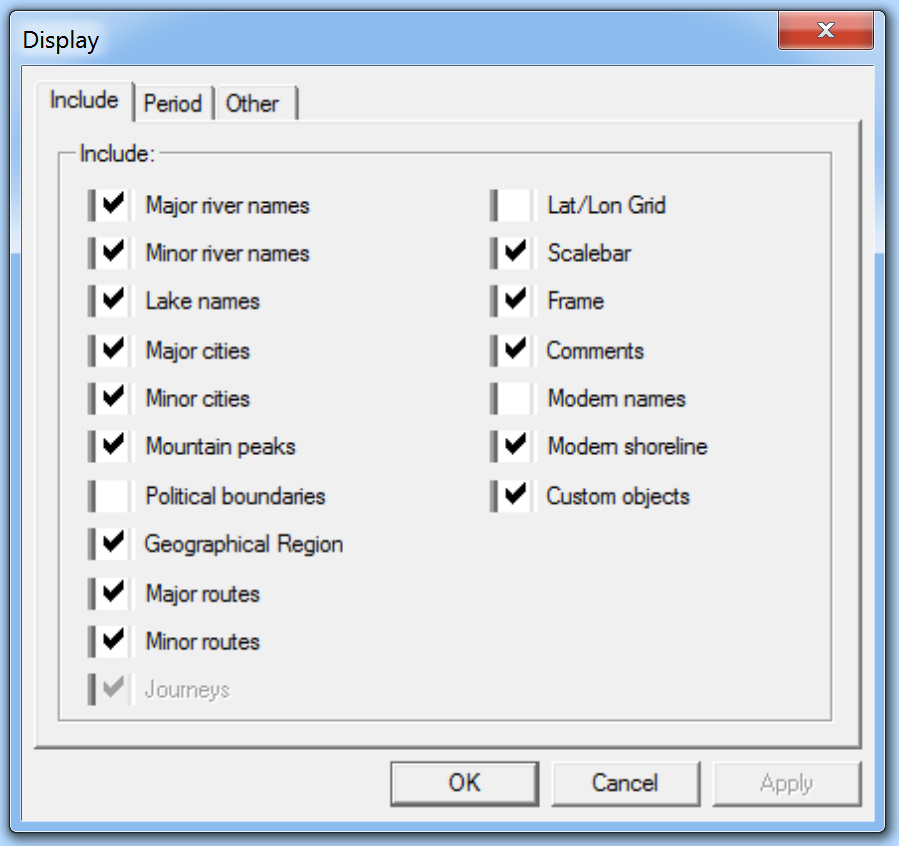
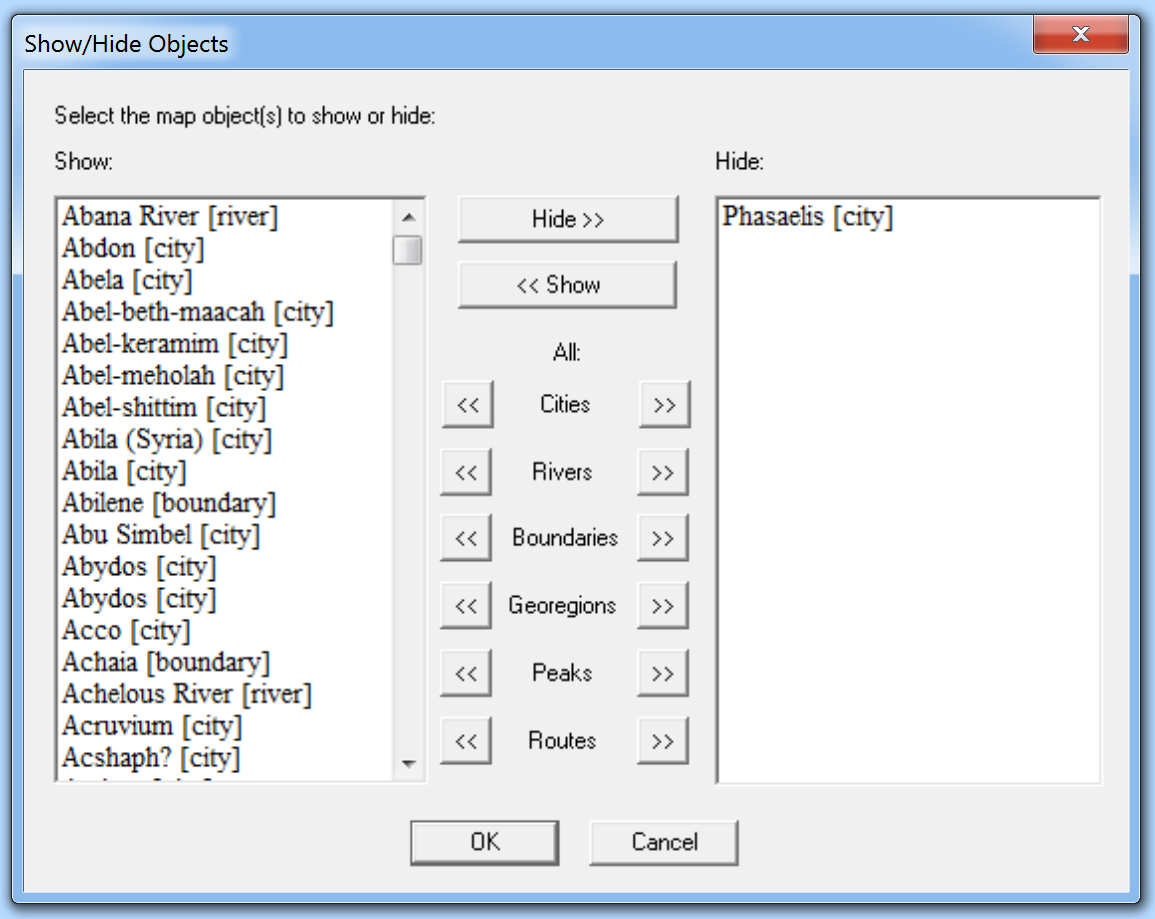
In my opinion, the real gold is the “View” menu. Here you can select what information is displayed: sites, roads, geographic features, or historical periods. Here are some of the options available.

You can import your own sites, adjust the widths and colors of lines, and adjust the appearance of dots. There are even options for repositioning labels.

A number of sample maps can be viewed at the Bible Mapper website gallery.

Bible Mapper is a Windows program. As a Mac user, I am able to use it by running Windows on a virtual machine (such as Parallels). One small issue I experienced was that Mac for some unknown reason appended .exe to the downloaded file. The file should be .msi, so Mac users may have to change the file extension manually before installing.

David Barrett also has created a Bible geography quiz just for fun.

Previous Posts:

Bible Mapper 2.0

Making My Own Map

Bible Mapper: New Wiki

Bible Mapper Version 4

Share:
(Post by A.D. Riddle)

Oftentimes, while researching archaeological sites and/or biblical places, I come across things like this:

map reference 193.142
M.R. 219156
1972 1954

These are grid coordinates for sites. One encounters them in key works such as The New Encyclopedia of Archaeological Sites in the Holy Land (5 vols.), Anchor Bible Dictionary, or the volumes from the archaeological survey of Israel. I want to locate these sites in Google Earth, but how do I convert them? (This subject came to mind while reading Chris McKinny’s post on Shaaraim [see here].)

There are two coordinate systems for Israel, the Old Israeli Grid and the New Israeli Grid. Sometimes these are abbreviated OIG or NIG, but typically no indication is given as to which coordinate system is being used. (To read more about OIG, see this page, and for NIG this page.) I have found that most coordinates are according to OIG, even in newer publications. I am going to assume we are using OIG. (If not, hopefully the results are so wrong that one can tell right away that they are not OIG. This point highlights the fact that you need already to have some kind of rough idea where the right location is so that you can verify the results.)

The coordinates should have an even number of digits. Sometimes they are divided in half by a space, period, or slash, but other times there is nothing separating the string of digits.

If you are given six digits, then the first three digits give one coordinate and the second three digits give the other coordinate. If you are given eight digits, then the first four are one coordinate and the second four are the other. And so on.

The first coordinate gives the easting position (think longitude or x-axis), and the second coordinate gives the northing position (think latitude or y-axis). In other words, the coordinates give you lon/lat. This is the opposite order we normally use of lat/lon for geographic coordinates.

The first (easting, x) coordinate is actually always six digits. If you are only given three digits, then you need to append three zeros to the right side. If you are given four digits, then append two zeros to the right side.

The second coordinate, on the other hand, can be six or seven digits, and is a little more complicated. For the second (northing, y) coordinate, if you are given three digits, then you have to append a “1” to the left side and three zeros to the right side.

With these expanded coordinates, you can now make the conversion using a fantastic website named “The World Coordinate Converter.” (Thanks to Shawn French for finding this gem.) In the top right, from the first dropdown list, scroll down to Israel and select Israel 1923. This is the Old Israeli Grid.

Then, paste the coordinates into the fields. Below this in the second dropdown list, you will need to select “WGS 84/Pseudo-Mercator.” It is found under *World, which is the first group of reference systems. This is the datum used by Google Earth. Finally, click Convert and voila! you have coordinates that you can copy/paste into Google Earth/Maps.

Here are three examples.

Khirbet Jazzir

  1. Anchor Bible Dictionary gives the coordinates 219156 for Khirbet Jazzir. This is thought to be the most likely site for the Levitical city Jazer.
  2. The easting (longitude, x-axis) coordinate is 219. We need to add three zeros to make this a six digit number, namely 219000.
  3. The northing (latitude, y-axis) coordinate is 156. We need to add a “1” to the left and three zeros to the right to get 1156000.
  4. Now go to “The World Coordinate Converter,” select Israel 1923, and paste in the expanded coordinates in the same order they were given to us, 219000, 1156000. Make sure you are converting to “WGS 84/Pseudo-Mercator” and click the Convert button.
  5. The converter generates the following lat/lon coordinates that I can then paste right into Google Earth: 31.996063441518004, 35.728730514891744. Make sure lat is first, and lon is second.

Tell el-Maṣfā

  1. In an article by Israel Finkelstein, Ido Koch, and Oded Lipschits, entitled “The Biblical Gilead: Observations on Identifications, Geographic Divisions and Territorial History,” it is proposed that Mizpah of Gilead be identified with Tell el-Maṣfā.
  2. The coordinates given are 227193.
  3. This gets expanded to 227000, 1193000.
  4. The convertor returns 32.32932657748971, 35.815608335148326 which can be used in Google to locate the site. (We note that these coordinates do not correspond to the hill that they have marked on the p. 143 photograph. It looks to me like their arrow needs to be moved about 1 inch to the left.)

Karm er-Ras

Finally, I was recently asked to make a map that shows Karm er-Ras in Galilee. The Hadashot Arkheologiyot article for this site gives very precise coordinates for each excavation area, both NIG and OIG. The OIG coordinates for Area A are 181580/239335. These are already six digits, so all I need to do is paste them into “The World Coordinate Converter” to get 32.74860752349965, 35.33387296365357.

Additional Notes

The OIG and NIG coordinates are measured in meters. If you are given three digit coordinates, then the accuracy could be off by about half a kilometer. If you are given all six digits, then your accuracy is sub-meter.

If the “The World Coordinate Converter” fails to load the Converter, you can still use the website to get the information you want. Once you select Israel 1923 and paste in your coordinates, a placemark will appear on the map with an info-window. The lat/lon coordinates that you can use in Google Earth appear within this info-window.

For batch conversions, you can supposedly import a CSV into Eye4Software Coordinate Calculator 3.2 (Windows only).  I have not successfully completed a batch conversion, but the software claims it can do so.

Share:
(Post by A.D. Riddle)

Yesterday we mentioned the Royal Inscriptions of the Neo-Assyrian Period publication project. The Neo-Assyrian kingdom (sometimes empire) began with the reign of Tiglath-pileser II ca. 966 B.C. and continued for 3-1/2 centuries until 609 B.C. when the Assyrians were definitively defeated by the Babylonians.

The first Neo-Assyrian king to have direct contact with Israel was Shalmaneser III, who ruled 858-824 B.C. Shalmaneser III is not mentioned in the Bible, but he mentions two kings of Israel in his inscriptions. A version of Shalmaneser III’s royal annals was inscribed on the Kurkh Monolith, a stele found at the base of the tell at Kurkh (now modern Üçtepe), near the Tigris River in Turkey. The annals recount (among other things) Shalamaneser III’s campaign in 853 B.C. to Qarqar where he fought a coalition of kings including Irhuleni of Hamath, Hadad-ezer of Damascus (possibly Ben-Hadad II), and Ahab of Israel. See Michael Caba’s post about the Kurkh Monolith here.


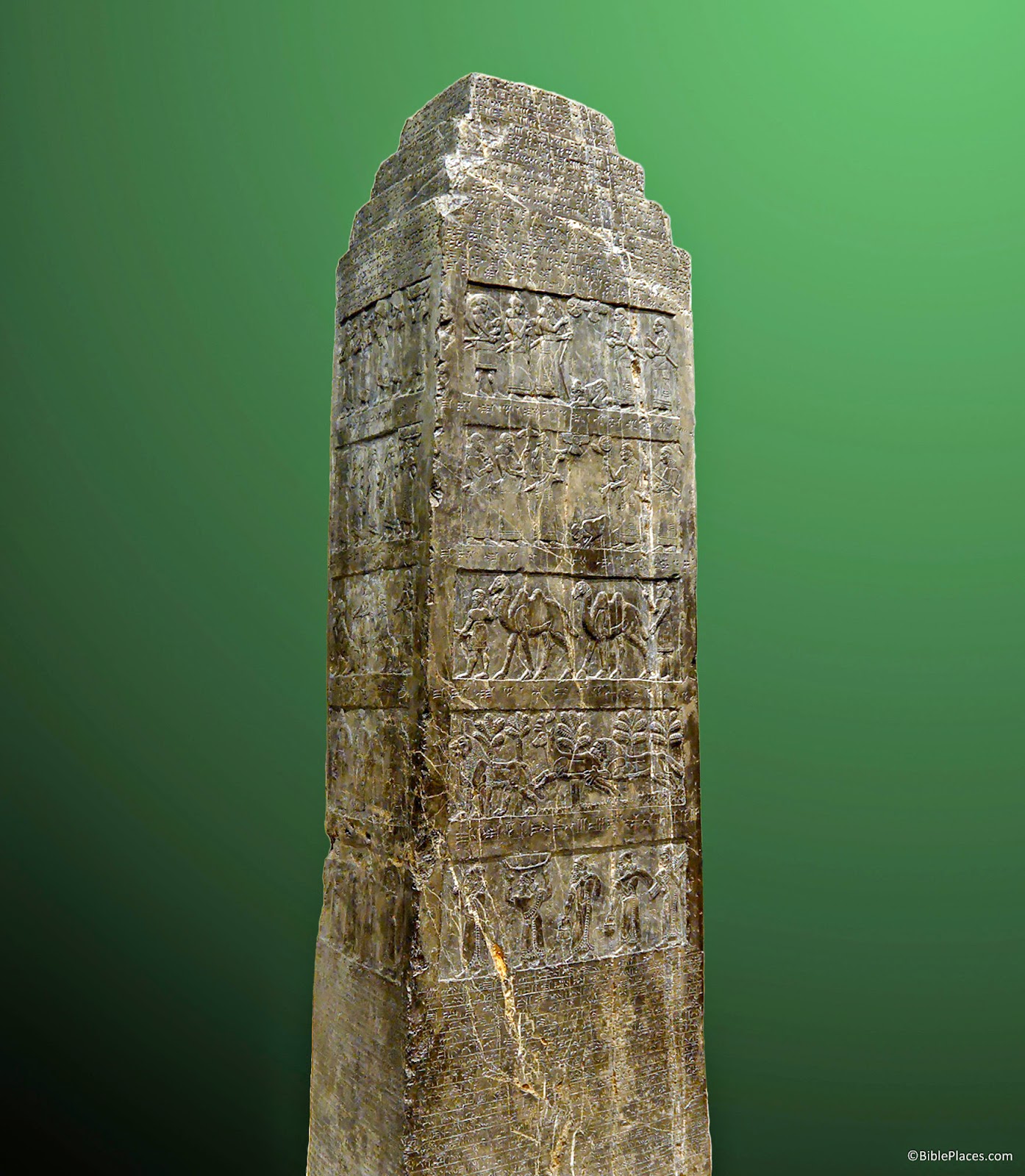
This same Neo-Assyrian king about 12 years later, in 841 B.C., campaigned against Damascus and in the process received tribute from Jehu of Israel. The event is recorded in several of Shalmaneser III’s inscriptions and is pictorially represented on the Black Obelisk. Again, see Michael Caba’s post about this monument here.

Black Obelisk (British Museum).

Following were a series of five kings who oversaw a period of relative weakness in the Neo-Assyrian monarchy: Shamshi-Adad V, Adad-nerari III, Shalmaneser IV, Ashur-dan III, and Ashur-nerari V. Although military campaigns were still conducted, this period saw rebellions in the heartland of Assyria, increase in the number of years the Assyrian king did not go on campaign, the rise in power of Assyrian governors who in some ways behaved as kings in their own right, and the massive expansion of Urartu to the north which posed a threat to Assyria.

None of these five kings are mentioned in the Bible, and only Adad-nerari III mentions a biblical king. During a campaign against Damascus in 796 B.C., Adad-nerari III received tribute from Jehoash of Israel.

The next king of Assyria, Tiglath-pileser III, paved the way for the Assyrian empire’s greatest expansion and he initiated the demise and eventual fall of the northern kingdom of Israel. Tiglath-pileser III and the next five kings are all mentioned by name in the Bible. Furthermore, these kings mention several kings of Israel and Judah in their inscriptions.

  • Tiglath-pileser III
    • 2 Kings 15:29; 2 Kings 16; 1 Chronicles 5:26; 2 Chronicles 28:20
    • Mentions Menahem of Israel, Pekah of Israel, Hoshea of Israel, Uzziah/Azariah of Judah, and Ahaz of Judah
  • Shalmaneser V
    • 2 Kings 17:3; 2 Kings 18:9
    • Conquers the northern kingdom of Israel in 722/721 B.C.
  • Sargon II
    • Isaiah 20:1 = campaign to Ashdod in 712 B.C.
  • Sennacherib
    • 2 Kings 18–19; 2 Chronicles 32; Isaiah 36–17
    • Mentions Hezekiah of Judah (see Michael Caba’s post here)
  • Esarhaddon
    • 2 Kings 19:37; Ezra 4:2; Isaiah 37:38
    • Mentions Manasseh of Judah
  • Ashurbanipal
    • Ezra 4:10
    • Mentions Manasseh of Judah
Stele of Tiglath-pileser III from Iran in which he mentions Menahem (Israel Musum).

There were at least four more kings after Ashurbanipal, but none of these are mentioned in the Bible, nor do any of them mention kings of Judah, for the Neo-Assyrian kingdom collapsed and ceased to exist within 18 years. The Medes captured the city of Ashur in 614 B.C., and the city of Nineveh in 612 B.C. The Babylonians pursued the Assyrians westward, defeating them at Harran in 610 B.C. and finally at Carchemish in 609 B.C.

Share:
(Post by A.D. Riddle)

The Royal Inscriptions of Mesopotamia (RIM) volumes are an excellent resource for reading and studying inscriptions by the kings of Babylonia, Assyria, Ur, and other Mesopotamian kingdoms. The texts are presented in transliteration and English translation, with brief introductions, catalogues of text exemplars, and bibliography. The RIM project was directed by A. Kirk Grayson at the University of Toronto.

RIM is divided up into RIME, RIMB, and RIMA. RIME = The Royal Inscriptions of Mesopotamia Early Periods, and includes volumes 1, 2, 3/1, 3/2, and 4.

  • Frayne, Douglas R. 2008. Presargonic Period (2700–2350 BC). The Royal Inscriptions of Mesopotamia Early Periods 1. Toronto: University of Toronto Press.
  • Frayne, Douglas R. 1993. Sargonic and Gutian Periods (2334–2113 BC). The Royal Inscriptions of Mesopotamia Early Periods Volume 2. Toronto: University of Toronto Press.
  • Edzard, Dietz Otto. 1997. Gudea and His Dynasty. The Royal Inscriptions of Mesopotamia Early Periods 3/1. Toronto: University of Toronto Press.
  • Frayne, Douglas R. 1997. Ur III Period (2112–2004 BC). The Royal Inscriptions of Mesopotamia Early Periods 3/2. Toronto: University of Toronto Press.
  • Frayne, Douglas R. 1990. Old Babylonian Period (2003–1595 BC). The Royal Inscriptions of Mesopotamia Early Periods 4. Toronto: University of Toronto Press.

RIMB = The Royal Inscriptions of Mesopotamia Babylonian Periods, of which only volume 2 was published. It would seem that RIMB volume 1 was supposed to have covered the Kassite Babylonian period, but I have seen nothing about the fate of this volume.

  • Frame, Grant. 1995. Rulers of Babylonia: From the Second Dynasty of Isin to the End of Assyrian Domination (1157–612 BC). The Royal Inscriptions of Mesopotamia Babylonian Periods 2. Toronto: University of Toronto Press.
RIMA = The Royal Inscriptions of Mesopotamia Assyrian Periods and includes volumes 1, 2, and 3.

RIMA 2 and RIMA 3 in particular get a lot of use in my own studies.

  • Grayson, A. Kirk. 1987. Assyrian Rulers of the Third and Second Millennia BC (to 1115 BC). The Royal Inscriptions of Mesopotamia Assyrian Periods Volume 1. Toronto: University of Toronto Press.
  • Grayson, A. Kirk. 1991 Assyrian Rulers of the Early First Millennium BC I (1114-859 BC). The Royal Inscriptions of Mesopotamia Assyrian Periods Volume 2. Toronto: University of Toronto Press.
  • Grayson, A. Kirk. 1996 Assyrian Rulers of the Early First Millennium BC II (858-745 BC). The Royal Inscriptions of Mesopotamia Assyrian Periods Volume 3. Toronto: University of Toronto Press.
The RIM volumes are not cheap, and many of them are now out of print. Several can be ordered from the University of Toronto Press’s website.

The RIM project was launched in 1978, and sometime around 2006 or 2007 (I am not sure of the exact chronology), it was discontinued. The last volume was published in 2008. I think the main cause was lack of continued funding. Unfortunately, the Assyrian royal inscriptions stopped at Ashur-nerari V, right before things get really interesting for the history of the southern Levant.

In 2006, Grant Frame, at the University of Pennsylvania, assumed direction of publication of the royal inscriptions, and thanks to Eisenbrauns, the Assyrian portion of the RIM project was revived under a new name, the Royal Inscriptions of the Neo-Assyrian Period, or RINAP. First, the RINAP project improved on the earlier RIM volumes by creating online indexes of personal names, deity names, place names, temple names, astronomical names, and so forth. Second, RINAP has already produced four volumes in print covering the reigns of Tiglath-pileser III, Shalmaneser V, Sennacherib, and Esarhaddon. In addition to the print volumes, RINAP has made the texts available online, in transliteration and English translation. You miss out on the introductions to the texts (important for making sense of them) and the bibliography that appear in the print versions, but you get the added feature of hyperlinked text which connects to a glossary and list of attested forms.

There are some other resources as well. The RINAP website is worth taking a little time to explore.

  • Tadmor, Hayim, and Shigeo Yamada. 2011. The Royal Inscriptions of Tiglath-Pileser III (744–727 BC) and Shalmaneser V (726–722 BC), Kings of Assyria. Royal Inscriptions of the Neo-Assyrian Period 1. Winona Lake: Eisenbrauns.
  • Grayson, A. Kirk, and Jamie Novotny. 2012. The Royal Inscriptions of Sennacherib, King of Assyria (704–681 BC), Part 1. The Royal Inscriptions of the Neo-Assyrian Period 3/1. Winona Lake: Eisenbrauns.
  • Grayson, A. Kirk, and Jamie Novotny. 2014. The Royal Inscriptions of Sennacherib, King of Assyria (704–681 BC), Part 2. The Royal Inscriptions of the Neo-Assyrian Period 3/2. Winona Lake: Eisenbrauns.
  • Leichty, Erle. 2011. The Royal Inscriptions of Esarhaddon, King of Assyria (680–669 BC). Royal Inscriptions of the Neo-Assyrian Period 4. Winona Lake: Eisenbrauns.

We were happy to hear just last week that Grant Frame has been awarded another grant for the RINAP project (see here). Volume 2, the reign of Sargon II, is nearly complete, and the article states that the grant money will be used for volume 5, the reign of Ashurbanipal.

Grant Frame, an associate professor of Assyriology in the Department of Near Eastern Languages & Civilizations in the School of Arts & Sciences (SAS) has been awarded a two-year, $250,000 National Endowment for the Humanities (NEH) grant for his Royal Inscriptions of the Neo-Assyrian Period (RINAP) Project.
The grant brings the total NEH funding Frame has received for the RINAP Project to nearly $950,000 since 2008.

Four books have been published so far by the RINAP Project; Frame is working on a fifth. The latest grant is for a sixth book, which will include most of the official inscriptions of Ashurbanipal (668c.-631 B.C.E.). Frame hopes to complete the Project with a seventh volume containing the remainder of Ashurbanipal’s inscriptions and those of his successors, up until the fall of Assyria.


We are grateful to Eisenbrauns and Grant Frame for taking on the task of seeing through to completion the publication of these royal inscriptions. Jamie Novotny also appears heavily involved in several steps of the project as well, and there are surely many others. The RINAP volumes are available from Eisenbrauns here.

HT: Agade
Sources:

Royal Inscriptions of Mesopotamia Project

RIM volumes listed at Eisenbrauns—all out of stock.

RIM volumes available from University of Toronto Press

History of the RINAP Project, by Jamie Novotny

Share:
(Post by A.D. Riddle)

On January 20, Google announced that Google Earth Pro is now available for free (see here.) Google Earth un-Pro was always free, but prior to this, Google Earth Pro required an annual subscription that cost $399.99.

The announcement lists some of the advantages to using the Pro edition.

Google Earth Pro has all the easy-to-use features and detailed imagery of Google Earth, along with advanced tools that help you measure 3D buildings, print high-resolution images for presentations or reports, and record HD movies of your virtual flights around the world. 

Google Earth works on both Windows and Mac. The program can be downloaded here. The free license key is GEPFREE.

To get started with some of the Pro features, this blog describes Movie Maker, and this help describes the use of Super Overlays for importing hi-resolution overlays into Google Earth Pro. Another option for importing large overlays is MapTiler.

Share: