(by Chris McKinny)
For the background of the Moza temple see Todd’s informative post showing the location of the Moza temple and discussing its significance for biblical studies.
Could
this site be an example of the ubiquitous statement of “the high places (that) were not taken away,
and the people still sacrificed and made offerings on the high places” (e.g. 1
Kings 22:43, cf. 15:14)? The writer of Kings indicates that these high places
persisted until the reign of Hezekiah (2 Kings 18:1-4, 22) who removed them.
Previously, archaeologists have sought to show Hezekiah’s (or Josiah’s) cult
reformation at the sites of Arad and Beersheba (see below), perhaps the Moza
temple is another example of this cult reformation. Similarly, its existence
during the 10-9th centuries BCE provides an important touchstone for
the cultic descriptions of the various Judahite monarchs until Hezekiah.
It should be noted that Moza strata
V and IV (Iron IIB-Iron IIC) show evidence of large grain storage in the form
of silos and a public storage building (building 150) (Greenhut and De Groot 2009; Greenhut 2012). In light of this, it is
worth mentioning that the ancient site sits very close to the ancient route
from Kiriath-Jearim to the Central Benjamin Plateau. Interestingly, the
narrative that discusses David’s moving of the Ark of the Covenant’s from
Kiriath-Jearim to Jerusalem (2 Samuel 6) indicates that David stopped the
procession “at the threshing floor of Nacon” after Uzzah’s fatal touching of the ark and
placed it in the house of “Obed-edom the Gittite” who was blessed due to its
presence (6:7-11). Could there be a connection between the 10th
century BCE temple (stratum V) and this narrative? Ultimately, it is impossible
to say, but the parallels between grain abundance, geographical setting and
archaeological sequencing are compelling. In any case, it appears that Moza
stratum VI is a clear example of a 9th century BCE cult context that
may be related to ongoing Judahite cult activity outside the Jerusalem temple.
For an actual threshing floor right below Kiriath-Jearim see here.
For the background of the Moza temple see Todd’s informative post showing the location of the Moza temple and discussing its significance for biblical studies.
The Iron Age II site of Moza (likely the biblical site of
the same name, cf. Josh. 18:26) sits right in the path of the ongoing expansion
of the Jerualem-Tel Aiv road (highway 1) right below the modern city of
Mevasseret-Zion. In the course of salvage excavations to build the road on the
slopes of Moza, the excavators encountered a unique Iron II temple with
fantastic cultic finds that seems to date to the Iron IIA and Iron IIB (c.
1000-701 BCE). Stratum VII represents the first phase of the Iron II, which the
excavators dated to the 10th centuries BCE on the basis of a
destruction that they relate to Shishak’s campaign (925 BCE, cf. 1 Kings
14:25). Stratum VI is the continuation of the Iron IIA habitation at the site
in the 9th century BCE before the temple was renovated and the
cultic material was buried in stratum V in the 8th century
BCE (Iron IIB, perhaps by Hezekiah) (Greenhut
and De Groot 2009; Greenhut 2012; Kisilevitz and Eirich-Rose 2013). Specifically, the altar and
standing stones (masseboth) at the
entrance of the temple were purposefully buried and the purpose of the building
was changed from stratum VI to V.
the same name, cf. Josh. 18:26) sits right in the path of the ongoing expansion
of the Jerualem-Tel Aiv road (highway 1) right below the modern city of
Mevasseret-Zion. In the course of salvage excavations to build the road on the
slopes of Moza, the excavators encountered a unique Iron II temple with
fantastic cultic finds that seems to date to the Iron IIA and Iron IIB (c.
1000-701 BCE). Stratum VII represents the first phase of the Iron II, which the
excavators dated to the 10th centuries BCE on the basis of a
destruction that they relate to Shishak’s campaign (925 BCE, cf. 1 Kings
14:25). Stratum VI is the continuation of the Iron IIA habitation at the site
in the 9th century BCE before the temple was renovated and the
cultic material was buried in stratum V in the 8th century
BCE (Iron IIB, perhaps by Hezekiah) (Greenhut
and De Groot 2009; Greenhut 2012; Kisilevitz and Eirich-Rose 2013). Specifically, the altar and
standing stones (masseboth) at the
entrance of the temple were purposefully buried and the purpose of the building
was changed from stratum VI to V.
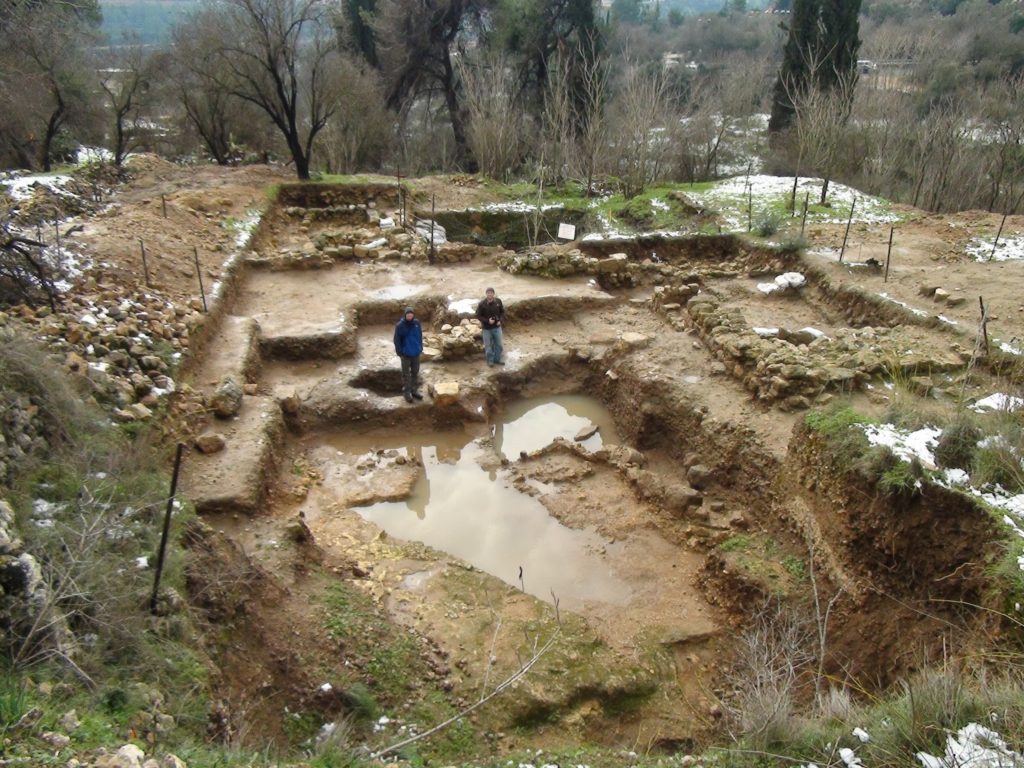 |
| Picture of Moza Iron II temple after last year’s snow (2013) – the stones between the two figures (I am the one on the right) has been interpreted as an altar |
Could
this site be an example of the ubiquitous statement of “the high places (that) were not taken away,
and the people still sacrificed and made offerings on the high places” (e.g. 1
Kings 22:43, cf. 15:14)? The writer of Kings indicates that these high places
persisted until the reign of Hezekiah (2 Kings 18:1-4, 22) who removed them.
Previously, archaeologists have sought to show Hezekiah’s (or Josiah’s) cult
reformation at the sites of Arad and Beersheba (see below), perhaps the Moza
temple is another example of this cult reformation. Similarly, its existence
during the 10-9th centuries BCE provides an important touchstone for
the cultic descriptions of the various Judahite monarchs until Hezekiah.
It should be noted that Moza strata
V and IV (Iron IIB-Iron IIC) show evidence of large grain storage in the form
of silos and a public storage building (building 150) (Greenhut and De Groot 2009; Greenhut 2012). In light of this, it is
worth mentioning that the ancient site sits very close to the ancient route
from Kiriath-Jearim to the Central Benjamin Plateau. Interestingly, the
narrative that discusses David’s moving of the Ark of the Covenant’s from
Kiriath-Jearim to Jerusalem (2 Samuel 6) indicates that David stopped the
procession “at the threshing floor of Nacon” after Uzzah’s fatal touching of the ark and
placed it in the house of “Obed-edom the Gittite” who was blessed due to its
presence (6:7-11). Could there be a connection between the 10th
century BCE temple (stratum V) and this narrative? Ultimately, it is impossible
to say, but the parallels between grain abundance, geographical setting and
archaeological sequencing are compelling. In any case, it appears that Moza
stratum VI is a clear example of a 9th century BCE cult context that
may be related to ongoing Judahite cult activity outside the Jerusalem temple.
For an actual threshing floor right below Kiriath-Jearim see here.
References:
Greenhut, Z.
2012 Moza and Jerusalem in the Iron II:
Chronological, Agricultural and Administrative
Aspects Unpublished Official. IAA Website.
Greenhut, Z., and A. De Groot
2009 Salvage Excavations at Tel Moza: The
Bronze and Iron Age Settlements and
Later Occupation. IAA Reports 39. Israel Antiquities Authority, Jerusalem.
Kisilevitz, S., and A. Eirich-Rose
2013 New Evidence of Religious Practice in the
Jerusalem Environs during the First
Temple Period, Based on Recent Excavations at Tel Moza. In Baltimore, November 20.
2012 Moza and Jerusalem in the Iron II:
Chronological, Agricultural and Administrative
Aspects Unpublished Official. IAA Website.
Greenhut, Z., and A. De Groot
2009 Salvage Excavations at Tel Moza: The
Bronze and Iron Age Settlements and
Later Occupation. IAA Reports 39. Israel Antiquities Authority, Jerusalem.
Kisilevitz, S., and A. Eirich-Rose
2013 New Evidence of Religious Practice in the
Jerusalem Environs during the First
Temple Period, Based on Recent Excavations at Tel Moza. In Baltimore, November 20.