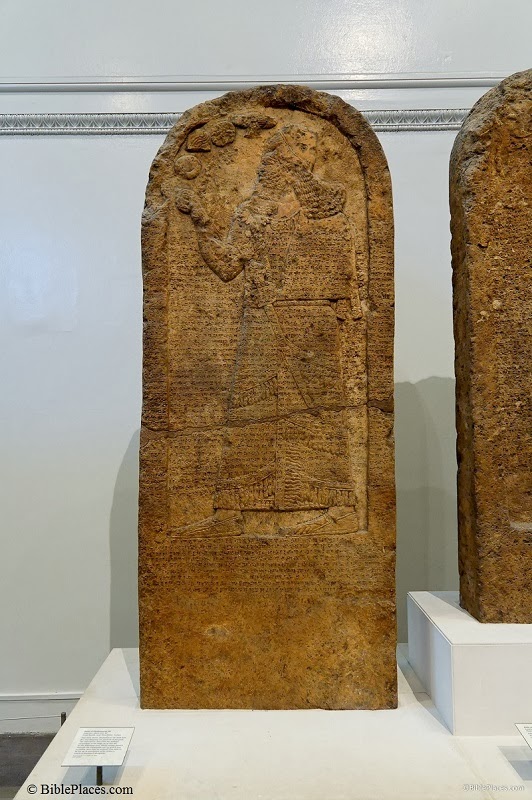
(Posted by Michael J. Caba)

This limestone monument, known as the Kurkh Monolith, is approximately seven feet high and is now located in the British Museum. Discovered in 1861 in Kurkh, Turkey, it was originally carved in c. 852 BC by the Assyrians. The cuneiform writing on the monument refers to a battle at Qarqar involving King Ahab of Israel, who is also frequently referred to in the Bible (cf. 1 Kings 16-22).

Of interest to Biblical studies is the fact that the battle mentioned on this monolith is not mentioned in the Bible, thereby indicating that the Biblical writers were selective in the events they recounted. Further, King Ahab is depicted in the inscription as being one of the major military contributors to a coalition of local forces which was assembled to counter the Assyrian threat. This coalition also included Damascus, which was often at odds with Israel. Though the monolith contains the typical Ancient Near Eastern talk by the Assyrian king claiming victory and so forth, it appears from subsequent events that the battle may not have gone so well for the Assyrians.

(Photo: BiblePlaces.com. Significant resource for further study: The Context of Scripture, Volume 2, pages 261-264.)
Share:

From the Jerusalem Post:

The Antiquities Authority announced Tuesday that it would construct the Middle East’s largest archeological library in Jerusalem. The library, to be called The Mandel National Library for the Archeology of Israel, is to house nearly 150,000 volumes, including 500 rare books and over 1,000 periodicals, the authority said. The adjacent Jack, Joseph and Morton Mandel National Archeological Archives is to contain the authority’s archive as well as maps, permits, plans and publications of excavations from the British Mandate period through today, serving researchers and the public. Both buildings, made possible by a donation from the Cleveland-based philanthropic Mandel Foundation, are to be part of the authority’s Schottenstein National Campus for the Archeology of Israel, currently under construction. The 35,000-square-meter campus, designed by renowned architect Moshe Safdie, is scheduled to be completed in April 2016 and will serve as a visitor center for the Antiquities Authority, as well as its official headquarters.

The full story includes a photo.

Share:
(by Chris McKinny)

For the background of the Moza temple see Todd’s informative post showing the location of the Moza temple and discussing its significance for biblical studies.

The Iron Age II site of Moza (likely the biblical site of
the same name, cf. Josh. 18:26) sits right in the path of the ongoing expansion
of the Jerualem-Tel Aiv road (highway 1) right below the modern city of
Mevasseret-Zion. In the course of salvage excavations to build the road on the
slopes of Moza, the excavators encountered a unique Iron II temple with
fantastic cultic finds that seems to date to the Iron IIA and Iron IIB (c.
1000-701 BCE). Stratum VII represents the first phase of the Iron II, which the
excavators dated to the 10th centuries BCE on the basis of a
destruction that they relate to Shishak’s campaign (925 BCE, cf. 1 Kings
14:25). Stratum VI is the continuation of the Iron IIA habitation at the site
in the 9th century BCE before the temple was renovated and the
cultic
material was buried in stratum V in the 8th century
BCE (Iron IIB, perhaps by Hezekiah) (Greenhut
and De Groot 2009; Greenhut 2012; Kisilevitz and Eirich-Rose 2013)
. Specifically, the altar and
standing stones (masseboth) at the
entrance of the temple were purposefully buried and the purpose of the building
was changed from stratum VI to V.
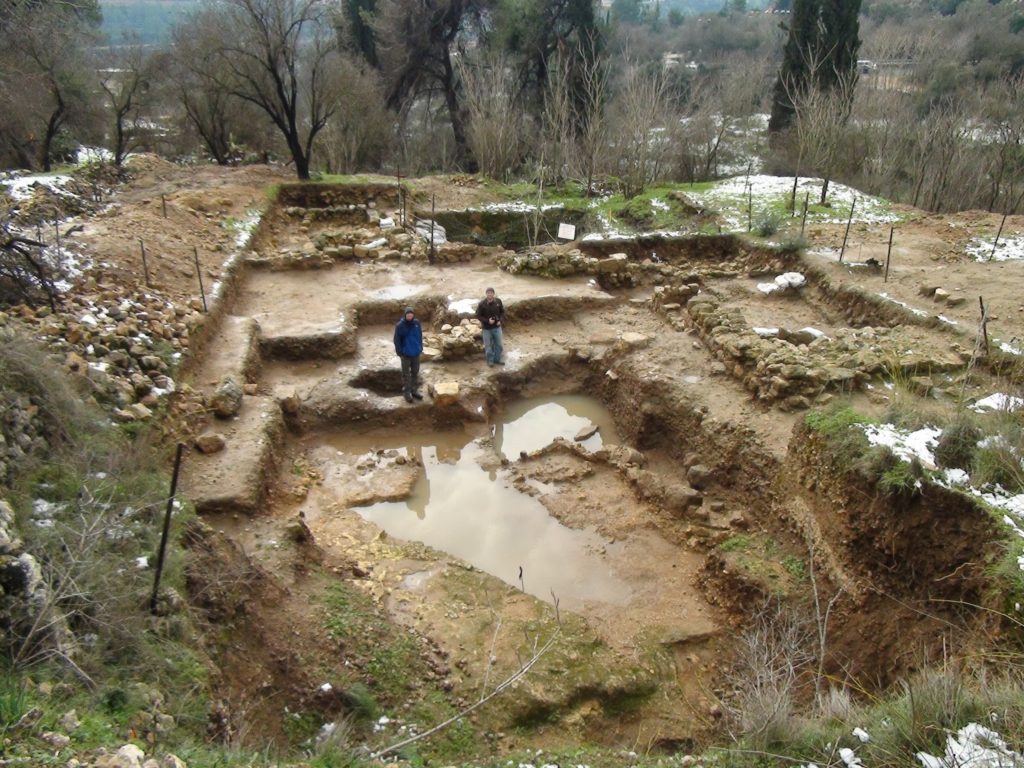


Picture of Moza Iron II temple after last year’s snow (2013) – the stones between the two figures (I am the one on the right) has been interpreted as an altar


Could
this site be an example of the ubiquitous statement of  “the high places (that) were not taken away,
and the people still sacrificed and made offerings on the high places” (e.g. 1
Kings 22:43, cf. 15:14)? The writer of Kings indicates that these high places
persisted until the reign of Hezekiah (2 Kings 18:1-4, 22) who removed them.
Previously, archaeologists have sought to show Hezekiah’s (or Josiah’s) cult
reformation at the sites of Arad and Beersheba (see below), perhaps the Moza
temple is another example of this cult reformation. Similarly, its existence
during the 10-9th centuries BCE provides an important touchstone for
the cultic descriptions of the various Judahite monarchs until Hezekiah.

It should be noted that Moza strata
V and IV (Iron IIB-Iron IIC) show evidence of large grain storage in the form
of silos and a public storage building (building 150) (Greenhut and De Groot 2009; Greenhut 2012).  In light of this, it is
worth mentioning that the ancient site sits very close to the ancient route
from Kiriath-Jearim to the Central Benjamin Plateau. Interestingly, the
narrative that discusses David’s moving of the Ark of the Covenant’s from
Kiriath-Jearim to Jerusalem (2 Samuel 6) indicates that David stopped the
procession “at the threshing floor of Nacon” after Uzzah’s fatal touching of the ark and
placed it in the house of “Obed-edom the Gittite” who was blessed due to its
presence (6:7-11). Could there be a connection between the 10th
century BCE temple (stratum V) and this narrative? Ultimately, it is impossible
to say, but the parallels between grain abundance, geographical setting and
archaeological sequencing are compelling. In any case, it appears that Moza
stratum VI is a clear example of a 9th century BCE cult context that
may be related to ongoing Judahite cult activity outside the Jerusalem temple.

For an actual threshing floor right below Kiriath-Jearim see here.

References:

Greenhut, Z.
            2012  Moza and Jerusalem in the Iron II:
Chronological, Agricultural and  Administrative
Aspects Unpublished Official. IAA Website.


Greenhut, Z., and A. De Groot

            2009  Salvage Excavations at Tel Moza: The
Bronze and Iron Age Settlements and
Later Occupation
. IAA Reports 39. Israel Antiquities Authority, Jerusalem.


Kisilevitz, S., and A. Eirich-Rose

            2013  New Evidence of Religious Practice in the
Jerusalem Environs during the First
Temple Period, Based on Recent Excavations at Tel Moza. In Baltimore, November 20.

Share:

Bryant Wood made the case that Khirbet el-Maqatir is biblical Ai in a lecture he gave at the recent symposium held at Houston Baptist University.

Biblical Archaeology Review has posted online the documentation for this month’s cover story,

“Archaeology Confirms 50 Real People in the Bible.” This is a valuable resource, and more easily accessible than the author’s monograph.

An alabaster statue of a New Kingdom princess has been discovered in excavations near Luxor. The 6-foot statue was once part of a 56-foot-tall statue that guarded the entrance to a temple.

“Iraq’s southern Dhi Qar province is ‘a global museum of antiquities,’ dotted with hundreds of unexcavated ancient cities whose archeological treasures could rival those of the great Sumerian capital of Ur, experts say.”

BibleX points to an article on the time and cost of Paul’s missionary journeys.

Israel experienced a very bad dust storm earlier this week, resulting in the closure of a number of the country’s airports.

Mark Hoffman explains how to make a custom Bible map using Accordance as well as other options.

The ASOR Archaeology Weekly Roundup links to stories about Pompeii, the Apostle Philip, and more.

I’m on this week’s edition of The Book and the Spade with Gordon Govier, discussing the upcoming summer excavations in Israel. (Here’s a direct link.)

Luke Chandler invites you to join him on a tour of Israel. At $3,300, it is one of the most affordable trips I know of.

Wayne Stiles flew out to Israel yesterday and will be blogging about his trip daily. He also will be posting new pictures on his Instagram feed. I’m heading over as well, but I don’t expect to have much time to write on this blog while I am away.

HT: Jack Sasson

Share:

Our friends at Preserving Bible Times have just announced a new website. In addition to the many articles and resources available, I would highlight two areas to check out:

1. 3-D Israel Topographical Relief Maps: Their collection has expanded (and the prices reduced) for an OT version, a Gospel Version, and a contemporary Holy Land version. The maps are roughly 9 x 14 inches (22 x 35 cm) and sell for $29.95 plus shipping. Check out the website for photos of the maps.

2. The Gallery section includes a series of glass slides from 1905.

You can stay up-to-date with the latest resources by visiting the “What’s New” section regularly.

Multi-Era Holy Land Map
3-D Topographical Relief Map of the Holy Land
Share:

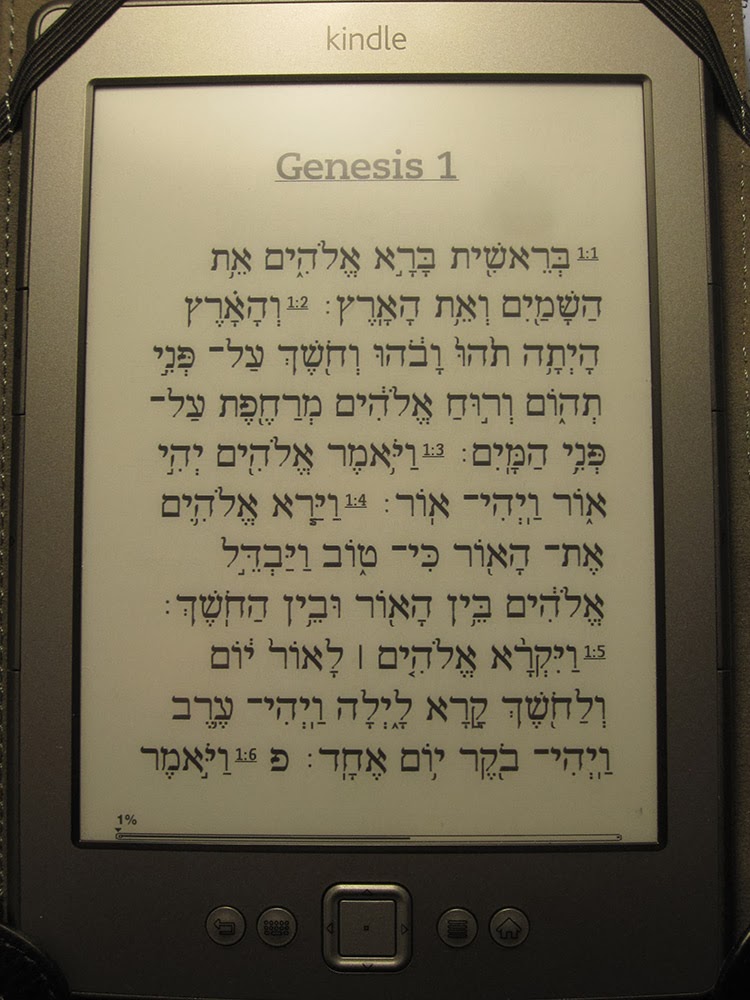
A friend just wrote to let me know that he has just released the first Hebrew Bible designed for the Kindle. That means the vowels and cantillation marks all line up and look great! The Bible is also linked to an English translation so you can easily look up those challenging verses.

Here are a few other features:

  • All 39 books of the Tanak (Torah, Nevi’im, Ketuvim) [Genesis through 2 Chronicles] in Hebrew.
  • Crisp, beautiful, large Hebrew characters that can be resized smaller or larger, as needed.
  • Easy click-through navigation to other books and chapters.
  • Hebrew text from the Codex Leningradensis (digitized through the Westminster Leningrad Codex Tanach).
  • Unicode Hebrew characters.
  • Ability to add primary Hebrew-specific font to Kindle for use with this book.

And the cost is only $5.99! I’m trying to think of a better book I’ve ever bought for less money. Still thinking…. 🙂

There are more details and screenshots at The Bible Student. You can purchase it here.

The Hebrew Bible for Kindle
Share: