Kathleen Kenyon was recently the subject of a biography written by Miriam C. Davis.  Dame Kathleen Kenyon: Digging up the Holy Land was reviewed in Haaretz by Magen Broshi, an archaeologist and the former curator of the Shrine of the Book in Jerusalem.  His review begins:

She never married, and her friends described her as a person whose world consisted of three loves: archaeology, dogs and gin. Kathleen Kenyon was also the head of a women’s college at Oxford. She bombarded the press with anti-Zionist and anti-Israel articles and letters − she thought that the Muslims had preferential rights to the Land of Israel because they had been living there for 1,400 years, whereas the Jews had ruled the land only during the First Temple period (about 400 years) and for another 100 years, during the Hasmonean dynasty. She was, however, one of the most important archaeolokenyon_biography gists ever to dig in the Land of Israel.
That is not a negligible achievement, because more archaeological work has been done in the land between the Mediterranean Sea and the Jordan River, in other words in the State of Israel and the territories, than anywhere else in the world. There is no other country that has been so thoroughly researched, and the number of digs and surveys carried out here is incomparably greater than what has been done in far larger countries. Kenyon is not only one of the most important archaeologists to have worked here (and they number over 1,000), she is also the leading female archaeologist to have worked anywhere (along with the prehistorian Dorothy Garrod).
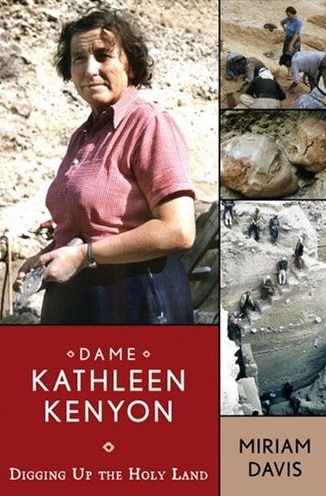
Broshi looks primarily at the three sites in the Holy Land that she excavated, Samaria, Jericho, and Jerusalem.  Concerning the last:

The final site excavated by Kenyon was Jerusalem, and here she was not so lucky. In effect, the digs there, as they are described in the book, were post-climactic. Despite the huge investment – seven digging seasons between 1961 and 1967 – with up to six sites operating simultaneously, employing hundreds of workers, the results were small in number and also unimportant. One reason for this is that while Jordan was still in charge of the old city, Kenyon was not permitted to work in the areas where other archaeologists – like Benjamin Mazar, who excavated south and southeast of the Temple Mount, and Nahman Avigad, who worked in the Jewish Quarter – later discovered many important finds. (Kenyon’s work was restricted because the Waqf Muslim religious trust was opposed to excavations in the Jewish Quarter, since there were Palestinian refugees living there).
The second reason is related to the limitations of her modus operandi, the Wheeler-Kenyon method, which relied on examinations in a limited zone and refrained from exposing a horizontal area. Careful examinations in pits, as meticulous as they may be, are likely to lead to a result similar to that of the Indian fable about the three blind men who fell on an elephant but were unable to identify it correctly: The person who fell on the tail shouted “ropes,” the one who encountered the legs declared “planks,” and the third, who climbed on the tusks, yelled “swords.” Only a dig that exposes a horizontal area is likely to take in the whole “elephant.”

The review concludes:

The figure of Kenyon as portrayed in the book is a model of diligence and dedication. The book is based on thorough research, including written and oral testimony. It is well-written and the story is appealing. In my opinion it deserves high praise.

HT: Joe Lauer
Share:

My friend Al sent along this link with the comment: Take away the wild and foolish speculation and it’s an interesting article.

I agree.

Do these mysterious stones mark the site of the Garden of Eden?

UPDATE: G.M. Grena, in the comments below, suggests a much more sensible article:

http://www.saudiaramcoworld.com/issue/200902/the.beginning.of.the.end.for.hunter-gatherers.htm (short link: http://tinyurl.com/c8tvtd)

Share:

Having been the victim of unwelcome, sometimes lengthy, and usually inflammatory comments on posts on this blog related to the Dead Sea Scrolls, I’m happy to see that New York police have arrested a man for allegedly creating many false identities, impersonating scholars, and slandering Dr. Lawrence Schiffman.  The guilty party, whether he is the accused or someone else, had a single agenda: to promote the widely panned theories of Dr. Norman Golb.  I have long been curious what sort of person would be so committed to such an endeavor as to spend countless hours to promote this view in places that have little real significance (this and other blogs, Wikipedia).  The answer, if NY prosecutors are correct, makes some sense: the perpetrator was Golb’s son.  That son, however, was not 14 years old, but 49.  One scholar who has wrangled extensively with the multiple-aliased offender is Bob Cargill.  A scholar at UCLA, Cargill has posted an extraordinary catalog of the campaign of this individual (be he the accused or someone else).  A few hours after Cargill posted his catalog, NY police announced the arrest.  From the NY Times:

For decades, the origin of the Dead Sea Scrolls has been intensely debated.
The prevailing theory is that these ancient documents, which include texts from the Hebrew Bible, were written over the three centuries before 100 A.D. by a Jewish sect known as the Essenes, who were based in Qumran, a settlement at the northwest shore of the Dead Sea near the caves where the scrolls were found between 1947 and 1956.
An alternative theory, passionately proffered by a University of Chicago professor, is that the scrolls’ authors were not Essenes, and that the scrolls themselves were kept in various libraries in Jerusalem until they were hidden in the caves around Qumran for safekeeping during the Roman war of A.D. 67 to 73. Qumran, he has said, was not an Essene monastery but a fortress, one of several armed defensive bastions around Jerusalem.
The professor, Norman Golb, has stood behind his theory despite significant criticism. His son, Raphael Haim Golb, has been one of his greatest allies.
But prosecutors said on Thursday that Raphael Golb took defending his father’s theory too far. Mr. Golb is accused of using stolen identities of various people, including a New York University professor who disagreed with his father, to elevate his father’s theory and besmirch its critics, Robert M. Morgenthau, the Manhattan district attorney, said at a news conference.
Mr. Golb, 49, was arrested Thursday morning and charged in Manhattan Criminal Court with identity theft, criminal impersonation and aggravated harassment. He faces up to four years in prison if convicted.
Prosecutors said Mr. Golb opened an e-mail account in the name of Lawrence H. Schiffman, the New York University professor who disagreed with Mr. Golb’s father. He sent messages in Professor Schiffman’s name to various people at N.Y.U. and to others involved in the Dead Sea Scrolls debate, fabricating an admission by Professor Schiffman that he had plagiarized some of Professor Golb’s work, Mr. Morgenthau said. Raphael Golb also set up blogs under various names that accused Dr. Schiffman of plagiarism, Mr. Morgenthau said.

NYUNews has posted one of the emails that Golb is alleged to have forged.

(HT: Joe Lauer)

Unfortunately dad’s response is not altogether encouraging.

Reached at his office in Chicago on Thursday afternoon, Professor Golb said he was shocked at the allegations leveled against his son, who is a real estate lawyer and has a Ph.D in comparative literature from Harvard.
“My son is an honorable person,” Professor Golb said. “He could not have done such a thing.”
Professor Golb said that opposing scholars had tried to quash his views over the years through tactics like barring him from Dead Sea Scrolls exhibitions. He said he saw the criminal charges as another attack on his work.
“Don’t you see how there was kind of a setup?” he said. “This was to hit me harder.”

I’m not sure that this is the best time for Professor Golb to be complaining of the same thing that led the impersonator to carry out his campaign.

Share:

A month ago I mentioned the value of the maps and illustrations of the ESV Study Bible, including its online version.  Now, through the month of March, the publisher has announced that access to the online version is free for all, with registration.  See the previous post (and here) for more info about the variety of images available.  Go here to register and get started.

Share:

How quickly one’s legacy can be re-defined.  In his day, William Foxwell Albright was regarded with the highest esteem by scholars in biblical and archaeological studies.  In recent decades, his approach is usually dismissed with an disparaging, how-could-anybody-be-so-naive elevation of the nostrils. 

The “Albright School” is equated with everything wrong in biblical archaeology.  Even the term “biblical archaeology” is rejected.  Albright certainly made significant mistakes, but I surmise that fifty years hence, the hindsight of time will prove less gracious to Albright’s critics than to the man himself.

It’s thus refreshing to read a recent appreciation of Albright’s work by Thomas Levy and David Noel Freedman, published at Bible and Interpretation.  Freedman was a student of Albright, and he co-wrote a biography of his teacher in 1975.  The current piece looks like it was prepared for publication, and its copyright attribution to the National Academy of Sciences suggests that it may have been written in connection with Levy’s induction into the academy last year.
I recommend reading the biography, but this article is a good, brief summary of his life and scholarly achievements.  The article includes a chronology of his life and a selected bibliography.  I note some interesting facts from the article to stimulate your interest:

  • Albright’s left hand was crippled in a childhood farm accident.
  • When he was ten years old, he received as a present the History of Babylonia and Assyria, by Professor R. W. Rogers.
  • Albright spent 18 hours a day for three days writing terrifying exams for the Thayer Fellowship on Syriac, Arabic, Hebrew, Greek, Latin, French, and German; Hebrew Bible Literature and Criticism; geography; archaeology; history; and epigraphy.
  • He mastered more than 26 ancient and modern languages.
  • He translated and published a text from the time of the Dead Sea Scrolls ten years before the Qumran scrolls were discovered.
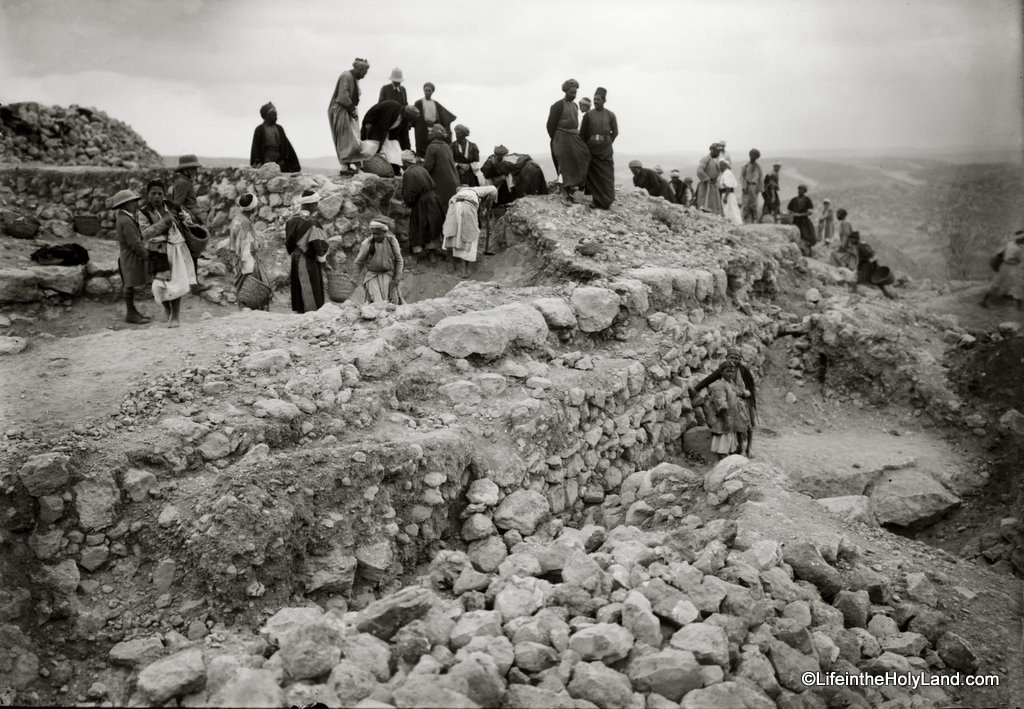
Tell Beit Mirsim, excavating house at east gate, mat05732Albright’s excavations at Tell Beit Mirsim, 1926
Source: Library of Congress, LC-matpc-05732
From a forthcoming collection from
www.LifeintheHolyLand.com
Share: