Wayne Stiles is leading an extraordinary tour of Israel that you should consider joining. Three features immediately mark this as a unique opportunity.

1. This tour has an exclusive focus on the life of Jesus. One of the struggles many have on their first tour is the lack of focus, as you jump from one period to another and back again all day, every day.

When you’re zeroed in on the four Gospels, you’ll be making all kinds of connections as you see, listen, and read about the life of the Messiah.

2. The particular itinerary of this trip is outstanding. Not only is it focused on the life of Jesus, you will see all kinds of places you won’t see on any other trip. Wayne gave me a chance to review the itinerary earlier this year and I was highly impressed. After some suggested tweaks, I don’t think you’ll find a better tour schedule.

3. Wayne Stiles has a unique gift for bringing the biblical world into our own. Some teachers are history gurus, but they can’t translate their research into how it affects us today. Wayne is superb at doing this in his books, on his blog, and at the sites. He is passionate, accurate, and faithful.

So that’s my three cents. I am often asked about a trip to Israel that I would recommend. Unless you’re an enrolled college student, I don’t have too many good suggestions. Today I do. I’d encourage you to take the opportunity while you can.

Cove of the Sower from top, tbs76029303
Try out the acoustics at the amazing Cove of the Sower!
Share:

From the Israel Antiquities Authority:

A rare find of tremendous historical significance was discovered in Jerusalem: a fragment of a stone engraved with an official Latin inscription dedicated to the Roman emperor Hadrian. Researchers believe this is among the most important Latin inscriptions ever discovered in Jerusalem.

During the past year the Israel Antiquities Authority conducted salvage excavations in several areas north of Damascus Gate. In one of those areas a stone fragment bearing an official Latin inscription from the Roman period was discovered. According to Dr. Rina Avner and Roie Greenwald, excavation directors on behalf of the Israel Antiquities Authority, “We found the inscription incorporated in secondary use around the opening of a deep cistern. In antiquity, as today, it was customary to recycle building materials and the official inscription was evidently removed from its original location and integrated in a floor for the practical purpose of building the cistern.

Furthermore, in order to fit it with the capstone, the bottom part of the inscription was sawed round.”

Upon finding the inscription it was immediately clear to the excavators that they had uncovered an especially significant discovery, as indicated by the size and clarity of the letters.

The inscriptions, consisting of six lines of Latin text engraved on hard limestone, was read and translated by Avner Ecker and Hannah Cotton of the Hebrew University of Jerusalem. The English translation of the inscription is as follows: (1st hand) To the Imperator Caesar Traianus Hadrianus Augustus, son of the deified Traianus Parthicus, grandson of the deified Nerva, high priest, invested with tribunician power for the 14th time, consul for the third time, father of the country (dedicated by) the 10th legion Fretensis (2nd hand) Antoniniana.

According to Ecker and Cotton, “This inscription was dedicated by Legio X Fretensis to the emperor
Hadrian in the year 129/130 CE.” Their analysis shows that the fragment of the inscription revealed by the IAA archaeologists is none other than the right half of a complete inscription, the other part of which was discovered nearby in the late nineteenth century and was published by the pre-eminent French archaeologist Charles Clermont-Ganneau. That stone is currently on display in the courtyard of Studium Biblicum Franciscanum Museum.

The full press release is here. The Times of Israel carries the story with more photos (only the last one gives you a sense of the inscription’s size). The Jerusalem Post has a 1-minute video without sound.

UPDATE: Joseph Lauer has sent some new information, including a link to four high-resolution photos and a link to an illustrated and informative post by Leen Ritmeyer.

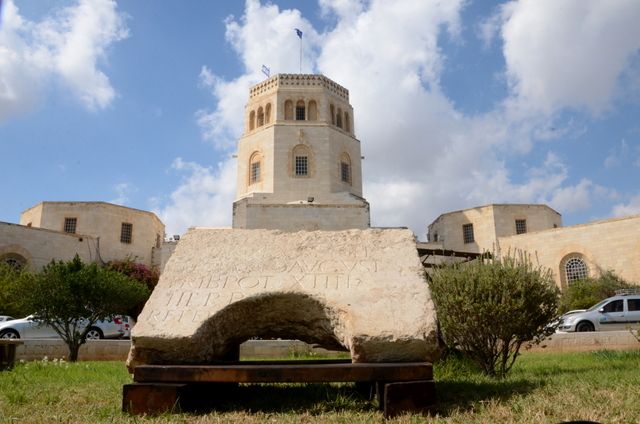
Photograph of the inscription against the background of the Rockefeller Museum, seat of the Israel Antiquities Authority. Photographic credit: Yoli Shwartz, courtesy of the Israel Antiquities Authority
Hadrianic inscription on display in front of the Rockefeller Museum Photograph by Yoli Shwartz, courtesy of the Israel Antiquities Authority
Share:

The Suez National Museum opened in Egypt last week with more than 2,500 antiquities on display.

Egypt’s Ministry of Antiquities announced that a restoration project for Meidum will begin immediately in order to improve the site for tourists.

The smallest of the three Giza pyramids will open next month to tourists after a two-year renovation
project.

The Hanging Church is again open after 16 years of renovation.

The Sesostris Canal that linked the Nile River to the Red Sea never existed.

A giant sphinx has been discovered in the sand dunes of California. This plaster figure was built for Cecil B. DeMille’s 1923 movie “The Ten Commandments.”

And a recent study shows that Hollywood does not portray archaeologists fairly.

HT: Explorator, Agade

Meidum pyramid from below, tb010705037
Pyramid of Meidum
Photo from Egypt volume of the Pictorial Library of Bible Lands
Share:

The BIBLE+ORIENT Museum at the University of Fribourg reopens on Monday in a new location.

Jodi Magness is lecturing on Tuesday at Queens College on “Samson in Stone:  New Discoveries in the Ancient Village and Synagogue at Huqoq in Israel’s Galilee.”

Wayne Stiles’s publisher has selected a cover for his new book.

Accordance Bible Software has a big sale this week on Zondervan Illustrated Bible Backgrounds 
Commentaries of the Old and New Testaments. Only $199 for all 9 volumes until Monday.

Biblical Archaeology Society has 21 free ebooks now available.

“Egypt’s Sunken Secrets” will be on display in Paris, Berlin, and London in the coming year.

Now online: the ETS Annual Meeting Program, the ASOR Academic Schedule, and the SBL Annual Meeting Preliminary Program Book. I’ll be in the exhibit hall (booth #411) at SBL if you’d like to say hi.

HT: G. M. Grena, Charles Savelle, Joseph Lauer, Agade

Share:

The Gaza Museum of Archaeology survived the summer war.

The cultic finds at Tel Burna received some attention in the mainstream press this week.

Leen Ritmeyer explains why he’s been on a hiatus from blogging—and what you need to do if you want to get the publisher to print his new guide book on the Temple Mount!

The Assyria to Iberia exhibit at the Met includes the Tel Dan Inscription (until Jan 4).

The amazing Amphipolis Tomb has its own website. The most recent discovery is a large mosaic showing Persephone being abducted by Pluto.

Just released: The Bible Reader’s Joke Book, by Stephen J. Bramer, a friend and former professor. He loves Bible geography, so I’m sure he’ll have some good puns and stories related to Bible places.

(Also in Kindle.)

HT: Steve Sanchez

Share:

Maney Publishing is offering a “free taster” of articles from three of its journals on the Levant. To find these articles, go to the journal’s homepage and select the “Editor’s Choice” tab on the right hand side. To give you a sense for what is available, I’ve listed a few of the titles below.


Palestine Exploration Quarterly

“A Note on an Iron Age Four-Horned Altar from Tel Dothan,” by Shimon Gibson, Titus Kennedy, and Joel Kramer.

“Archaeological Evidence for a Previously Unrecognised Roman Town Near the Sea of Galilee,” by K. R. Dark.


Levant

“Camels, Copper and Donkeys in the Early Iron Age of the Southern Levant: Timna Revisited,” by
Caroline Grigson.

“Kings in Cuirass — Some Overlooked Full-Length Portraits of Herodian and Nabataean Dynasts,” by Andreas J. M. Kropp.


Tel Aviv

“The Pottery Assemblage from the Rock-Cut Pool near the Gihon Spring,” by Alon De Groot and Atalya Fadida.

“Four Notes on Taita King of Palistin with an Excursus on King Solomon’s Empire,” by Benjamin Sass.

To stay up-to-date on offerings from Maney Publishing, subscribe to their Archaeology,

Conservation, and Heritage mailing list. You can see a full list of related journals available online
here.

HT: G. M. Grena

Share: