From The Washington Post:

On Monday, Israel, Jordan and the Palestinian Authority agreed on an ambitious plan to begin refilling the ancient salt lake with briny water pumped from the Red Sea — and relieve local shortages of fresh water at the same time.
In the first stage of what could become a massive joint initiative, private investors will be asked to finance construction of a large desalination plant in Jordan, on the Gulf of Aqaba. The plant would suck billions of gallons from the Red Sea and convert it to drinking water that would be shared by Israel and Jordan. Israel, in turn, would increase the amount of water it sells to the Palestinian Authority by as much as 30 million cubic meters a year.
Billions of gallons of “reject brine” — essentially, super-salty water created by the desalination process — would be pumped via a new, 100-mile pipeline and discharged into the Dead Sea, in quantities hoped to be large enough to buy some time and slow the lake’s disappearance.
[…]
Much about the project remains to be worked out. Bids from private investors will be solicited next year, with estimated construction costs for the plant and pipeline running anywhere from $500 million to about $1 billion. The sensitive issue of fees for the water and the exact routing of the pipeline remain to be negotiated.
The first drop of brine would probably not be deposited into the Dead Sea before 2017.

Such a project has been discussed for many years, but this is the first agreement that I am aware has been signed. The Washington Post includes more details, background, and a map of the area. For more general info and photos on the Dead Sea, see this page.

Dead Sea view of lake from above PEF Marker, tb011703401
View of Dead Sea from approximate level of water 100 years ago
Photo from Judah and the Dead Sea
Share:

Robert Deutsch is suing the Israel Antiquities Authority for $3 million.

Leen Ritmeyer points to a Washington Post article and detailed graphic of the Temple Mount.

Seth Rodriquez shares an animated map that shows who controlled the Middle East from 3000 BC to present.

The story of Eilat Mazar’s discovery of gold coins and medallion near the Temple Mount and how she kept it secret is recounted by Israel HaYom.

The Egyptian Museum is open, but King Tut is all alone, according to an update in the Washington Post.

The first winter storm in Israel brought snow to Mount Hermon and a rise in the level of the Sea of Galilee.

HT: Jack Sasson

Graphic from The Washington Post
Share:

The Caspari Center Media Review summarizes a recent report in Maariv on antagonism between Jews and Christians on Mount Zion.

The area surrounding King David’s tomb on Mount Zion has become a conflict zone between Christians and Jews, reports Ari Galhar. The monks from Dormition Abbey, which is adjacent to the tomb, claim that the Jews who frequent the place “spit on priests and nuns, spray-paint graffiti on the walls, stand in front of the church and curse the Christians, calling out ‘Death to Christians and Jesus is a monkey,’ and hold events on Saturday evenings with loud music.” The Jews, on the other hand, claim that a secretary and priest from the Abbey, both from Germany, “harass the Jews in that place for anti-Semitic reasons, especially because of the priest’s German background.” They also claim that Christians removed two mezuzot from the entrance to the tomb and also removed prayers books, which they then threw away “in order to hurt us.” An effort has been made to mediate between the two sides in recent weeks. One mediator explains that much of the blame can be placed on both Jewish and Christian delinquent youth who have been stirring up trouble on purpose. The church held a special meeting on Monday with representatives from the president’s office, the mayor’s office, the Ministry of Interior, and the police, where they expressed their grievances. According to the mayor’s office, the next step will be to hold a similar meeting with the Jews who frequent the tomb.

David's Tomb building from north, tb082305461 Passageway leading to David’s Tomb from Dormition Abbey
Photo from Jerusalem volume

Share:

(Post by Seth M. Rodriquez)

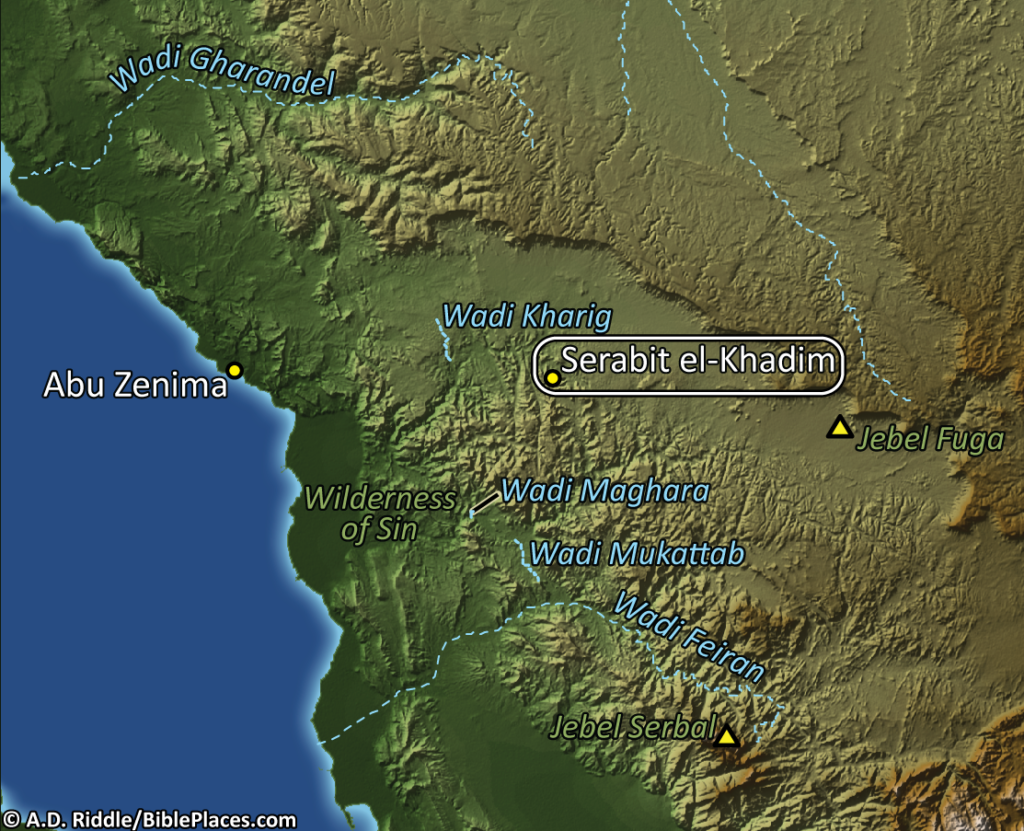
Our picture of the week focuses on the obscure site of Serabit el-Khadim in the Sinai Peninsula.  This is not a place that you will visit on your typical tour of Egypt.  In fact, it was not a place that even many ancient Egyptians would have visited!

Located about 17 miles (27 km.) from the Gulf of Suez, Serabit el-Khadim was a mining site. Teams of miners would be sent to this region by the Pharaoh to dig up turquoise and copper. However, this was only carried out during times when there was a strong central government in Egypt.  The site was occupied on and off from the time of the 4th Dynasty (c. 2600 B.C.) to the time of the 20th Dynasty (c. 1100 B.C.) The following map, which is included in Volume 7 of the Pictorial Library of Bible Lands, shows its position near the Gulf of Suez. (A special thanks is due to A.D. Riddle who created the original maps in the PLBL and has volunteered to customize those maps for this series of blog posts.)

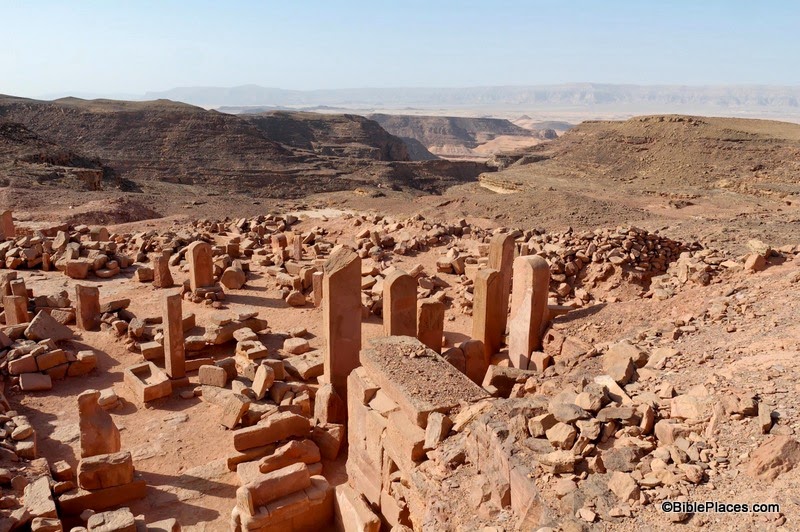
Pictured below are the ruins of the Temple of Hathor that stood at this site and the scorching desert of the Sinai spreading out below it. Starting with a small shrine within a cave, this temple complex grew larger and larger over the course of several hundred years as successive Pharaohs each added their own special touch.

In The Archaeological Encyclopedia of the Holy Land, the temple and its development is described in the following way:

During the excavations an early high place, and a series of temples that replaced it, were revealed within a temenos (enclosure), 200 feet by 140 feet in area. The original Egyptian shrine consisted of a cave sacred to Hathor, goddess of the land and of minerals. In front of the cave a portico was constructed, and then a large court; and further shrines were added during the long Egyptian occupation of the site. Within the temenos were caves dedicated to other deities, such as the moon-god Thoth.

Mining of turquoise did not begin at Serabit el-Khadem until the time of the 12th Dynasty …. Turquoise was essential to the Egyptian jewelry industry, while copper was important for the production of tools and weapons …. The earliest Egyptian monarch to send an expedition to Sinai was Sneferu, the first king of the 4th Dynasty. Mining continued with some interruption down to the end of the 6th Dynasty, when both mines were again worked under Ammenemes III of the 12th Dynasty. Stalae set up in the temple record the various mining expeditions, of which no less than seven took place during Ammenemes III’s reign. …

The temple of Serabit el-Khadem had been enlarged repeatedly. Continuing the process, Sethos I, founder of the 19th Dynasty, extended it. Rameses II and Merneptah are also recorded in the temple, as is Rameses III of the 20th Dynasty. At the beginning of the 21st Dynasty the mines of Sinai went out of use once more.

This map and photograph, along with over 1,000 other images, are available in Volume 7 of the Pictorial Library of Bible Lands, available here for $34 (with free shipping).

Excerpt is taken from “Serabit el-Khadem,” in The Archaeological Encyclopedia of the Holy Land, Logos Edition, ed. Avraham Negev (New York: Prentice Hall Press, 1990).

Share:

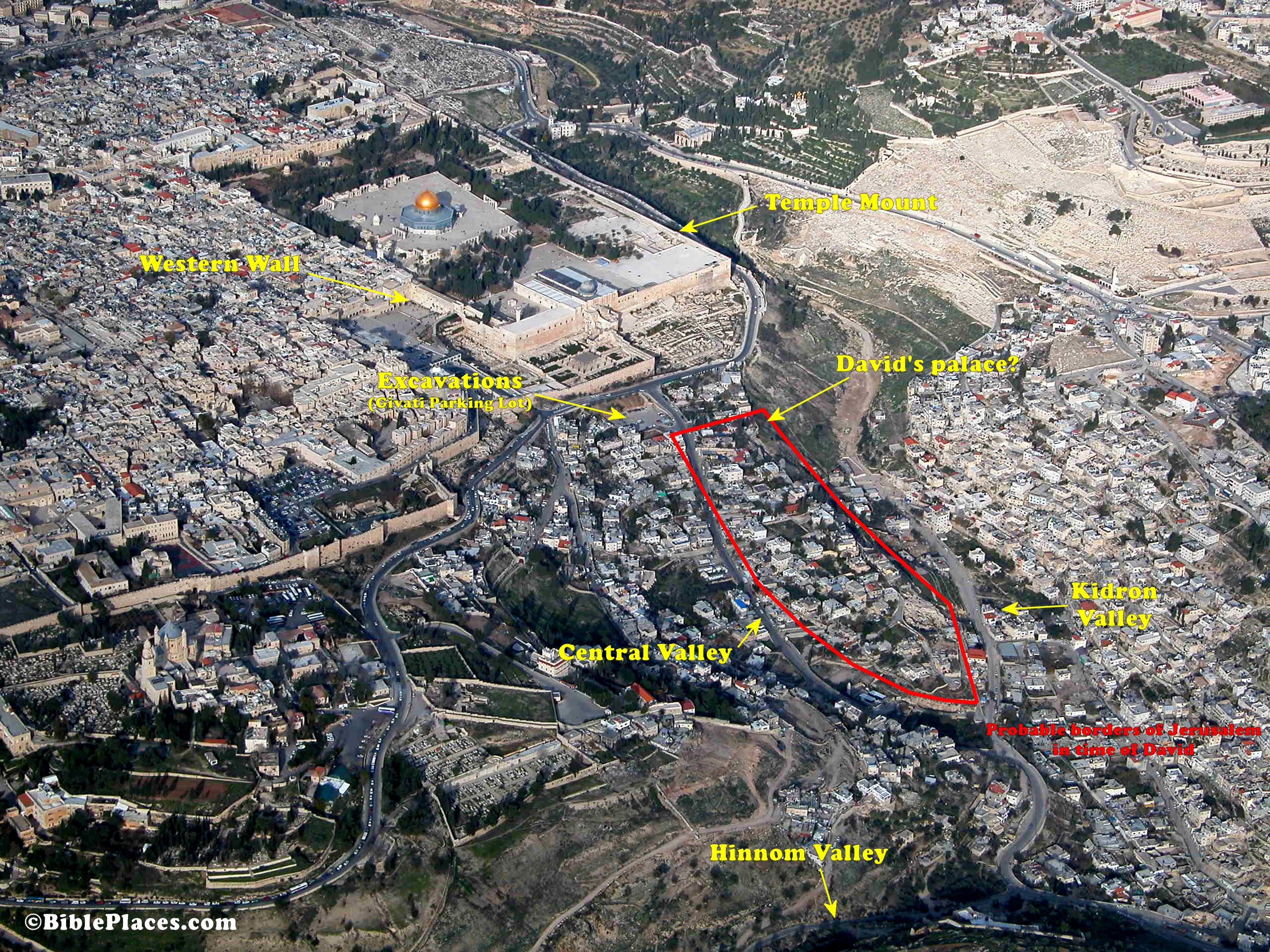
The holiday of Hanukkah is an appropriate time to announce the discovery of a Hasmonean-period building in Jerusalem. The structure is located in the Central Valley just south of the Dung Gate in the former Givati parking lot. The Israel Antiquities Authority describes the find in a press release.

In recent months remains of an impressive building from the Hasmonean period (second century BCE) are being unearthed in excavations the Israel Antiquities Authority is directing in the Giv‘ati parking lot, located in the City of David in the Walls Around Jerusalem National Park. The excavations are sponsored by the “Friends of City of David”.
The building stands c. 4 meters high and covers an area of c. 64 sq. m. The building’s broad walls (more than one meter thick) are made of roughly hewn limestone blocks that were arranged as headers and stretchers, a construction method characteristic of the Hasmonean period.
Although numerous pottery vessels were discovered inside the building, it was mainly the coins that surprised the researchers. These indicated the structure was erected in the early second century BCE and continued into the Hasmonean period, during which time significant changes were made inside it.
According to Dr. Doron Ben Ami and Yana Tchekhanovets, the excavation directors on behalf to the Israel Antiquities Authority, “The importance of this discovery is primarily because of the conspicuous paucity of buildings from the Hasmonean city of Jerusalem in archaeological research, despite the many excavations that have been conducted to date. Apart from several remains of the city’s fortifications that were discovered in different parts of Jerusalem, as well as pottery and other small finds, none of the Hasmonean city’s buildings have been uncovered so far, and this discovery bridges a certain gap in Jerusalem’s settlement sequence. The Hasmonean city, which is well-known to us from the historical descriptions that appear in the works of Josephus, has suddenly acquired tangible expression”.

The story is also reported by Arutz-7 and Israel HaYom.

We’ve reported on excavations at this same area many times in the past:

Hasmonean period building uncovered in Jerusalem
Hasmonean building in Jerusalem.
Photo by Assaf Peretz, courtesy Israel Antiquities Authority.
Aerial view of City of David, tb010703 givati parking diagram 
Jerusalem from the southwest Click photograph for higher-resolution version.

UPDATE (12/4): Eric Welch has sent this photo taken at the excavations during the summer.

Givati
Excavations in Givati parking lot. The three chambers in the foreground correspond with the chambers on the right side of the top photo.
Share:

We announced this in the latest BiblePlaces Newsletter, but if you missed that, you may want to know that a new edition of the Satellite Bible Atlas is available. The hardcover edition is more durable and lays flat, making it ideal for study at home and on the field. For only $28, this is an affordable investment for all who love the Bible. Here are a few reasons why:

1. Every map covers a full page and is in full color. That allows for lots of detail and context.

3. The atlas provides maps of everything from Abraham’s journey from Ur to Paul’s arrival in Rome. Whatever you’re reading or teaching, you will find a map that marks the location and explains the event. You’ll never have to guess where something took place.

7. Purchase includes free access to all of the maps in digital (jpg) format. This makes it easy to use the maps in the classroom and on location.

You can see the full list of why I think this new atlas by Bill Schlegel is a fantastic resource here.

A wall/door map is also available for $7, but if you buy it together with the atlas, the cost is only $4.

If you’re like us, you always wonder what surprise you’ll find when you go to checkout and learn the shipping cost. For those in the U.S., shipping is free. (And for those not in the U.S., the shipping is outrageous, but that’s beyond our control. There is an Israeli distributor who can ship to some countries less expensively.)

We encourage you to consider this as a gift for a parent, child, pastor, teacher, or friend. This is a unique resource at a terrific price.

Share: