Information on the second Qeiyafa inscription coming later this year (Luke Chandler)
The Tel Burna Arch
aeological Project (ASOR Blog)

Israel approves drilling for oil in Golan Heights (Jerusalem Post)

John the Baptist: The First Christian Martyr (Bryant Wood)

Review of The Unsolved Mystery of Noah’s Ark (Gordon Franz and Bill Crouse)


NIV Study Bible for Kindle marked down to $6.64 (Amazon)

Ferrell Jenkins has begun a series on famous people buried in the Protestant Cemetery on Mount
Zion, including Horatio G. Spafford and James Leslie Starkey.

Online Battle Over Sacred Scrolls, Real-World Consequences (New York Times) Includes an interview with Raphael Golb.

Oak forest on Golan Heights, tb020506169
Oak forest on Golan Heights
Photo from Galilee and the North
Share:

Several articles this week are related to King Herod and the new exhibit at the Israel Museum. With a lengthy list for tomorrow’s roundup, I thought a separate post might be worthwhile.

Herodium, home of the most reviled monarch in Judea – Miriam Feinberg Vamosh writes about Herod’s fortress in a free article in Haaretz.

A King on Exhibition: Herod is Ready for His Close-Up – Karl Vick gives some background on the new exhibit in Time. There are errors.

In Search of Herod’s Tomb – This article by the Herodium’s excavator, Ehud Netzer, was published posthumously in Biblical Archaeology Review.

Herod the Great—The King’s Final Journey – Suzanne F. Singer describes the museum exhibit in the current issue of Biblical Archaeology Review. A slideshow is included.

Over the years, I’ve written about sites important to King Herod, including Masada, Herodium, Caesarea Maritima, Caesarea Philippi, and Jerusalem’s Temple Mount. See also King Herod: Ten 
Things You Didn’t Know.

HT: Jack Sasson

Jerusalem model Herod's Palace from southwest, tb020101208
Model of Herod’s Jerusalem palace, now on display at the Israel Museum. Photo from Pictorial Library of Bible Lands.
Share:

(Post by Seth M. Rodriquez)

From the legend of Atlantis to the recent ABC television series called Lost, disappearing islands have always fascinated people.  Modern history tells the story of another disappearing island, but unlike other stories, there is little mystery about why it happened.

Our picture of the week (the second image displayed below) comes from Volume 5 of The American Colony and Maston Collection which focuses on Egypt and Sinai.  To show the development of the site over the last century, I have also included a drawing from Picturesque Palestine, Sinai and Egypt and a photograph from the revised Pictorial Library of Bible Lands in this week’s post.

From the Roman Period until the late 19th century, the island sanctuary of Philae looked similar to the image below.  A temple to Isis was built on the site in the Roman Period and later was converted to a Christian worship site.
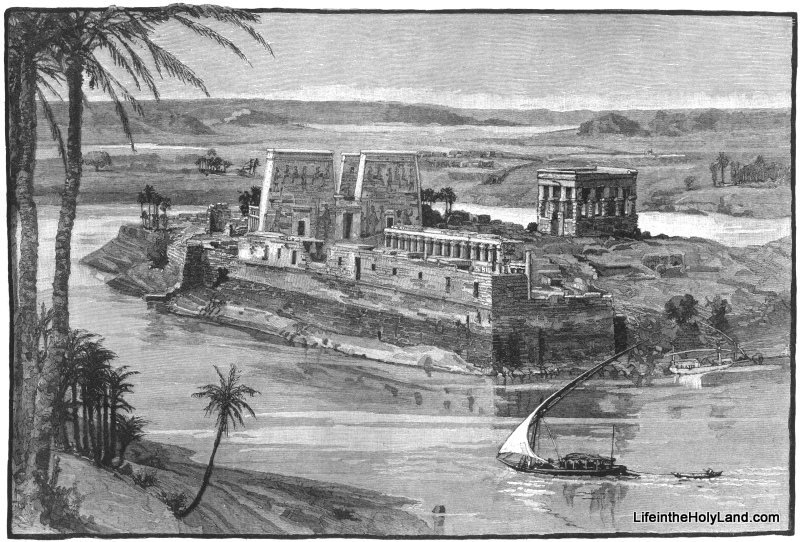
Philae in the 1800s

In 1898, the British constructed the Aswan Dam near the first cataract of the Nile.  The dam helped control the flow of the Nile River but it also flooded the area to the south, including the island of Philae.  The ruins of Philae were partially submerged, as can be seen in the photo below.  This photo was taken sometime between 1910 and 1920.  (Volume 5 of The American Colony and Eric Matson Collection includes a couple of pictures of the Aswan Dam when it was in use, and of tourists visiting Philae by boat.) 
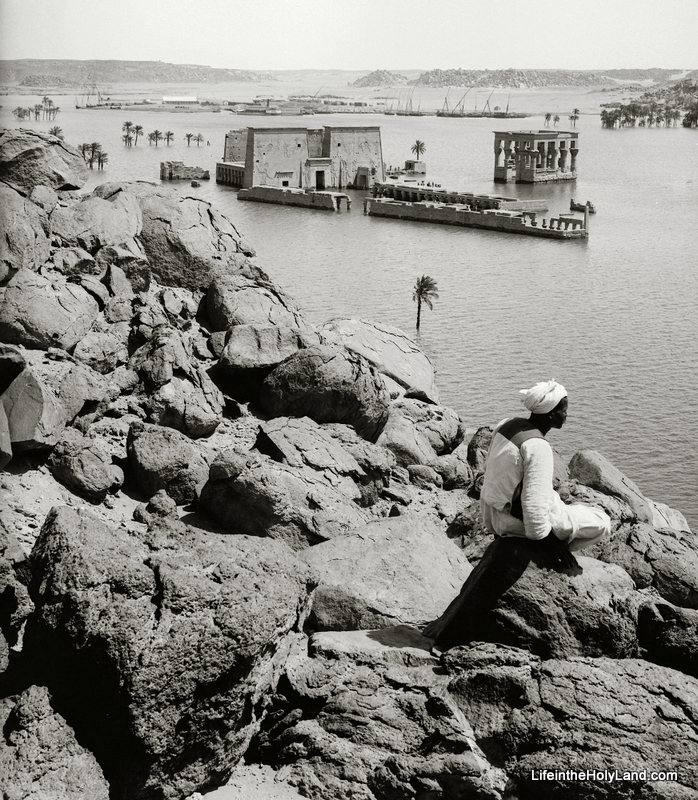
Philae in the Early 1900s

In the 1960s and early 1970s, the High Dam was built which raised the waterline even further.  So if you visit the area today, there is nothing left of the island of Philae.  Fortunately, the ruins on the island were dismantled and moved to the nearby island of Agilika, so you can still see the ruins of Philae … you just can’t see them in their original spot.
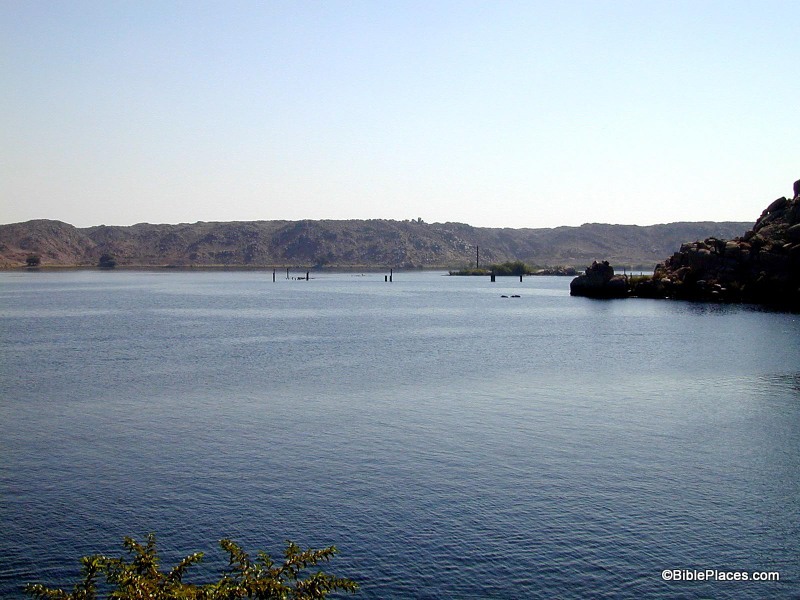
Philae Today

The photograph of the partially submerged ruins of Philae and over 450 others images of Egypt and Sinai are available in Volume 5 of The American Colony and Eric Matson Collection and can be purchased here for $15 (with free shipping).

The drawing of the island before the dams were built is from Volume 4 of Picturesque Palestine, Sinai and Egypt which can be purchased for $20 here (with free shipping).

The photo of Philae today is from Volume 7 of the Pictorial Library of Bible Lands, Revised and Expanded Edition which can be purchased here for $34 (with free shipping).

Additional images and information on Philae can be found here on LifeintheHolyLand.com and here on BiblePlaces.com.

Share:

The Israel Antiquities Authority has issued a press release on the latest discovery:

Recently impressive remains of an industrial installation from the Byzantine period which was used to extract liquid were exposed on Hai Gaon Street.
Installations such as these are usually identified as wine presses for producing wine from grapes, and it is also possible they were used to produce wine or alcoholic beverage from other types of fruit that grew in the region. Yafo’s rich and diverse agricultural tradition has a history thousands of years old beginning with references to the city and its fertile fields in ancient Egyptian documents up until Yafo’s orchards in the Ottoman period.
According to Dr. Yoav Arbel, director of the excavations on behalf of the Israel Antiquities Authority, “This is the first important building from the Byzantine period to be uncovered in this part of the city. The fact that the installation is located relatively far from Tel Yafo adds a significant dimension to our knowledge about the impressive agricultural distribution in the region in this period. The installation, which probably dates to the second half of the Byzantine period (sixth century – early seventh century CE), is divided into surfaces paved with a white industrial mosaic. Due to the mosaic’s impermeability such surfaces are commonly found in the press installations of the period which were used to extract liquid. Each unit was connected to a plastered collecting vat. The pressing was performed on the mosaic surfaces whereupon the liquid drained into the vats. It is possible that the section that was discovered represents a relatively small part of the overall installation, and other elements of it are likely to be revealed in archaeological excavations along adjacent streets which are expected to take place later this year.”

The full story is here. Three high-resolution images are available here. Haaretz has a report here.

inst west-east
Byzantine winepress excavated in Jaffa. Photo by IAA.
Share:

Fifty important artifacts and discoveries are listed in chronological order at www.bibleandarchaeology.com. The collection includes photographs from a variety of sources. If I only had time to teach ten to a class, I would choose these:

  • #2: Merneptah Stele
  • #3: Ten Dan Inscription
  • #6: Kurkh Monolith
  • #7: Black Obelisk
  • #8: Mesha Stele
  • #13: Hezekiah’s Tunnel
  • #16: Lachish Reliefs
  • #20: Ketef Hinnom Amulets
  • #28: Cyrus Cylinder
  • #43: Pool of Siloam
  • #46: Gallio Inscription

Alternately, you can just pass on the link to your class (or friends or pastor) and they can get a quick study in the world of biblical archaeology.

Hezekiah's-Tunnel,-tb051803206-bibleplaces
Hezekiah’s Tunnel
(photo source)
Share: