Some environmentalists are not happy with a plan to save the Dead Sea with a pipeline from the Red Sea.

Archaeology in Egypt has suffered from the political turmoil and resulting loss of tourist dollars.

Residents of Modi’in are protesting plans to build where someone else used to live a long time ago.

Seth Rodriquez provides insight into the Broken Wall of the Sluggard.

Rubén Gómez has a new website for his Spanish-speaking tour of Israel later this year.

The History Channel shares six “secrets” of King Tut.

In honor of Ehud Netzer, the Biblical Archaeology Society has made a collection of Ehud Netzer’s articles available for free, including the recent “In Search of Herod’s Tomb.” Click on each title to read.

The ASOR Blog provides a weekly roundup of stories in the broader world of archaeology.

HT: Jack Sasson

Share:

The Gezer Excavation Project includes a major regional survey under the direction of Eric Mitchell.

A preliminary report of the first five seasons (2007-2011) has now been published in Hadashot Arkheologiyot. Some excerpts:


Purpose: “The purpose of the project is to carry out a systematic high resolution archaeological survey of the region, within 1 km of Tel Gezer, and to locate and publish all features therein. This survey will aid in gaining a better understanding of the historical development of relationship between the ancient city of Gezer and its surrounding landscape.”


History: “The immediate vicinity of Tel Gezer has been investigated by R.A.S. Macalister who noted over 200 archaeological features within 1.5 km of the tell (Macalister 1912 III: Pl. VIII). In recent years, A. Shavit conducted a survey of the entire Gezer Map. Shavit noted that his survey was intensive but he was selective in the surveyed areas.”


Methodology: “To date, 1260 features have been recorded during the current investigations. Features are defined as any individual cultural element deposited on, built on, or carved into the landscape.

Therefore, with features such as winepresses, which include a basin, vat, channel, and cupmarks, each individual feature was added to the total and thus, the number of sites can be reduced significantly.”


Tombs: “Forty-one tombs were accessible for interior survey. Seven basic categories of tomb type have been encountered during the survey. These include tombs with irregularly shaped interior plans (6), simple bench-style tombs (4), arcosolium or recessed bench tombs (5), a distinct simple double arcosolia type (5), loculus or kokhim tombs (9), tombs with multiple styles (3), and tombs that are incomplete, partially filled, or otherwise do not fit into the above categories (9).”


Surface Visibility: “While modern and old disturbances could have easily hidden the existence of tombs, caves, and presses where agricultural land now stretches, the ploughed fields and orchards now offer excellent surface visibility and provide ample opportunity to observe and collect pottery, tesserae, and chert flake scatters, which would otherwise have been obscured by dense brush.”


Conclusions: “The results of the 2007–2011 Tel Gezer Survey seasons have been encouraging in terms of both artifacts and features documented, as well as total area covered. At the current rate, it is estimated that two to three additional seasons will be necessary to complete surveying a 1 km radius around Tel Gezer. Our goal for the future is to publish a catalog of features within our survey area, as well as articles on the tombs and presses of Tel Gezer. At the end of the project, we will analyze all our GPS location data for features and artifacts from every season via mapping software. Using this data, we can construct a clearer understanding of distribution patterns for various features, as well as draw wider conclusions about the use of the land around the ancient city of Gezer.”

The full report includes five images. Check out the official website for information about joining the team.

gezer-tomb
View of arcosolia in Gezer tomb
Photo by Tel Gezer Regional Survey
Share:

(Post by Seth M. Rodriquez)

What is it about old photographs that make them so fascinating? 

I think part of the answer lies in our natural curiosity about the past.  What did things look like back then?  And to a student of archaeology, old photographs of archaeological sites can be especially fascinating because it raises the question: What did things look like when the first archaeologists stepped onto the scene?

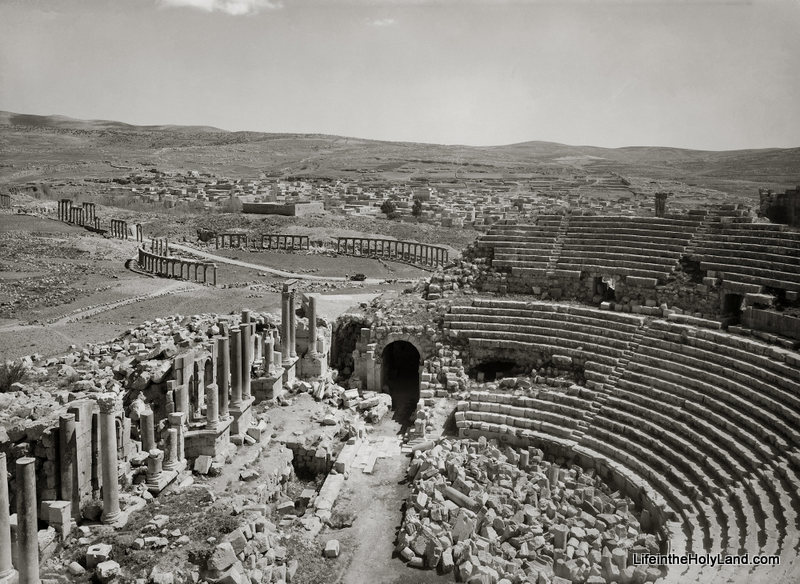
Our picture of the week comes from Volume 4 of The American Colony and Eric Matson Collection, which focuses on Lebanon, Syria, and Jordan. In the photo below, you can see the southern theater and the forum at Gerasa (a.k.a., Jerash) in the modern country of Jordan.  Gerasa was one of the cities of the Decapolis, and “the country of the Gerasenes” is mentioned in Mark 5:1, Luke 8:26, and Luke 8:37.

The photo was taken sometime between 1920 and 1933. Another early photograph of the forum can be found here on LifeintheHolyLand.com. By way of contrast, this page on BiblePlaces.com shows you what Gerasa looks like today, after the archaeologists have excavated, cleaned up, and reconstructed these ruins. The differences between then and now are striking.

The American Colony and Eric Matson Collection is a wealth of information and has a variety of uses:

  • For the archaeologist, this collection provides photographs of early digs and of sites as they looked before excavations. For better or worse, this was an age when a lone scholar stood over a team of local workers who moved tons of dirt in a single season (and this practice can be seen in the collection). Yet this was also a period when things were fresh and exciting as archaeologists were digging into sites for the first time.
  • For the preacher and teacher, this collection provides additional material which can be used to transport your listeners back to a culture and landscape similar to biblical times. It also can be used to discuss geography or illustrate particular sites.
  • For the historian, this collection provides windows into this dramatic period of history. This was the period of the late Ottoman Empire and the British Mandate when Jewish immigrants were migrating to Palestine and establishing new settlements. It was also a time when technology was on the rise: electric stations and telephone stations were being built, railroads were being constructed, and automobiles and airplanes were coming onto the scene.
  • For the artist and graphic designer, this collection provides many beautiful, crisp, black & white photos of places in the Holy Land that can be used in a variety of ways.  These photos still capture people’s attention and fire their imaginations.

This photograph and over 700 others are available in Volume 4 of The American Colony and Eric Matson Collection and can be purchased here for $20 (with free shipping).  Historic images of other Roman cities can be seen here, here, and here on LifeintheHolyLand.com.

Share:

A cave above En Gedi is revealing well-preserved artifacts from the first century AD.

Luke Chandler has word that Yosef Garfinkel plans to follow his Khirbet Qeiyafa dig with excavations at Lachish.

The Daily Mail has photos of the newly opened exhibit of King Herod at the Israel Museum. Shmuel Browns has more.

Some are claiming that the Waqf is destroying more antiquities on the Temple Mount.

Gordon Franz evaluates Robert Cornuke’s use of a computer model to predict the location of Paul’s shipwreck on Malta.

A website for the excavations of Tel Abel Beth Maacah is now online.

En Gedi and Nahal David aerial from northwest, tb010703272
Aerial view of Nahal David and En Gedi
Share:

You might want to put down your coffee before you read how David Ussishkin classifies himself in relation to other archaeologists. This description is from his chapter in Understanding the History of Ancient Israel. He writes:

“The biblical archaeologists of our time can in fact be divided into three groups according to their approach to the use of the biblical text.610ojNdqnGL._SS500_

“The first group includes the fundamentalists, who believe in the reliability of the biblical text in all its details, and that the text forms the basis and guide for their archaeological work. I can mention, for example, Bryant Wood and his work on Jericho (e.g. Wood 1990), and Adam Zertal, who restored an imaginary altar on Mount Ebal on the basis of the biblical text (e.g. Zertal 1986–87). Both of them, as well as other scholars of this group, are good, professional archaeologists, but their archaeological work is clearly biased and distorted by their views on the biblical text.


“The second group should be termed the ‘Followers of Albright’. This group includes the majority of biblical archaeologists practising today. Prominent among them are the American scholars who have been introduced to archaeology through theology and biblical studies. I can mention people like Albright himself, Ernest Wright or William Dever. The ‘Followers of Albright’ also dominate biblical archaeology in Israel. Yigael Yadin, who was a follower of Albright, was the leader of this school of thought in Israel, and its present centre is Jerusalem. Significantly, neither Yadin nor the majority of Israeli biblical archaeologists are religious, hence their adherence to this school of thought does not stem from religious beliefs.

“The basic concept of the ‘Followers of Albright’ is the acceptance of the framework of biblical history as the basis for their archaeological studies. They take the archaeological data and fix them into this framework in exactly the same way that children assemble a jigsaw puzzle: also in this game one follows a known general framework, and then whenever an additional piece is identified, one puts it into its proper position in the framework.


“The third group includes a small number of scholars, whom I labelled ‘the Followers of Hercule Poirot’ for lack of a better term, and at present their centre is at Tel Aviv. I shall mention here Aharon Kempinski, Ze’ev Herzog, Israel Finkelstein and myself, and there are several others. These scholars believe that in recent years the discipline of biblical archaeology has developed tremendously and reached maturity, that huge amounts of significant data have accumulated, and also new research techniques and methods have been adopted and applied. As a result, biblical archaeology has slowly become an independent discipline, and archaeological research can now be conducted in an objective manner without leaning on the biblical text.”

Source: David Ussishkin. “Archaeology of the Biblical Period: On Some Questions of Methodology and Chronology of the Iron Age.” In Understanding the History of Ancient Israel, ed. H. G. M. Williamson, 131–41. Proceedings of the British Academy, vol. 143. Oxford: Oxford University Press for The British Academy, 2007. (Amazon, Worldcat)


Comment: If only those backward fundamentalists would come around to realizing that biblical archaeology has reached maturity, that huge amounts of significant data have accumulated, that new research methods have been adopted, and that objective archaeology doesn’t lean on the biblical text.
Ussishkin’s dating of the Jezreel compound to the time of Ahab is a parade example of leaning (falling? laying prostrate?) on the biblical text. I think he’s right to do it, but it does call into question his categories.

Share:

Tel Kison (Tell Keisan): Two excavation areas revealed remains from the Chalcolithic, Iron I-II, and Persian-Hellenistic periods, including a rich repertoire from the Persian era. The site may be identified with biblical Achshaph and may have been one of the cities of Cabul given by Solomon to Hiram.

Dabburiya: A survey of the area revealed 11 ancient sites including caves, industrial installations, and a quarry. The site preserves the name Deborah and is located on the western side of Mount Tabor.

Ramla: Excavations southeast of the city uncovered 11 strata, the most important dating from the Early Islamic period. An impressive Roman pottery kiln was also discovered.

Regevim, West: Located near remains of a Roman road connecting Caesarea and Megiddo, this site was the location of 6 limestone quarries and 6 tombs, one of which had a rolling stone in situ. The quarries may have served for construction of the Roman road.

Shihin: James Strange directed a survey of the area northwest of Sepphoris which identified 111 ancient features and indicated the site’s prominence in the Early Roman period.

Tell Jatt: Excavations on this tell 6 miles (10 km) northwest of Karmiel exposed three strata from the Middle Bronze IIA and Iron I-IIA.

Megiddo: An excavation north of Kibbutz Megiddo identified 22 quarries, 2 tombs, and a road, all probably used primarily by the Sixth Roman Legion stationed here in the 2nd-3rd centuries AD.

iaa-5680-12
Roman burial cave near Megiddo.
Photo by Israel Antiquities Authority.
Share: