There are difficulties in identifying certain cities in the biblical text, but I’ve never seen anything as strange as the location as Bethulia in the book of Judith. The following is abridged from the Bethulia entry by Sidnie Ann White in the Anchor Bible Dictionary (1: 715-16).

BETHULIA (PLACE) [Gk Baityloua (Βαιτυλουα)]. City where the events of the book of Judith are located (Jdt 4:6). The author of Judith gives many indications of the location of Bethulia: it is N of Jerusalem (11:19), near Betomasthaim (4:6), over against Esdraelon (4:6), near Dothan (4:6), in the hill country of Samaria (6:11). It is described as having a spring below the city (7:12–13), and it is positioned to hold the narrow mountain pass giving access to Jerusalem from the N hill country (10:10–11). However, the name Bethulia is unknown to modern readers, and its exact location, despite all the descriptive material, is uncertain. Enslin (1972) points out that we do not even know whether the city was actually known to the author.

[…]

None of these locations is definitive. It is possible that the author of Judith modeled his city on one of the major cities in the N hill country (Shechem being the most likely candidate), but that does not lead to an absolute identification. It seems most helpful to follow Craven (1983) when she says, “It seems best to leave the details of the Book of Judith alone as the products of a fertile, creative imagination.”

This reminds me of an interview once in which I was asked about various place names that sounded somewhat biblical but were clearly misinformed. Though not without its challenges to interpreters 2,000 years later, the Bible clearly stands apart from other religious texts.

To say it another way, there is no Pictorial Library of Apocryphal Lands or Pictorial Library of Mormon Lands because one cannot photograph what did not exist.

Shiloh from west, tb120806860

Judges 21:19 (NIV) “But look, there is the annual festival of the Lord in Shiloh, to the north of Bethel, and east of the road that goes from Bethel to Shechem, and to the south of Lebonah.”

Footnote: Not all apocryphal or deuterocanonical texts are ahistorical or a-geographical, but as readers have long recognized, the biblical books are unique.
Share:

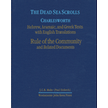
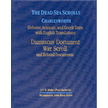
Christianbook.com is running a special on two volumes of James Charlesworth’s The Dead Sea Scrolls. Retailing for $150 each, they are available now for $20. These are not the first books to buy on the Dead Sea Scrolls, but they are essential for more careful study of the sectarian literature.

21994: The Dead Sea Scrolls, Volume 1: Rules of the Community and Related Documents The Dead Sea Scrolls, Volume 1: Rules of the Community and Related Documents
By James H. Charlesworth / Westminster John Knox Press

“This important work brings together all copies of the Dead Sea Scroll text known as THE COMMUNITY RULE (also called the Manual of Discipline), with original Hebrew and English translations on facing pages. This volume offers the most up-to-date research, an indispensable compendium for anyone doing research on the scrolls.” [taken from BIBLICAL ARCHAEOLOGY REVIEW] THE DEAD SEA SCROLLS Vol. 1 was winner of the Biblical Archeological Society Publication Awards–Best Scholarly Books on Archaeology for 1995. Includes introduction, selected bibliography, and footnotes.

22037: The Dead Sea Scrolls, Volume 2: Damascus Document, War Scroll, and Related Documents The Dead Sea Scrolls, Volume 2: Damascus Document, War Scroll, and Related Documents
By James Charlesworth / Westminster John Knox Press

The Princeton Theological Seminary Dead Sea Scrolls Project was established to make available the first comprehensive edition of texts, translations, and introductions to all the Dead Sea Scrolls that are not copies of books in the Biblia Hebraica. Hence the documents composed at Qumran, as well as the Jewish writings composed elsewhere but found in the 11 Qumran caves, are collected in this series.

Amazon has volume 1 for $110 and volume 2 starting at $90.

HT: Peter Wong

Share:

I don’t receive all that many direct suggestions for this blog, but probably a full half of them are recommending this IMAX video trailer. People obviously really enjoy it and want to make sure that I didn’t miss it (though I mentioned it last June and September). If others missed it, you may have too, and so for that reason, and in hopes of saving my readers time to write, I am posting this again.

By the way, the search box at this blog’s upper right is real handy for locating items we have previously mentioned. I often use it to help me remember what I have posted here. (Now if only I could do that for things I say in the classroom…)

Share:

Did the mosaic floor unearthed in 2005 in the yard of a prison near Megiddo belong to the “world’s most ancient Christian church”? As far as the developers of a $7 million project are concerned, it did. The prison will be moved within two years and a tourist center constructed to welcome half a million tourists in the first year alone. Haaretz reports:

The church remains were unearthed four years ago [sic], during prison renovations. The excavations revealed a mosaic floor, with three inscriptions. The one to the west of the mosaic reads, “The god-loving Akeptous has offered the table to God Jesus Christ as a memorial.” The inscription and other findings, such as coins, are believed to date from the third century.

The findings suggest that the Roman army that was positioned at the site was involved in Christian community rituals even before the institutionalization of the Christian church.

When the findings were unearthed archaeologists said that “it is likely that the inscription points to the antiquity of the building. At first there were tables that served an eating ceremony, and only later alters were added. That takes us back to an ancient period, before the institutionalization of churches with basilicas.”

The full report is here. Previous related stories on this blog include:

Share:

The Friends of the Israel Antiquities Authority has announced the establishment of the Brandt-Lewis Center for Ancient Jewelry and Artifacts, to be part of the Schottenstein National Campus for the Archaeology of Israel in Jerusalem.

The BBC reports on a dispute over oil pipelines that run under the ruins of Babylon.

The Jerusalem Post reviews the 30th volume of Eretz Israel.

The Freeman Institute has produced a 14-minute film on the Rosetta Stone and how they create full-size replicas.

James Tabor explains why he believes that finding Jesus’ remains in the Talpiot tomb does not contradict Christian belief in Jesus’ resurrection. Michael Heiser writes an excellent response.

Joe Yudin describes the wonders of the Small Machtesh.

Don’t forget about Eisenbrauns 30/30/300 sale. It ends on the 30th.

I’ll be traveling the next couple of weeks, but I have some posts prepared and may have a little time along the way. When I return I’ll have the most important announcement in the history of this blog.

HT: Joseph Lauer, Jack Sasson

Machtesh Qatan panorama, tb042207334

Machtesh Qatan panorama
Share:

A preliminary report for the fourth and fifth seasons (2010-2011) at Khirbet Qeiyafa has been published by Hadashot Arkheologiyot. Written by Yossi Garfinkel, Sa‘ar Ganor, and Michael Hasel, the report summarizes the finds in Areas A through E, gives a stratigraphical chart of the six strata (from Late Chalcolithic to Ottoman), and concludes with an assessment of the site in its three major periods. Of most interest to us are the finds from Stratum IV, dated to the late 11th and early 10th centuries. This portion is excerpted below, with emphasis added for those who like to skim.

The lower stratum, from Iron Age IIA, dates to the late eleventh–early tenth centuries BCE. The remains of this settlement, uncovered to date, included two gates, two gate plazas, twenty-eight casemates (twenty complete), ten residential buildings and remains of administrative buildings at the top of the site. Large quantities of artifacts were discovered on the floors of the houses in each area, including hundreds of pottery vessels that can be restored, hundreds of stone objects, dozens of metallic objects and small finds. It is obvious that this stratum was suddenly destroyed. Much evidence was found of ritual activity, including mazzevot, a cultic chamber, models of temples (two of ceramic and one of stone) and a figurine.
The Iron Age city had impressive architectural and material finds:
1. A town plan characteristic of the Kingdom of Judah that is also known from other sites, e.g., Bet Shemesh, Tell en-Nasbeh, Tell Beit Mirsim and Be’er Sheva‘. A casemate wall was built at all of these sites and the city’s houses next to it incorporated the casemates as one of the dwelling’s rooms. This model is not known from any Canaanite, Philistine or Kingdom of Israel site.
2. Massive fortification of the site, including the use of stones that weigh up to eight tons apiece.
3. Two gates. To date, no Iron Age cities with two gates were found in either Israel or Judah.
4. An open space for a gate plaza was left near each gate. In Area C an area was left open parallel to three casemates and in Area D, the area was parallel to four casemates.
5. The city’s houses were contiguous and built very close together.
6. Some 500 jar handles bearing a single finger print, or sometimes two or three, were found. Marking jar handles is characteristic of the Kingdom of Judah and it seems this practice has already begun in the early Iron Age IIA.
7. A profusion of bronze and iron objects were found. The iron objects included three swords, about twenty daggers, arrowheads and two spearheads. The bronze items included an axe, arrowheads, rings and a small bowl.
8. Trade and imported objects. Ashdod ware, which was imported from the coastal plain, was found at the site. Basalt vessels were brought from a distance of more than 100 km and clay juglets from Cyprus and two alabaster vessels from Egypt were discovered.
The excavations at Khirbat Qeiyafa clearly reveal an urban society that existed in Judah already in the late eleventh century BCE. It can no longer be argued that the Kingdom of Judah developed only in the late eighth century BCE or at some other later date.

The full preliminary report, with illustrations, is here. All of this data provides archaeologists with much to evaluate with regard to the 10th-century debate.

HT: Joseph Lauer

Khirbet Qeiyafa west gate, tb010412815

West gate of Khirbet Qeiyafa, facing Azekah
Share: