Tel Burna’s spring 2011 season has begun in earnest – the last three days have seen the Master’s College IBEX program (Israel Bible Extension), a pre-military group of Israelis from Kibbutz Beth Guvrim, and several other volunteers continuing the work started in last summer’s inaugural excavation.  The first two days of the excavation have been summed up on Tel Burna’s blog by the co-director of the site, Joe Uziel, they can be viewed here and here.

The finds thus far have been rich and are beginning to illuminate some of the stratigraphic layout of the site. Our current excavations are being carried out in two main areas – Areas A and B.
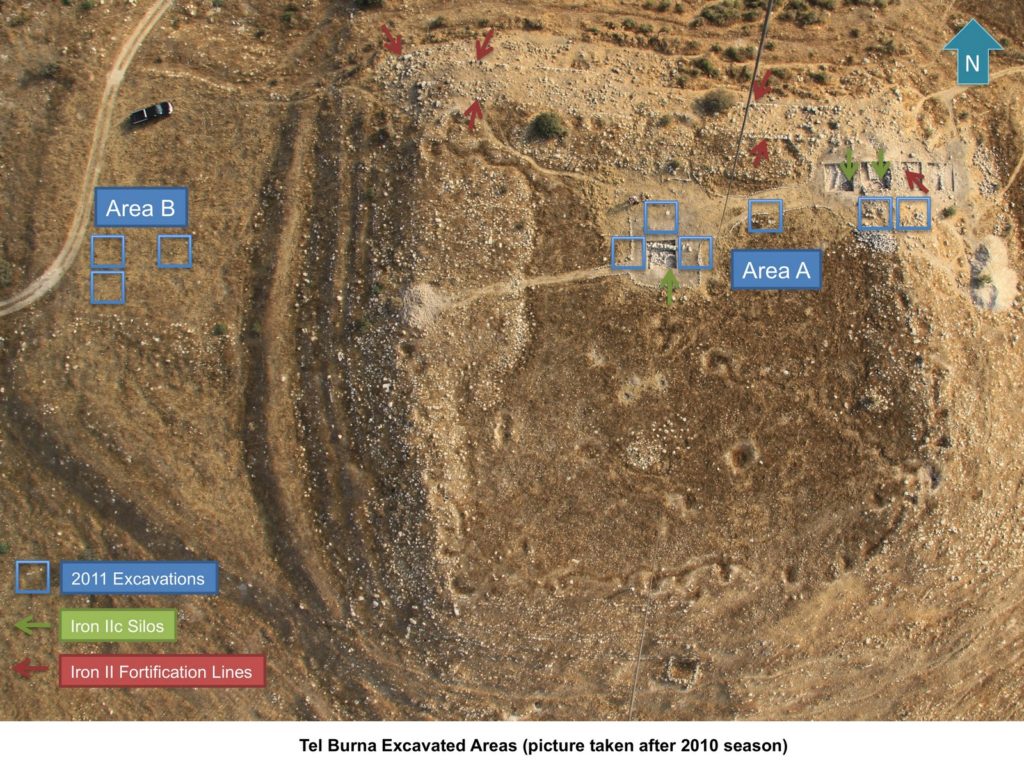
In Area A we are continuing to uncover remains from all of the Iron II with high concentrations of architecture and pottery from the Iron IIc (7th cent. BCE). The discovery of the 7th cent. at Burna, at the very least, allows the site to continue to be considered near the top of the contenders for the identification of biblical Libnah. Its presence shows that the site was occupied during the time of Josiah who married a certain “Hamutal…of Libnah” (2 Kings 23:31; 2 Kings 24:18). Additionally, we have continued to expose the eastern course of the Iron II fortification walls – it is our hope that this season will reveal the different phases of this massive fortification.
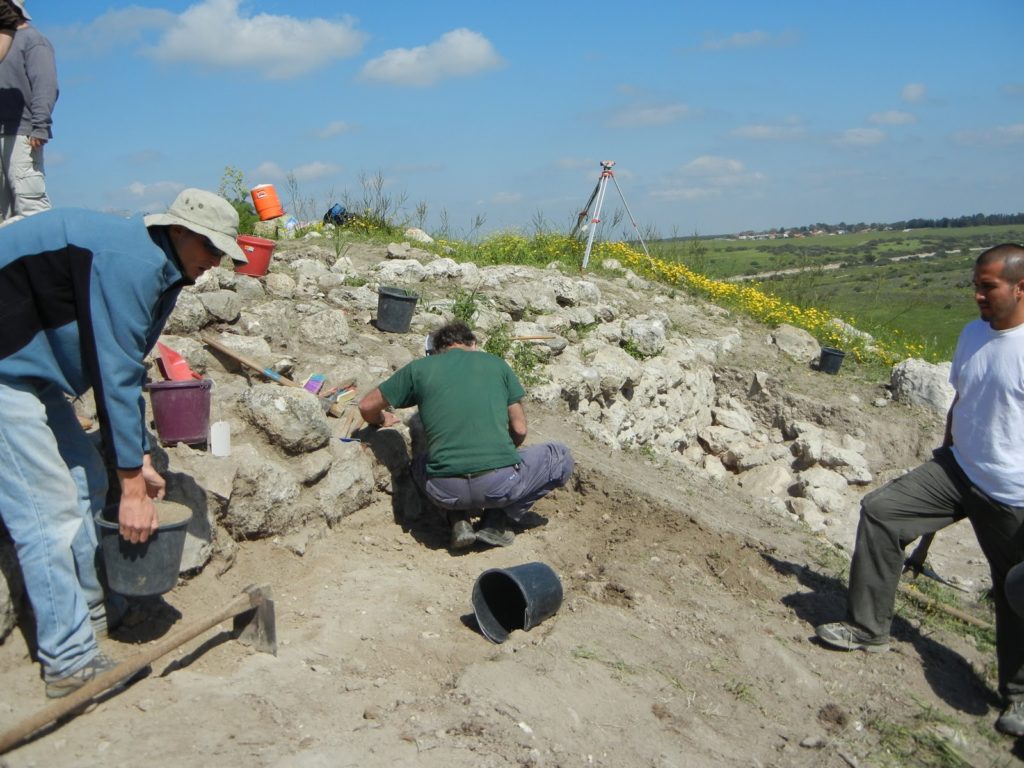
Excavating the eastern course of Iron II fortifications – see continuation in adjacent square

Based on our surface survey of Area B (Shai and Uziel Tel Aviv 2010) we were expecting to find primarily Late Bronze Age remains (1550-1200 BCE) on the western platform – the results have not disappointed. So far the vast majority of the pottery excavated in Area B dates to the Late Bronze Age. It’s always nice when survey results match excavation results. On a more exciting note there have been several special discoveries in this newly opened area – including a rather unique find – a ritualistic mask with a very large nose and eye holes, a well-crafted stone dish, and a nice tabun/tannur.
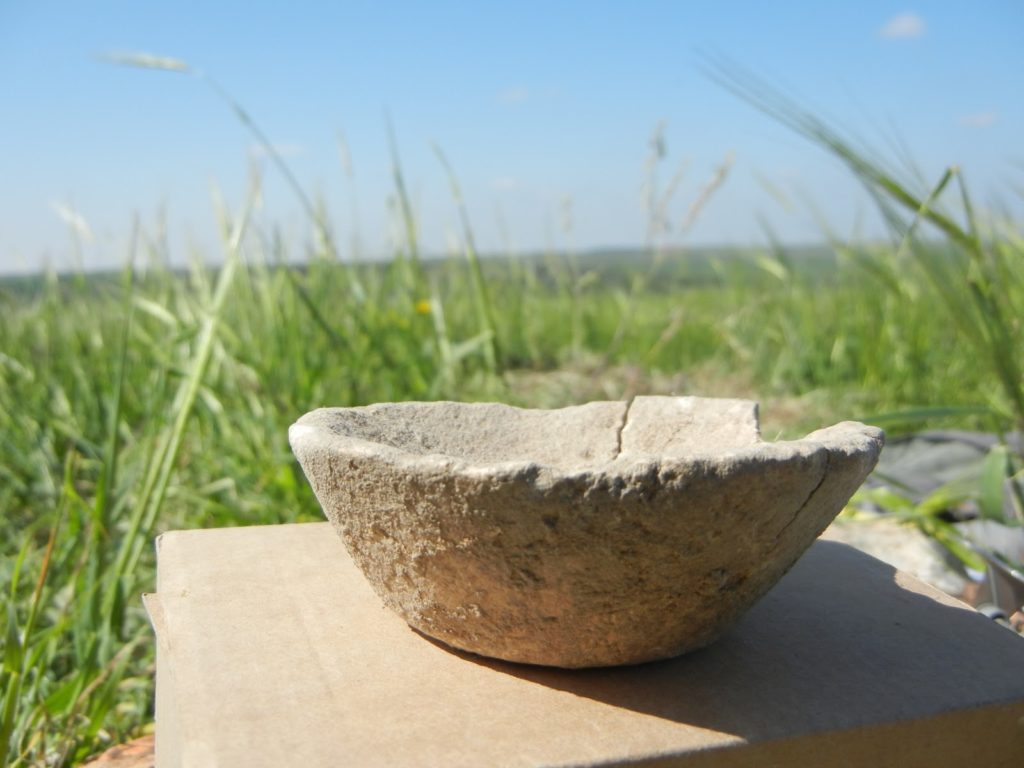
Small stone vessel (made from chalk) from Area B
Partially preserved “cultic” mask from Area B

Excavations will continue through the end of next week and will be renewed this summer on June 12-July 1 – see here for registration details

Share:

After protests against his leadership, Zahi Hawass resigned from his post as head of Egyptian antiquities.  Now he has returned, according to Ahram:

Zahi Hawass‎, chief of the Supreme Council of Antiquities, announced that he had been re-‎appointed as Minister of Antiquities following a meeting with Prime Minister Essam Sharaf ‎on Wednesday. ‎ Hawass first took up the newly-created post in the cabinet when ex-president Hosni ‎Mubarak installed him late in January.‎ After a number of artefacts had been declared missing in the wake of the 25 January revolution the Egyptian archaeologist had stepped down from his post.

HT: Jack Sasson

Share:

Joe Lauer sends word that a conference entitled “Ancient Tzfat and the Galilee – Archaeology, History and Heritage,” will be held tomorrow, Thursday, March 31, 9 am – 5 pm, at the Yigal Allon Center in Tzfat (Safed).  From Arutz-7:

New discoveries in the old city of Tzfat will be revealed for the first time at a special conference to take place March 31st at the Yigal Allon Center in Tzfat. The conference will be held on behalf of the Northern Antiquities Authority, in cooperation with the University of Haifa, the Tzfat Municipality and Tfzat College. The conference will focus on archeology, history and heritage. The Israel Antiquities Authority states that ancient Tzfat (also known as Safed) is a unique, urban heritage, dating back to the Mamluk period in the 13th century. Tzfat is home to the Ari synagogue where prayer services have taken place for over 500 years in a row and houses one of the world’s oldest known Torah scrolls. 

A press release in Hebrew may be found here and here.

Share:

The rainy season in Israel is over and the results are not good.  This marks the seventh consecutive year of drought.  From the Jerusalem Post:

This year, the North received much more water than the center and the south, reaching a bit more than 90 percent of Israel’s average rainfall, according to Schor, but he cautioned that this is not worthy of celebration. […] To be 100% average, Schor explained, is not sufficient, particularly because this is the seventh consecutive year in which we are “taking more water than we get.” Overall, including the South and Center, the country achieved an accumulation of only 70% of average, he said. Meanwhile, despite heavy rains in the past few months that have brought water levels in the Kinneret [Sea of Galilee] above the red line, Schor warned that “we are missing almost four meters of water” from the reservoir.

The full story is here.

Share:

The Christian Book Expo has listed award finalists for 2011.  In the “Bible Reference” category, four of the five nominated books have been praised here before.

A Visual Guide to Gospel Events, by James C. Martin, John A. Beck, and David G. Hansen

Crossway ESV Bible Atlas, by John D. Currid and David P. Barrett


The Story of the Bible: The Fascinating History of Its Writing, Translation and Effect on 
Civilization, by Larry Stone [not noted on this blog]

Zondervan Atlas of the Bible, by Carl G. Rasmussen

Zondervan Illustrated Bible Backgrounds Commentary, John H. Walton, General Editor

If judging on the basis of unique value to a Bible student, I would give the award to the five-volume (3,000-page!) commentary set.  The other books are more affordable, and all make 2010 an outstanding year for works in the field.

Share:

The Travel section of the New York Times features an article by a volunteer to last summer’s excavations of the Philistine city of Ashkelon.  Sam Roberts writes:

The expedition is a mix of Outward Bound and summer school. The classes are all outdoors — below ground, mostly — in deep pits excavated in grids marked on a 130-acre bowl atop an eroding cliff that overlooks the beach below. The site is part of a national park, populated by picnickers and jackals and mongoose, with guest appearances by the pink, black and white-crested hoopoe, Israel’s national bird. The accommodations are vastly improved from the first year when, with the group camping out near the dig, the director stumbled into a cesspool and had his pants stolen. These days, the accommodations compare very favorably with sleepaway camp and the hotel food is tolerable (it’s served at a buffet, so at least there’s plenty of it). […] What is striking, too, is the juxtaposition of ancient ruins and modern technology. Each artifact and the daily changing dimensions of the dig are meticulously digitized. “Every field book is typed onto a laptop, every bucket is assigned a bar code to enable us to communicate the results to the archaeological community faster,” said Dr. Daniel M. Master, an archaeology professor at Wheaton College and the expedition’s new co-director with Dr. Lawrence E. Stager, a Harvard archaeology professor and director of the Harvard Semitic Museum, who has overseen the dig for 25 years.

The article includes information about qualifications to volunteer at Ashkelon as well as the cost and deadline.  (The cost doubles for those getting academic credit from Harvard.)  The writer includes the Israelites as among the ancient groups that lived in the city, but I’m having difficulty recalling when that could have been.

Share: