The Israel Antiquities Authority reports in a press release:

A bathhouse that dates to the Byzantine period was exposed in an archaeological excavation undertaken by the Israel Antiquities Authority near Kibbutz Gevim (at the site of Horvat Lasan) and underwritten by the Israel Railways, prior to laying a railroad track from Ashkelon to Netivot.
According to archaeologist Gregory Serai, director of the excavation on behalf of the Israel Antiquities Authority, “The bathhouse, which covers an area of 20 x 20 m, was apparently destroyed in a cave-in and was later used as a rubbish dump that was filled with household refuse. It was ascertained in the excavation that the furnace (hypocaust) was dug into the natural soil and its ceiling was built of a cement-like material that was lined with ceramic tiles. The ceiling was supported by means of one meter high colonnades built of mudbricks. The bathers entered the changing room (apodyterium) and passed from there into a room with cold water (frigidarium) where there were probably stepped tubs. From there they continued into the room with warm water (tepidarium) and on to the room with hot water (caldarium – comparable to today’s sauna). The floor of the caldarium was paved with marble flagstones, some of which were as big 1 x 1 m. Evidence of the ceiling’s destruction is attested to by the manner in which the hypocaust columns were toppled in different directions”.
Following its destruction, the structure served as a source of building material as evidenced by the stone walls that were robbed. Secondary use of the stones was noted in the center area of the excavation. A number of residential buildings were discovered in this part of the site and they contained storage jars that were still in situ.
The village’s buildings and bathhouse join the finds that were revealed in a previous excavation that was conducted on the other side of the road. In the opinion of Gregory Serai, “We are dealing with a village whose economy was based on the production of wine and the manufacture of pottery vessels. The site was situated on a road that linked Beer Sheva with Gaza and probably began as a road station in the Roman period.

There’s a brief article about Kibbutz Gevim, including its location, at Wikipedia.  Eight photos of the excavations can be found with the article at this temporary link, or directly here (zip).

HT: Joe Lauer
Share:

ScienceNews carries an interesting article on looting in Israel and around the world.

The on-going renovation of the Israel Museum is apparently on track to be completed in May 2010. 

An article at Bloomberg.com gives some details of the work.

Excavations are underway in the Roman theater of Tiberias.  See a previous post and photo here.

On the ASOR Blog, Aren Maeir discusses the potential impact of the financial crisis on archaeological excavations.

Der Spiegel has an article on what is being called the longest tunnel in the ancient world.  It ran 66 miles in the modern countries of Syria and Jordan.  120 years were spent on its construction, but it turned out to be a failure.

The Chronicle of Higher Education has a story on the alleged charges against Raphael Golb.  The real estate lawyer with a doctorate in comparative literature from Harvard is charged with “30 counts of criminal impersonation, 18 counts of forgery, 21 counts of misdemeanor identity theft, one count of felony identity theft, one count of aggravated harassment, and one case of unauthorized use of a computer.”

Logos Bible Software is hosting a “March Madness” book tournament which allows readers to vote and receive discounts of 25-75% on specific volumes.

You can play golf in the shadows of the pyramids for $25.

The first tour group of Westerners has visited Iraq

Share:

From Haaretz:

The Nature and National Parks Protection Authority yesterday opened “Abraham’s Gate” at Tel Dan in the north, for visits by the public.
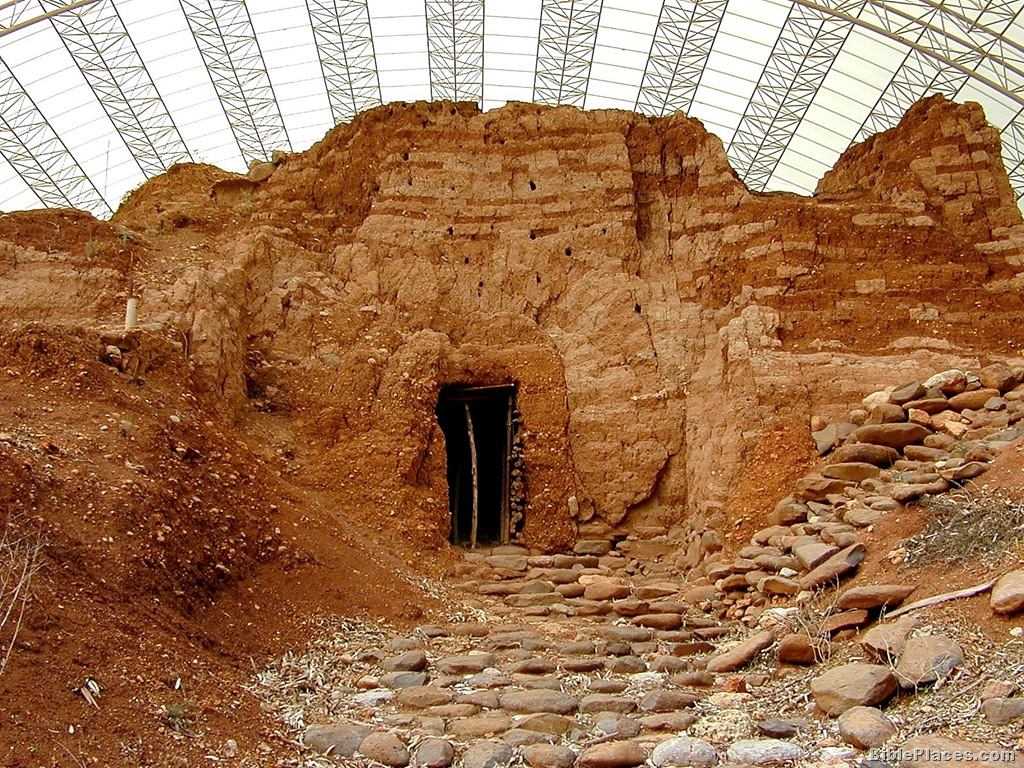
The ancient structure from the Canaanite period of the Bronze Age is made of mud and is thought to have been built around 1750 B.C.E. The authority named the archaeological site for Abraham, the first patriarch of the Jewish people, indicating that it dates from the period of Abraham.
The gate was uncovered in 1979 but more recently underwent restoration. It is composed of three arches and constructed of sun-dried mud brick on a foundation of large basalt stones. The gate, which in ancient times stood seven meters tall, has been restored to its original height. It features two towers and a horizontal structure linking them below the arches, the oldest arches ever found in the Land of Israel.

HT: Joe Lauer

Dan Middle Bronze mudbrick gate2, tb011500 Middle Bronze gate before restoration (Jan 2000)
Share:

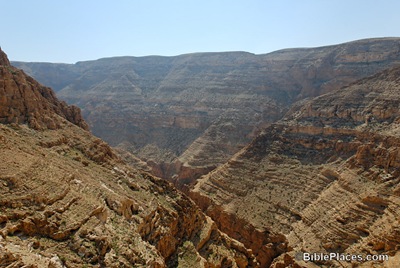
One of my favorite hikes in Israel is described in a recent story in the Jerusalem Post.  The Nahal Darga is a large canyon that drains the Judean Wilderness into the Dead Sea.  The marvelous hike combines spectacular views, historic caves, and challenging climbing.  Jacob Solomon’s article offers sage advice, but if you’re planning to heed the call, do not make the same mistake that he does and miss the real jewel of the hike, that is, climbing down the canyon itself!  Some excerpts from the article:

This is a memorable, varied and demanding full-day route. Shaded for much of the way, the earlier parts follow the deep, steep-sided gorge of Nahal Darga, and the sun should be well behind the Judean Hills by the late afternoon descent to the finish at Mitzpe Shalem. Check the flash-flood forecast immediately before this excursion….
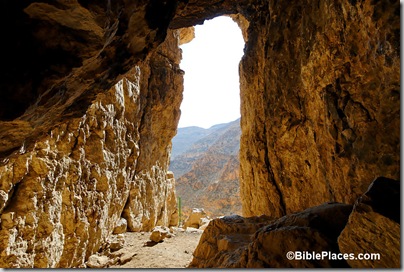
You have reached one of the last stands of the Second Jewish Revolt against Rome (132-135 CE), led by Simeon Bar Kosiba, a.k.a. Bar Kochba. The official Roman conversion of Jerusalem to the pagan city of Aelia Capitolina with a temple to the god Jupiter fired a rebellion of sufficient magnitude for Emperor Hadrian to bring down his premier general Severus, then in Britain. The fighters retreated, making their last guerrilla-style stands in these mountains in the hopeful but erroneous belief that the geographical obstacles you have just surmounted might deter Hadrian’s imperial army.

If you do opt to climb through the canyon, you must be in good shape, you may need climbing rope, and you will get wet and probably dirty.  You also would be wise to leave anything behind that cannot get wet, including your camera. 

Nahal Darga, Wadi Murabaat, tb021107575Nahal Darga from above
Wadi Murabaat, Bar Kochba cave, view from interior, tb021107619Wadi Murabaat = Nahal Darga, Cave where Bar Kochba scrolls found
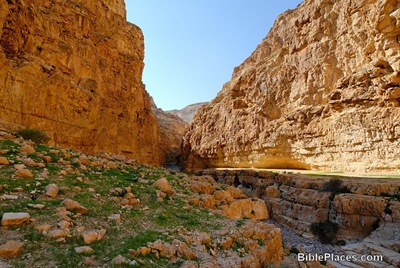
Nahal Darga, Wadi Murabaat, tb021107581

The best part of the hike is through the canyon itself 
Nahal Darga, Wadi Murabaat, tb021107612 
The best time of the year to hike Nahal Darga is February to April.  After that, the temperatures are too hot and the water becomes too putrid.
Share:

This discovery is reported by the Jerusalem Post, Haaretz, and CNN.  The following is the beginning of the press release of the Israel Antiquities Authority.

A church that dates to the Byzantine period which is paved with breathtakingly beautiful mosaics and a dedicatory inscription was exposed in an archaeological excavation the Israel Antiquities Authority is conducting near Moshav Nes-Harim, 5 kilometers east of Bet Shemesh (at the site of Horvat A-Diri), in the wake of plans to enlarge the moshav.
According to archaeologist Daniel Ein Mor, director of the excavation on behalf of the Israel Antiquities Authority, “The site was surrounded by a small forest of oak trees and is covered with farming terraces that were cultivated by the residents of Nes-Harim. Prior to the excavation we discerned unusually large quantities of pottery sherds from the Byzantine period and thousands of mosaic tesserae that were scattered across the surface level”.
The excavation seems to have revealed the very center of the site, which extends across an area of approximately 15 dunams, along the slope of a spur that descends toward Nahal Dolev.
During the first season of excavation (November 2008) the church’s narthex (the broad entrance at the front of the church’s nave) was exposed in which there was a carpet of polychrome mosaics that was adorned with geometric patterns of intertwined rhomboids separated by flower bud motifs. Unfortunately, at the conclusion of the excavation this mosaic was defaced and almost completely destroyed by unknown vandals. During that excavation season a complex wine press was partly exposed that consists of at least two upper treading floors and elongated, well-plastered arched cells below them that were probably meant to facilitate the preliminary fermentation there of the must. Part of the main work surface, which was paved with large coarse tesserae, was exposed at the foot of these cells. A complex wine press of this kind is indicative of a wine making industry at the site; this find is in keeping with the presence here of a church and is consistent with our knowledge about Byzantine monasteries in the region during this period (sixth-seventh centuries CE).

The press release continues here

The IAA has posted (temporary link) three high-resolution images:

1) an aerial view of the site;

2) workers cleaning the church floor;

3) a close-up of the church’s dedicatory inscription.

A direct link to the images is here.

HT: Joe Lauer

Share:

Today the feast of Purim is celebrated in Jerusalem (it was yesterday elsewhere in the world), and the Jerusalem Post carries a column on a site in Iran that tradition identifies as the tomb of Mordechai and Esther.  Iran has thus far been outside of my areas of travel, so I do not have anything to contribute to this particular discussion.  The Book of Esther is one of the most brilliant literary compositions, and as I read through it with family and friends on Monday night I was struck by Mordechai’s words to Esther: “For if you keep silent at this time, relief and deliverance will rise for the Jews from another place, but you and your father’s house will perish” (4:14).  My first response was to marvel at the way that God has protected his people, time and again, over the millennia.  My later response was to consider the striking parallel with the rise of a new Persian threat against Israel and those who will or will not act to stop it.  I will leave that for your own consideration and quote here the first few paragraphs of the JPost column by Michael Freund:

A few months ago, the normally hostile Iranian regime took the rather unusual step of adding a Jewish holy site to its National Heritage List. On December 9, 2008, Iranian news outlets reported that the tomb of Mordechai and Esther, the heroes of the Purim saga, would now be under official government protection and responsibility.
The move cast a brief spotlight on the site, which is well-known to Iranian Jews but largely unfamiliar to those outside the country. And with Purim being celebrated this week, it is worth taking a moment to ponder this relic of our ancient past.
The mausoleum housing the shrine of Mordechai and Esther consists of a simple brick structure crowned with a dome which was built five to seven centuries ago over the underground grave sites. It is located in the northwestern city of Hamadan, about 335 kilometers west of Teheran. According to tradition, Hamadan is believed to be the site of the city of Shushan, which played such a central role in the events described in the Book of Esther.

The column continues here.

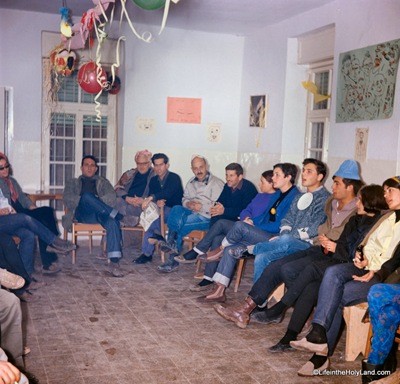
Expedition members Purim party with Yigael Yadin, db6703260105Purim Party, Megiddo excavation team, March 1967
with Yigal Shiloh, Immanuel Dunayevsky, Yigael Yadin, and Amnon Ben-Tor
Children in Purim costumes, db810319p175Children in Purim costumes, 1981
Photos by David Bivin, Views That Have Vanished CD
Share: