Five years ago, a big stir was created with the announcement of the existence of the Jehoash Inscription.  The tablet was so exciting because it appeared to come from the Jerusalem temple, dating to approximately 800 B.C., and paralleling 2 Kings 12:12.

The inscription, however, had problems.  The chief one was that it surfaced in the hands of an antiquities collector, not in a controlled archaeological dig.  That by itself is enough for some to deny the authenticity of the artifact, even though many demonstrably authentic objects were recovered illegally.

Another problem was the stone itself and the patina (sheen produced by age).  Though the first geologists to study the inscription said it was ancient, the Israel Antiquities Authority issued a report concluding that the inscription was a modern forgery.  60 Minutes aired a horrible report (regardless of conclusion, the report was dishonest) which included an interview with a man claimed to have created the inscription.

To me, the most interesting part of all of this has been the way one side has acted on the matter. And I don’t mean the 60 Minutes crew (who merit only the lowest of expectations anyway).  There are some professionals who have acted as if they have a lot to lose if this inscription is authentic.  On the other hand, those who think the inscription may be ancient appear to me to desire simply that the proper studies be done.  Some professionals apparently think that a few tests are sufficient, after which all discussion must be silenced and all tests denied.

Which means their dander is up after another study was published this summer in the Journal of Archaeological Science.  The conclusion of the five geologists who wrote the article is that the inscription is likely ancient.  The pdf is available for a fee, but the abstract is online:

A gray, fine-grained arkosic sandstone tablet bearing an inscription in ancient Hebrew from the First Temple Period contains a rich assemblage of particles accumulated in the covering patina that includes calcite, dolomite, quartz and feldspar grains, iron oxides, carbon ash particles, microorganisms, and gold globules (1–4 μm in diameter). There are two types of patina present: thin layers of a black to orange-brown, iron oxide-rich patina, a product of micro-biogenetical activity, as well as a light beige patina mainly composed of carbonates, quartz and feldspar grains. The patina covers the rock surfaces and inscription grooves post-dating the incised inscription as well as a fissure that runs across the stone and several of the engraved letters. Accelerator Mass Spectrometry (AMS) analyses of the carbon particles in the patina yields a calibrated radiocarbon age of 2340–2150 Cal BP and a conventional radiocarbon age of 2250 ± 40 years BP. The presence of microcolonial fungi and associated pitting indicates slow growth over many years. The occurrence of pure gold globules is evidence of melting (above 1000 °C) indicates a thermal event. This study supports the antiquity of the patina, which in turn, strengthens the contention that the inscription is authentic.

Let the studies continue!  When there is a “reasonable doubt” about authenticity, it is anti-scientific and anti-academic to try to prevent further investigation.

(Note: the trial against the alleged forgers is going on three years and running, which suggests, to me at least, that the evidence is not as iron-clad as the prosecutors and their fans have insisted.)

Share:

Since April 3 this year, the Sea of Galilee has dropped 6.4 feet (2.0 m), a new record for the size of drop in this amount of time.  Israel has had four years of below average rainfall.  If the water level drops another 2.6 feet (0.82 m), all pumping from the lake will cease.  The Jerusalem Post reports:

The water level in Lake Kinneret dropped two meters this year, the Water Authority said Thursday, a steeper annual drop than in any previous year.
The hydrological year ended on September 30 with the Kinneret at 214.05 meters below sea level, down from its height of 212.05 meters below sea level reached on April 3.
The Kinneret’s “black line,” newly coined this year, is 214.87 meters below sea level. When the black line is reached, the pumps in the lake are exposed to the air, and they can no longer send water into the National Water Carrier.
In July, the lake dropped below the “red line,” at which the concentration of pollutants rises to undesirable levels.
Since spring 2004 the Kinneret has lost 5.13 meters, which is equivalent to 850 million cubic meters of water, the authority said. That is roughly equivalent to an entire year’s worth of household water use.
This was the fourth consecutive year of dwindling rainfall and the forecast for the next couple of years is just as bleak.

You can read the rest here.

Sea of Galilee at dusk, tb040306012ddd

Share:

I’ve been collecting items of interest over the past week:

Archaeologist Shimon Gibson claims that a concert near Jaffa Gate would damage antiquities (JPost).

A Christian organization in Colorado Springs is spending $2.3 million on a replica of the Western Wall, and a building to showcase it.  50 million tons of stone will be brought from Israel.

King Tut comes to Dallas on Friday.

The JPost Magazine has a profile of Eilat Mazar, currently excavating in the City of David.  She says,
“I work with the Bible in one hand and the tools of excavation in the other. The Bible is the most important historical source.”

The ESV Study Bible, which was mentioned before here, is due out in a couple of weeks and its visual components (maps, charts, drawings) gets further explanation in an interview with Justin Taylor.

Leen Ritmeyer, renowned for his architectural work on the Temple Mount, is now offering some of his excellent work in affordable PowerPoint files.

I’ve just added Ferrell Jenkins’ Travel Blog to the blogroll.

This is not new, but I do not remember really recognizing all that is here before, so perhaps you did not either.  The Archaeological Study Bible website has many dozens of photos, charts and maps (medium-resolution) available for download.  You can find your way around from here, or go directly to Introduction, Old Testament, New Testament, or Maps.

David Padfield has photos of a Roman army enactment performed at Jerash.  There are 15 free PowerPoint-size images.

If you’re an image junkie, you’ll save time downloading images from the last two sites if you have a download manager.  (I use Free Download Manager with FlashGot on Firefox)

Shana tova (happy new year)!

Share:

The first one has passed, but Wheaton College has many more in their fall lecture series entitled, “From Migdol to Aswan: Geoarchaeology in Egypt and Sinai.”  I don’t see it stated explicitly on the website, but in previous years the lectures were open to the public, free of charge.  For locations and other information, see their website.

Monday, October 6, 7:00 PM


The Application of Satellite Imagery to Archaeological Research
Sarah Parcak, University of Alabama-Birmingham


Mining Operations in Sinai in Pharaonic Times Greg Mumford, University of Alabama-Birmingham

Monday, November 3, 7:00 PM


“Moses Slept Here:” A Critical Review of Popular Exodus Theories James K. Hoffmeier, Trinity International University
Stephen O. Moshier, Wheaton College

Monday, November 10, 7:00 PM


Some Applications of Geologic Science in Ancient Egyptian Archaeology James A. Harrell, University of Toledo

Monday, November 17, 7:00 PM
New Insights into the Geography of the Exodus: Reports from Excavations in the Eastern Delta and Northwest Sinai James K. Hoffmeier, Trinity International University
Stephen O. Moshier, Wheaton College

Monday, December 1, 7:00 PM


Paleolithic Occupation of the Sinai Jim Phillips, Field Museum of Natural History

Share:

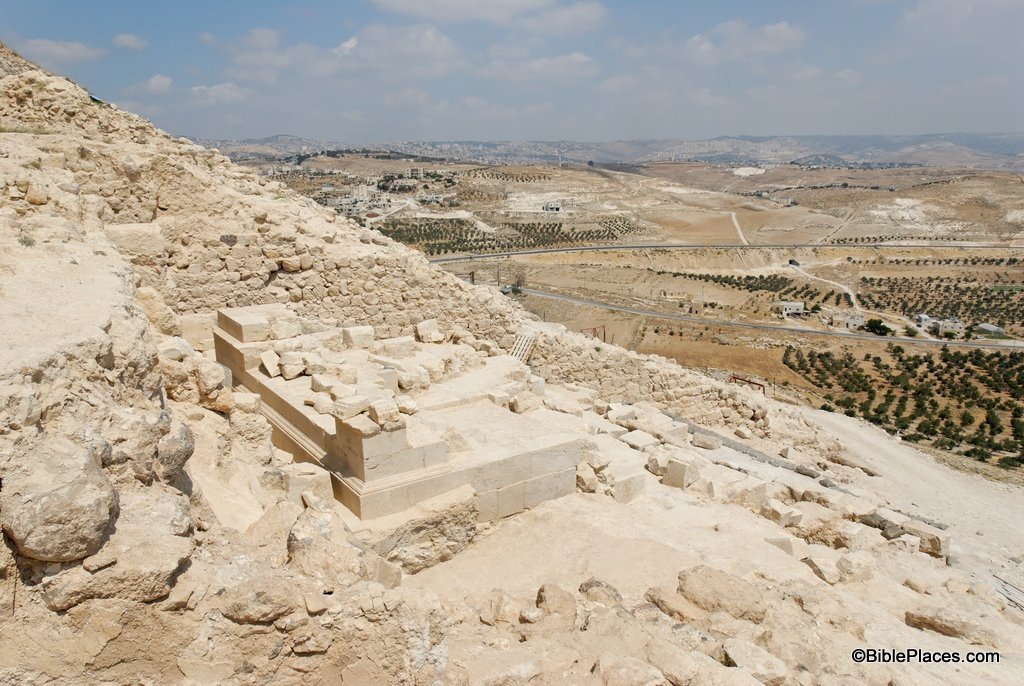
Since most people don’t read comments on blogs, especially on posts from a year and a half ago, I’ll note one made today by Sigho concerning Herod’s tomb at Herodium.

Thanks for your information. I was preveledged to be able to enter the site of Herod’s Tomb Yesterday (Sept. 21, 2008). The site is open for public from a distance. But we (3 people) were granted by on site-archaeologists to enter the site. It is still being excavated. Unfortunately, pictures I took yesterday cannot be publicized. Just wait for the official publication by the archaeologists.

I did not realize that work was on-going here.  The restriction on taking photos may indicate that they’re doing more than sweeping dirt.

Herodium tomb of Herod, tb051708036dxo Herod’s tomb, May 2008
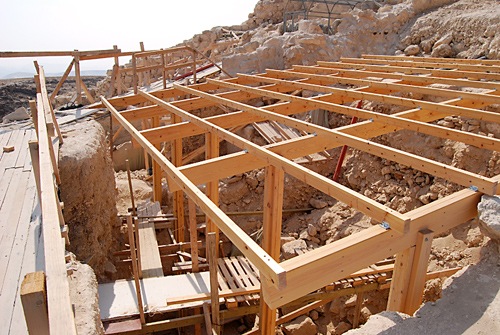
UPDATE (9/23): Ferrell Jenkins has given me permission to post a photo he took of construction work going on at the tomb last month.
Herodium
Photo courtesy of Ferrell Jenkins, August 23, 2008
Share: