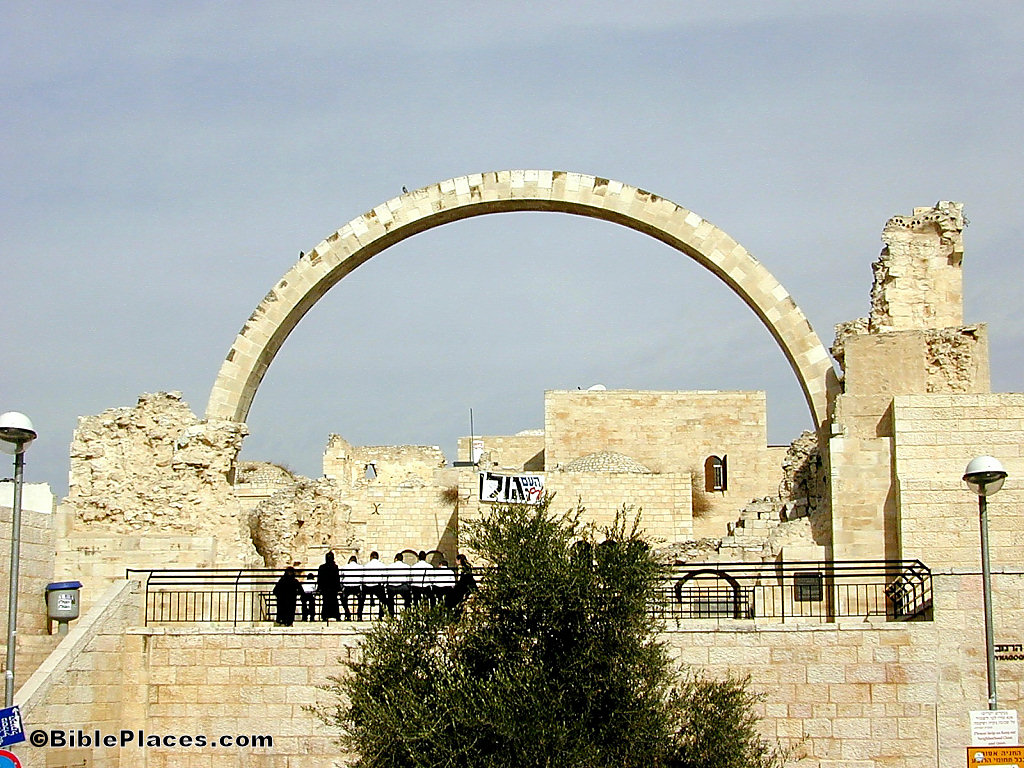
A record number of Jews streamed to the Western Wall this morning for the traditional blessing of the priests during the festival of Sukkot. Police had to close the entrances into the prayer plaza because of the crowds.


Arutz-7 reports:

The ceremony has become a tradition ever since the liberation of the Temple Mount during the Six-Day War in 1967 and is seen as an observance of the Jewish obligation to make a pilgrimage to Jerusalem and the Holy Temple three times a year, on Pesach (Passover), Shavuot (Pentecost) and Sukkot (Tabernacles). During the weeklong Pesach and Sukkot holidays, the ceremony is held on the second of the Hol haMoed (intermediate) days.

Hundreds of kohanim, Jews who trace their lineage to Aaron, the first High Priest, stood closest to the Western Wall to take part in the special blessings. Attending the Western Wall prayers Monday were Chief Rabbis Shlomo Amar and Yonah Metzger, as well as Western Wall Rabbi Shmuel Rabinovitch. Rabbi Rabinovitch told Arutz-7 that Monday’s priestly blessing marked the largest such gathering for prayers at the site since the first Sukkot after the Six Day War.

Police were forced to close the gates leading to the Western Wall Plaza due to its being filled to capacity by worshippers. “The blessing, however, reaches those stuck outside the plaza as well, obviously,” Rabbi Rabinovitch said. He added that many of those packing the plaza were not outwardly observant. “Many secular Jews have adopted the custom of making a pilgrimage to the Western Wall on the holiday,” he said.

The Birkat Kohanim is a part of daily prayers in Israel, but is only recited on holidays in most communities outside Israel. The blessing given appears in Numbers 6:23-27:

And G-d spoke to Moses saying: Speak unto Aaron and his sons, saying, in this manner shall you bless the children of Israel. Say to them:
May the Lord bless you and keep you.
May the Lord shine His face upon you.
May the Lord lift His countenance upon you, and grant you peace.

Share:

Numerous national parks in northern Israel are open to the public for free throughout the festival of Sukkot (Tabernacles) this week. The Jewish Agency is sponsoring the free admission in order to encourage tourism in the north following this summer’s war.

The sites include:

  • Sepphoris (Zippori) National Park
  • Achziv National Park
  • Horshat Tal National Park
  • Baram National Park
  • Tel Hazor National Park
  • Nahal Iyon (Ayoun) Nature Reserve
  • Nimrod Fortress National Park
  • Kursi (Gergesa) National Park
  • Corazim (Chorazin) National Park
  • Ein Afek (Aphek) Nature Reserve
  • Nahal Amoud Nature Reserve
  • Hamat Tiberias National Park
  • Beit She’arim National Park
  • Beit Alfa Synagogue National Park
  • Kochav Hayarden (Belvoir) National Park
  • Tel Megiddo National Park
  • Nahal Me’arot Nature Reserve
  • Majersa (Batiha) Nature Reserve
  • Gamla Nature Reserve
  • Hula Valley Nature Reserve
  • Yehiam Fortress National Park
  • Beit She’an (Beth Shean) National Park
  • Agmon Hahula Yarden Park

Arutz-7 has a list of many other Sukkot activities, including a hike near Hebron, tours of the Temple Mount, concerts and more.

Mosaic floor from Tiberias synagogue featuring a lulav (palm frond) and etrog (citron), now on display at Eretz Israel Museum, Tel Aviv

Share:

The media is reporting the discovery of oil near the Dead Sea. Expected yield is very low, but it raises hopes that there might be more in the area. From All Headline News:

A nationally-held Israeli exploration company announced Wednesday that it had discovered oil near the Dead Sea.

Speaking on Israel’s Channel 10 News, Dr. Eli Tenenbaum of Genco said that after drilling to a depth of 1.2 miles, “we noticed that the pressure in the area was very high and when we opened the tap, oil started flowing freely for several minutes.”

Dr. Tenenbaum said the reserve could contain as much as six million barrels of oil, giving it an estimated commercial value of $300 million.

“We hope it was the first of many [such discoveries],” he added.

Genco started its work 10 years ago, but was forced to stop due to the high costs of its operations. But with oil prices soaring, the government recently gave the company the go ahead to resume exploratory drilling.

Infrastructure Minister Binyamin Ben-Eliezer told The Jerusalem Post that the government is now ready to back any company that wants to try to find oil inside the borders of Israel.

Dead Sea from west, Sept. 27, 2006

UPDATE (10/11): The Jerusalem Post has more details, including a major new investor.
Share:

The AP has a good summary of the battle over the construction of the Museum of Tolerance in Jerusalem. The Simon Wiesenthal Center wants to build the museum where a parking lot has been located, but Muslim organizations are unhappy because it encroaches on an old Muslim cemetery. 

Read the story for the update, but note the archaeologist’s comment that if you’re going to protect every grave in Israel, people are going to need to commute from another country. Some have noted the irony that Muslims built a hotel over the part of the cemetery in the mid-20th century. It’s also interesting to see the ultra-Orthodox and Muslims groups join hands on this issue.

Jerusalem from northwest.
Click on photo for more detail.
Share:

Excavations have been going on for a few months in the back (west side) of the Western Wall plaza. The Israel Antiquities Authority has a brief description of the finds so far. In short, they are excavating a building complex from the Mamluk and Ottoman periods that consists of several vaults.

This is a view from near the Western Wall towards the excavations, which are located just to the left (south) of the police station.

The excavations began in April, before construction of a building in this location.

One of the vaults is visible below the metal walkway.

Share:

I’ve mentioned The Exodus Decoded here before, and over at Higgaion, Chris Heard is doing a very extended review of the movie (Part 1 | Part 2 (with addendum) | Part 3 | Part 4 | Part 5 | Part 6 | Part 7). His analysis has elicited responses from the man behind the movie, Simcha Jacobovici, which gives the reader the chance to decide for himself/herself who to trust. Those who have watched the movie and think there’s something to it would do well to read it. Such a dialogue should have taken place before the 3 million dollars was spent, and it’s a lesson on why you should never trust new ideas which are first promoted on television. If the ideas had merit, they could bear the weight of scholarly scrutiny and an end-run around academia to the masses with dazzling graphics would not be necessary. Unfortunately this isn’t the first guy to pull such a trick and it won’t be the last.

Lest any new readers to this blog think that I’m just another liberal blasting someone trying to prove the Bible true, that’s not so. I believe the Bible is an accurate record of history, including in all of its details about the exodus. I just believe that The Exodus Decoded does not do any favors to the biblical record.

UPDATE (9/22): Bryant Wood of Associates for Biblical Research has posted a review of the movie. This one is shorter than Heard’s and is written by one who believes in the accuracy of the biblical narrative. I recommend it.

Share: