Sinclair Bell writes about Imperial Rome’s passion for chariot racing. The article includes some beautiful illustrations, some of which come from a new documentary on the subject.

A new study shows that ancient Egyptian scribes added lead to their inks to help their writing dry.

“An Egyptian archaeological mission working in the ​​al-Ghuraifah area in Minya Governorate has uncovered the tomb of a royal treasury supervisor.”

Free lecture on YouTube: “Tutankhamun’s Life, Death, and Afterlife: New Evidence from Thebes,” by W. Raymond Johnson (available until Nov 21).

Zoom lecture on Nov 10: “Citron Detectives, Nomadic Acacias, and Pomegranate Physics: Some Puzzles and Solutions in Biblical Ethnobotany,” by Jon Greenberg, a Biblical and Talmudic ethnobotanist.

The Israeli TV series “The Holy Land in the Eyes of History” is now available online in some countries (but not the US), with subtitles in English.

Smithsonian Magazine explains the Athenian background of ostracism, in which inscribed potsherds (ostraca) were cast to exile a political candidate from the city for the next decade.

Newly launched: PEACE: a Portal of Epigraphy, Archaeology, Conservation and Education on Jewish Funerary Culture, covering from antiquity to the 20th century.

The Winter 2020 issue of Biblical Archaeology Review includes articles on Herod’s throne niche at Macherus and a private archive discovered at Maresha.

Denny Sissom’s The Bridge to the New Testament is on sale now with discount code WINTER2020.

Tutku has announced its list of tours in 2021 and 2022, including discounted trips for professors to Turkey, Greece, Egypt, and Jordan.

Claude Mariottini provides an introduction to the city of Susa.

HT: Agade, Ted Weis, Mark Hoffman
Share:

A border stone from the Roman period was discovered in the Golan Heights with a Greek inscription reading, “A border stone between Amatiya [or Amatira] and Kfar Nafah.”

Archaeologists have uncovered remains of a Byzantine church that was constructed in Caesarea Philippi in about the year 400 on top of a Roman temple to the god Pan.

A gem stone featuring a portrait of the god Apollo was discovered in debris sifting of soil coming from an ancient drainage channel in the City of David.

$40 million will be spent to upgrade the Tower of David Museum, with a plan to double the size of the current museum, including the addition of seven new galleries, a new sunken entrance visitor center outside the Old City walls, and a multi-sensory experience in the Kishle excavations. Some photos of the renovation work are available here temporarily.

Scholars are still unconvinced by Simcha Jacobovici’s claim that nails found in Caiaphas’s ossuary were the ones used to crucify Jesus.

Some archaeologists at Tel Aviv University are interpreting some new archaeological discoveries to suggest that the Manasseh was a hugely successful king who was turned into a scapegoat by the biblical authors (Haaretz premium).

E-Strata is the new Newsletter of the Anglo-Israel Archaeological Society. The issues feature the latest new stories, interviews with notable figures, reports on recent publications, and more.

Bryan Windle highlights the top three reports in biblical archaeology this month.

Aren Maeir shares his experience of harvesting olives at Gath.

HT: Joseph Lauer, Agade, Ted Weis

Share:

Leen Ritmeyer suggests that a couple of recently discovered arches on the Temple Mount may belong to a gate leading from the Court of the Women into the Music Room.

Archaeologists have discovered a copper-ore smelting furnace in Beersheba from the Chalcolithic period, making it the oldest known to date.

Opposition is increasing toward Jerusalem’s plan for a cable car to the Old City.

Tourism to the Holy Land has completely stopped for the first time since the Franco-Prussian War. This article in Haaretz (premium) describes the effects on the industry, renovation projects underway, and prospects for the future.

John DeLancey’s newest video provides a tour of the Jerusalem model at the Israel Museum.

GTI Tours has begun a new podcast, with interviews with Gary Burge on the Fifth Gospel, Brad Gray on Jesus’s baptism, and more.

Eric Cline talks about the story of the excavations at Megiddo in the 1920s and 1930s on The Times of Israel podcast.

Bryan Windle pulls together a lot of detail and good photographs in his archaeological biography of King Jehu.

Wayne Stiles looks at Israel’s journey through the Red Sea and to Mount Sinai to see how God works through painful journeys.

Ginger Caessens will be leading an intensive study tour of Jordan in June. I have recommended this many times in the past and continue to do so.

New: A Christian’s Guide to Evidence for the Bible: 101 Proofs from History and Archaeology, by J. Daniel Hays.

Steven Anderson’s research on the identifications of Darius the Mede is now posted online in a very easy-to-read format, presenting the major views and objections to each.

HT: Agade, Explorator, Carl Rasmussen

Share:

Archaeologists working at Azekah may have found traces of the Assyrian siege ramp used to conquer the city in 701 BC.

“The Waqf filled in a hole that opened in the Temple Mount floor with concrete on Tuesday, raising concerns that possible archaeological findings may now be lost.” Zachi Dvira at the Temple Mount Sifting Project offers his thoughts on the possible significance of the now-filled opening, along with some rare photos of underground areas of the Temple Mount.

The Israel Museum has re-opened “with a coronavirus-safe approach that includes half-hour capsule tours of the museum’s permanent and current exhibits.”

Gordon Govier writes about the summer excavations in Israel that were not, and those that were.

Lawrence Schiffman writes on discoveries made in 2020 for Ami Magazine.

Usha, an ancient village in western Galilee, is the subject of a 6-minute news piece on Israel Daily. (Note: add “the Sanhedrin Trail” to your bucket list.)

Zvi Koenigsberg looks at the possible connection between the site(s) of Gilgal and the strange phenomenon of “footprints” on the eastern side of Israel.

Dan Warner is on The Book and the Spade this week talking about the Gezer water tunnel.

Biblical Israel Ministries and Tours has just released a brand-new resource that features beautiful aerial footage of more than 55 biblical sites in Israel and Jordan. The launch price is only $30 for the DVD and $45 for a higher-res version on a thumb drive. Individual high-res site videos are available for only $4 each.

HT: Agade, Ted Weis, Joseph Lauer

Share:

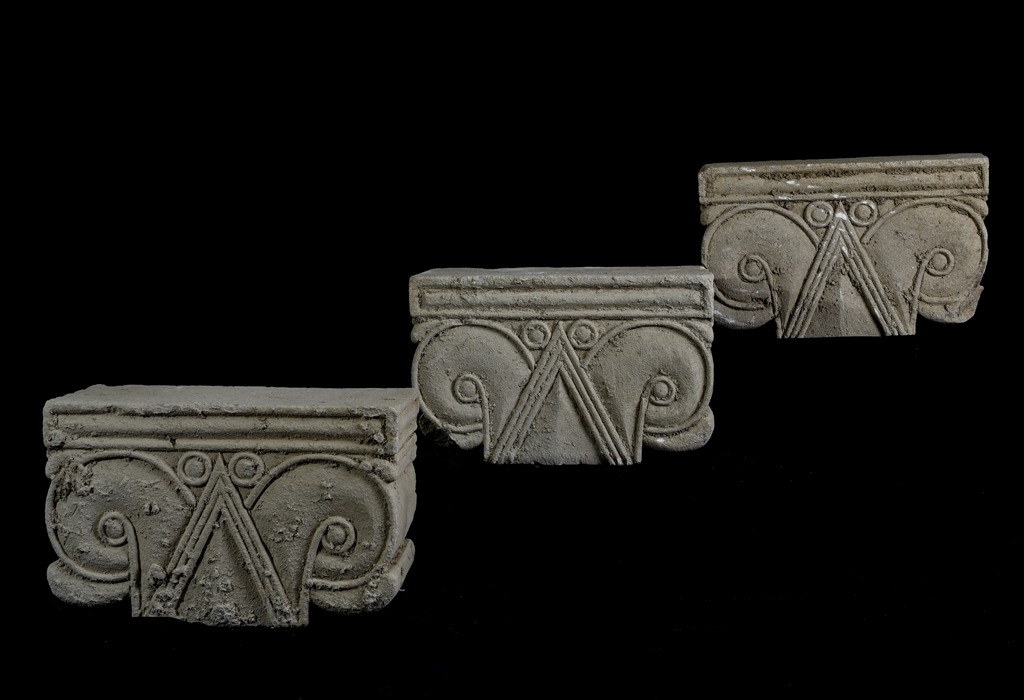
I don’t usually take away from class time to talk about the latest (usually over-hyped) discovery, but I did today. The announcement of the discovery of three royal (Proto-Aeolic) capitals south of ancient Jerusalem is exciting, as it provides beautiful evidence of a building that once served Manasseh or Josiah.

The Jerusalem Post has a good write-up, including a 2.5 minute video that captures well the excitement of the moment of finding the second capital in an unexpected place.

One of the things that makes this discovery so interesting is that relatively few such capitals have been found over the last century of excavating in Israel. My notes may need some updating, but here is what I have for the locations, numbers, and dates of Proto-Aeolic capitals:

  • Dan – 1 (9th c.)
  • Hazor – 2 (9th c.)
  • Megiddo – 13 (10th-9th c.)
  • Samaria – 7 (9th c.)
  • Gezer – possibly
  • Jerusalem (City of David)- 1 (late Iron Age?)
  • Ramat Rahel – 10 (late Iron Age)
  • Medeibiyeh, Jordan – 1 (late Iron Age?)

This discovery of three in close proximity, along with their excellent preservation, surely stirs the imagination as to what impressive building stood here in the final decades before Jerusalem fell to Babylon.

5.Photo-Shai Halevi Israel Antiquities Authority (44)

Three Proto-Aeolic Capitals discovered near the Armon Hanatziv Promenade near the UN Headquarters. Photo courtesy of Shai Halevi, Israel Antiquities Authority.

Share:

“A Canaanite fortress from the middle of the 12th century BCE (the days of the biblical judges), was unearthed in an excavation . . . outside Kiryat Gat.”

The headlines are more sensational, but the real story is this: a wall on Mount Zion dated by Bargil Pixner to the Iron Age does not date to the Iron Age. A revolution in our understanding of the size of Jerusalem in the time of Hezekiah is not warranted.

A hoard of 425 gold coins from the Abassid period was discovered by students working on an excavation in central Israel. There is a 2-minute video here.

Atlas Obscura has posted an article on the Sidonian Cave (Apollophanes Cave) at Beit Guvrin and one of its mysterious inscriptions.

The Legacy Hotel in Nazareth has a display of artifacts from the Bronze and Iron Ages that were discovered during the hotel’s construction.

The Daily Mail has a well-illustrated story on Rami Arav’s continued insistence that et-Tell is Bethsaida.

“The ‘Digging for Identity’ program is a four-day journey for Israeli 10th-grade students, which includes taking part in an active archaeological dig” and more.

John DeLancey’s latest video focuses on Lachish.

Ralph Ellis provides his interpretation of the elephant mosaic discovered in the ancient Huqoq synagogue.

Aren Maeir and Nick Barksdale talk Philistines and DNA (12 min).

Bryan Windle highlights the “top three reports” in biblical archaeology for August. (He also wrote a nice resource review of our new 1 Samuel Photo Companion.)

HT: Agade, Ted Weis, Joseph Lauer, Alexander Schick

Share: