Archaeologists working at Magdala have discovered a bronze incense shovel and a bronze jug. The press release includes a 1.5-minute video.

Archaeologists believe that they have unearthed a Byzantine church in Gaza. But as quickly as it was discovered, it was destroyed. (This does not serve well those who wish to turn land over to Palestinian control.)

The shrine over the traditional tomb of Jesus will be dismantled and rebuilt in the coming months.

Maybe one of these days they’ll get around to moving the ladder.

Archaeologist Ram Buchnik believes that the Romans influenced ancient Jewish ritual slaughter.

Israel21c has a roundup of recent discoveries made in Israel by hikers, including more details on the discovery of the gold coin.

Shmuel Browns shares some beautiful photos of sinkholes at the Dead Sea.

A New York Times reporter has visited Palmyra and published a photo essay. Note Paleojudaica’s warning before you click the link. Daily Mail has a look inside the Palmyra Museum and it’s not pretty.

What’s new in ancient Cyprus?” is the subject of a forthcoming study day at The British Museum.

A new Cambridge research project, Contexts of and Relations between Early Writing Systems, “is to focus on exploring how writing developed during the 2nd and 1st millennia BCE in the ancient

Mediterranean and Near East, and will investigate how different writing systems and the cultures that used them were related to each other.”

A new DVD presentation by Bryant Wood has been released entitled “The Pharaohs of the Bondage: The Israelite Slavery in Egypt.

Tent Work in Palestine, by Claude R. Conder, is available as a free pdf download at the Biblical Archaeology Blog.

Who was the real life archaeologist behind the character of Indiana Jones?

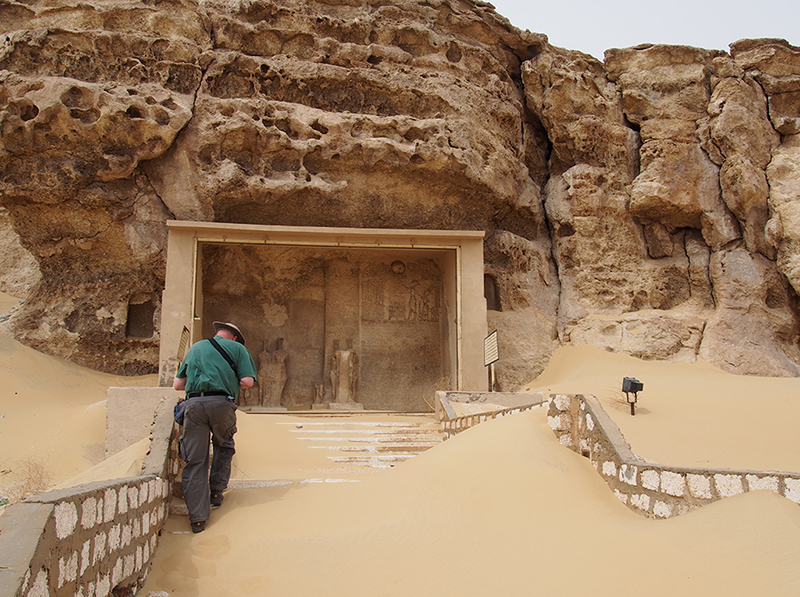
Egyptian officials are unhappy after finding a star of David engraved on an ancient temple in Aswan.

Luxor Museum will allow photography of its exhibits, for a time, for a fee.

Wayne Stiles explains how Jesus’s healing of the lame man at the Pools of Bethesda shows how God’s kindness motivates repentance.

Eli Ofir has recently launched Holy Land Portraits, a collection of beautiful, high-quality prints of sites in Israel drawn as if in biblical times.

HT: Charles Savelle, Joseph Lauer, Agade, Steven Anderson, Ted Weis

Share:

Archaeologists have identified the oldest known quarry in Israel at Kaizer Hill near Modiin.

Some radar experts doubt the existence of hidden chambers in King Tut’s tomb. Another scan was done yesterday, but results will not be announced for at least a week. Luxor Times has photos of the scanning operation.

Mosaics from the Roman Empire, depicting scenes from mythology, daily life, nature, and arena spectacles, are on display at the Getty Museum through September. The exhibit catalog is available for free online.

Joseph Aviram, president of the Israel Exploration Society, recently celebrated his 100th birthday!

A German doctor has returned a rare coin that he found in Jerusalem 25 years ago.

A video of the memorial service and academic symposium for William W. Hallo is online.

Wayne Stiles was robbed last week on the Good Samaritan Road and he learned an expensive lesson.

An article in Haaretz tries to debunk the “biblical” notion that the Philistines were crude barbarians.

But perhaps it’s worth noting that the Bible doesn’t make the Israelites look very good at times (e.g., Judg 19; Jer 5; Ezek 16).

Archaeologists now believe that Tell Qudadi, a site in Tel Aviv, was a Neo-Assyrian fortress built in the late 8th century. The final excavation report has all of the details.

With the recapture of Palmyra, the Syrian antiquities director estimates that 80% of the site’s ruins are intact but damage to the museum is “severe.” The Syrian government is planning to restore the site.

Paleojudaica has more its Palmyra roundup.

Iraq is struggling with the looting of archaeological sites.


The Daily Tar Heel carries a brief interview with archaeologist Jodi Magness.

Heavy rains led to the closing of Petra, but adventurous tourists headed north to Little Petra.

TheIsraelBible.com “offers the 24 books of the Tanakh (Genesis to Malachi) in both English and Hebrew, transliteration of selected Hebrew verses as well as the proper Hebrew pronunciation of key biblical names and places.”

The Temple Institute is searching for priests qualified to perform animal sacrifices.

Tom Powers has an interesting and well-researched post on the visit of the Graf Zeppelin to Jerusalem.

HT: Ted Weis, Agade, Joseph Lauer, Charles Savelle

Share:

Ferrell Jenkins remembers the events of this weekend with photos related to the crucifixion and resurrection.

Michael Heiser offers some links in response to the perrennial “miracles-are-impossible” stories that surface this time each year.

The battle continues over the size of the Kedem Center in the City of David.

Shmuel Browns’ photo of the week is a beautiful shot of the Judean wilderness.

A number of interesting finds have been made in an excavation of a Byzantine church in Gush Etzion.

If you are an American undergrad looking to excavate in Israel this summer, you should apply for a scholarship to join the Tel Burna team.

Wayne Stiles gives three reasons why you should travel to Israel.

The Tel Al-Amarna Visitors Centre has been inaugurated in Minya. Work on the Aten Museum and
Malawi National Museum is on-going, despite rumors to the contrary.

Archaeologists are learning more about ancient watercraft from an Old Kingdom boat excavated in Abusir.

Reproductions of the 50-foot arch that formed the entrance to Palmyra’s Temple of Baal will be erected in New York City and London next month.

The Syrian army is close to re-capturing Palmyra.

John Brown University has received an anonymous gift of $1 million for their Abila Archaeological Project.

The Torlonia collection, with more than 600 statues and sculptures, will be on display in Rome for the first time in decades. An overseas tour will follow.

Described as one of most important recoveries in decades, 45 crates of archaeological material, dating between the 7th century BC to 2nd century AD, has been returned to Italy after being stolen from sites in the 1970s and 1980s.

“Analysis of Herculaneum papyrus scroll fragments reveals the use of metallic ink in Greco-Roman literary inscription centuries earlier than previously thought.”

Bruce and Ken Zuckerman will be lecturing on “Archaeological Photography” on March 28 at the South Bay Camera Club.

Now online: “The Lenkin Family Collection of Photography at the Penn Libraries, as it is now known, comprises over 5,000 original photographs, primarily of Jerusalem and Palestine taken from 1850 to 1937.”

For a limited time, access to the latest issue of Near Eastern Archaeology is available for free without a login required.

Bible Software Review is looking for a new owner-editor.

Going Places with God, by Wayne Stiles, is on sale for Kindle right now for $0.99. It’s at the same price on Vyrso/Logos. The sale won’t last. I recommend it!

Happy 13th Anniversary to Paleojudaica! And Aren Maeir recently celebrated his birthday.

For photos recalling the momentous events of this week nearly 2,000 years ago, check out our posts this week on Facebook and Twitter.

HT: Jared Clark, G. M. Grena, Agade, Ted Weis, Charles Savelle

Share:

Six statues of the Egyptian goddess Sekhmet have been discovered at the Temple of Amenhotep near Luxor.

Monumental piers have been discovered in the ongoing excavations of Corinth’s harbor of Lechaion.

The Museum of Lost Objects traces the stories of 10 antiquities or ancient sites that have been destroyed or looted in Iraq and Syria.”

Bradley Schaefer provides an astronomical perspective on Good Friday and Easter on The Book and the Spade radio program.

National Geographic reports on new American and Iraqi excavations of Abraham’s hometown of Ur.

This story about the recently discovered mosaic featuring 16 animals and an inscription from Isaiah 65 includes photos.

New book: The Onomasticon of Iudaea, Palaestina, and Arabia in Greek and Latin Sources Volume I: Introduction, Sources and Major Texts, by Leah Di Segni and Yoram Tsafrir, with Judith Green with 20% the $65 price this month with the promotional code 630-16.

Another new book: The Economy of the Roman World, by Jean Andreau, Corina Kesler, Ellen
Bauerle, and David Potter. Use the code above for 20% off $50 through March 31.

HT: Charles Savelle, Agade, Ted Weis

Share:

From The Times of Israel:

Radar scans of the tomb of pharaoh Tutankhamun in the ancient necropolis of Luxor showed a “90 percent” chance of two hidden chambers, possibly containing organic material, Egypt’s antiquities minister said Thursday.
Experts had scanned the tomb to find what a British archaeologist believes could be the resting place of Queen Nefertiti, the legendary beauty and wife of Tutankhamun’s father, whose mummy has never been found.
Preliminary scans of Tutankhamun’s tomb reveal “two hidden rooms behind the burial chamber” of the boy king, Antiquities Minister Mamduh al-Damati told reporters.
“Yes, we have some empty space, but not totally empty, including some organic and metal material,” Damati said in English.
When asked how certain he was, he said there was a “90 percent” chance.
A study by renowned British archaeologist Nicholas Reeves has said that Nefertiti’s tomb could be in a secret chamber adjoining Tutankhamun’s tomb in the Valley of Kings in Luxor in southern Egypt.

The next radar test is scheduled for March 31. The full story has more details.

Share:

Some scholars have weighed in on the seal of the woman discovered in Jerusalem. Christopher Rollston has a lengthy analysis, concluding in part that the seal dates to approximately 700 BC.

Robert Deutsch writes that the archaeologists made several mistakes, including misreading the name on one of the seals. The Daily Mail has a number of photographs. For some political irony, see The Blaze.

The first phase of the Terra Sancta Museum in Jerusalem (at the Monastery of the Flagellation) opens on March 17.

The latest issue of Near Eastern Archaeology features articles on Jericho, Adam (Tell Damiyah), Gustaf Dalman, and more.

A schedule of forthcoming lectures for the Anglo-Israel Archaeological Society are online here.

New Excavation Report: Beer-Sheba III: The Early Iron IIA Enclosed Settlement and the Late Iron IIA-Iron IIB Cities, by Ze’ev Herzog and Lily Singer-Avitz. Sold as a 3-volume set by Eisenbrauns.

The latest exhibit at the Israel Museum, “Pharaoh in Canaan: The Untold Story,” looks at Egyptian presence in Israel during the Middle and Late Bronze periods. A one-minute video provides a preview.

“Pharaoh: King of Ancient Egypt” opens at the Cleveland Museum of Art on March 13, featuring many pieces from the British Museum.

Many documents from the 18th and 19th centuries have been discovered in a storeroom in Egypt, including letters from Flinders Petrie and Howard Carter.

Luxor is sending 778 artifacts to be displayed in the Grand Egyptian Museum in Cairo.

National Geographic runs a well-illustrated story on King Tut’s grandparents, Yuya and Tuyu.

The Karnak Temple did not catch on fire.

A New York Times reporter describes some of the challenges of being a tourist in Saudi Arabia.

The BBC reports on the impact of the Syrian civil war on the archaeology of Tell Qarqur (Qarqar).

Clyde Billington is on The Book and the Spade this week discussing the harbor of Corinth and the fortress of Macherus.

Now on pre-pub pricing for Logos: Archaeology in Action: Biblical Archaeology in the Field ($50).

Many of the early volumes of the Palestine Exploration Fund Quarterly Statement are now online.

Recommended book, on sale for Kindle: Israel: Ancient Kingdom or Late Invention?, edited by Daniel I. Block ($2.99)

Zecharia Kallai, professor emeritus of Historical Geography of Palestine at Hebrew University, died last month.

HT: Charles Savelle, Agade, Pat McCarthy, Joseph Lauer

Jaffa, rough sea, mat00699
Our most liked photo this week on Facebook was this one of the harbor at Jaffa (biblical Joppa), from the American Colony and Eric Matson Collection.
Share: