There is something important to this story, but it’s not what you might think.  What is exciting is that ancient Magdala is being excavated.  Perhaps that will increase our knowledge of this ancient city that was home to Mary Magdalene.  Perhaps it will result in the site being opened to visits by tourists.  Perhaps there will be silly sensational claims made before analysis is done – oh wait, that wish has already come true.  From the Telegraph, written by Nick Pisa in Rome:

Archaeologists have discovered vases of perfumed ointment which may have been used by Mary Magdalene to anoint the feet of Jesus.

This sentence should immediately clue you into the fact that this is a “made-for-TV” story, fashioned for maximum publicity without regard to truth.  You know this because:

1. It is quite incredible that of all the vases in the ancient world, the first ones the archaeologists find at this city are related to this biblical event.

2. Mary was from Magdala, but since there is no record that Jesus was ever in Magdala, his feet were not anointed there.  Perhaps, though, Mary carried the bottles back to her hometown.

3. Except that it’s hard to believe that Mary only poured some of the contents out and left the rest for archaeologists to find.

4. Most important to ignore in order to make this story fly is the fact that the Bible nowhere says that Mary Magdalene anointed Jesus’ feet.  A different Mary anointed him the week before his crucifixion (John 12:1-8).  And a sinful woman anointed him at the house of a Pharisee (Luke 7:36-50).  She is never named and Mary Magdalene is introduced by Luke two verses later (Luke 8:2) with no indication that this was the same woman.  Furthermore, the unnamed woman used an alabaster jar. 

Did the excavators find an alabaster jar?  Mary Magdalene did plan to anoint Jesus’ body one Sunday morning, but she failed in her attempt (Mark 16:1-8).

The Italian team have been digging for several months at the ancient Palestinian town of Magdala – from where Mary gets her name.

In Mary’s day, Magdala was in the district of Galilee.  Today, its ruins are in the state of Israel.  It was not then, and is not now, a Palestinian town, except for those who wish to see the Jewish nation replaced by an Arab one.

The archaeologists of the Franciscan academic society Studium Biblicum Franciscanum found the unopened vases dating to the first century AD conserved in mud at the bottom of a swimming pool in Magdala’s thermal complex….

Speaking of the discovery Father Stefano De Luca who is leading the dig, said: “The mud-filled condition of the site allowed us to find these truly extraordinary objects, which were intact and sealed and still contain greasy substances.

“We think these are balms and perfumes and if chemical analysis confirms this, they could be similar to those used by Mary Magdalene in the Gospels to anoint the feet of Christ.

I have a revolutionary idea.  Analyze the contents, and then tell us what they are.

“The discovery of these vases is very important. We have in our hands the cosmetic products from the time of Jesus. It’s very likely that the woman who anointed Christ’s feet used these products, or ones similar in organic composition and quality.”

Frankly, this story could have been written long before the excavations.  They already knew the site was inhabited in the 1st century A.D.  All they needed was to find some vases, any vases, and they could say that these were related to Mary.  And the reporters would come, and the donations would flow.

HT: Joe Lauer

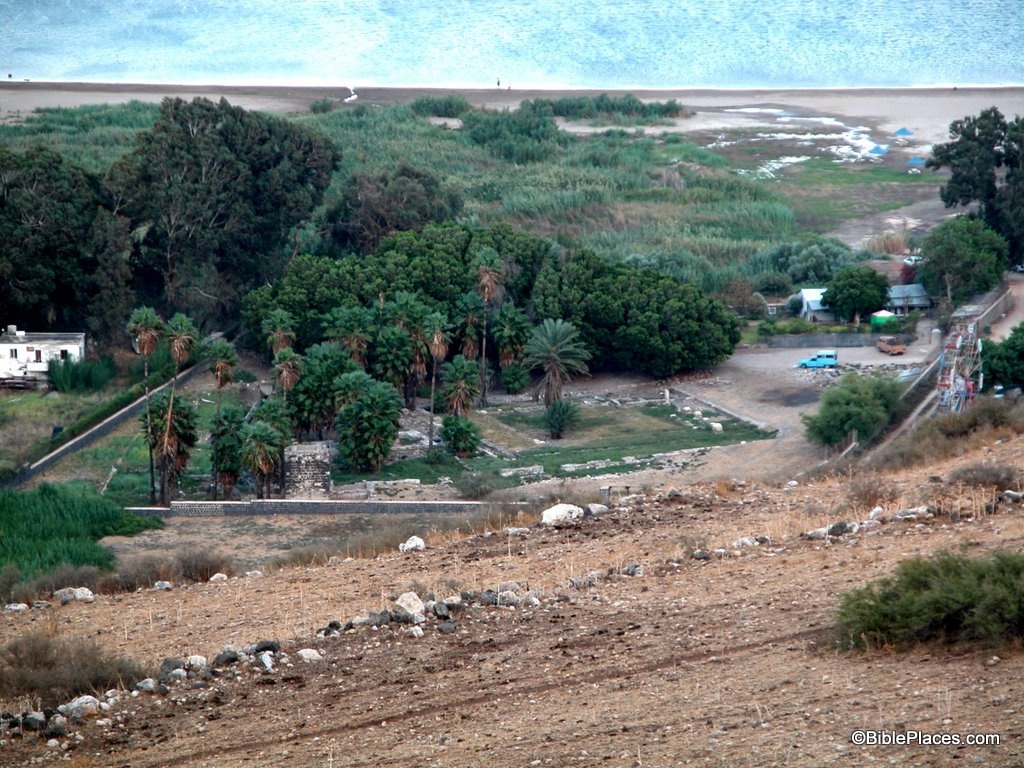
Magdala from above, tb102702020 Magdala from west
UPDATE (12/12): An article in Italian is longer and includes a photograph.

In advance of the upcoming National Geographic special on Herod’s tomb, as well as the cover story of the same on the December issue of NG, archaeologist Ehud Netzer held a press conference today announcing the most recent discoveries.  You can read the Hebrew University press release (with photos) and articles in Arutz-7, Haaretz, and National Geographic.  Below are selected portions of the articles.


Summary

The findings include coffins of Herod’s family, a theater with a VIP room, and two coffins containing the remains of most likely Herod’s wife and the wife of Archelaus, Herod’s son. The new findings further support the idea that the grave discovered last year belongs to Herod the Great. (Arutz-7)

Netzer described the winter palace, built on a largely man-made hill 680 meters high, as a kind of country club, with a pool, baths, gardens fed by pools and aqueducts and a 650-seat theater. (Haaretz)

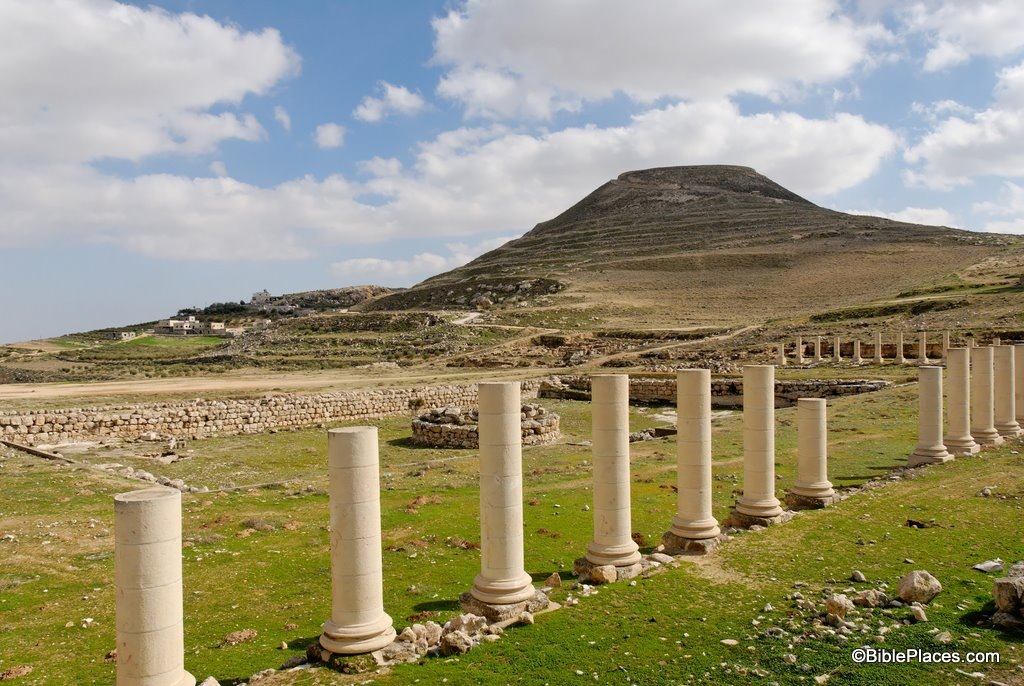
Herodium with lower pool, tb021407740dxo

Herodium with lower pool


Theater

A theater that could hold an audience of 750 was discovered not far from the mausoleum. In front of the seating area is a large room for VIPs, from which the king and his close friends would watch the shows. (Arutz-7)

“In Herod’s private box at the auditorium, the diggers discovered delicate frescoes depicting windows opening on to painted landscapes, one of which showed what appeared to be a southern Italian farm,” said Roi Porat, one of Netzer’s assistants on the digs. Just visible in the paintings, dating from between 15-10 B.C., are a dog, bushes and what looks like a country villa. (Haaretz)

“Normally in Judean art you wouldn’t paint scenes such as these with animals. The style is so similar to what is known from Italy, it really looks like a team came over to do the painting,” said Rachel Chachy-Laureys, a surveyor working with Nezter. “It fits the context.” (National Geographic)
The theater, its two side rooms and VIP section, were intentionally destroyed when Herod constructed the cone-shaped artificial mountain, which enclosed the round structure that stood at the top of the hill. (Arutz-7)


Tomb

“What we found here, spread all around, are architectural fragments that enable us to restore a monument of 25 meters high, 75 feet high, very elegant, which fits Herod’s taste and status,” [Netzer] told The Associated Press. (Haaretz)

In the excavation that took place this year in the area of the mausoleum, the remains of two white-colored tombs were found, most likely belonging to Herod’s family. The bright red and elegant coffin of Herod, which was displayed last year, is now completely restored, along with a large tomb. Prof. Netzer ascertains that the red coffin is the burial coffin of Herod. In contrast to the white coffins, the red coffin was shattered into hundreds of pieces, and spread throughout the mausoleum area. Prof. Netzer estimates that Malthace the Samaritan was buried in the larger of the two white burial coffins. (Arutz-7)

One big question remains: Where is Herod’s body?  “We have only found a very small number of human bones at the site and have not been able to come to any conclusions,” Netzer said. “We have not yet finished digging and have only uncovered a small area.”  But he does not believe the king’s remains will ever be recovered. (National Geographic)

Previous discussion and photos of Herod’s tomb can be found here.

There was a flurry of news coverage of the Khirbet Qeiyafa inscription yesterday, even though only a few words of that inscription have been translated (or, at least, announced).  Here are a few highlights.

CBS News has a 45-second video showing a man opening and handling the inscribed potsherd (ostracon).  A few letters are visible.

You can watch a 5-minute interview with the excavator, Yosi Garfinkel (in Hebrew) (via Yitzhak Sapir).

A few photos were released, but they appear to be deliberately impossible to read, as the excavators naturally want to translate the inscription before someone on the internet does.  It also has been suggested that high-tech photos may be necessary before the excavators are able to read the inscription in its entirety.  Here are a few photos: ostracon 1, ostracon 2, aerial view of the site and the gatehouse.

There is some debate on the ANE-2 list about whether this is a (Proto-)Canaanite inscription or a Hebrew inscription.

A member of the excavation team has posted some of his thoughts on Jim West’s blog.

The most ridiculous headline belongs to a British rag: ‘Proof’ David slew Goliath found as Israeli archaeologists unearth ‘oldest ever Hebrew text’

And if you prefer your inscriptions on a coffee mug, Eisenbrauns just announced the 2008 Gezer Calendar mug

There are a couple of other stories that I don’t have time to comment on now, but you can read about Eilat Mazar’s discovery of the tsinnor (water shaft) that David used to conquer Jerusalem and about an inscribed stone seal found in Jerusalem.  Don’t believe everything you read.

The Jerusalem Post has some details about the inscription from today’s archaeology conference in Jerusalem.  Some extracts:

A teenage volunteer found the curved pottery shard, 15 centimeters by 15 centimeters, in July near the stairs and stone washtub of an excavated home. It was later discovered to bear five lines of characters known as proto-Canaanite, a precursor of the Hebrew alphabet. Carbon-14 analysis of burnt olive pits found in the same layer of the site dated them to between 1,000 and 975 B.C., the same time as the Biblical golden age of David’s rule in Jerusalem. Scholars have identified other, smaller Hebrew fragments from the 10th century B.C., but the script, which Garfinkel suggests might be part of a letter, predates the next significant Hebrew inscription by between 100 and 200 years…. The shard is now kept in a university safe while philologists translate it, a task expected to take months. But several words have already been tentatively identified, including ones meaning "judge," "slave" and "king." The Israelites were not the only ones using proto-Canaanite characters, and other scholars suggest it is difficult – perhaps impossible – to conclude the text is Hebrew and not a related tongue spoken in the area at the time. Garfinkel bases his identification on a three-letter verb from the inscription meaning "to do," a word he said existed only in Hebrew. "That leads us to believe that this is Hebrew, and that this is the oldest Hebrew inscription that has been found," he said…. If the inscription is Hebrew, it would indicate a connection to the Israelites and make the text "one of the most important texts, without a doubt, in the corpus of Hebrew inscriptions," Maier said. But it has great importance whatever the language turns out to be, he added.

The full story is here.

The New York Times has an article in tomorrow’s print edition about Khirbet Qeiyafa (with thanks to Joe Lauer for pointing it out).  The article appears to me to be a teaser, released on the same day of the excavator’s lecture in Jerusalem, which likely will include some new revelations.  The article quotes a number of archaeologists, but most of the information is already known to those who have followed the excavation here or elsewhere.  I’m going to comment on some portions of the article, but you’ll do best the read the article in its entirety first, and then read my comments.

Five lines on pottery uncovered here appear to be the oldest Hebrew text ever found and are likely to have a major impact on knowledge about the history of literacy and alphabet development.

This is a dramatic statement, but the rest of the article ignores the inscription.  The “competition” for the earliest Hebrew text would be the Izbet Sartah inscription (11th century), the Gezer Calendar (10th century), and the Tel Zayit Inscription (10th century).  Interestingly, all of these inscriptions are from the same general vicinity (the western foothills, aka Shephelah).

A great power [like that described of David and Solomon], they note, would have left traces of cities and activity, and been mentioned by those around it. Yet in this area nothing like that has turned up — at least until now.

Hold on here.  Gezer is only a few miles up the road, and the excavations there were pretty decisive that it was a well-fortified city in the time of Solomon.  This is an example of trying to make the site more important by denigrating the significance of others.

Another reason this site holds such promise is that it was in use for only a short period, perhaps 20 years, and then destroyed — Mr. Garfinkel speculates in a battle with the Philistines — and abandoned for centuries, sealing the finds in Pompeii-like uniformity.

This is very important.  The problem with other sites is that they may be used for a long period of time, making it difficult to distinguish exactly what was going on at an earlier point it is history.  For that reason, archaeologists love destructions.  Even better is a single period site with a relatively short-lived occupation.

“The fortification required 200,000 tons of stone and probably 10 years to build,” he said as he walked around the site one recent morning. “There were 500 people inside. This was the main road to Jerusalem, the key strategic site to protect the kingdom of Jerusalem. If they built a fortification here, it was a real kingdom, pointing to urban cities and a centralized authority in Judah in the 10th century B.C.”

These are some numbers that I had not seen before.  It does seem strange that a fortress that took 10 years to build would only be in use for 20 years.  Why was it not rebuilt?  Was it because it was captured by the Philistines?  Or was it because David’s kingdom was strong enough (and its border now further away) that this fortress was no longer necessary?

“This is an important site, one of the very few cases from the 10th century where you can see a settlement fortified in a style that is typical of later Israelite and Judean cities,” said Amihai Mazar, a professor of archaeology at Hebrew University. “The question is who fortified it, who lived in it, why it was abandoned and how it all relates to the reign of David and Solomon.”

Mazar certainly asks the key questions.  It’s important to remember that many of these things are interpretive, which means that an archaeologist can interpret the finds one way and another archaeologist can come to a different (even opposite) conclusion.  If only the stones could speak.

The Philistines had a huge city, Gath, some seven miles away, but pottery found there looks distinct from what Mr. Garfinkel has found here.

This suggests that Qeiyafa was an Israelite fort.  That’s a real question because the Shephelah at this time was contested by the Philistines and Israelites.

Seymour Gitin, an archaeologist and a director of the Albright Institute in Jerusalem, a private American institution, who has seen the finds, said: “The real value is that there was an urban center in the 10th century. You can extrapolate and say this helps support a kingdom, a united monarchy under David and Solomon. People will rightly use this material to support that.”

What Gitin is saying is that a fortress like this doesn’t come out of nowhere.  There must be some sort of strong organizing force (government) that financed and directed it.  This compound wasn’t built by three bored Israelites one Sunday afternoon.

“Some of us look at things in a very ethnocentric way — everything is Israelite or Judahite,” [Israel Finkelstein] said. “History is not like that. There were other entities playing a big role in the southern part of the country. And even if it belongs to Jerusalem, fine. So there is a late 10th-century fortified structure there. I don’t believe that any archaeologist can revolutionize our entire understanding of Judah and Jerusalem by a single site. It doesn’t work that way. This is a cumulative discipline.”

Whoops!  Look at how quickly Finkelstein re-dated the whole enterprise by approximately a century. 

Earlier in the article the fortress is dated to 1050-970 B.C.  Finkelstein makes it late 10th-century with a wave of his hand.  This is not accidental, as his recent publications are built upon the theory that the biblical history was written very late and is entirely unreliable.  Any discovery which suggests a strong central government in Judah in the 10th century is very inconvenient for his views.

He [Garfinkel] says with some 96 percent of this site still to be unearthed, a process likely to take 10 years, he hopes that more writing, more olive pits and more pottery will be uncovered, and add depth to what he believes is a revolutionary find.

Most critical in the whole discussion is this note of caution.  Too often absolute and sensational conclusions are made after the first discoveries.  We have time.  Any discoveries heralded now, of course, certainly makes recruiting slave labor volunteers much easier.

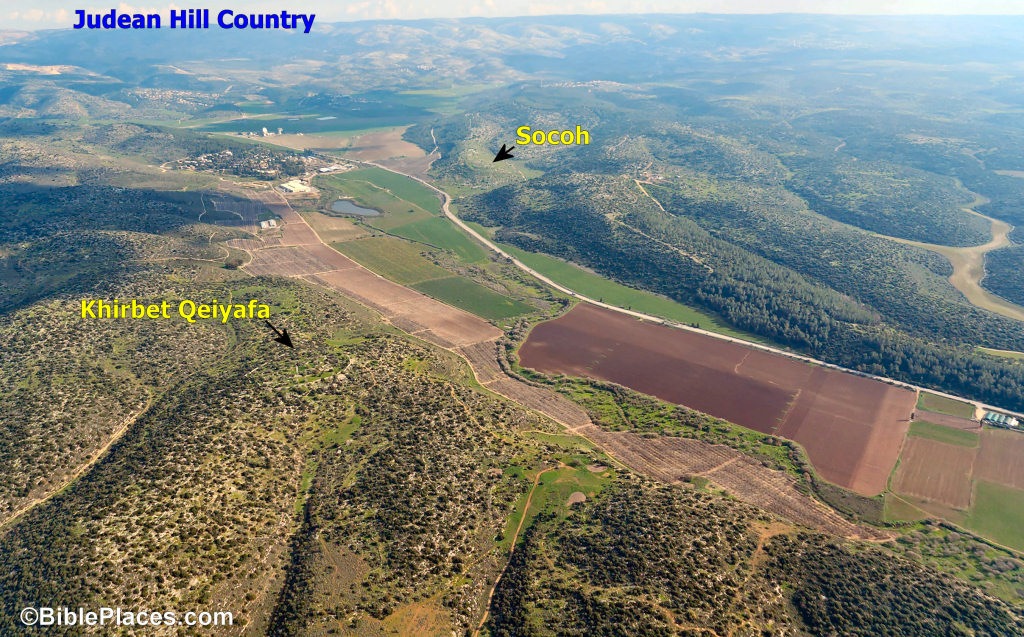
The New York Times does not have any photos of the site, but we do.  For more photos of the site in relation to the Elah Valley, and my speculation before the Times article or Garfinkel’s lecture, see this previous blog post.  The Times article does not mention the possibility that Khirbet Qeiyafa is Ephes Dammim.

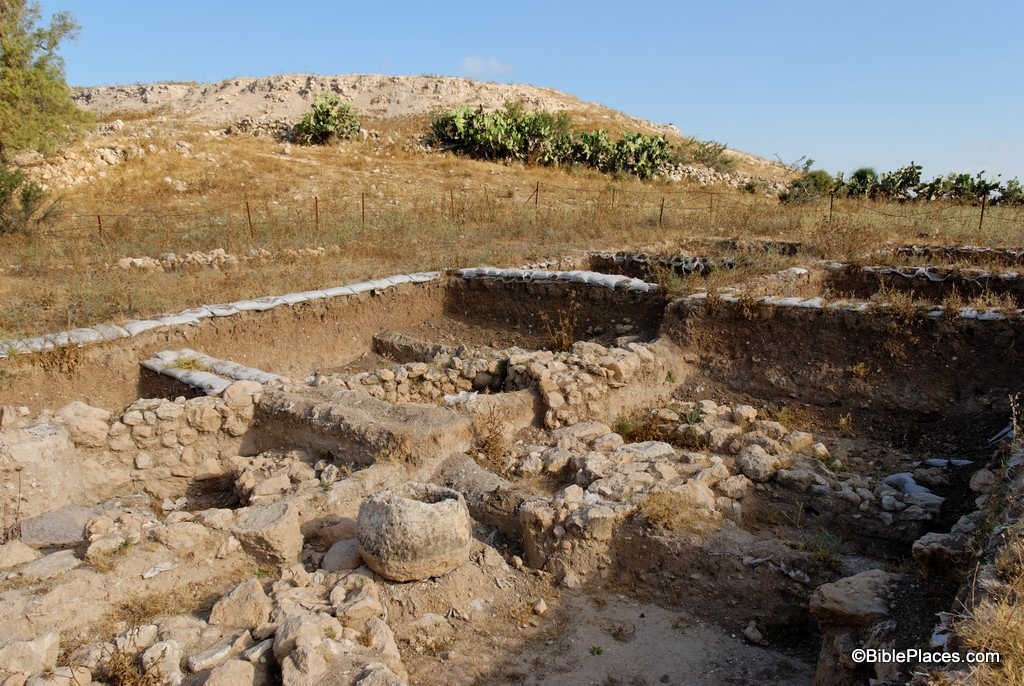
Khirbet Qeiyafa, 10th c four chambered gate, ar080731447

Khirbet Qeiyafa four-chambered gatehouse (10th century B.C.)
Khirbet Qeiyafa stele fragment, ar080731446  Khirbet Qeiyafa excavations with stele fragment

An update for the 2008 season at Gath (Tell es-Safi) is now posted at The Bible and Interpretation website.  Director Aren Maeir has summarized the discoveries and it’s worth reading in full.  Some of the highlights:


Early Bronze Age: the site was apparently huge


Middle Bronze Age: more excavation of the city wall and glacis


Late Bronze Age: a very large building, with rich collection of pottery


Iron Age I: remains of plants and animals could help determine the Philistines’ diet; Mycenaean IIIC pottery found


Iron IIA (1000-800 B.C.): – all bullet points are direct quotations from the article

  • clear early Iron IIA pottery
  • a well-dated fragment of a seal impression (of the late 21st Dynasty in Egypt, ca. mid-10th cent BCE)
  • several nice clusters of carbonized grape pips. This latter find should be able to provide robust 14C datings for this phase
  • One cannot overemphasize the importance of the finds in this level, since it may provide the first concrete, well-dated (from several perspectives) context from the early Iron Age IIA in Philistia. In fact, the finds from this level may serve as a central key to solving the “hot debate” on the chronology of the Iron Age, raging for now for more than a decade. Hopefully, the 14C results will be available by late 2008.
  • these finds demonstrate conclusively that our original assumption that the city of Gath was very large during the Iron Age IIA, reaching ca. 45-50 hectares [108-120 acres] in size, was correct. This makes it perhaps the largest site in Philistia, and perhaps in the entire Land of Israel during this period. As such, it appears to match the image of Gath that is portrayed in the biblical texts that relate to the early monarchy, in which the city is described as the largest and most important of five cities of the Philistine Pentapolis, the primus inter pares among the five cities.


Iron IIB (c. 700 B.C.): two destruction layers, possibly related to Sargon II and Sennacherib


Methodology: “in-field laboratory (including an IR spectrometer in the field), which was supplemented by the additional laboratories back in the base camp, provided us with “on-line” results of these analyses – which enabled “real-time” understanding of the archaeological finds. This joint program is unparalleled at ANY excavation in Israel, and in fact, in the world. The close integration of a “regular” excavation team with a wide team of archaeological scientists IN THE FIELD, is simply unparalleled anywhere.”

For many reasons, this excavation looks like it will be extremely beneficial for archaeological and biblical studies.

Gath, Tell es-Safi, from east, tb060906175 Gath, view from the east