A stone seal discovered this summer at Abel Beth Maacah suggests Israelite presence at the site in the 9th century.

Luke Chandler has collected a number of photos of floor tiles from Herod’s Temple Mount that have been restored by the Temple Mounting Sifting Project. The Jerusalem Post has more details. There are more photos here. A 20-minute video of the press conference is online, with English starting at about 3 minutes.

Archaeologists have uncovered a Byzantine-era stable at Avdat in southern Israel. High school students joined in the sifting of hundreds of buckets of organic material left behind by donkeys, sheep, and goats. Five high-resolution photos are available.

There’s now an island in the Sea of Galilee. It’s near the southern shore and is the result of the low water level. Artillery shells from WWI have also been discovered nearby.

A mosaic from the Huqoq synagogue may depict Alexander the Great meeting the high priest of Jerusalem. Another interpretation is that it shows the battle between Antiochus VII and John Hyrcanus I. The National Geographic article has photos.

Israel’s ancient capital of Samaria has been vandalized. A video in Hebrew shows some of the damage.

Exploring Bible Lands continues its series on “Walking like Jesus” with a photo of a Roman road in Galilee.

Wayne Stiles explores why Kiriath Jearim is ignored, and why it shouldn’t be.

Thursday’s Archaeological Conference in the City of David entitled “Digging for Truth — Jerusalem,
Archaeology & UNESCO” may be watched online. Parts are in Hebrew and other parts in English, with the whole lasting 4.5 hours. The program may be viewed here. The Jerusalem Post reports on the talk by Dore Gold.

Olive pits discovered at Khirbet Qeiyafa receive special attention at a new exhibit at the Bible Lands
Museum Jerusalem.

HT: Joseph Lauer, Charles Savelle, Agade, Ted Weis

Share:

The National Parks Authority has begun a $750,000 project to restore the Lower Aqueduct between Abu Tor and the Temple Mount in order to open it to visitors for Sukkot.

A stone workshop has been excavated in Galilee between Nazareth and Cana. The archaeologist suggests that perhaps the large stone jars mentioned in John 2 came from a cave like this one.

Archaeologists working in the Hittite capital of Alacahöyük have discovered a secret tunnel.

An article in Haaretz highlights similarities of Philistine culture to Cypriot cities and technology, supporting the theory of their Aegean origins.

A collection of metal artifacts discovered near the coast of Caesarea over several decades has been turned over to the Israel Antiquities Authority.

Seventy percent of the work on the archaeological park around the Giza pyramids is complete and the plan is to open it by the end of the year.

The BBC asks, “Will the skyscrapers outlast the pyramids?

The tomb of Suleiman the Magnificent is being excavated in a small town in Hungary.

New book: The Archaeology and History of the Church of the Redeemer and the Muristan in Jerusalem, edited by Dieter Vieweger and Shimon Gibson. Publication details here.

Wayne Stiles has a very good deal going right now on the audiobook version of his excellent Waiting on God.

HT: Agade, Joseph Lauer, Charles Savelle

Share:

A high school student found a ballista ball from the Bar Kochba Revolt during recent excavations of Beitar.

Excavators working at Abel Beth Maacah discovered one of the earliest silver hoards ever found.

There’s more information about the excavation of the chariot race mosaic in Cyprus.

To make the looting of Syrian artifacts more difficult, the US State Department announced emergency import restrictions.

“Oxford University researchers say that trees which grew during intense radiation bursts in the past have ‘time-markers’ in their tree-rings that could help archaeologists date events from thousands of years ago.”

Wayne Stiles explains how the Herodium testifies to God’s sovereignty.


The New York Times is no fan of the Ben-Hur remake.

The Associates for Biblical Research are beginning to recruit for their first season of excavations at Shiloh next summer.

Leon Mauldin posts on the end of wicked Queen Athaliah and shares a photo of a model of Jerusalem at the Bible Lands Museum.

If you wanted to know a little more about Enoch’s journey through the world (referenced in
Thursday’s survey results), Paleojudaica explains.

The new NIV Cultural Backgrounds Study Bible is being released on Tuesday. It looks impressive, and you can flip through the entire books of Genesis and Matthew online to see for yourself.

Hundreds of photos, maps, and charts accompany study notes edited by John Walton (OT) and Craig
Keener (NT). The promotional website also includes videos and infographics.

HT: Agade, Ted Weis, Joseph Lauer
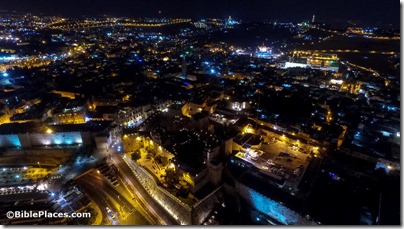
Old City aerial at night from southwest, ws052016101
Our most re-tweeted photo of the week was this aerial photo taken by Bill Schlegel of Jerusalem from the southwest. The Citadel of David is in the foreground and the Mount of Olives is in the distance.
Share:

A first-century AD synagogue has been discovered in eastern lower Galilee at Tel Rekhesh (Tell el-Mukharkhash). The synagogue was apparently in use until the village was abandoned during the Bar Kochba Revolt. Ynet News has the story:

Last Tuesday, an excavation team discovered, just ten centimeters below the peak’s surface, a synagogue from the first century AD. The find contained a huge and impressive room nine meters high and eight meters wide with walls lined with benches made of limestone blocks. Diggers also discovered one of the two foundational pillars supporting the synagogue’s roof.
[…]
“This is the first synagogue of its kind in the Galilee villages,” Dr. Aviam explained. “In Migdal, for example, there is a synagogue but that is a big city. Here we are talking about a magnificent agricultural area about four Dunam [1 acre] in size where buildings are decorated with frescoes and stucco articles. Jewish families lived in the estate but due to the fact that the nearest synagogue was four kilometers away (a distance deemed too far from a community according to Jewish law) the owner of the estate built the synagogue for himself and for the dozens of workers in his employment.”
[…]
Dr. Aviam told Ynet that the remains of objects were found which could definitely be dated back to the first century AD. Prior to the recent discovery, archaeologists already suspected the presence of a Jewish community on the peak.
Indeed, one of the main reasons that the researchers were able to extrapolate that the estate belonged to a Jewish community was the absence of big bones or remains. Indeed, pig was a staple part of a community’s diet in which Jews did not reside.
Further proof that Tel Recheš was an old Jewish community was the existence of many stone utensils. According to Jewish law, stone utensils cannot become impure, unlike other tool such as metal and glass. The preferred material of choice for cooking among Jews toward the end of the Second Temple era was stone.

As the article notes, Tel Rekhesh is not easily accessible to visitors. The 11-acre site is located about 5 miles (8 km) southeast of Mount Tabor and about 7.5 miles (12 km) southwest of the Sea of Galilee. Yohanan Aharoni identified it as biblical Anaharath (Josh 19:19), a city also mentioned in the records of Thutmose III, Amenhotep II, as well as in the Amarna Letters.

HT: Joseph Lauer

Tel Rekhesh from west, adr1306295291
Tel Rekhesh from the west
Photo by A.D. Riddle
Share:

In work to construct a mikveh in the Jewish Quarter of Jerusalem, archaeologists discovered a Roman bathhouse and below that a cistern connected to the aqueduct from Bethlehem.

Hundreds of Roman fresco fragments from a large building, dating to the 2nd century, have been excavated in Zippori National Park (Sepphoris).

A journalist gets a rare chance to visit Mount Ebal and its “altar.”

A site proposed as one of the Gilgals of the Bible is in danger because of the establishment of a new garbage dump.

Nadav Shragai asks why the media ignores illegal Muslim activity on the Temple Mount.

A new music video by Michael W. Smith was filmed entirely in Israel and includes some beautiful drone footage.

The Baptist News interviews a zooarchaeologist who excavated in the Philistine cemetery of Ashkelon.

A collection of Dead Sea Scroll fragments owned by the Museum of the Bible have been published in a book edited by Emanuel Tov, Kipp Davis, and Robert Duke.

It’s not just the words, but where they were spoken, argues Wayne Stiles.

Dan Warner is on the Book and the Spade this week talking about his excavation of the Canaanite water system at Gezer.

Seth Rodriquez appreciates the support he received for his trip to teach biblical backgrounds at the
Baptist Theological Seminary of Zimbabwe and he reports on his time there.

HT: Joseph Lauer, Ted Weis, Agade, Charles Savelle

Mount Ebal altar from northwest, ws092213002
Proposed altar on Mount Ebal
Photo by Bill Schlegel
Share:

A youth group working alongside archaeologists in Ibillin in northern Israel have uncovered a Canaanite fortress.

A pottery workshop from the Roman period has been excavated in western Galilee. High-res photos are available here.

After a four-year break, excavators are back at work at Tel Dan.

Jodi Magness provides an update on this summer’s excavations of Huqoq on The Book and the Spade.

Israel’s only mummy is now on display in a special exhibit at the Israel Museum that opened this week.

A project featuring ten mosaic replicas was unveiled in Jerusalem’s Cardo this week. A Jerusalem Post article indicates that the project will take a year to complete.

A group of Israeli archaeologists was attacked when touring the Temple Mount. The Temple Mount Sifting Project has a firsthand report.

Israel’s High Court is allowing the transfer of the ancient library at the Rockefeller Museum to the new IAA headquarters.

The Temple Mount Sifting Project is looking for help in identifying some of their finds.

Wayne Stiles explains the King’s Garden in Jerusalem, past and present.

CBD has a good deal going on the New Encyclopedia of Archaeological Excavations in the Holy Land. Get the original four volumes for $148, or get all five for $260. The update volume is available separately as well for $111. (Used sets at Amazon are a little more and new are $400+228.)

HT: Joseph Lauer, Agade

Share: