The Caspari Center Media Review summarizes a recent report in Maariv on antagonism between Jews and Christians on Mount Zion.

The area surrounding King David’s tomb on Mount Zion has become a conflict zone between Christians and Jews, reports Ari Galhar. The monks from Dormition Abbey, which is adjacent to the tomb, claim that the Jews who frequent the place “spit on priests and nuns, spray-paint graffiti on the walls, stand in front of the church and curse the Christians, calling out ‘Death to Christians and Jesus is a monkey,’ and hold events on Saturday evenings with loud music.” The Jews, on the other hand, claim that a secretary and priest from the Abbey, both from Germany, “harass the Jews in that place for anti-Semitic reasons, especially because of the priest’s German background.” They also claim that Christians removed two mezuzot from the entrance to the tomb and also removed prayers books, which they then threw away “in order to hurt us.” An effort has been made to mediate between the two sides in recent weeks. One mediator explains that much of the blame can be placed on both Jewish and Christian delinquent youth who have been stirring up trouble on purpose. The church held a special meeting on Monday with representatives from the president’s office, the mayor’s office, the Ministry of Interior, and the police, where they expressed their grievances. According to the mayor’s office, the next step will be to hold a similar meeting with the Jews who frequent the tomb.

David's Tomb building from north, tb082305461 Passageway leading to David’s Tomb from Dormition Abbey
Photo from Jerusalem volume

Share:

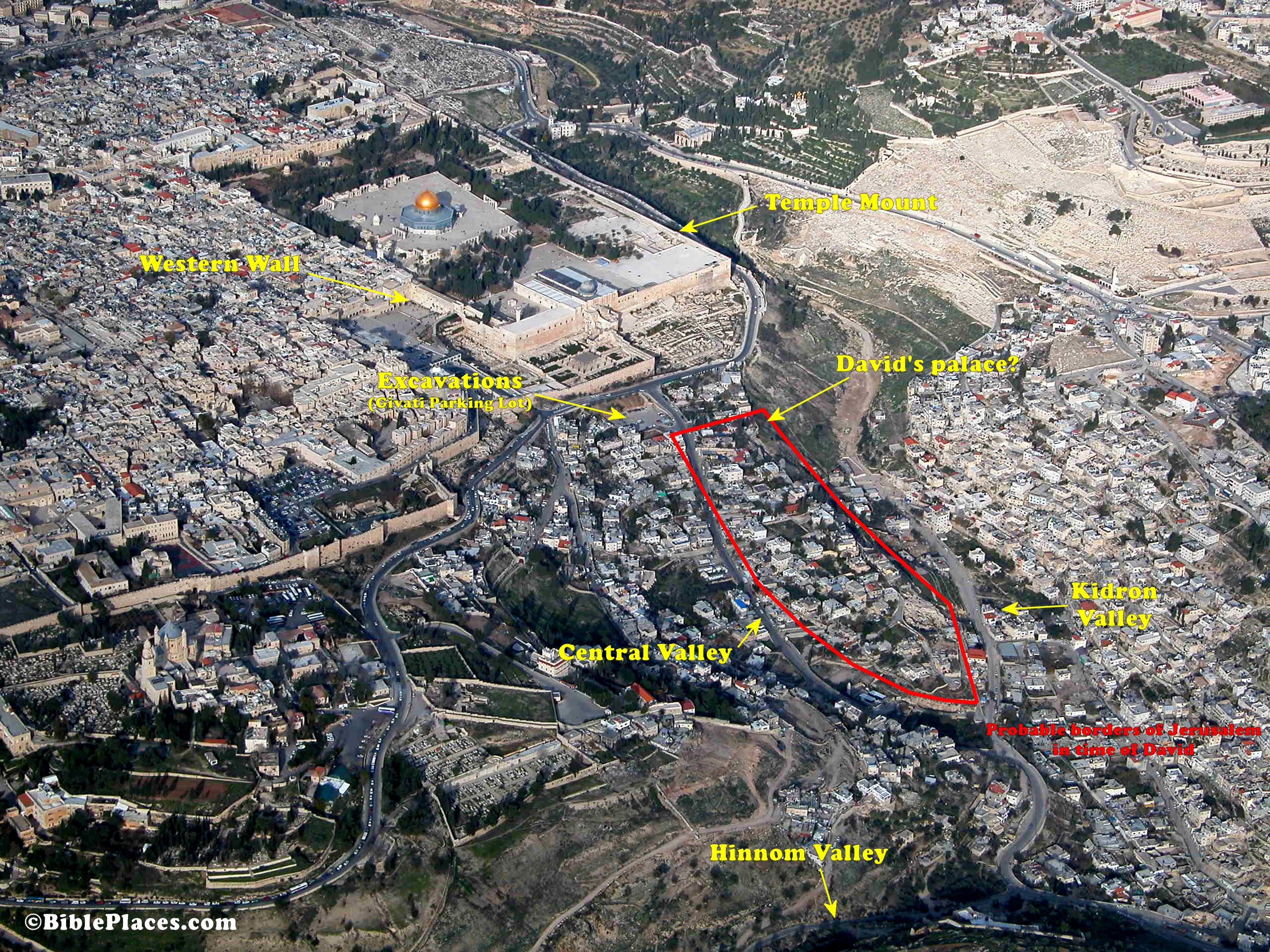
The holiday of Hanukkah is an appropriate time to announce the discovery of a Hasmonean-period building in Jerusalem. The structure is located in the Central Valley just south of the Dung Gate in the former Givati parking lot. The Israel Antiquities Authority describes the find in a press release.

In recent months remains of an impressive building from the Hasmonean period (second century BCE) are being unearthed in excavations the Israel Antiquities Authority is directing in the Giv‘ati parking lot, located in the City of David in the Walls Around Jerusalem National Park. The excavations are sponsored by the “Friends of City of David”.
The building stands c. 4 meters high and covers an area of c. 64 sq. m. The building’s broad walls (more than one meter thick) are made of roughly hewn limestone blocks that were arranged as headers and stretchers, a construction method characteristic of the Hasmonean period.
Although numerous pottery vessels were discovered inside the building, it was mainly the coins that surprised the researchers. These indicated the structure was erected in the early second century BCE and continued into the Hasmonean period, during which time significant changes were made inside it.
According to Dr. Doron Ben Ami and Yana Tchekhanovets, the excavation directors on behalf to the Israel Antiquities Authority, “The importance of this discovery is primarily because of the conspicuous paucity of buildings from the Hasmonean city of Jerusalem in archaeological research, despite the many excavations that have been conducted to date. Apart from several remains of the city’s fortifications that were discovered in different parts of Jerusalem, as well as pottery and other small finds, none of the Hasmonean city’s buildings have been uncovered so far, and this discovery bridges a certain gap in Jerusalem’s settlement sequence. The Hasmonean city, which is well-known to us from the historical descriptions that appear in the works of Josephus, has suddenly acquired tangible expression”.

The story is also reported by Arutz-7 and Israel HaYom.

We’ve reported on excavations at this same area many times in the past:

Hasmonean period building uncovered in Jerusalem
Hasmonean building in Jerusalem.
Photo by Assaf Peretz, courtesy Israel Antiquities Authority.
Aerial view of City of David, tb010703 givati parking diagram 
Jerusalem from the southwest Click photograph for higher-resolution version.

UPDATE (12/4): Eric Welch has sent this photo taken at the excavations during the summer.

Givati
Excavations in Givati parking lot. The three chambers in the foreground correspond with the chambers on the right side of the top photo.
Share:

Aren Maier reports that he may have been the last archaeologist to see the excavations of Eshtaol.

But you can see a video of the site before it was buried.

Some are unhappy that the Palestinian Authority is excavating a Hasmonean fortress between Bethlehem and the Herodium.

Barry Britnell saw the Jerusalem movie and he declares it to be “fantastic.” You can see if it is in a theater near you here.

The Kathleen Kenyon collection is now on display at the Ian Potter Museum in Melbourne.

This travel piece may inspire you to do more on your next trip to Israel than ride on a bus.

If you expect to be touring Israel in late May, you should plan now to avoid the pope.

You can save an extra 30% on any print book at Amazon through Dec 1, 11:59pm. Enter “BOOKDEAL” at checkout under the “Gift cards & promotional codes.” Up to $10 off. I recommend this book (for an amazing $21.47 after discount. I’ll say more about this book later, but not before this deal expires. Preview here.)

HT: Charles Savelle, Joseph Lauer

Share:

The James Ossuary has been released by the Israel Antiquities Authority to the owner Oded Golan. Matthew Kalman explains how police contamination of the James Ossuary was a factor in the the verdict of “not guilty.” Ninety antiquities on sale in a Jerusalem auction were returned to Egypt last week. Nir Hasson reports on antiquities dealers in Israel who are fighting governmental efforts to force them to use a computer database. Haaretz: How a Canaanite goddess conquered ancient Egypt The Biblical Archaeological Society is providing open access to its seven articles on Lachish in honor of the opening of the fourth expedition. The Catholic Herald runs a recent interview with Jerome Murphy-O’Connor. Leen Ritmeyer shares some of his own reflections. The Book and the Spade re-runs an interview from 2008. Ritmeyer shares a screenshot of a digital picture of ancient Jerusalem from the forthcoming iMax 3D movie. HT: Joseph Lauer, Jack Sasson

Share:

Jerome Murphy-O’Connor passed away today in Jerusalem. A Dominican priest and author of many books, Murphy-O’Connor is best known to many visitors of Israel for The Holy Land: An Oxford Archaeological Guide from Earliest Times to 1700. This excellent guide has been published in five editions beginning in 1980 with the most recent update in 2008.

HT: Paleojudaica

Second edition, 1986
Third edition, 1992
Fourth edition, 1998
Fifth edition, 2008
Share:

Norma Franklin asks, Why was Jezreel so important to the kingdom of Israel? Her claim that “there is no mention in the biblical narrative” of an Israelite palace is incorrect (1 Kings 21:1).

Another story on the excavations of Carchemish reports that the Japanese offered a million dollars for the opportunity to dig there.

The pigs in ancient Israel allegedly came from Europe.

Five historical monuments have been destroyed in Syria’s civil war. The photos show the damage.

How did ancient Greek music sound? The BBC reports on the research of Armand D’Angour.

How do you avoid losing what you learned on your trip to the Holy Land? Wayne Stiles suggests seven ways. My favorite is #4: Share with people what you have learned and experienced.

Leon Mauldin is doing a series on the cities of refuge. So far, he’s visited Kedesh, Shechem, and Hebron.

All of the entries from Skyview’s 2013 Creative Shot Contest are online.

The Batchelder Conference of Biblical Archeology at the University of Nebraska is scheduled for Thursday through Saturday.

Haaretz profiles the Mormon campus on the Mount of Olives, with details about the campus architecture and the “Non-Proselyting Agreement.”

HT: Jack Sasson

Brigham Young University on Mount of Olives, tb011612774
Brigham Young University campus in Jerusalem
Share: