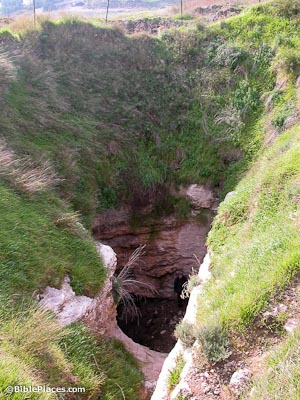
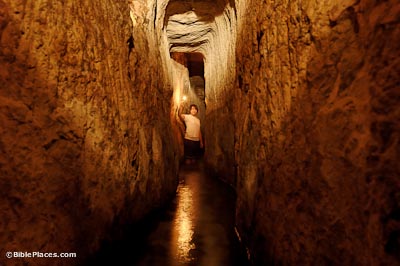
Excavations west of the Temple Mount have revealed a massive water reservoir from the Old Testament period. Over the last few years, archaeologists have been excavating the path of a 1st-century street and drainage channel leading from the City of David to the Temple Mount, and the reservoir was discovered during this work. The reservoir is similar to contemporary systems excavated at Beth Shemesh and Beersheba. From the Jerusalem Post:

The recently discovered reservoir, with an approximate capacity of 250 cubic meters, is one of the largest water reservoirs ever discovered from the First Temple period. Due to its size, archaeologists believe the reservoir was designed for and used by the general public.
According to Eli Shukron, the excavation director on behalf of the Israel Antiquities Authority, “the exposure of the current reservoir, as well as smaller cisterns that were revealed along the Tyropoeon Valley, unequivocally indicates that Jerusalem’s water consumption in the First Temple period was not solely based on the output of the Gihon Spring water works, but also on more available water resources such as the one we have just discovered.”

The Israel Antiquities Authority has issued a press release with more details.

According to Dr. Tvika Tsuk, chief archaeologist of the Nature and Parks Authority and an expert on ancient water systems, “The large water reservoir that was exposed, with two other cisterns nearby, is similar in its general shape and in the kind of plaster to the light yellow plaster that characterized the First Temple period and resembles the ancient water system that was previously exposed at Bet Shemesh. In addition, we can see the hand prints of the plasters left behind when they were adding the finishing touches to the plaster walls, just like in the water reservoirs of Tel Be’er Sheva, Tel Arad and Tel Bet Shemesh, which also date to the First Temple period.” Dr. Tsuk says, “Presumably the large water reservoir, which is situated near the Temple Mount, was used for the everyday activities of the Temple Mount itself and also by the pilgrims who went up to the Temple and required water for bathing and drinking.”
The exposure of the impressive water reservoir that lies below Robinson’s Arch joins a series of finds that were uncovered during recent excavations in this region of the city, indicating the existence of a densely built-up quarter that extended across the area west of the Temple Mount and predating the expansion of the Temple Mount. It seems that with the expansion of the Temple Mount compound to the west and the construction of the public buildings and the streets around the Temple Mount at the end of the Second Temple period, the buildings from the First Temple period and early Second Temple period were dismantled in this region and all that remains of them is a series of rock-cut installations, among them the hewn water reservoir.

A presentation about the discovery will be made this evening at the City of David Archaeological Conference. The Israel Antiquities Authority has released three high-resolution photos. The story is also reported by Arutz-7.

IMG_4745
Iron Age reservoir in Jerusalem
IMG_4672
Iron Age reservoir in Jerusalem. Photos by Vladimir Naykhin, IAA.
Share:

From The Temple Mount Sifting Project: On Thursday evening this week, September 6, 2012, the City of David will be hosting their 13th Annual Research Conference sponsored by the Megalim Institute. The program begins with an open house from 16:00 to 18:30 to give you an opportunity to visit the City of David and see all the newly excavated areas including the Second Temple Period street and water channel from the Siloam Pool up to the Temple Mount. The formal part of the program begins at 18:30. Admission is free and no registration is required, but space is limited. During the open house from 16:00 to 18:30, the Temple Mount Sifting Project will host an exhibit of finds recovered during the past 7 years of work.  The display, in the courtyard just inside the entry gates of the City of David, will include ancient seals and coins, personal items such as hair combs and jewelry, arrowheads, dice and game pieces, clay idols, weights, Herodian architectural elements and paving tiles that were once part of the Temple Mount plaza. This is the first time that these artifacts have been available for public viewing. Later in the evening as part of the Conference, at about 21:00, we will give a presentation [in Hebrew] of the Sifting Project’s important finds since our last Research Conference report, given in 2007. We will also be updating the public on our ongoing research and our new understandings about the Temple Mount’s past. Please stop by the City of David on Thursday evening to view this amazing exhibit of artifacts that helps tell the history of the Temple Mount. More information about the City of David Archaeological conference is here. HT: Joseph Lauer Sifting Temple Mount debris, tb110906729 Temple Mount Sifting Project

Share:

About half a dozen new excavation reports were published yesterday at the IAA’s Hadashot Arkheologiyot, including three from Jerusalem: Mishkenot Sha’ananim – a section of the Low-Level Aqueduct from the Roman-Byzantine period and an earlier unknown period. This aqueduct brought water from Solomon’s Pools to Jerusalem. St. Claire’s Monastery, Talpiot – a section of the High-Level Aqueduct from the 1st-2nd centuries AD. Zedekiah’s Cave – co-sponsored by the [Ron] Wyatt Museum of Tennessee, this 2011 excavation focused on two areas in the lower level of the cave. Remains were found from the Arab and Crusader periods, but the ark of the covenant was not located. All reports include maps, plans, and photographs. Several other discoveries have been mentioned in recent days: Byzantine-era remains of Jewish town found 9 miles (15 km) north of Beersheba will require the re-routing of Israel’s new north-south toolway. Imported pottery from Cyprus discovered at Tel Burna in the Shephelah has been photographed. A figurine was discovered on the surface of Tell es-Safi/Gath by a student. 5386-6 Water channel excavated at St. Claire’s Monastery. Photo by IAA.

Share:

Two Neolithic figurines were discovered at Moza (biblical Emmaus?) along the Jerusalem-Tel Aviv highway. High-res photos from the IAA are available. Two men were arrested for trying to steal bones from excavations in Beth Shemesh. The Israeli government has appealed the verdict in the case of the Jehoash Inscription, but the rationale for doing so is unclear. Shmuel Browns suggests a 10-day itinerary that will take you to many places you won’t see on a typical Christian tour. Stephen Gabriel Rosenberg provides a review of the archaeological stories in July. Aaron’s tomb near Petra is a “quiet, austere holy site.” There is a lot to see in the Kidron Valley of Jerusalem. Accordance 10 has some nice new features for photographs and maps. Now shipping: Alexander to Constantine: Archaeology of the Land of the Bible, by Eric M. Meyers and Mark A. Chancey. HT: Charles Savelle Neolithic figurine from Moza Neolithic figurine from Moza. Photo by Yael Yolovitch, courtesy of the Israel Antiquities Authority.

Share:

In an interview posted this morning on Justin Taylor’s blog, Leen Ritmeyer describes the “Palatial Mansion” that overlooked the Temple Mount in the first-century. This impressive structure inside today’s Wohl Museum is frequently skipped by tourists to Jerusalem, if I can judge by the private visits my groups usually enjoy at the site. Many who have been to Jerusalem may thus “see” this ancient home through the Leen Ritmeyer’s eyes, as the supervisor of the reconstruction effort provides a helpful “walk-through.” The house also provides the opportunity to clarify a difficult portion of the New Testament. How could Peter be warming himself by a fire in the courtyard on the night he denied Jesus, and yet be able to “go outside” the house of the high priest (Luke 22:54-62)? Ritmeyer explains and illustrates the concept of an open courtyard inside the palace. While I appreciate the way that Ritmeyer makes these discoveries so accessible to the average Bible reader, I am less optimistic that this particular house is the very house where Jesus stood on trial and Peter denied the Lord. In favor of making this positive identification is the fact that this is the largest house known from this time period in Jerusalem. On the other hand, most of the land in the Old City has never been excavated. If there were 100 houses in Jerusalem in the first century, how likely is it that the only complete one excavated is the same one mentioned in the Bible? See the post for the full interview, some of Ritmeyer’s famous diagrams, and links to his excellent resources. A commenter to the post also shares 63 high-resolution photos he took on a visit. These are particularly valuable because photography is not allowed unless you pay a lot of money.

Share:

Free on Kindle today: The Apostle: The Life of Paul, by John Pollock. The ASOR Blog has posted the latest Archaeology Roundup. Three new volumes of the City of David final excavation reports have been published. If you have not had the chance to visit Hebron, you should take the illustrated tour today with Wayne Stiles. (Another version with smaller images is published at the Jerusalem Post.) Is skinny-dipping in the Sea of Galilee sacrilegious? The Washington Post gives my answer to the question. WiFi access is important enough to visitors in Israel that one biblical village has equipped their donkeys with WiFi routers. HT: Charles Savelle Sea of Galilee windsurfer, tb060105650 Windsurfer on Sea of Galilee (photo source)

Share: