Archaeologists working near the Gihon Spring are confounded by a series of “V” shapes cut into the floor of a room. Archaeologists Eli Shukron and Ronny Reich date the marks to 800 BC or earlier, and they note a similar mark from the excavations of Parker, but they cannot explain the purpose of these 1.5-feet-long (0.5-m) carvings in the limestone. From the Associated Press:

Israeli diggers who uncovered a complex of rooms carved into the bedrock in the oldest section of the city recently found the markings: Three “V” shapes cut next to each other into the limestone floor of one of the rooms, about 2 inches (5 centimeters) deep and 50 centimeters long. There were no finds to offer any clues pointing to the identity of who made them or what purpose they served.
The archaeologists in charge of the dig know so little that they have been unable even to posit a theory about their nature, said Eli Shukron, one of the two directors of the dig.
“The markings are very strange, and very intriguing. I’ve never seen anything like them,” Shukron said.

The continuation of the story gives more information about the “V” found by Parker, the unique nature of the room, the standing stone found nearby, and a couple of nice photos.

The City of David Facebook page is asking readers who have seen anything similar elsewhere in the world to share their knowledge.

Share:

Last month Eisenbrauns released a new book that looks fantastic. Unearthing Jerusalem: 150 Years of Archaeological Research in the Holy City has a rich collection of articles authored by those who know the subjects best [with one glaring exception]. I have not read the book, and will not be able to for several months, but I know that some of the readers here will want to get this on their Christmas list. GALUNEART

The Eisenbrauns website has the publication details, but more helpful than the two-paragraph description is the table of contents. I’ve re-formatted that below for easier reading.

It should be noted that the book is based on a conference held in 2006 and thus those looking for the latest results from excavations will want to check elsewhere.

Frank E. Peters, Where Three Roads Meet: Jewish, Christian, and Muslim Pilgrimage to Jerusalem


Part 1: The History of Research

Shimon Gibson, British Archaeological Work in Jerusalem between 1865 and 1967: An Assessment

Ulrich Hübner, The German Protestant Institute of Archaeology (Deutsches Evangelisches Institut für Altertumswissenschaft des Heiligen Landes)

Joan R. Branham, The American Archaeological Presence in Jerusalem: Through the Gates of the Albright Institute

Dominique Trimbur, The École Biblique et Archéologique Française: A Catholic, French, and Archaeological Institution

Michele Piccirillo, The Archaeology of Jerusalem and the Franciscans of the Studium Biblicum

Ronny Reich, The Israel Exploration Society

Jon Seligman, The Departments of Antiquities and the Israel Antiquities Authority (1918–2006): The Jerusalem Experience


Part 2: From Early Humans to the Iron Age

Ofer Bar-Yosef, Prehistory of the Jerusalem Area

Aren M. Maeir, The Archaeology of Early Jerusalem

Israel Finkelstein, Jerusalem in the Iron Age: Archaeology and Text; Reality and Myth
Part 3: The Roman Period

Joseph Patrich, The Location of the Second Temple and the Layout of its Courts, Gates and Chambers: A New Proposal

Doron Ben-Ami and Yana Tchekhanovets, Has the Adiabene Royal Family “Palace” Been Found in the City of David?

Ronny Reich and Eli Shukron, The Pool of Siloam in Jerusalem of the Late Second Temple Period and Its Surroundings

Zvi Greenhut, A Domestic Quarter from the Second Temple Period on the Lower Slopes of the Central Valley (Tyropoeon)

Donald T. Ariel, Coins from Excavations in the Domestic Quarter of the City of David, Jerusalem

Hillel Geva, On the “New City” of Second Temple Period Jerusalem: The Archaeological Evidence

Jodi Magness, Aelia Capitolina: A Review of Some Current Debates about Hadrianic Jerusalem
Part 4: The Byzantine Period

Oren Gutfeld, The Urban Layout of Byzantine-Period Jerusalem

Leah Di Segni, Epigraphic Finds Reveal New Chapters in the History of the Church of the Holy Sepulchre in the 6th Century

Jon Seligman, The Hinterland of Jerusalem during the Byzantine Period


Part 5: The Early Islamic and Medieval Periods

Gideon Avni, From Hagia Polis to Al-Quds: The Byzantine–Islamic Transition in Jerusalem

Donald Whitcomb, Jerusalem and the Beginnings of the Islamic City

Shlomit Weksler-Bdolah, Early Islamic and Medieval City Walls of Jerusalem in Light of New Discoveries

Mahmoud Hawari, Ayyubid Jerusalem: New Architectural and Archaeological Discoveries

Robert Schick, Mamluk and Ottoman Jerusalem

One last comment: the natural choice for the presentation/article on Iron Age Jerusalem is Gabriel
Barkay. He knows the city and this period far better than Israel Finkelstein and he does not suffer from the biases that make the latter’s work unreliable. Perhaps a logistical reason made Barkay’s participation impossible.

Share:

After the city engineer of Jerusalem demanded that the Mughrabi bridge be repaired or closed for safety reasons, Israel’s prime minister has ordered that the reconstruction of only non-Muslim access to the Temple Mount be postponed because of Muslim opposition. From the Jerusalem Post:

According to the report, work on the bridge – which received approval in March – was to have begun early Sunday morning.  The initial work of demolishing the existing structure would have necessitated the deployment of large IDF and security forces in Jerusalem and around the Temple Mount, as well as stepped up army preparedness in the West Bank. Channel 2 reported that Cairo and Amman warned Jerusalem that the work would likely lead to "disruptions" in both Jordan and Egypt.  
Officials in both the Prime Minister’s Office and the Jerusalem Municipality refused Sunday night to relate to the reports.
Previous work on the bridge caused widespread rioting in neighborhoods throughout the Jerusalem area and in Jordan. […] Under the plans, a permanent bridge is to be built to replace the current temporary wooden structure that has been in use since a 2003 earthquake and winter storm caused part of the original bridge to collapse. The bridge is used as the main entry point for non- Muslim tourists and security forces entering the Temple Mount.

The full story is here. Haaretz has additional details. For background, see this post from one month ago.

Share:

The discovery announced yesterday was analyzed by a number of writers:
Doug Petrovich (ANE-2) notes that “it long has been accepted” that King Herod did not finish the Temple Mount project and that “all this find does is to date more precisely the building of the SW corner of the Temple Mount (to AD 17/18).”

Ferrell Jenkins observes that “we already knew” what archaeologists claim to have discovered, given the record of Josephus and John 2.

Alexander Schick provides photos of the incomplete section on the northern end of the Western Wall, suggesting that the story is sensational only because the New Testament evidence was ignored.
(Google translation link)

Shmuel Browns was at the press conference and provides his own summary. He also makes some observations and poses some questions in a comment to yesterday’s post on this blog.

The Reuters story provides one solution to the press release by suggesting that academic historians are aware of Josephus but that tour guides are not.

Leen Ritmeyer explains the phases of construction of the western and southern walls of the Temple Mount. This is a must-read for any tempted to claim that Herod did not build the Western Wall.

Ritmeyer’s expert diagrams will help you to understand even if you are not familiar with some of the terms and place names. Read it!

Share:

Today’s press conference at the Western Wall promised to “challenge the conventional viewpoint” of the dating of the construction of the Temple Mount. The new evidence does that only if imagines that the conventional viewpoint was something other than it is. Someone in the Israel Antiquities
Authority obviously felt that this minor story needed to be a major story and this justified creating a new conventional viewpoint that could be contradicted.

All quotations are from the official press release (also here) of the Israel Antiquities Authority, not from some journalist untrained in the field.

The release begins:

Who built the Temple Mount walls? Every tour guide and every student grounded in the history of Jerusalem will immediately reply that it was Herod.

This might be true. When asked a simple question, a tour guide may respond with a simple answer.

However, in the archaeological excavations alongside the ancient drainage channel of Jerusalem a very old ritual bath (miqwe) was recently discovered that challenges the conventional archaeological perception which regards Herod as being solely responsible for its construction.

Ah, but now they’ve twisted the question so as to create a dramatic discovery. The question asked every tour guide above was not who was solely responsible for its construction. Actually, every tour guide and student knows that Josephus reported that in AD 64 work was halted on the Temple Mount and 18,000 workers were laid off (Ant. 20:219-23).

In fact, the press release acknowledges as much, in the concluding (and bolded) paragraph:

This dramatic find confirms Josephus’ descriptions which state that it was only during the reign of King Agrippa II (Herod’s great-grandson) that the work was finished, and upon its completion there were eight to ten thousand unemployed in Jerusalem.

So if this find confirms Josephus’ descriptions, how does it “challenge the conventional viewpoint”?

The fact is that it doesn’t.

Furthermore, the press release fails to note that the New Testament makes it clear that the Temple Mount construction was on-going during the time of Jesus’ ministry (ca. AD 30).

John 2:20 (NET) “Then the Jewish leaders said to him, ‘This temple has been under construction for forty-six years, and are you going to raise it up in three days?’”

The conventional viewpoint is that construction on the Temple Mount began in 20 BC and continued, likely with some stops and starts, until AD 64.

There is valuable information gained from the recent excavation that is nearly obscured by the pathetic attempt to garner headlines with inaccurate reporting. The excavations of Shukron and Reich demonstrate that construction of Robinson’s Arch and the area in the southwestern corner of the Temple did not begin until AD 17/18. This spectacular staircase may have been freshly completed when Jesus arrived with his disciples. So if the story corrects an interpretation for guides and students of the Temple Mount, it is that King Herod, who died in 4 BC, never entered the complex by means of the southwestern gate.

The press release, with inline photos, can be read at the Israel MFA site. Two high-resolution photos may be downloaded at the IAA site (temporary link) or with this direct link to the zip file.

The story is reported in the media by the Associated Press, the Jerusalem Post, Arutz-7, and Haaretz.

All of these publications report that the excavations “challenge” what we knew and “confirm” what Josephus says. None of them mention John 2:20.

Leen Ritmeyer provides photos including a portion of a well-known unfinished section and notes that “this late date is not surprising” because of the reference in John 2.

First-century street below Robinson's Arch, tb051805944

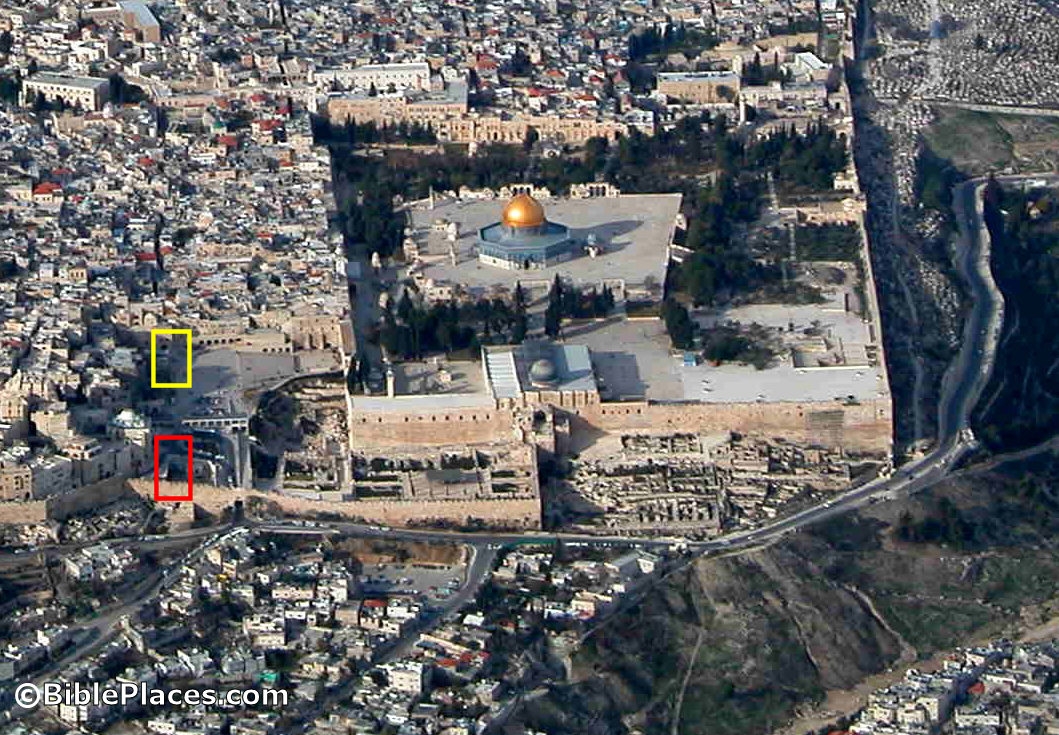
Southwestern corner of the Temple Mount and Robinson’s Arch
Share:

Joseph Lauer passes along a press conference invitation sent by the Israel Antiquities Authority, the City of David, and other related parties.

Invitation: Tomorrow (Wednesday, November 23, 2011) at 11:15 AM–a Press Conference in the Jerusalem Archaeological Garden A find will be presented that challenges the conventional viewpoint in archaeology regarding the construction of the Western Wall of the Temple Mount. The press conference will be held in the Jerusalem Archaeological Garden, next to the Western Wall. For further information, kindly contact: Yoli Shwartz, Israel Antiquities Authority spokesperson, 052-5991888 [email protected]

Leen Ritmeyer has posted a note suggesting that the new information has to do with the date of the construction of Robinson’s Arch.

Share: