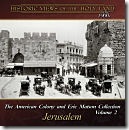
I think that for a certain subset of this blog’s readers, photo challenges are enjoyable.  I’ll tell you a little and you can tell me the rest.  This photo is part of the Jerusalem volume of The American Colony and Eric Matson Collection and it was taken in approximately 1900.

jerusalem_challenge

The best answer in the comments below wins a free copy of the Jerusalem CD (or your choice of another if you already have it).  An important part of the answer is why it is impossible to take this same photo today.

Share:

Recently a friend alerted me to a discussion online about major renovations to be started soon in the vicinity of Jaffa Gate.  Among other things, this will close the gate off to vehicular traffic.  If they dig anything up, chances are very high that they’ll find something of significance, which will slow their progress down even further.  A source in Jerusalem relates the following:

1. The gate is being closed to car traffic due to road renovations.

2. They may leave one lane open for one-way traffic.

3. The gate is supposed to close soon after Succot (which ended a few days ago).

4. A Muslim policeman “who isn’t trustworthy” said that the gate would NOT reopen ever.

5. Shop owners are concerned about how they will receive supplies.

This is not the first time the authorities have done major work on the road here.

View inside Jaffa Gate, mat04928 Jaffa Gate area from east, with Crusader moat of Citadel visible in foreground.  Date of photograph: 1898-1907.  From the new Jerusalem CD.
Share:

A Second Temple period hall near the Western Wall has been excavated and restored.  The “Hall of Ages” is scheduled to be opened to the public in a few weeks.  HT: Joe Lauer

The Baptist Press has a story on the “Joseph coins,” in which they quote Steven Ortiz and Robert Griffin as skeptical. 

G. M. Grena has some comments about the upcoming ASOR meetings at his LMLK blogspot, including this note of interest to Qeiyafa watchers:

By the way, Prof. Garfinkel will have some interesting photos of jar handles with special impressions that in many ways parallel the LMLK phenomenon.

BAS reports that from January to August 2010 the Oriental Institute will launch a new exhibit
Pioneers to the Past: American Archaeologists in the Middle East, 1919-20.” 

James Henry Breasted had received a large donation from John D. Rockefeller, Jr. to establish the Oriental Institute in 1919 and quickly organized an expedition to travel across the Middle East to acquire objects for the Institute and identify sites for excavation. World War I had just ended, the political map of the Middle East had not yet been redrawn, and it was a dangerous time to be travelling through the region. The exhibit will present the incredible adventure story of the Breasted expedition through photographs, excerpts from letters, original documents from the archives, and objects purchased on the trip.

BAS is now offering a free e-book entitled “Israel: An Archaeological Journey” (requires quick registration if you haven’t already).  The contents include:

  • The Fury of Babylon: Ashkelon and the Archaeology of Destruction, by Lawrence E. Stager
  • Vegas on the Med: A Tour of Caesarea’s Entertainment District, by Yosef Porath
  • How Jewish Was Sepphoris in Jesus’ Time?, by Mark Chancey and Eric M. Meyers
  • Where Masada’s Defenders Fell, by Nachman Ben-Yehuda
  • A New Reconstruction of Paul’s Prison, by Ehud Netzer
Share:

The photo below shows another very familiar place in Jerusalem, at the northwestern corner of the Old City walls.  This site, I believe, may be distinguished as the location most often renovated in the modern city’s history.  I’ve long suspected that the municipality, which has its offices on the north side of this square, uses the area as training grounds for its construction crews.

New City outside nw corner of Old City walls, mat13390

This American Colony photo shows how the area looked sometime between 1932 and 1946.  The round building on the right served as Barclay’s Bank on the lower floor and basement, while the rest of the building held offices of the City Hall.  Because it was located next to “No Man’s Land” from 1948 to 1967, the building’s facade today bears pockmarks from the hostilities.  Mayor Teddy Kollek’s office was in the second floor of this building for many years.

011Construction at Old City northwest corner, tb122006010dxo2

This picture could have been taken many times since, as the area has been torn up time and again to install various traffic features, water fountains, and pedestrian walkways.  This photo was taken in December 2006 after the construction of a traffic tunnel.  The round building is in the distant center.

Excavations near Old City northwest corner, Peter Wong, IMG_6480

This photo was taken in July 2009 by Peter Wong and looks west (the municipal building is off to the right).  It shows excavations of the area, including what appears to be a cistern in the top center.

Shortly after Peter took this photo, the area was cemented over.

Share:

Jewish Quarter from Temple Mount, mat04722

Jewish Quarter from the Temple Mount

It wasn’t all that long ago that this area looked very different.  This photograph, taken from the Temple Mount, looks towards the Jewish Quarter.  I don’t have a “today” comparison because sensitivities now do not allow one to access this area.

Dominating the skyline are two domed synagogues, once major landmarks in the Old City: the taller Tiferet Israel (“Glory of Israel”) on the left and the Hurvah (“Ruin”) on the right. Sadly, both structures fell victim to the hostilities of 1948. During the final fighting for the Jewish Quarter in May 1948, both synagogues, which had served as strategic positions for the quarter’s Jewish defenders, were intentionally blown up by Arab forces. Then, with Israeli control of the Old City after 1967, the remains of both buildings were consolidated and preserved as memorials. Until 2006, the Hurvah site sported a memorial arch which became a visual symbol of the new Jewish Quarter and an Old City landmark. Today the Hurvah is being rebuilt, exactly to its original mid-19th century appearance.

In the foreground are the houses and other structures of the Mughrabi Quarter, an Arab neighborhood which covered what is now the expansive Western Wall plaza and the adjacent excavated areas around the Temple Mount. After Israel captured the Old City in the 1967 Six Day War, within a matter of days the Mughrabi Quarter’s residents were forced out and relocated, and most of the buildings seen here were razed. However, the lower floors of some of the houses became the base of an earthen ramp that provided access to the Temple Mount’s Mughrabi Gate from 1967 until 2004, when part of the ramp collapsed. Now, these same houses—and more ancient structures beneath them—are being exposed archaeologically in advance of construction of a new Mughrabi Gate foot-bridge.42_jerusalem_front

This photograph and description are taken from the Jerusalem volume of The American Colony and Eric Matson Collection.  The photograph is originally from the Library of Congress, LC-matpc-04722, and the description was written by Tom Powers.  The $25 CD includes 685 high-resolution photographs and the equivalent of a 200-page book of annotations such as the one above.

Share: