Jerusalem, looking down moat toward clock tower, mat08549

Jaffa Gate vicinity from southwest, 1907-1920

I cannot locate a “today” version from this perspective, but you can just imagine the changes:

1) the Crusader moat in the foreground has been completely filled in;

2) the shops on the left side of the photo have been torn down;

3) the clock tower has been dismantled;

4) the fountain has been removed.  Other than that, it looks pretty much the same today.


If a reader has a photo from this perspective that they want to share, feel free to send it to me and I will post it here.  I’ve walked this way many times, but I guess I just considered it too ordinary to photograph. It was 19 years ago that I walked this way on my first date with (now) wife.

Jaffa Gate, by Menachem Brody Jaffa Gate, present day.  Photo by Menachem Brody.

This photograph is from the newly released Jerusalem CD, volume 2 of The American Colony and Eric Matson Collection. The collection includes 685 photographs, including 26 in the Jaffa Gate set, revealing the dramatic changes in this area from 1898 to 1946. Photo: Library of Congress, LC-matpc-08549.

Share:

General Charles Gordon was a well-known British leader when he came to live near Jerusalem in 1882, often visiting the home of Horatio and Anna Spafford, founders of the American Colony.  From their quarters atop the northern wall of the Old City, Gordon had a view of a rocky escarpment in which he identified the features of a skull.  He identified this location as the “Place of the Skull” (Aramaic: Golgotha; Latin: Calvary).  Around the corner was an ancient tomb which he believed was the empty tomb of Christ.  A decade later, the property was purchased by a concerned group of Christians in England and the Garden Tomb Association was formed.

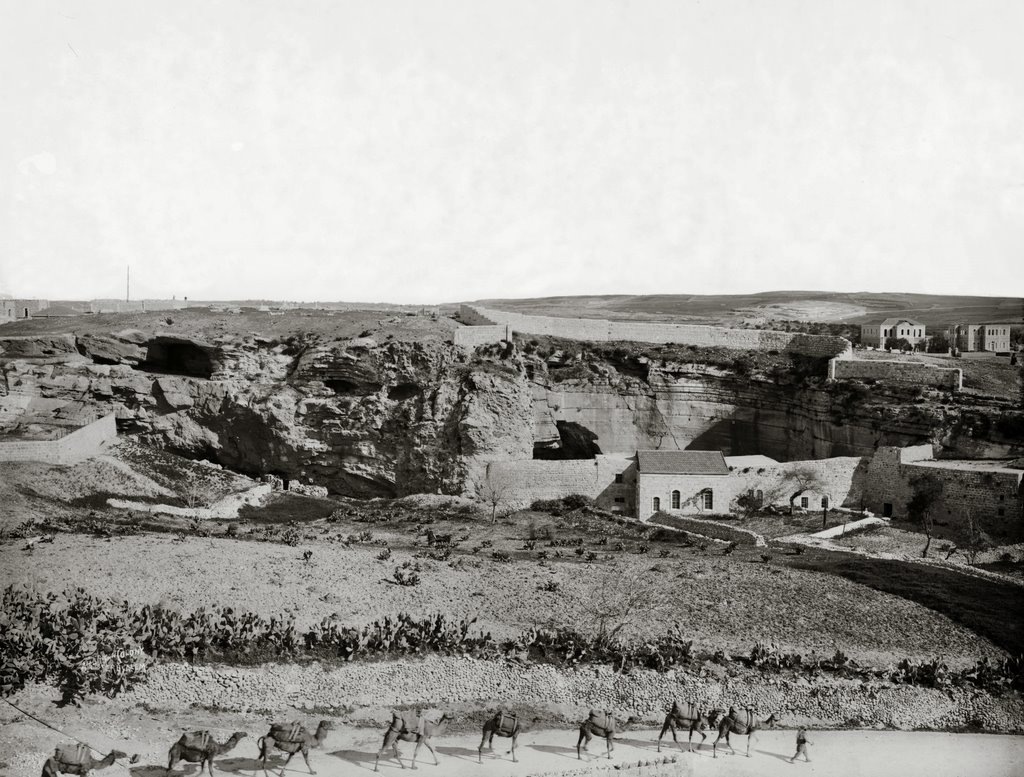
Gordon's Calvary, mat06666 The area known as “Gordon’s Calvary,” early 1900s

In this photo, taken between 1898 and 1914, the view is similar to the one that Gordon had from the American Colony home.  The caves that form the eye sockets of the skull are visible just left of center.  The tomb is out of view behind the wall on the left side.  On the top of the hill some tombs of the Muslim cemetery can be seen.  The camels are walking east along what is today a busy four-lane street.

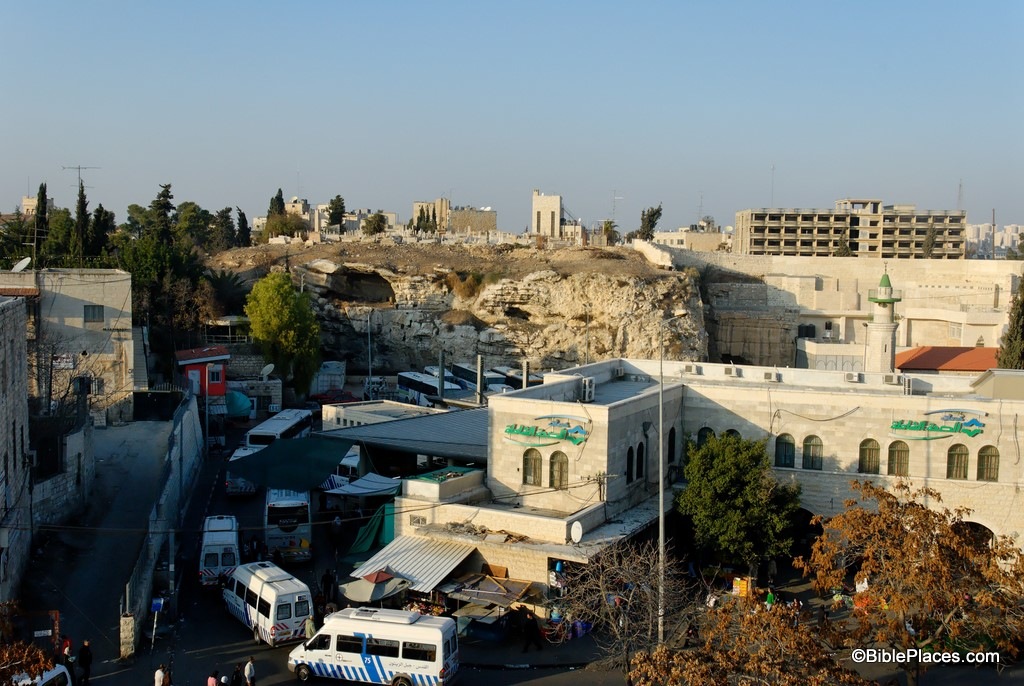
The photo below was taken in 2006 and the most prominent feature is the bus station.  The two “eye sockets” are visible, but most of the rest of the landscape is covered.  If you believe that Jesus was crucified in this area, you’ll do better using the black and white photo to visualize the event.

Gordon's Calvary from south, tb122006023 The area known as “Gordon’s Calvary,” present day

Concerning the tomb’s authenticity, Robert Alexander Stewart Macalister wrote in 1907:

It is a pity that so much is claimed for [this tomb]; the prejudice raised thereby is apt to blind one to the fact that it is a remarkably interesting sepulchre. . . . In conversation with tourists at the hotel in Jerusalem I constantly hear such a remark as this: ‘I came to Jerusalem fully convinced that the Church of the Holy Sepulchre was the true site; but I went to the Church and saw all the “mummery” that goes on there, and I saw the Muhammadan soldiers guarding the place to prevent the Christians fighting. Then I went to that peaceful garden: and then I knew that the church was wrong, and that Gordon had found the real site.’ This is the most convincing argument that can be advanced in favor of the tomb, and it is obviously quite unanswerable (Palestine Exploration Quarterly, 1907, p. 232).

The top photo is one 15 photographs in a presentation of the Garden Tomb in the newly released Jerusalem CD, volume 2 of The American Colony and Eric Matson Collection. The presentation includes a carefully researched history of the area.  Photo: Library of Congress, LC-matpc-06666.

Share:

Excavations continue to reveal more of the large 1st century city street that ran from the Pool of Siloam to the Temple Mount. The Israel Antiquities Authority (IAA) has issued a press release and made available two high-resolution photographs of the street and drainage channel.

The street is beautifully paved and though only 6 feet (2 m) in width have been exposed, the full width of the street is estimated to be 25 feet (8 m).

As far as I can tell, this story is not relating a new discovery but indicates that excavation work (once halted) has continued with success. It was mentioned on this blog before in December 2005, December 2006, and September 2007. In the 2005 post, I wrote:

The archaeologist told me that he would like to reveal the entire length of the road from the Pool of Siloam to the Temple Mount. I told him he was crazy. Unless he is thinking of digging a tunnel underneath all of those houses. Then he’s still crazy :-).

Leen Ritmeyer believes that the report concerns a different street, namely a side street on the east side of the Byzantine/upper pool. He has a helpful drawing that illustrates that. In the articles I have read, it has not been clear to me that a separate street has been found, but Ritmeyer may have first-hand knowledge. (See update below.)

You can ignore any reports which describe these excavations as undermining Al Aqsa Mosque. The mosque is 1600 feet (500 m) distant. You should also ignore the ubiquitous comment in the news stories that the dig is funded by Elad. Such a note insinuates that the archaeologists distort their results, and anyone who knows Ronny Reich and Eli Shukrun knows that that is a falsehood.

Joe Lauer has sent along links to the story in various sources, including Haaretz, the Jerusalem Post, and Arutz-7. A previously mentioned IAA video of a tour of the City of David includes this street.

UPDATE (9/16): Ritmeyer has posted a correction.

Share:

The previously-reported discovery of a stone cup with an inscription dating from the 1st century A.D. is covered by National Geographic.  The inscription is proving quite difficult to decipher.

“These were common stone mugs that appear in all Jewish households” of the time, said lead excavator Shimon Gibson of the University of North Carolina.
“But this is the first time an inscription has been found on a stone vessel” of this type.
Deciphering the writing could provide a window into daily life or religious ritual in Jerusalem around the time of Jesus Christ.
Working on historic Mount Zion—site of King David’s tomb and the Last Supper—the archaeologists found the cup near a ritual pool this summer. The dig site is in what had been an elite residential area near the palace of King Herod the Great, who ruled Israel shortly before the birth of Jesus.
[…]
What sets the newfound cup apart is its inscription, which is still sharply etched but so far impossible to understand.
Similar to intentionally enigmatic writing in the Dead Sea Scrolls, the cup’s script appears to be a secret code, written in a mixture of Hebrew and Aramaic, the two written languages used in Jerusalem at the time.
“They wrote it intending it to be cryptic,” Gibson said.
In hopes the script can be deciphered, Gibson’s team is sharing pictures of the cup with experts on the writing of the period. The researchers also plan to post detailed photos of the cup and its inscriptions online soon.
One thing the team is sure of, though, is that whoever inscribed the cup had something big in mind—and didn’t want just anyone to know.
“They could be instructions on how to use [the cup], could have incantations or curses. But it’s not going to be something mundane like a shopping list.”

The complete article is here and it includes a nice photograph (enlarged here).  A friend of mine dug this cup out of the dirt, but as with all excavations, the credit goes to the archaeologists, not to the laborers, and you’ll never see his name in print.  The official excavation website is here.

HT: Paleojudaica

Share:

A PhD student has discovered a fragment of Codex Sinaiticus under the binding of an 18th-century book. The parchment contains part of Joshua 1:10 and dates to A.D. 350.

Azusa Pacific University has purchased five Dead Sea Scrolls fragments from a book dealer in southern California. “This acquisition will set Azusa Pacific University apart from all other Christian institutions of higher education in the world,” said Paul Gray, vice provost for graduate programs and research and dean of the University Libraries. As an educator, I think this is a publicity stunt which will do little more than give them bragging rights for recruiting. How about this as an idea for setting apart a school and improving education: build an extension campus for your students in Israel.

CNN carries the story of the Middle Bronze passageway discovered in Jerusalem, together with a 2.5 minute video that includes interviews with archaeologists Reich and Shukrun.

A carved stone with Egyptian signs from the First Dynasty has been discovered at Tel Bet Yerah (Khirbet Kerak) on the southwestern shoreline of the Sea of Galilee (photos here).

HT: Joe Lauer and Ferrell Jenkins

UPDATE (9/11): NPR has a 4-minute radio interview of Ronny Reich (with written transcript)

Share:

The discovery of a massive fortified walkway leading to Jerusalem’s Gihon Spring has been announced by archaeologists Ronny Reich and Eli Shukrun. Excavations so far have uncovered a portion of a Middle Bronze wall that is 26 feet (8 m) high and 75 feet (24 m) long. The wall apparently protected a passageway that led from the fortified city of Jerusalem down the eastern slope of the City of David to the Gihon Spring in the Kidron Valley.

The discovery is reported in a press release of the Israel Antiquities Authority and a story in Arutz-7, soon to be followed by all the major news outlets. There are some parts of the story that don’t make sense or are inaccurate.

“This is the most massive wall ever discovered in the City of David,” Reich said. “It is tremendously large in terms of its dimensions, thickness, and size of the rocks used. It appears that they protect a walk-way used to walk down from some tower atop the hill towards the spring.”

That statement is fine, but then Reich is quoted as saying,

This is the first time we have found such massive building in Jerusalem from before the period of King Herod.

But he said the same thing years ago, for his excavations of the Pool and Spring Towers reveal monumental construction from the Middle Bronze Age. Perhaps he means that collectively all of his excavations in the past decade have found such construction “for the first time.”

The new double wall/passageway is apparently related to the Pool and Spring Towers which protected Jerusalem’s water supply at this same period. When discovered, there was a mystery as to whether these were free-standing towers outside of Jerusalem’s wall. My guess is that this new wall “connects the dots” and explains how Jerusalemites accessed these towers without exposing themselves to enemy attack.

Connecting discoveries to biblical figures increases interest, but few people would agree with the article’s assertion that this was the time period of Abraham. The wall dates to 1800-1700 BC, while the biblical chronology puts Abraham’s death closer to 2000 BC.

My favorite quote of the article is a statement I’ve often heard archaeologists make, but which rarely seems to make it into print.

The new discovery shows that the picture regarding Jerusalem’s eastern defenses and the ancient water system in the Middle Bronze Age 2 is still far from clear.

And then this:

Despite the fact that so many have excavated on this hill, there is a very good chance that extremely large and well-preserved architectural elements are still hidden in it and waiting to be uncovered.

The IAA release invites you to see the discoveries in person.

The fortification will be revealed to the public for the first time tomorrow (Thursday, September 3), within the framework of the 10th Annual Archaeological Conference on the discoveries in the City of David. Admission to the conference is free and the public is invited. Unique artifacts from all of the excavations at the site, such as the gold earring that was found in the excavation at the Givati Car Park, will be presented in the conference. In addition, before the conference, visitors can participate in any of 17 different tours that will be guided by scholars there.

Two high-resolution photographs of the wall are available here or here (direct link to zip file).

The official (and beautiful) website of the City of David is here.

Share: