Dr. James Tabor gives an illustrated report of the first three weeks of the current excavation on Mount Zion.  Here is an extract:

The results have been simply astounding, the finds quite spectacular, and the whole area has been transformed….
Our major goals this season have been to remove much of the garden fill and rubble that has accumulated over the past decades so as to get down to the archaeological layers that lie below, with particular emphasis on the 2nd Temple period levels that are preserved to an extraordinary height of 10-12 meters….
We will, of course, publish full reports on our Web site later this year but in terms of an overview here are some of our more spectacular finds so far:
1. A stone vessel with an ancient inscription of ten lines written in an archaic Jewish script…. We have found a dozen or more on our site over the past three years. However, to have ten lines of text is unprecedented.
2. Murex snail shells with holes drilled through them….
3. A fire pit that can be precisely dated to just after the destruction of Jerusalem by the Romans in 70 CE and the rebuilding of the city by Hadrian following the Bar Kochba rebellion in 135 CE….
4. The threshold of a magnificent Fatimid period double gate….
5. An arched doorway with mosaic floor and plastered wall….
6. Exposure of several well preserved 2nd Temple period vaulted chambers likely containing mikvot (ritual baths) and storage areas….

The report concludes with an urgent appeal for funds:

Funding has been extraordinarily tight this season with North Carolina state funds frozen entirely and many donors feeling the pinch of the recession. In order to complete our season, plus a minimum of conservation and post-excavation work, we have inaugurated a Web fund drive (http://digmountzion.com/information/Donations.html) to raise $50,000 by July 15th and we are about 1/3 there. Gifts have ranged from $25 to $3000, with the average around $100. I hope you will join this fund drive and pass on the word to others. I think by pulling together a few hundred of us can easily meet our goal.

You can read the whole report here (also in pdf format).

HT: Jim West via Joe Lauer
Share:

From the Jerusalem Post:

An ancient quarry covering approximately one dunam and dating back to the end of the Second Temple period was uncovered during excavations on Shmuel Hanavi Street in Jerusalem ahead of the construction of residential buildings, Israel Antiquities Authority said on Monday.
According to Dr. Ofer Sion of the Authority, who directed the dig along with Yehuda Rapuano, the 2,300 year-old site was probably the source of the stones used to build the Second Temple walls.
“The immense size of the stones indicates it was highly likely that the large stones that were quarried at the site were destined for use in the construction of [legendary builder of ancient Jerusalem King] Herod’s magnificent projects in Jerusalem, including the Temple walls,” Sion said.

The article continues here.

The article gives conflicting dates for the quarry.  It is dated to the “end of the Second Temple period,” which is the years before A.D. 70.  But it was used for Herod’s projects, and he ruled in Jerusalem from 37-4 B.C.  But the site is 2,300 years old.  Given the monumental construction of Herod’s rule, I would guess that it dates from this period.

The location of the site is Shmuel Hanavi Street, which is a major thoroughfare about one mile north-northwest of Damascus Gate, running between Sanhedria and Mea Shearim.

Other major quarries from roughly the same time period have been discovered in Ramat Shlomo (location, photos), Sanhedria, and “Solomon’s Quarries” near Damascus Gate.  The quarry at Ketef Hinnom (now covered by the Menahem Begin Heritage Center) may date to the same period.

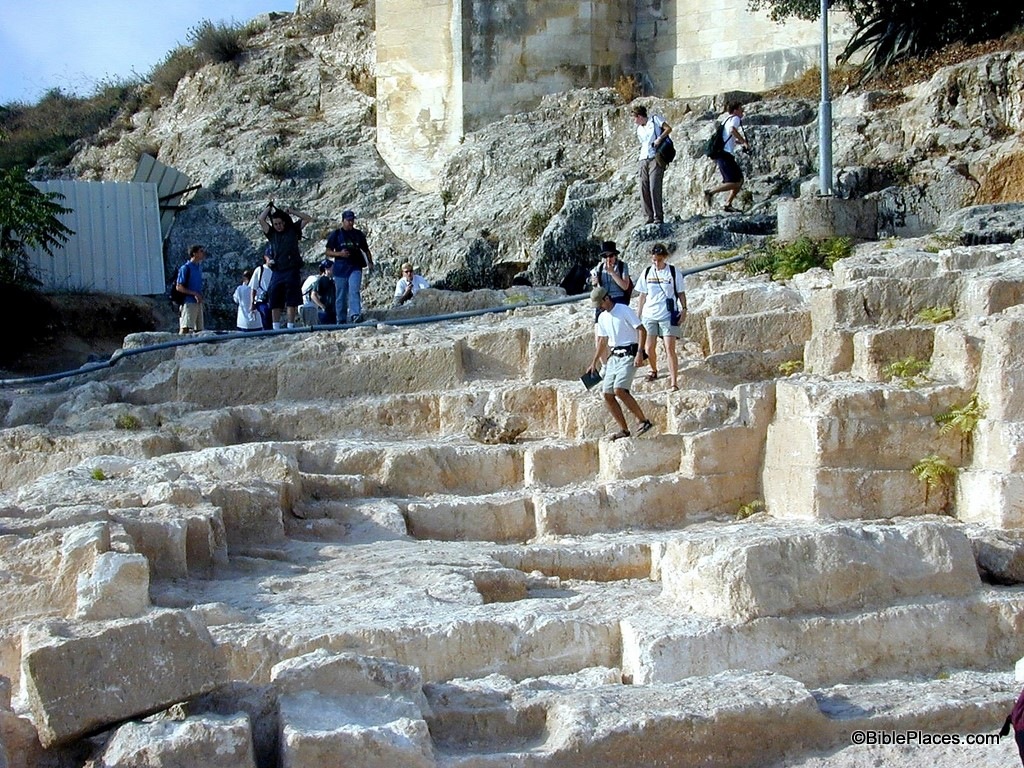
Ketef Hinnom new excavations, tb090299803

Ketef Hinnom quarry, September 1999

UPDATE: Joe Lauer notes that a couple of high-resolution images are available from the Israel Antiquities Authority here (zip).  The press release is posted here, and Arutz-7 also has an article.

Share:

From Arutz-7:

The Jerusalem Festival of Lights is a large scale artistic event, the first of its kind in Israel, taking place between June 10 and June 16. The Light Festival brings to Israel the greatest light sculptors and light designers in the world, who exhibit their artworks throughout the streets and alleys of the Old City, in major tourist sites and public spaces.

For photos, see the article.

Share:

One of the most impressive building projects of King Herod and others of his period is the aqueduct system that brought water to Jerusalem from the area south of Bethlehem.  Most people aren’t familiar with this project, or if they are, they really can’t fathom how remarkable the system is.  This is because unless you get out and hike around for at least a few hours, it is difficult to get a sense for the obstacles that were overcome.

Several aqueducts brought water to a series of three massive pools known today as “Solomon’s Pools.”  Two aqueducts then transported the water to Jerusalem.  The upper-level aqueduct led to the area of Herod’s Palace on the Western Hill and the lower-level aqueduct fed the pools and cisterns around the Temple Mount.

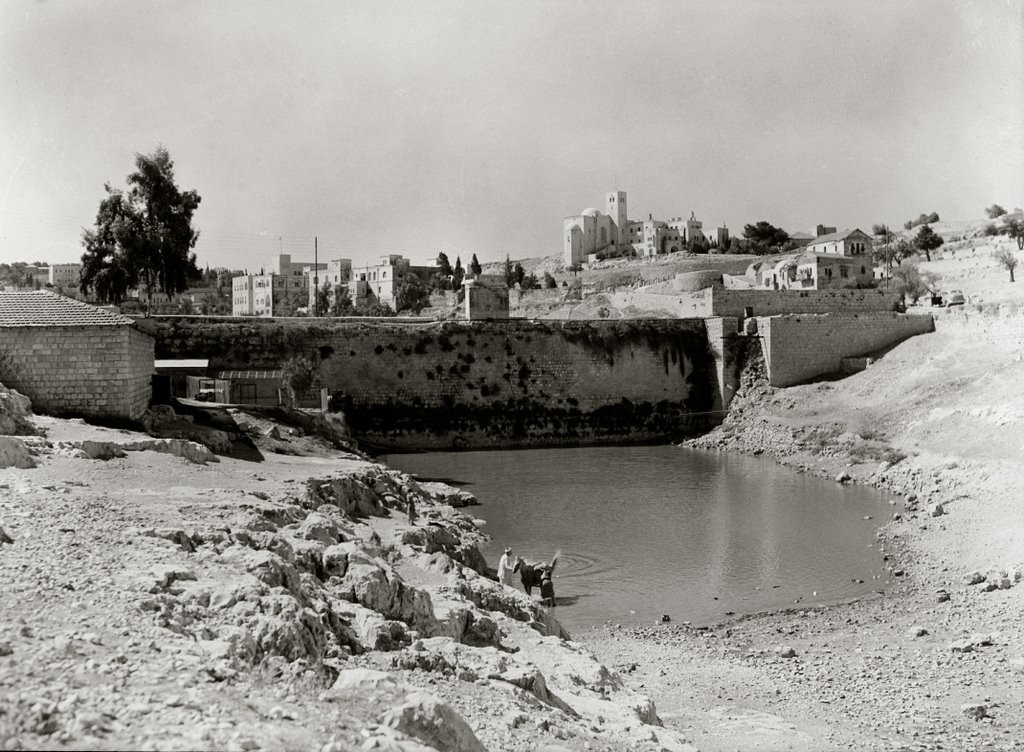
The relationship and date of Sultan’s Pool (photo below) to the low-level aqueduct has never been clear.  The pool is located in the Hinnom Valley on the western side of Jerusalem, and recent excavations suggest that it was only constructed in the Byzantine period.

The Israel Antiquities Authority announced today that they have discovered a channel that diverted water from the low-level aqueduct into Sultan’s Pool.  Built in the Byzantine period (330-640), the channel was repaired multiple times in the Ottoman period (1517-1917).

The IAA has issued a press release and two high-resolution aerial photos (zip).  Arutz-7 has the story (“Jerusalem’s Secret Revealed”) and includes low-res photos in the article.

From the press release:

The Israel Antiquities Authority uncovered the main aqueduct that conveyed water to the Sultan’s Pool during an excavation prior to the construction of the Montefiore Museum in Mishkenot Sha’ananim by the Jerusalem Foundation. The ancient aqueduct supplied pilgrims and residents with water for drinking and purification.
Most Jerusalemites identify the Sultan’s Pool as a venue where large cultural events are held; however, for hundreds of years it was one of the city’s most important water reservoirs.
In an archaeological excavation the Israel Antiquities Authority recently conducted prior to the construction of the Montefiore Museum, which the Jerusalem Foundation plans to build in Mishkenot Sha’ananim, an aqueduct was uncovered that conveyed water to the Temple Mount and also served as the principal water supply to the Sultan’s Pool. The excavation, directed by Gideon Solimany and Dr. Ron Beeri of the Israel Antiquities Authority, focused on a section along the course of the Low-level Aqueduct, on the western side of Ben Hinnoam Valley above the Derekh Hebron bridge.
According to Dr. Ron Beeri, excavation director on behalf of the Israel Antiquities Authority, “We are dealing with a very impressive aqueduct that reached a height of three meters. Naturally, one of the first things Sultan Suleiman I hastened to do in Jerusalem (along with the construction of the city wall as we know it today) was to repair the aqueduct that was already there which supplied the large numbers of pilgrims who arrived in Jerusalem with water for drinking and purification. Suleiman attached a small tower to the aqueduct, inside of which a ceramic pipe was inserted. The pipe diverted the aqueduct’s water to the Sultan’s Pool and the impressive sabil (a Muslim public fountain for drinking water), which he built for the pilgrims who crossed the Derekh Hebron bridge and is still preserved there today”. Dr. Beeri said, “It is evident that the location of the aqueduct was extremely successful and efficient: we found four phases of different aqueducts that were constructed in exactly the same spot, one, Byzantine, from the sixth-seventh centuries CE and three that are Ottoman which were built beginning in the sixteenth century CE. The last three encircle a large subterranean water reservoir that was apparently built before the Ottoman period”.

Sultan's Pool with St Andrew's Church, mat12447 Sultan’s Pool in the Hinnom Valley, September 1943
Library of Congress, matpc-12447
From the forthcoming photo CD: The American Colony and Eric Matson Collection: Jerusalem
Share:

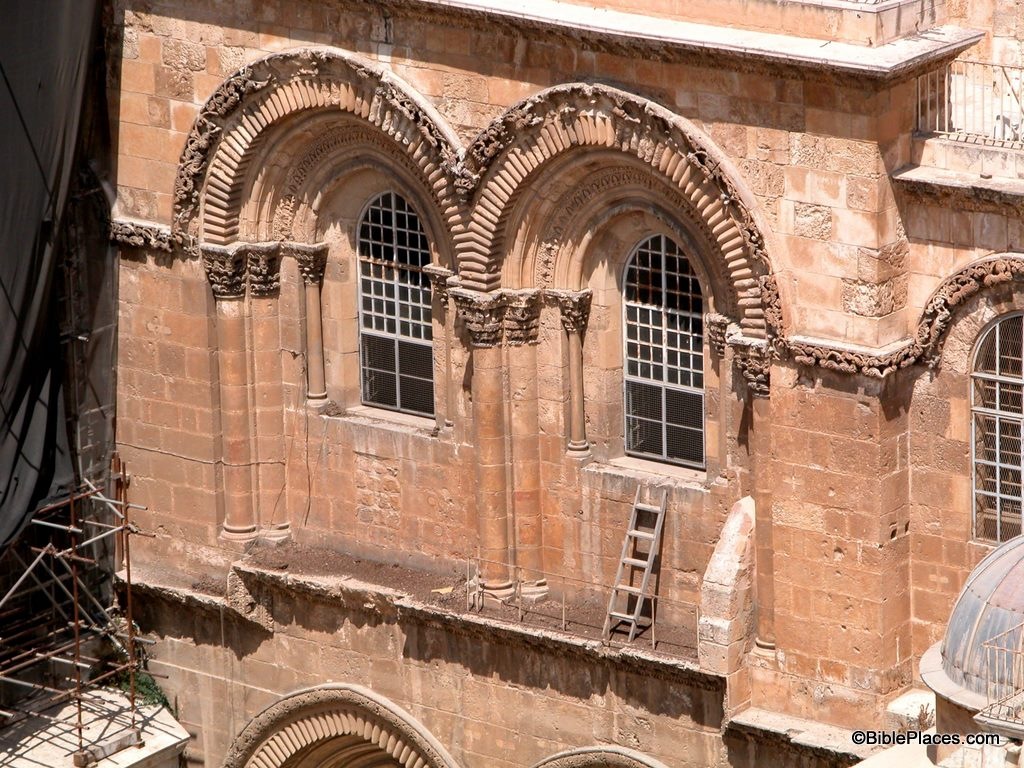
If you’ve ever wondered what the background is for the fistfights, the unmoving ladder, or the eternal state of disrepair of the Church of the Holy Sepulcher in Jerusalem, this essay by Raymond Cohen at The Bible and Interpretation is well worth reading.  Cohen goes back to the Crusader period to explain where the “Status Quo” came from and how it has evolved over the centuries.  The following paragraphs may stir your interest, and if the article itself does not satisfy, you can pick up Cohen’s recent book, Saving the Holy Sepulchre: How Rival Christians Came Together to Rescue their Holiest Shrine (New York: Oxford University Press, 2008).

Out of communion for centuries, six ancient churches are represented today at the Holy Sepulchre by communities of monks. The three major communities administering the Holy Sepulchre, the Greek Orthodox, Roman Catholics—represented by the Franciscan Order—and Armenian Orthodox have their own chapels and share common areas, which include the stone of unction, the edicule containing Christ’s tomb, and surrounding paving. Two minor communities, the Coptic Orthodox and Syrian Orthodox, have rights of usage, but no say in the running of the church. The tiny Ethiopian Orthodox community, living on the roof, has no rights in the Anastasis….
In some respects, the Status Quo functions like a railway timetable, specifying for every day of the ecclesiastical year the time and place of services and processions conducted by the communities in public areas of the church. It also acts as a sort of property register, detailing possession of every stone and nail. Not a carpet can be laid, a candle lit, or a step swept unless it is the custom….
In the end, an inoffensive compromise design was agreed upon by church leaders and inaugurated in January 1997, enabling the scaffolding disfiguring the rotunda to come down. However, the restoration was unfinished: The edicule was left untouched, visibly disintegrating and only held together by steel bands; paving throughout the church was cracked and shabby; the electrical and sewage systems badly needed renovation, as did the malodorous public latrines….

You can read the whole thing here.

Holy Sepulcher ladder closeup, tb090402202 Facade of the Church the Holy Sepulcher, with ladder allegedly placed for repairs that were never agreed upon by church authorities.
Share:

Earlier this week a discovery was announced of an inscription of “Menahem” from an excavation on the southern end of the Mount of Olives (JPost or, with photo, Arutz-7).  The name “Menahem” gets attention because it is the name of one of the last rulers of the northern kingdom (c. 752-742 BC). 

There is some difficulty with this reading, and other proposals have been made, including that it says “M / Nahum” or “[B] N (son) / Nahum.”  It sure seems like there have been a lot of Old Testament-era Hebrew inscriptions found in Jerusalem (and Judah) this decade.

Share: