The Jerusalem Post has a long, but very good, article on the preparations being made for the construction of the Third Temple by the Temple Institute.  If I had an extra couple of hours, I’d enjoy commenting on various statements made.  Since I don’t, I’ll simply refer you to the article, which begins:

For centuries Jews have remembered and mourned the destruction of the Temple through traditions such as crushing a glass at weddings or leaving unpainted a patch of wall opposite the entrance to one’s home – each stressing that nothing can be perfect or complete without the Temple.
Built by Solomon in about 950 BCE and destroyed by the Babylonians in 586 BCE, the Temple was rebuilt about 70 years later but finally razed by the Romans in 70 CE.
Talmud scholar Rabbi Yohanan wrote: “During these times that the Temple is demolished, a person is not allowed to fill his mouth with laughter. This is because the verse [Psalms 126] says, ‘Then our mouths will be filled with laughter,’ and does not say ‘Now our mouths will be filled with laughter.’ And when is ‘then’? ‘Then’ will be when the Third Temple is rebuilt.”
In other words, “Jewish life without the Temple is like fish out of water,” says Rabbi Chaim Richman, head of the international department of the Temple Institute.
An author of 10 books on the Temple, Richman adds: “Do you realize that 202 commandments out of 613 must have the Temple to be fulfilled? Without the Temple, Judaism is a skeleton of what it’s supposed to be.”
To this end, the Temple Institute was founded in 1987 with the explicit goal of rebuilding the Temple. Located in the Jewish Quarter, some 100,000 visitors, about half of them Christian, visit the institute each year to learn about the First and Second Temples and preparations for the Third Temple.
The institute is presently involved in education, research and constructing vessels for use in the longed-for Temple.

You can read the full article here.

HT: Joe Lauer
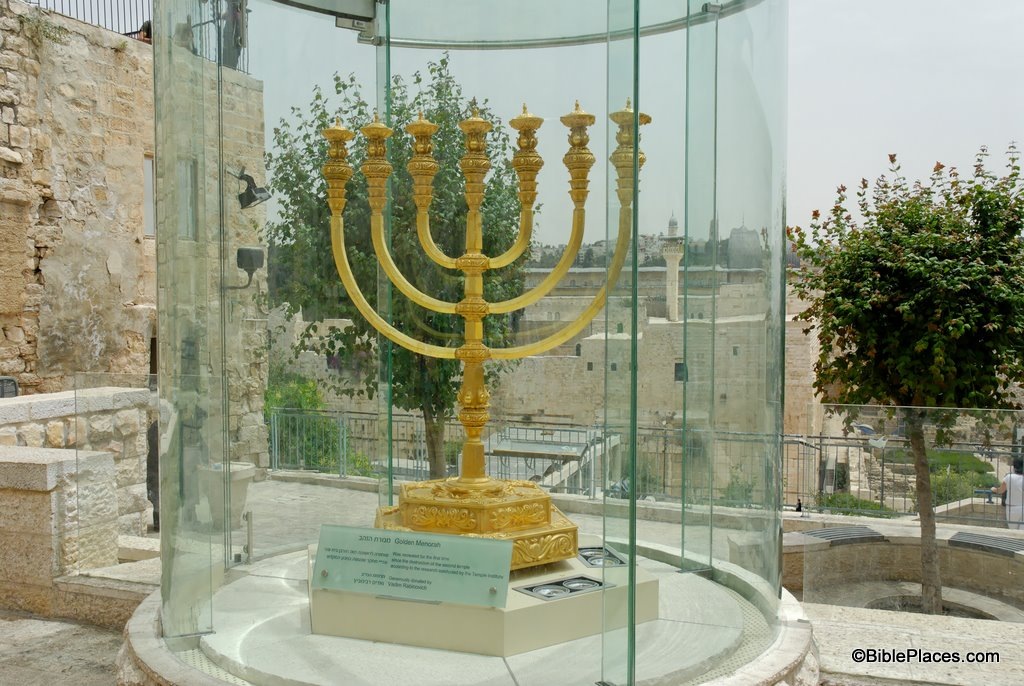
Golden menorah for third temple, tb051408996dxo Golden menorah, prepared for Third Temple.  Estimated value: $3 million
Share:

Arutz-7 published several articles related to the Sukkot (Tabernacles) celebration in Israel, including a photo essay of Sukkot, an article and video on the priestly blessing, and an article and video of the public reading of the Torah that occurs every 7 years.

Eisenbrauns has a remarkable deal going until October 31: anyone can get any of their conference (SBL/ASOR) specials at conference prices!  Not only does that save you a flight to Boston and conference fees, but if you’re going to Boston, it saves you from carrying an extra suitcase (which now results in a surcharge).  There is some fine print, but it’s all very reasonable.  The page probably of most interest to readers of this blog is the Carta page (this is the direct link in my browser, but no guarantees that it’ll work for you).  Another work that may be significant in the present archaeological controversy over the 10th century is Literate Culture and Tenth-Century Canaan: The Tel Zayit Abecedary in Context, edited by Ron E. Tappy and P. Kyle McCarter Jr.  That was just released on Thursday, includes a free DVD, and is available for only $26.

The Jerusalem Mosaic reports that a new park will be constructed at the Beit Zayit Reservoir.  Many visitors to Jerusalem drive right by this (on the south side of Highway 1 before the last ascent to Jerusalem), but soon will have reason to stop for a picnic or a boat ride.  In addition, a 35-mile (60-km) bike trail is being built to connect a series of parks in the Jerusalem area.

Publicized earlier this summer, but not noted here, is a fragment of Nehemiah from the Dead Sea Scrolls.  Though small, this is the only known portion of this book from Qumran.  You can see the fragment and read about it here.

Share:

If you want to avoid the crowds and get a different glimpse of Jerusalem, there are some great opportunities in the Old City for the next two weeks.  From the JPost:

After putting their heads together, the Jerusalem Development Authority, the municipal Tourism Authority, the Tourism Ministry and the municipal company Ariel came up with a brilliant move called Autumn Nights in the Old City. Successful beyond their wildest dreams, it consists of special (free) Monday and Thursday programs offered from the beginning of September until the end of October. Among the goodies are two light-hearted guided tours, evening performances of vastly diverse music programs and discounted museums kept open until evening.

The article has lots of details of the sites that are open and the costs.  If you like to take photographs, I’d recommend the Ramparts Walk and the Tower of David.

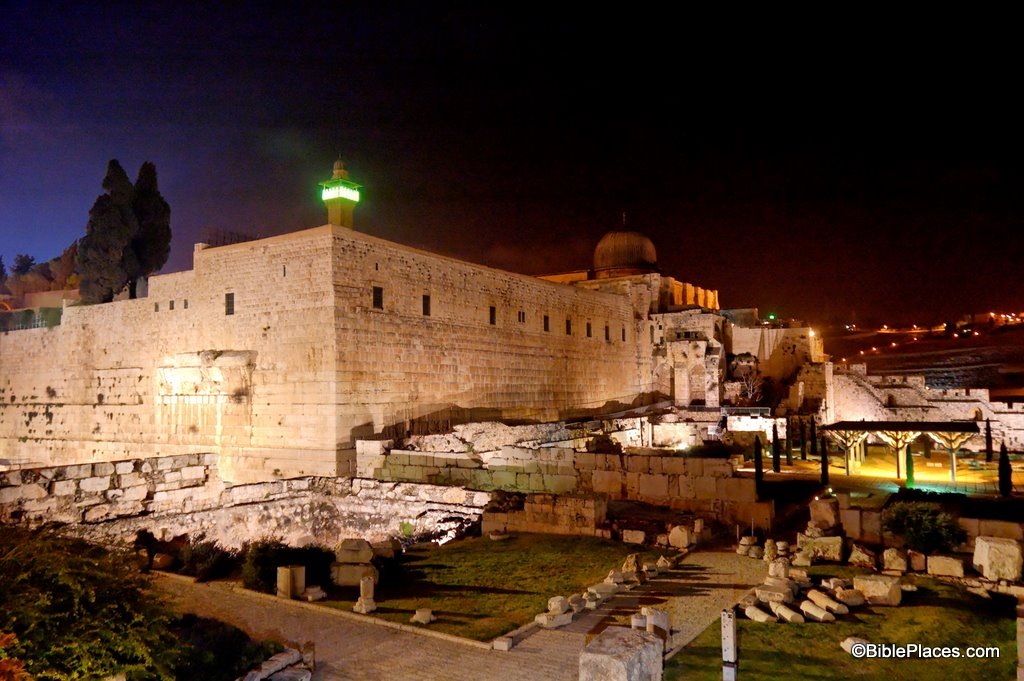
Temple Mount southwestern corner at night, tb031505525ddd
Temple Mount and excavations from southwest
Share:

Arutz-7 reports:

Archaeologists excavating north of Jerusalem have found a piece of a sarcofagus – a stone coffin – belonging to a son of a High Priest.  The visible inscription reads, “the son of the High Priest” – but the words before it are broken off.  It thus cannot be ascertained which High Priest is referred to, nor the name or age of the deceased…
The precise location of the find is not being released, for security reasons. 
The sarcophagus cover fragment – 60 centimeters (2 feet) long by 48 centimeters (19 inches) wide – is made of hard limestone, is meticulously fashioned, and bears a carved inscription in Hebrew letters that are both similar to today’s script and typical of the Second Temple period.
A number of High Priests served in the Temple in its final decades – it was destroyed in 70 C.E. – and there is no way of knowing which one is noted in the fragment.  Among the known High Priests of the end of the Second Temple period were Caiaphas, Theophilus (Yedidiya) ben Chanan, Shimon ben Baitus, Chanan ben Chanan and others…
Other discoveries at the site include public and residential buildings, agricultural installations, pools and cisterns.

Tombs from the 1st centuries B.C. and A.D. are very common in Jerusalem.  There was a large upper class that built lavish stone tombs, approximately 1,000 of which have been found.

The full story (and a tiny photo) is here.

UPDATE: The Israel Antiquities Authority press release includes a link to a zip file with three high-res photos, including one of the excavation site and two of the inscription. 

HT: Joe Lauer

UPDATE (10/8): Haaretz has the story with some new details, and the Jerusalem Post has a 2-minute video about the excavation and discovery.

Share:

I’ve been collecting items of interest over the past week:

Archaeologist Shimon Gibson claims that a concert near Jaffa Gate would damage antiquities (JPost).

A Christian organization in Colorado Springs is spending $2.3 million on a replica of the Western Wall, and a building to showcase it.  50 million tons of stone will be brought from Israel.

King Tut comes to Dallas on Friday.

The JPost Magazine has a profile of Eilat Mazar, currently excavating in the City of David.  She says,
“I work with the Bible in one hand and the tools of excavation in the other. The Bible is the most important historical source.”

The ESV Study Bible, which was mentioned before here, is due out in a couple of weeks and its visual components (maps, charts, drawings) gets further explanation in an interview with Justin Taylor.

Leen Ritmeyer, renowned for his architectural work on the Temple Mount, is now offering some of his excellent work in affordable PowerPoint files.

I’ve just added Ferrell Jenkins’ Travel Blog to the blogroll.

This is not new, but I do not remember really recognizing all that is here before, so perhaps you did not either.  The Archaeological Study Bible website has many dozens of photos, charts and maps (medium-resolution) available for download.  You can find your way around from here, or go directly to Introduction, Old Testament, New Testament, or Maps.

David Padfield has photos of a Roman army enactment performed at Jerash.  There are 15 free PowerPoint-size images.

If you’re an image junkie, you’ll save time downloading images from the last two sites if you have a download manager.  (I use Free Download Manager with FlashGot on Firefox)

Shana tova (happy new year)!

Share:

A friend who works for the Jerusalem Post has alerted me to the first in a new series of articles: perspectives on Israel from college students studying near Jerusalem.  You can read the first one about a visit to the Old City of Jerusalem here

The students writing in this series are studying at the Israel Bible Extension (IBEX) of The Master’s College.  The school is located in the Judean hills west of Jerusalem, and students come from the United States to study biblical geography, archaeology, history, Hebrew, and more.  The semester-long program is very popular among students, and, in my opinion, is one of the best things a college student can do, anywhere, ever.  I’m not unbiased; I taught at the school for many years until my present study leave. 

Share: