Lela Gilbert has an article in the Jerusalem Post on the recent trend of denying that a Jewish temple existed in Jerusalem.  It includes a lengthy interview with archaeologist Gabriel Barkay, and concludes:

IN SPITE of these discoveries, Temple denial remains a growing phenomenon in Europe and America, particularly in leftist intellectual circles. It is supported by the reality that there are no visible remains of the temples of Jerusalem on the Temple Mount. Barkay contends that there were remains still visible in the 1960s and 1970s, which have either been removed or covered up by gardens.
“The Islamic Wakf says, ‘We are not going to let you dig, but show us any remains of the Temple.’ You cannot have it both ways. If you don’t allow people to dig, then don’t use this absence of remains as an argument.
“Temple denial is a very tragic harnessing of politics to change history. It is not a different interpretation of historical events or archeological evidence. This is something major. I think that Temple denial is more serious and more dangerous than Holocaust denial. Why? Because for the Holocaust there are still living witnesses. There are photographs; there are archives; there are the soldiers who released the prisoners; there are testimonies from the Nazis themselves. There were trials, a whole series of them, starting with Nuremberg. There are people who survived the Holocaust still among us. Concerning the Temple, there are no people among us who remember.
“Still, [to deny the Temples], you have to dismiss the evidence of Flavius Josephus; you have to dismiss the evidence of the Mishna and of the Talmud; and you have to dismiss the writings of Roman and Greek historians who mention the Temple of Jerusalem. And you have to dismiss The Bible. That is, I think, way too much.”

Previous related post: Muslims Recognize Temple’s Existence

HT: Joe Lauer

Share:

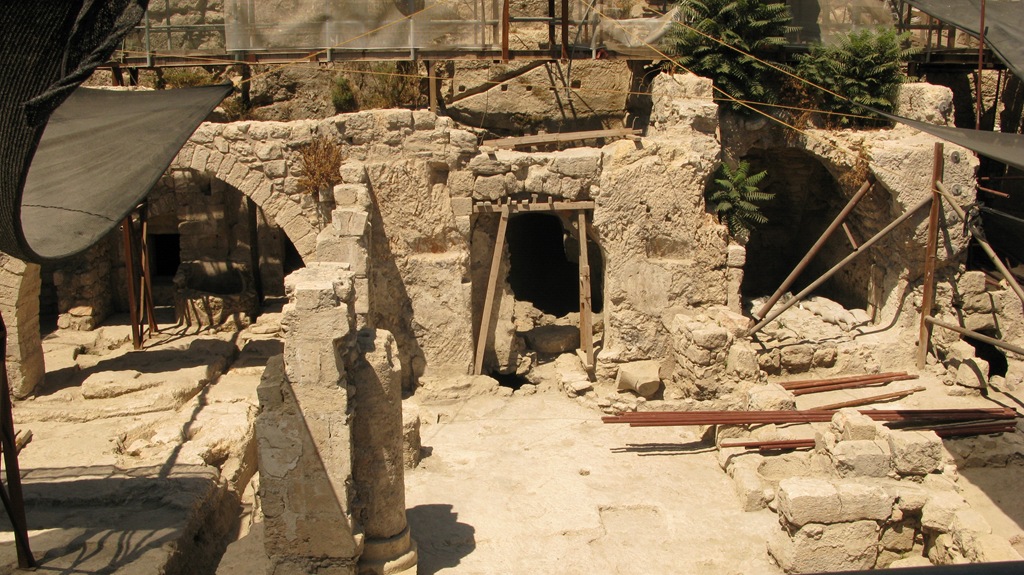
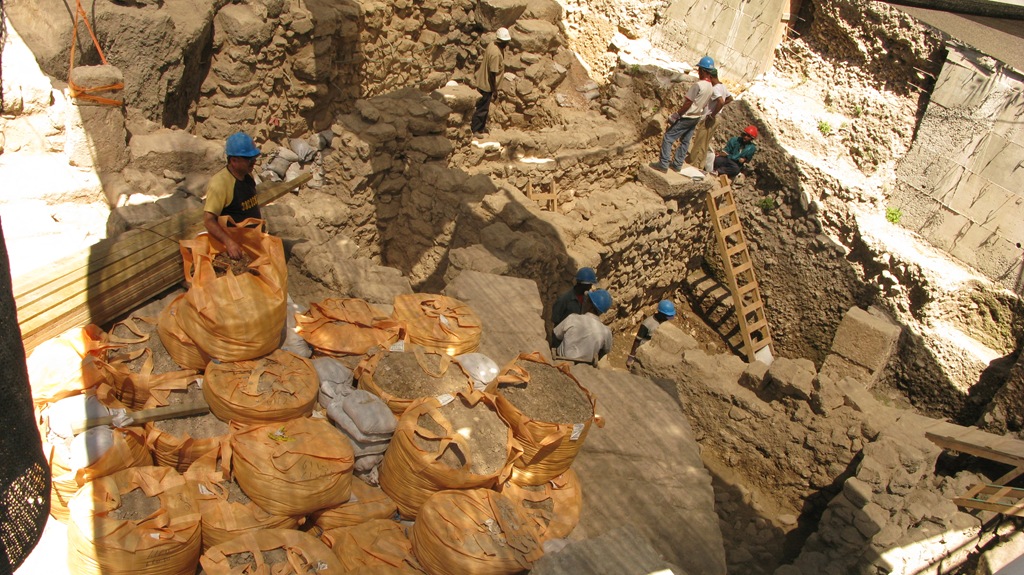
Excavations continue at the western end of the Western Wall prayer plaza, and as the work proceeds further into the ground, the more interesting it gets (at least to those of us interested in pre-Byzantine periods).  Peter Wong from Hong Kong was at the site this week and sent me a couple of photos. 

They show a remarkable level of preservation.

IMG_5262

IMG_5268

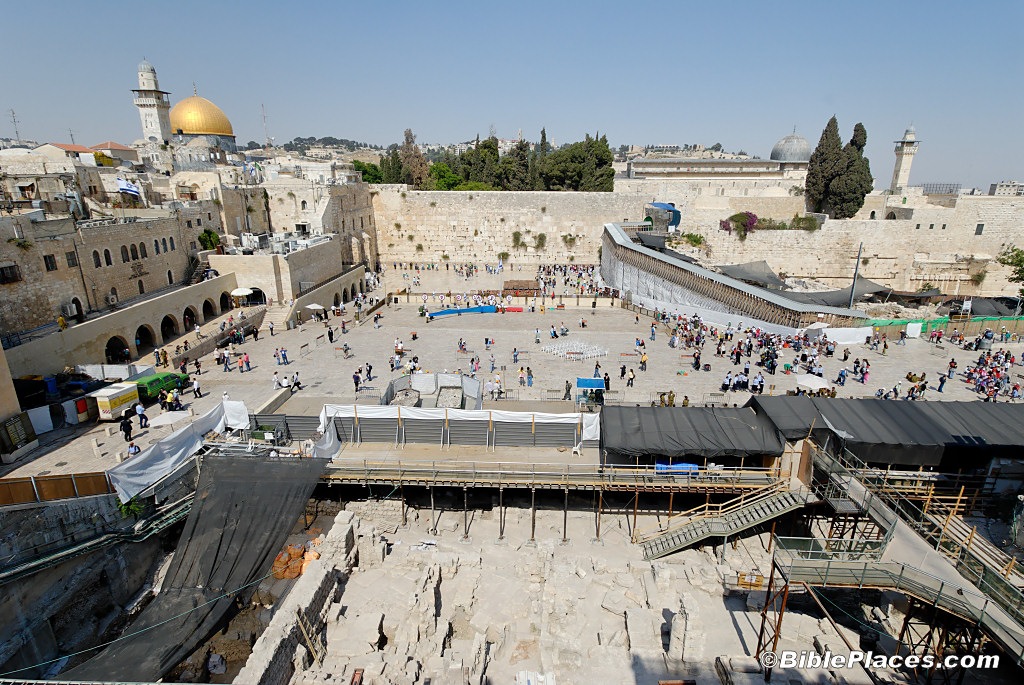
For context, here’s a photo I took a few months ago that shows the excavation (at bottom) in relation to the prayer plaza.

Western Wall plaza excavations, tb051908178

I have not seen anything reported on this excavation recently, but when I do, I’ll make note of it.

Share:

Haaretz is reporting on the discovery of a hoard of coins at a site three miles south of ancient Jerusalem.

A few days ago, archaeologists made a most surprising find at the bottom of such a columbarium, at a site at Kibbutz Ramat Rachel near Jerusalem – a hoard of coins from the time of the destruction of the Second Temple (70 C.E.).
Late in July, archaeologists from Tel Aviv University identified, beneath the floor of the columbarium, a ceramic cooking pot from the 1st century C.E. that held 15 large gold coins. “It’s very special to find a hoard like this, and it’s very exciting,” related the director of the excavations at the site, Dr. Oded Lipschits, of TAU. “We discovered the hoard with a metal detector, and then we went down into the niche and found this small cooking pot inside it.”
What was a pot holding coins doing at the bottom of a cave used for raising pigeons? According to Lipschits, the pot was covered up in a way that indicates that it had been concealed in a hurry. “We know that coins like these were brought to the Temple,” he says. “Possibly after the Temple was destroyed there was no place to bring the coins, and since the columbarium was no longer in use, they buried the coins here. This arouses sad thoughts as we approach Tisha B’Av,” he added, referring to the Hebrew date (the ninth of Av) that traditionally marks the destruction of both the First and Second Temples.

For photos, see the Hebrew version of the article. (HT: Joe Lauer).

Unrelated to the coin discovery is discussion of the function of the building that has previously been identified as a palace of the Judean kings (something akin to Camp David in the U.S.). 

Lipschits says that one of the aims of the current dig is to clarify the purpose of this structure. “The accepted claim is that it is a palace of the kings of Judea, but I’m dubious of that. The palace lacks any Judean characteristics, and there is no reason that a royal palace would have been built here, when the City of David is not far away.”
Lipschits believes that the palace was built during the period of the Assyrian subjugation. “This entire complex is, in my opinion, an administrative center for the occupying regime, a place where agricultural produce was collected, for delivery as a tax to the Assyrians.”
During the period of the return to Zion (beginning 539 B.C.E.), the Assyrian regime was replaced by a Persian one, but the administrative center continued to operate. Many seal impressions from this period have been found, bearing the name “Pahwat Yahud,” the name of the country under this regime. The Ramat Rachel excavation is is the main accumulation in the country of impressions of this sort, and Lipschits sees this as further proof that the site was an administrative center.

There’s some confusion about this elsewhere, but I think the journalist has it correct.  What Lipschits is suggesting, contrary to his predecessors (Aharoni, Yadin, and Barkay) is that the palace was an Assyrian center, following the time of the Assyrian subjugation of Judah under Hezekiah.  While most would agree that Assyria maintained some sort of control over Judah for about 50 years after Sennacherib’s failed attempt to conquer Jerusalem, Lipschits goes farther in claiming that Ramat Rahel was an on-site command post for Assyria.  Here’s a brief summary of archaeologists’ conclusions about this important and beautiful building:

  • Yohanan Aharoni: Palace of Judean king Jehoiakim (cf. Jeremiah 22); ca. 600 B.C.
  • Yigael Yadin (never missing an opportunity to disagree with YA):  Palace of Judean queen Athaliah; ca. 840 B.C.
  • Gabriel Barkay: Palace of Judean king Hezekiah; ca. 700 B.C. (possibly built, destroyed, and rebuilt during his reign)
  • Nadav Na’aman and Oded Lipschits: Assyrian headquarters in Judah; ca. 700 B.C.

If you’re interested in more, you can start with the article by Barkay in Biblical Archaeology Review, Sept/Oct 2006, pp. 34-44.

Share:

Eilat Mazar announced yesterday that the seal of a government official was discovered in her excavations in the City of David.  The story was covered by several media outlets (JPost, the Trumpet), and here’s my summary with a few thoughts.


What: The clay seal impression, about 1 cm (.4 inch) in diameter, has the name Gedaliah, son of Pashur.


Who: Gedaliah was a government official mentioned in the book of Jeremiah as serving the last king of Judah, Zedekiah.  Gedaliah was among those who intended to kill the prophet Jeremiah.  The relevant passage is Jeremiah 38:1-5.

Now Shephatiah the son of Mattan, Gedaliah the son of Pashhur, Jucal the son of Shelemiah, and Pashhur the son of Malchiah heard the words that Jeremiah was saying to all the people, 2 “Thus says the Lord: He who stays in this city shall die by the sword, by famine, and by pestilence, but he who goes out to the Chaldeans shall live. He shall have his life as a prize of war, and live. 3 Thus says the Lord: This city shall surely be given into the hand of the army of the king of Babylon and be taken.” 4 Then the officials said to the king, “Let this man be put to death, for he is weakening the hands of the soldiers who are left in this city, and the hands of all the people, by speaking such words to them. For this man is not seeking the welfare of this people, but their harm.” 5 King Zedekiah said, “Behold, he is in your hands, for the king can do nothing against you” (ESV).


Note: The man mentioned immediately after Gedaliah is Jucal the son of Shelemiah.  His seal impression was found nearby in Mazar’s excavation three years ago. 


Where, specifically:  Trumpet reports:

”We found the bulla of Jehucal inside the palace structure,” Mazar told theTrumpet.com yesterday. “This time, we found the bulla of Gedaliah outside the wall, just at the foot of the same spot we found Jehucal.” The two must have been connected somehow, she said.


When: Zedekiah was king from 597-586 B.C.  The date of the seal impression’s discovery is not given, as far as I can tell.  With the last discovery of a seal impression, Mazar announced it so fast that later she had to go back and apologize for mis-reading the inscription (backwards).


Photos: For photographs of the seal impression, see theTrumpet.com.  For some excellent line drawings of the inscription by G. M. Grena, see the files posted at biblicalist. For a general photo of the excavation area, see my photo here.


A few additional comments on the JPost article:

The excavation at the history-rich City of David, which is located just outside the walls of the Old City near Dung Gate, has proven, in recent years, to be a treasure trove for archeologists.

Actually, on the whole, I’d say that the discoveries have been minimal.  This is a central area of the City of David and after three years of excavation, three seal impressions and two controversial building identifications is not what I’d call a “treasure trove.”  A few meters down the slope Yigal Shiloh found an archive of more than 50 seal impressions, including one belonging to a government official more friendly to Jeremiah, Gemariah the son of Shaphan (Jer 36).  Of course, it is altogether possible that Mazar has made other significant finds but is choosing to publicize them in the future.

The archeologist, who rose to international prominence for her excavation that may have uncovered the Biblical palace of King David nearby, has been at the forefront of a series of back-to-back Jerusalem archeological finds, including the remnants of a wall from the Biblical prophet Nehemiah, also in the area.

It seems to me that there’s a problem here when an archaeologist can “rise to international prominence” on the basis of a couple of sensationalistic identifications without peer review.  If those identifications prove untenable (and there is significant discussion among archaeologists about both of the above issues), will she still be internationally prominent?  Should an individual scholar be so elevated on the basis of his/her own unconfirmed claims?  I would note here that lots of Bible skeptics would say the same thing; I am not among them, but still am uneasy about some of the ways these matters have been handled.  Of course, this new seal impression is not part of the debate.

The current dig is being conducted on behalf of the Shalem center, a Jerusalem research institute, and the right-wing City of David Foundation, and was carried out under the academic auspices of the Hebrew University of Jerusalem.

Is there relevance to the fact that the City of David Foundation is “right-wing”?  Is the JPost suggesting that this discovery or its interpretation is affected by the political views of a funding organization?  Should the identity of the the financial supporter have priority over the identity of the academic authority?  Would the JPost have identified another institution as “left-wing”? 

UPDATE (8/3): In an email, the City of David Foundation includes this additional information:

Dr. Eilat Mazar completed the third phase her excavation of what she believes to be Kind [sic] David’s palace at the City of David site a month and a half ago and is currently sifting through the remains of that excavation. It was in this material that she found the seal. Much of the rubble from the dig has yet to be sifted and it is likely that more discoveries will be made.
Share:

Justin Taylor at Between Two Worlds has posted a two-part interview with Leen Ritmeyer.  Ritmeyer served as the archaeological and architectural reconstruction editor for the forthcoming ESV Study Bible, of which Taylor is the managing editor. 

Part one of the interview focuses on what theGolgotha and Jerusalem, ESV Study Bible place of Jesus’ crucifixion looked like.  It includes a stunning, high-resolution reconstruction of the Temple Mount as it may have looked in the time of Jesus.

Part two of the interview concerns what the tomb of Jesus looked like.  It features a high-resolution image of what the “new tomb” may have looked like.

I have had the privilege of having an preview of dozens of graphics and hundreds of full-color maps that will be included in the ESV Study Bible and I concur with Ritmeyer’s assessment:

It is vital for Bible students to have a correct knowledge of the background of the Bible, and I am sure that the Study Bible will be of tremendous help for those who love to study the Word of God. With its many exquisitely rendered reconstruction drawings and accurate maps, a new standard has been set for biblical illustration, raising the bar for many years to come.

Share:

Leen Ritmeyer has a posted (with a follow-up) on his identification of several stones in the eastern wall of the Temple Mount that are clearly pre-Herodian.  Ritmeyer dates them to the time of King Hezekiah, suggesting that he was the one to build the 500-cubit square Temple Mount that Ritmeyer has previously identified.  He includes some helpful illustrations and photos.

A review of current excavations in Turkey is given at Today’s Zaman.  New Testament sites being excavated include Alexandria Troas, Miletus, Hierapolis, Sardis, Smyrna, and Laodicea.  There are many other sites as well.  Many of these cities have very impressive remains, unlike many sites in Israel.  Today’s Zaman also has an article on recent discoveries at Sardis.

NASA has a photo of a street of Ephesus at night, with (the planet) Jupiter illuminating the way.
Across the way in Greece, the ancient hippodrome of Olympia has been discovered.  This is a good story that counters the myth that everything to be found has already been found.

A couple fragments of the Dead Sea Scrolls have now been published by James H. Charlesworth. 

One of the fragments may be from the Samaritan Pentateuch, and the other appears to be from Nehemiah, making it the first portion of that book to be found among the DSS.  Paleojudaica gives more info and links.

If you’re a tourist in Israel and have a question, you can now call the 24-hour tourist hotline.  It’s easy (dial *3888), but it’s not a toll-free number.

Share: