Like the quarry found last year, this one is north of the Old City.  From the Jerusalem Post:

For the second time in the past year, archeologists have uncovered a Second Temple Period quarry whose stones were used to build the Western Wall, the Israel Antiquities Authority announced Monday. The latest archeological discovery was made in the city’s Sanhedria neighborhood, located about two kilometers from the Old City of Jerusalem. The quarry was uncovered during a routine "salvage excavation" carried out by the state-run archeological body over the last several months ahead of the construction of a private house in the religious neighborhood. The quarry is believed to be one of those used to build the Jerusalem holy site because the size of the stones match those at the Western Wall. "Most of the stones that were found at the site are similar in size to the smallest stones that are currently visible in the Western Wall, and therefore we assume that the stones from this quarry were used to build these structures," said Dr. Gerald Finkielsztejn, director of the excavation. The stones were dated by pottery found at the site, he added. "This is a rather regular quarry except that there are really big stones," Finkielsztejn said. The largest of the stones found at the quarry measures 0.69 x 0.94 x 1.65 m, while some of the stones were apparently ready for extraction but were left in place. The quarry was probably abandoned at the time of the Great Revolt against the Romans in 66-70 CE, he said.
Share:

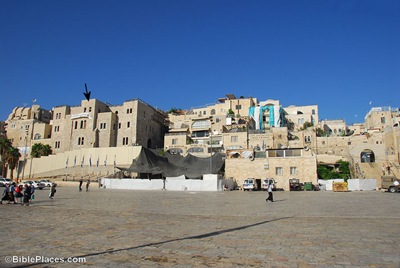
Ynet is reporting that Aish HaTorah is currently building a large museum opposite the Western Wall which will feature “an elaborated massive replica of the Temple.”  The rest of the brief article discusses the museum and no other details are given about the model.

The three-storey museum, whose construction is valued at nearly $20 million will be erected in the Aish HaTorah (“Fire of the Torah”) Yeshiva complex. The museum will feature a journey through Jewish history, from the days of Abraham to the present, emphasizing the message and significance of the Jewish people’s presence in the Land of Israel and their degree of accomplishment in world improvement….
In addition to the great lavish interior, the museum’s crowning glory is no doubt the massive amphitheater, whose cost is being sponsored by veteran Hollywood star Kirk Douglas, and his no less famous son, Michael.
The amphitheater will feature a three-dimensional film depicting the history of the Jewish nation over a huge glass screen through which one can see the Western Wall. The museum will also include a learning center with a VIP wing to host movie stars, politicians and other celebrities from Israel and abroad.

The brief article is here.

Western Wall plaza excavation, tb091306080
The Aish HaTorah building is on the left, marked with an arrow.
Share:

The Book and the Spade radio program now features an interview with Jerome Murphy-O’Connor, author of The Holy Land: An Oxford Archaeological Guide (mentioned before here).  There are two parts, each about 15 minutes each.  Part two is currently posted, but this link should get you part one. 

If you’re interested, grab them now as the mp3 files are archived relatively quickly and I don’t think the podcast link is currently working.

Share:

Did Jesus ever imagine that a few hundred yards from where he told the disciples that Christians would be known by their love that Jewish authorities would break up a brawl among his followers? 

And not just once, as “brawls are not uncommon at the church.”

Israeli police rushed into Jerusalem’s Church of the Holy Sepulchre to break up fist fights between dozens of Greek and Armenian worshippers on Orthodox Palm Sunday, witnesses said.
Some 20 officers intervened after Armenian worshippers threw a Greek Orthodox priest out of the church, sparking a free-for-all, they said.
Several worshippers then started beating the police officers with palm fronds they were holding for the Palm Sunday celebrations that mark the return of Jesus to the Holy City a week before he was crucified.
After the incident, dozens of members of Jerusalem’s Armenian community marched from the church to the Old City’s police headquarters in protest at the detention of two Armenians.
Brawls are not uncommon at the church, which is shared by various branches of Christianity, each of which controls and jealously guards part of site — considered one of the holiest in Christianity.
Precisely in order to prevent such disturbances, two Muslim families have been entrusted for the past 800 years with opening and closing the gates of the church, a cavernous labyrinth of chapels and crypts built on the site where many Christians believe Jesus was crucified and buried.

The full story is here.

Share: