Recently I noted an article about a planned animal sacrifice in Jerusalem.  This event was controversial because 1) there is no temple or altar in Jerusalem today; 2) killing an animal makes some people mad.

Friends in Jerusalem went to the Old City that day and saw a guy they suspected of carrying a ritual knife in his briefcase and followed the guy through a wild maze of streets in pursuit.  It turned out they followed the right guy.  They filmed the service.

We talked about the appropriateness of putting this online.  The 5-minute video is as graphic as it gets.  More and more people today don’t realize that meat doesn’t originate at a grocery store.  They have little concept of an animal being raised and then slaughtered.  Furthermore, almost no one in the Western world has ever sacrificed an animal for religious purposes.

I think, however, that is precisely why this *graphic* video should be shown.  We read about sacrifice in the Bible but we don’t really understand what that means.  We read passages that talk about the “life being in the blood,” but those are just words that we don’t really consider.  We “know” that the wages of sin are high, but we don’t get the life lesson that the ancient Israelites received every year.

The point of sacrifice was simply this: you deserve to die because of your sin.  This animal is dying in your place.  Watching the priest slice his throat and watching the blood drain out drove the point home much better than reading a chapter of Leviticus.

Today New Testament believers know that the blood of bulls and goats is not enough to take away sin.  But I think that we can often just take for granted Jesus’ death in our place.  We don’t think about his innocent blood draining away because we can’t conceptualize it.  We don’t always appropriate the idea of substitute because we’ve never seen a living object die in our place.  But our loss can be this: sin is easy because forgiveness (we think) is cheap.

The video was made by SourceFlix Productions.  Instead of dubbing over the scene with English commentary, they chose to include some explanatory text below.  Don’t watch this video while eating, and if you’re thinking about showing your children, watch it yourself first.
Passover begins Saturday at sundown.
Related: for photos and explanation of the Samaritan Passover, see BiblePlaces.com (modern photos) or LifeintheHolyLand.com (19th century photos and text).  Several years ago I wrote an article about a visit to the Samaritan Passover sacrifice (En Gedi Resource Center).
Share:

The Jerusalem Post is reporting that stones in the Western Wall are crumbling.  A little background:

The “Western Wall” is a 60-meter section of a 480-meter long western compound wall of Herod’s Temple Mount.  This portion of the wall has been revered by Jewish people for centuries as a place of prayer because the temple does not exist and access to the temple court areas has been forbidden (either by rabbis or Muslim rulers or both).

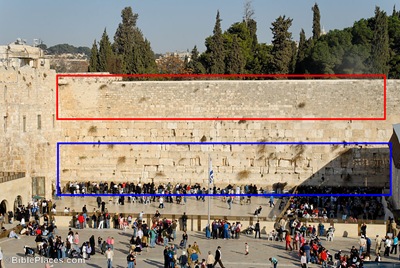
Three distinct sections of construction are visible in the prayer portion of the Western Wall today. 

The lowest seven courses (blue box in photo below) were constructed by King Herod in the 1st century B.C.  The wall above this was destroyed, probably mostly in the Roman destruction of A.D. 70.  Arab rulers in the 7th-8th centuries rebuilt part of the wall and these stones are visible above the Herodian stones (between blue and red boxes). 

In the 19th century, there were problems with Muslims throwing objects and trash from the Temple Mount down on Jewish worshipers at the wall and so the British-Jewish philanthropist Moses Montefiore donated so that the wall could be built to a higher level.  It is these stones (in red box) that are the subject of this JPost story.  Read the article to learn more about whether the rabbis will permit restoration or not.

Western Wall, tb122006991
The crumbling stones are the smallest and most recent stones (red box). 
The original Herodian stones are in the blue box.
Update (4/17): Leen Ritmeyer has a lengthy explanation of the situation on his blog.
Share:

There are a number of stories I’ve noted over the past week or so that may be of interest.

The Philistine city of Gath has been “civilized” with the creation of a new national park.  I think they should have called it the Gath National Park, instead of the Tel Zafit National Park, as no one seriously questions the identification any more.  The site is now off-limits to 4-wheel drive vehicles (that makes it a climb to the top!) and signs are posted around.  See the Official/Unofficial Gath Blog for details.

A special exhibit this summer will feature a long portion of the Isaiah Scroll.  The first 28 chapters (8 feet; 2.3 meters) will be displayed at the Shrine of the Book from May 13 to August 15, 2008.  The Isaiah Scroll was once on display in the center of the exhibit, but because of stress on the manuscript, it was replaced by a replica many years ago.

You don’t have to go anywhere to see these 12 stunning photos of Egypt from National Geographic

(HT: Dr. Claude Mariottini).

The biographer of Kathleen Kenyon recently gave a lecture on the archaeologist at Baylor University.  This link is to a (flawed) news report and not the lecture itself.  I mentioned the biography itself before here.

Here’s a good little article on the excavations in the City of David around the possible palace of David.  If you’ve kept up on the story, you won’t find anything new here, but it is an informed presentation.  CBN has another, less helpful, tourist visit to the City of David. 

(HT: Joe Lauer)

Share:

For thousands of years, the Jewish people have celebrated the Passover sacrifice, but without a *sacrifice.*  It’s one thing when you’re an oppressed minority in Europe, but it’s another when you’re the ruling majority in your own land.  One would think that this would be the cause of great discussion, but it seems that the intervening years have muted the felt need for a sacrifice for most. 

But not all.  From Arutz-7:

The demonstration of the Paschal sacrifice is part of a study day scheduled to take place on Sunday, the First of Nissan (April 6), at the Kotel Yeshiva in the Jewish Quarter of Jerusalem’s Old City. The study day is a joint project of the Temple Institute, the Sanhedrin and the King David Museum. It was originally planned to take place one week later, but the organizers decided to dedicate it to the memory of the eight yeshiva boys murdered in Jerusalem recently, and to hold it on the 30th day after their death.
The study day is to include a public sacrifice which is being termed a “general rehearsal” for the actual Pesach sacrifice on the Temple Mount, a ritual prescribed by the Torah but currently forbidden by the Israel government and courts.
Glick told Ynet Monday that according to Jewish law, abstaining from performing the sacrifice is an extremely serious offense, comparable in its severity to avoiding a brit (circumcision ceremony) for one’s newborn boy. He explained that although Jewish law forbids Jews in an impure state (which all Jews are in as long as the Temple rites are not renewed) from entering the Temple area, an exception is made for public sacrifices like the Pesach sacrifice. 
The Temple movement recently sent a formal request to Prime Minister Ehud Olmert and Minister of Public Security Avi Dichter, to allow them to conduct the sacrifice on the Temple Mount. “Making the Paschal sacrifice is part of the religious freedom which is a basic human right and a cornerstone of democracy,” they wrote.  Glick said, however, that the organizers “have no intention of trying to ascend to the Mount without permission from the police….
Another animal rights activist, Etti Altman, said the sacrifice has no place in an “enlightened country” like Israel and quoted from the ancient Sifri biblical commentary which says: “As God is called ‘compassionate,’ so should you be compassionate.”

The full story is here.

Share:

A new museum of sorts has opened in the Old City.  From Arutz-7:

A rich mix of Jerusalemites came out on a brisk Jerusalem night in early March to celebrate the city’s newest museum: The King David Museum and Genealogy Center.  Located in the heart of the Old City, the museum is a celebration of the most celebrated king in Jewish history, the author of the Book of Psalms and a major subject of the biblical Book of Samuel. The museum tracks the unbroken Jewish connection to the city Jerusalem, that was first conquered and made the capital of Israel by King David. The permanent exhibition features artifacts from the first and second temple periods including earthenware, ceramics, coins, arrowheads, and more. There is also a section dedicated to printed matter about King David and the Temple Mount, featuring the first known printed book of Psalms, published in 1511, and a swath of original printings that date from 1696 to modern times. Another section of the museum features a series of jarred spices. Mixed together in the correct proportions, the spices were combined to create the incense that was offered daily in the Holy Temple…. The King David Museum and Genealogy Center is located at 19 Tiferet Yisrael Street in the Old City of Jerusalem. Opening Hours are Sunday- Thursday, 9 am – 9pm, Friday 9 am – 1pm. For more information, please call (02) 628-1502

The full story is here.

Share:

I’ve mentioned the on-going sifting operation of the Temple Mount debris before (here and here), but I haven’t noted a relatively new video about the project.  The video is about 5 minutes long and gives a good overview of what they are doing and why.  If you’re interested in participating in the “excavation,” but don’t want to go alone, there’s a group going with the Associates of Biblical Research this summer.

Share: