The best archaeological guide to Israel is now out in its fifth edition. The Holy Land: An Oxford Archaeological Guide, by Jerome Murphy-O’Connor is the best companion for a trip to ancient sites  anywhere in Israel. The section on Jerusalem is especially lengthy (150 pages in the 4th edition), and the whole is accurate and readable. Don’t expect to find out about hotels or restaurants – this is a guide to archaeological sites only! The 4th edition came out in 1998, so while I haven’t yet seen the new edition, I expect it will have significant updates. The author has lived in Jerusalem longer than I have been alive.
From Haaretz:
The High Court of Justice issued a temporary restraining order against the Israel Antiquities Authority (IAA), ordering a halt to an archaeological dig in the Silwan neighborhood of Jerusalem, after local Arab residents complained that the excavations were being carried out underneath their homes and without their approval. They claimed that according to the law, the IAA is required to notify property owners if they want to dig under their property. After the suit was filed, the police arrested three of the seven plaintiffs. (Meron Rapoport)
This is a reference to the excavations headed by Ronny Reich and Eli Shukrun in the vicinity of the Pool of Siloam. This excavation has been covered before here.
HT: Joe Lauer

Herodian Street from Pool of Siloam to Temple Mount
The Israel Antiquities Authority (IAA) has announced the discovery of an Iron Age seal from the excavations in the Western Wall plaza. This is the second of two seals previously reported and it reads “[belonging] to Netanyahu ben Yaush.” Both names are known from the Bible, but this particular person is not mentioned. This seal was found a debris layer dating to the end of the Iron Age (c. 586 B.C.) underneath the “Eastern/Valley Cardo.” The area of the excavations is shown in the photo below. More information about the discovery and a photo of the seal is available in the IAA press release (and repeated by Arutz-7).
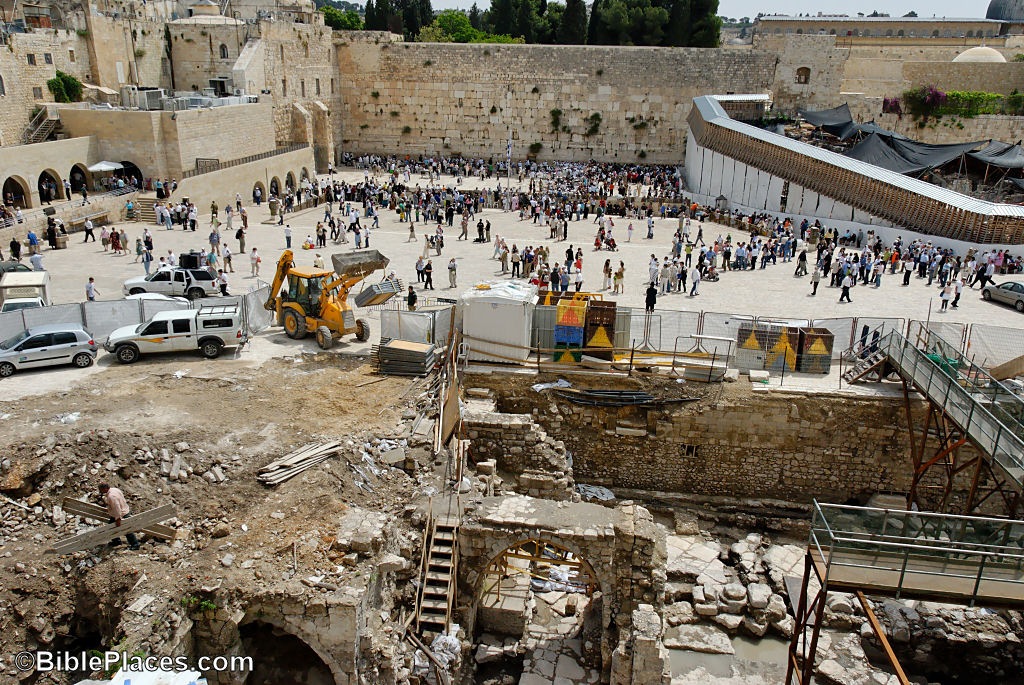
Excavations in Western Wall plaza, May 2007
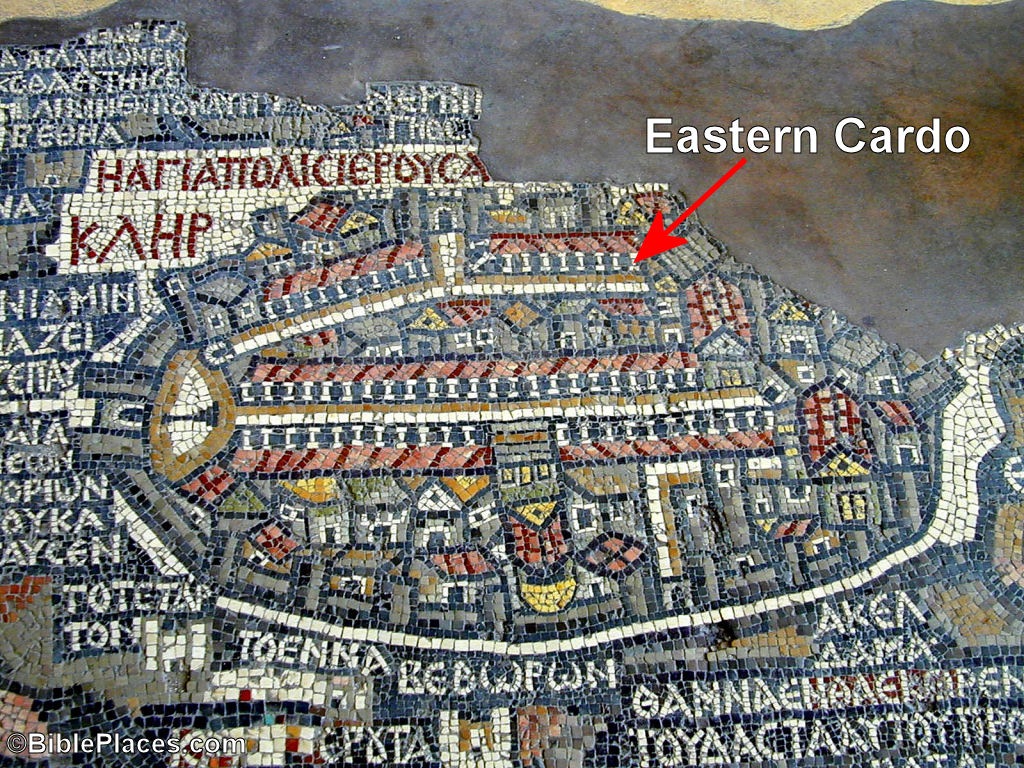
Medeba Map depiction of Jerusalem, 580 A.D.
The following paragraph from the press release seems strange to me, and if it wasn’t the IAA reporting it, I’d not believe it:
In addition to the personal seal, a vast amount of pottery vessels was discovered, among them three jar handles that bear LMLK stamped impressions. An inscription written in ancient Hebrew script is preserved on one these impressions and it reads: למלך חברון ([belonging] to the king of Hebron).
My guess is that this is a standard LMLK seal impression, and it simply gives one of the four place names that are listed on LMLK seals (Hebron, Ziph, Socoh, MMST). The place name is a royal distribution center, and is not a reference to the domain of the king. “To the king” means that it was royal property. “Hebron” is the place of distribution. All of this is well-known (and you can learn more than you ever wanted to know at www.lmlk.com), which makes me wonder if this discovery is something different, or if the press report was written by a secretary.
UPDATE (3/17): The JPost now has an article on the discovery, which essentially covers the same ground, including repetition of the error of the seal “belonging to the king of Hebron.” The article ends with details I don’t recall seeing:
The newly-found remnants of the city’s past will be preserved next to a new Western Wall Heritage Center, slated to be built at the site, and whose planning prompted the salvage dig.
The construction of the building, which is expected to take several years and is being underwritten by the American media mogul Mort Zuckerman, will include an educational center, a video conference room, a VIP lounge and a police station.