A few weeks ago I reported on a discovery of Persian period material in the City of David. In a presentation at an archaeological conference in Israel yesterday, Eilat Mazar gave more details about the discovery. The mainstream press hasn’t yet picked up the story, but it is reported on the web at theTrumpet.com (HT: Joe Lauer). A few excerpts in italics, with my commentary:


Yesterday, at an archaeological conference at Bar Ilan University near Tel Aviv, Dr. Eilat Mazar told 500 attendees that she had discovered Nehemiah’s wall.

This conference was the 13th Annual Conference of the Ingeborg Rennert Center for Jerusalem Studies on “New Studies on Jerusalem.” One of the lectures scheduled later that day was by Israel Finkelstein: Jerusalem in the Persian Period and the Wall of Nehemiah. No report of that talk is given in this article.


Adjacent to the palace wall stood a large stone tower archaeologists believed to be built during the Hasmonean dynasty (142-37 b.c.). Early last summer, a section of that tower, which was built on a steep slope just outside the palace, began to give way, indicating it was on the verge of collapse. And so what started as a simple task of repairing a collapsing tower turned into a six-week dig—and a fascinating new discovery.

There are two towers that could fit this description. My guess is it is the northernmost of the two, because

1) the excavation had been working in close proximity to this for the last couple of years, including workers standing on top of it for debris removal and

2) previous excavators had suggested that the base of this tower was originally built in the Persian period. I’ve taught for years that if there’s any evidence in Jerusalem that has been found of Nehemiah’s wall, it’s here. What’s new, then, is the additional evidence to support this contention.
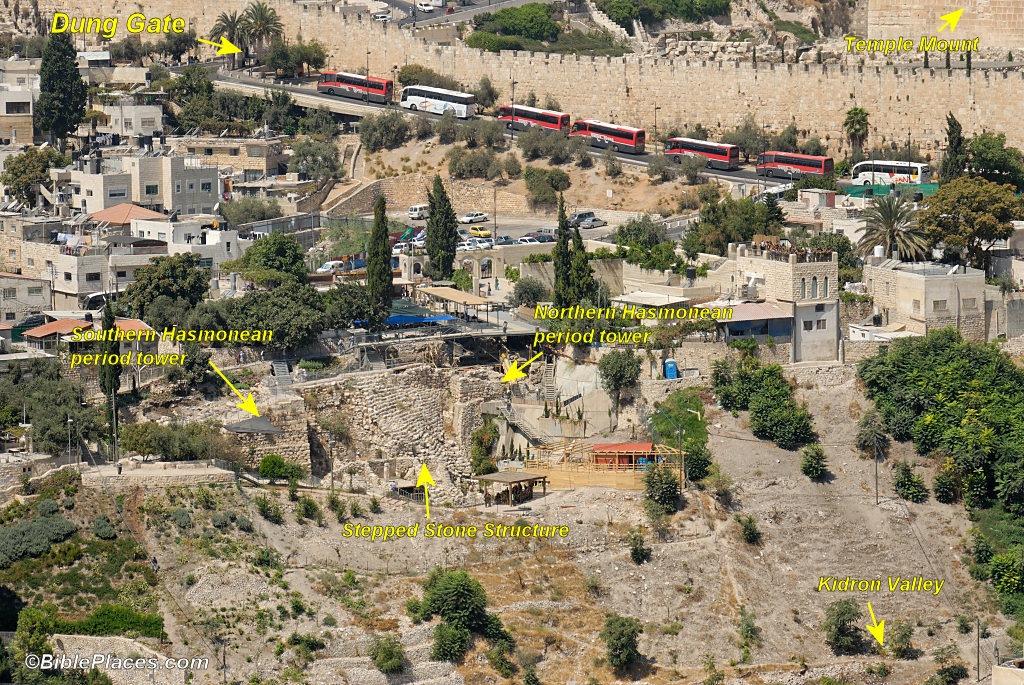
City of David Area G from southeast, tb091306302labeled


“Under the tower,” Dr. Mazar said at the conference, “we found the bones of two large dogs—and under those bones a rich assemblage of pottery and finds from the Persian period [6th to 5th centuries b.c.]. No later finds from that period were found under the tower.” The pottery is what clearly dates the time period for the tower’s construction. Had the tower been built during the 2nd or 1st century b.c., Dr. Mazar explained, 6th-century pottery underneath the wall would leave a chronological gap of several hundred years. Therefore we know, based on the pottery dating, that the tower would have been built three to four centuries earlier than previously thought, during the Persian Empire’s heyday, which is precisely when the Bible says Nehemiah rebuilt the wall around Jerusalem.

According to biblical chronology, Nehemiah returned to build the walls of Jerusalem in about 445 B.C., which is the middle of the 5th century. Thus the dating of this wall would correspond with the biblical record of Nehemiah’s wall. Furthermore, it is logical that that the Hasmoneans built their wall (the “First Wall”) above the remains of Nehemiah’s wall. The dog burials are interesting because 800 of such were found in a Persian period level at Ashkelon. The article does not mention the seal impression (bulla) with “a beautiful 5th century B.C. inscription” mentioned here previously.


Many of the landmarks described in Nehemiah’s book can now be clearly identified today thanks in large part to the work of Eilat Mazar.

False on two counts. Most of the landmarks of Nehemiah’s book are not identifiable today (for understandable reasons). And Mazar has excavated very little from the Persian period. Mazar would not make this claim for herself.


For the rest of the morning, Dr. Mazar’s colleagues spoke one after another, each of them picking apart her findings, some even rejecting her conclusions. But the entire morning session of perhaps the most important archaeological conference of the year in Israel was devoted to Eilat Mazar’s work—not her theories, her work.

This is what makes the archaeological discipline so much better than it was 100 years ago, when one archaeologist could make a claim and that was the end of the matter.


And that’s just the way she likes it. As she has said before, in the end, the stones will speak for themselves.

Rubbish. Stones do not speak for themselves. Archaeology is large part interpretation, which makes it as much of an art as a science.

UPDATE (11/12): Yitzhak Sapir was at the conference and would have written an entirely different article.

Share:

From Arutz-7:

A group of 150 Israeli citizens have filed a class action suit against the Moslems who run the Temple Mount site for having destroyed Jewish antiquities there.

The suit, brought by the Shurat HaDin Israel Law Center, charges that Islamic officials have engaged in the deliberate destruction of ancient Jewish relics on the Temple Mount. The indictment was filed in the Jerusalem District Court last week, and Shurat Hadin sources say it is the first of its kind in Israeli legal history….

She explained that the 150 plaintiffs are acting as representatives of the Jewish People, who are the owners of the Temple Mount and therefore the injured party as a result of the Waqf actions at the holy site…

The suit accuses members of the Waqf of intentionally demolishing priceless Jewish artifacts, including remains from the Second Temple.  In recent months, the Waqf has brought in bulldozers and heavy digging equipment for the purpose of digging a long trench on the Mount, supposedly to replace electrical cables.  “Israeli archaeologists who sifted through the discarded earth,” the Law Center reports, “were shocked to discover a great number of Jewish artifacts brutally trashed by the bulldozers. A wall from the outer courtyard of the Second Temple is believed to have been completely pulverized.”

The full story is here.

Share:

I don’t have access to the particular guide referenced, but I don’t doubt that it is true. Of course, the statement was made in a different day and age. But now that politics are different, so is truth.

From a letter to the editor, Jerusalem Post, Oct 31, 2007:

Sir, – I read with interest “Jerusalem mufti: Western Wall was never part of Jewish temple” (October 25).
The kind of denial by former mufti Ikrema Sadi is somehow disputed by no more and no less than the institution he represents: the Supreme Muslim Council. In an official guide published by the council in 1930, it states: “This site is one of the oldest in the world. Its sanctity dates from the earliest times. It’s identity with the site of Solomon’s Temple is beyond dispute. This, too, is the spot, according to universal belief, on which ‘David built there an altar unto the Lord, and offered burnt offerings and peace offerings’ from 2 Samuel XXIV, 25.”

The rest is here.

UPDATE (11/21): Reader Sean Q has located a copy of the guide and has scanned it. You can download it in pdf format here.

Share:

There is news for three items related to the Temple Mount:


Quarry: The Orthodox Union has new photos online (or if you prefer a slide show)


First Temple Period Remains: Leen Ritmeyer has marked out the find location on a couple of diagrams.  The discovery matches his previous conclusion that this area was within the temple area of Hezekiah’s time.


Temple Mount Destruction: The transcript from the government meeting about the bulldozer excavations is now online in Hebrew.  Yitzhak Sapir has made the following observations:

Present at the meeting were archaeologists Yuval Baruch (district archaeologist of Jerusalem for the IAA), Gabriel Barkai and Meir Ben-Dov, as well as Shuka Dorfman, head of the IAA. Eilat Mazar was also invited but she doesn’t appear to speak during the meeting.
Aside from their statements on the topics, which are really interesting, there are also some interesting statements by Limor Livnat, who was in the past Minister of Education and responsible for the IAA, and an architect who claims that when the dig began two months ago, he found a segment of the Northern Wall of the Temple, that was covered up the next day.

Share:

I was talking with a scholar the other day about the general lack of archaeological material in Israel from the Persian period (530-330 B.C.).  This is especially true for the city of Jerusalem.  Then today I learned this from a reliable source:

Just yesterday, Eilat Mazar found a Persian period layer with much pottery and bullae, mostly fragments, but one with a beautiful 5th century B.C. inscription from the Persian Period.

Mazar is excavating in the City of David, above Shiloh’s Area G, on the summit of the hill in an area where she believes she is excavating the palace of David.  When I know more, or when this is reported in the media, I’ll mention it here.

Share:

The Jerusalem Post story on the on-going saga of “excavations” on the Temple Mount is here.  The abbreviated version follows:

Genius #1: Shmuel Dorfman

“There was no damage to the remains of buildings or artifacts.”

Sir, can you tell me if you excavated with a tractor?

“They were under time pressure.”

It’s good to know that you can excavate with a tractor and cause “no damage” to ancient remains. 

This guy wouldn’t pass Archaeology 101.  Unfortunately he is the Director-General of the Israel Antiquities Authority.

Genius #2: Meir Ben-Dov, retired archaeologist

“There were no archeological findings in the ground,” Meir Ben-Dov told the committee. “They dug
a total of 50 cm. [18 inches] deep and all of it was fill-in from the earlier infrastructure that had been installed.”

Somebody should have told this guy about the Iron Age remains from an undisturbed layer that were discovered in this trench.  Ben-Dov is not an honest man.  He just expected that the Muslims would have destroyed it all so thoroughly that no one would ever be able to prove him wrong.  Fortunately somebody was watching “the excavation” between tractor scoops and not all was lost.

The good news:

“The Knesset State Control Committee on Monday decided to ask the State Comptroller’s Office to investigate procedures for allowing the Wakf Islamic trust to excavate on the Temple Mount, amid claims by archeologists that the laying of electric cables there in August endangered ancient artifacts.”

Share: