The most interesting story of the week is that of the “Darius ostracon,” but I need more space for that, so see below.

There are currently 80 archaeologists working on 14 active excavations in Jerusalem. This story is focused on the Pilgrimage Road excavation.

Moshe Gilad visits the Bar’am synagogue and notes that a very “complicated and significant restoration” is underway. The story is illustrated with some beautiful photos of the site.

Aren Maeir provides a translation of a public statement made by the Israel Archaeological Association about the effect of governmental changes upon archaeological sites and research.

Ilan Sharon, longtime co-director of the excavations at Tel Dor, died recently.

A trailer is out for “Quest for the Throne of God,” a movie that follows the tabernacle and the ark of the covenant, featuring Craig Evans and Scott Stripling, produced by Gesher Media.

Season 3 of “The Holy Land: Connecting the Land with Its Stories,” hosted by John Beck, has been released.

Now to the story of the week. On Wednesday, the Israel Antiquities Authority made a dramatic announcement: a visitor walking around Tel Lachish in December picked up a potsherd reading “Year 24 of Darius,” a reference to the Persian king who ruled over the land of Israel from 522 to 486 BC. It seemed incredible that an inscription would just be laying on the surface, never before noticed, so the archaeologists worked very carefully to confirm its authenticity.

After several months of investigation by the leading researchers of the IAA, press releases were crafted, a video was created, and the discovery was announced. There was no doubt, the experts concluded, that the inscription was genuine. According to The Jerusalem Post:

A few weeks later, [Eylon] Levy received a phone call from the authority’s Saar Ganor. He said he was “on his way from the Dead Sea Scrolls labs. We’ve put it through three scanners. This is authentic. No modern hand could do it, and it’s from two and a half thousand years ago, from before the story of Purim.”

Ganor analyzed Levy’s discovery with Dr. Haggai Misgav of the Hebrew University of Jerusalem and they both confirmed that the artifact dated to the Persian royal administration at Lachish in the Achaemenid period, at the turn of the fifth century BCE.

Haaretz has this:

How confident are they in their interpretation? “Very,” Ganor answers, adding that the writing is so clear that Misgav could read it on the spot. Even so, the ostracon was of course handed over for restoration, during which process its authenticity was confirmed. The inscribed potsherd will be published in the Israel Antiquities Authority journal ‘Atiqot, vol. 110.

But on Friday someone reading about the discovery contacted the IAA to let them know that she had inscribed the potsherd in a demonstration to students. The piece was then tossed aside at the site, to be picked up several months later.

The IAA took full responsibility:

In terms of ethical and scientific practices, we see this as a very severe occurrence. Leaving the newly inscribed sherd on the site was careless.

Yes, indeed. And they are going to do something about it, working to “refresh proper procedures and policies with all foreign expeditions working in the country,” so that no one else dares leave a modern inscription at any archaeological site.

For my part, I will continue to put my full trust in the archaeological experts and their three scanners as long as we know the truth from other sources. As James Davila observes, “What are all those scans and laboratory tests worth if they can’t even identify a modern pedagogical showpiece that wasn’t intended to fool anyone?”

HT: Agade, Arne Halbakken, Gordon Dickson, Ted Weis, Explorator
A Roman-era lead sarcophagus was uncovered in a cemetery in the northern Gaza Strip.

“At Jerusalem’s Western Wall plaza, a recent excavation has alarmed some heritage specialists who fear the traces of [the Mughrabi quarter,] a centuries-old Arab neighbourhood razed by Israel may disappear.”

Leen Ritmeyer tells the story of his remarkable journey from kibbutz volunteer to expert archaeological architect, largely working in Jerusalem but contributing to many other sites in Israel.

A volunteer describes her experience in excavating Azekah.

Webinar on March 1: “More Than Just Mosaics: The Ancient Synagogue at Huqoq in Israel’s Galilee,” by Jodi Magness. The event is a fundraiser to support graduate students, and the event will not be recorded.

John DeLancey offers an on-location devotional at Masada in his latest episode in “Faith Journeys with God in the Land.”

James Howell interviews Eric Meyers about his life and work.

A new video series, “If These Stones Could Talk,” created and hosted by Rabbi Dr. Kenneth Brander, has released six videos so far.

Wayne Stiles has just announced a Greece Tour and Cruise in August/September and an Israel tour in October.

The Albright Institute in Jerusalem is accepting applications for the Position of Director.

The University of Haifa has been given a rare map collection from the 1500s and 1600s.

Bible Mapper has created a poster map of Israel and Judah that can be downloaded at several resolutions.

I mentioned the new ebook by Jerusalem Perspective earlier this week, and Lois Tverberg has posted one of its articles: “Jesus’ Devout Jewish Parents and Their Child Prodigy.”

The oldest nearly complete Hebrew Bible, dating to approximately AD 900, is expected to sell at auction for $30 to $50 million, the highest valued manuscript ever to go to auction. If you are not confident that your bid will win, you can be grateful that the Sassoon Codex has been digitized, is in the public domain, and is available online.

HT: Agade, Arne Halbakken, Alexander Schick, Keith Keyser, Greg Ford

Jerusalem Perspective has published “Treasures New and Old (Matt. 13:52): Celebrating 35 Years of Jerusalem Perspective.” The 35 articles are organized under the following sections: “Who Was Jesus?,” “The Sermon on the Mount, “Second Temple Jewish Sects,” Bible Languages and Translation,” “Second Temple Jewish Life and Thought,” “The Land of Jesus,” and “A New Solution to the Synoptic Problem.” Highlights include:

“Was Jesus a Rabbi,” by David N. Bivin

“The Appearance of Jesus: Hairstyles and Beards in Bible Times,” by Marvin R. Wilson

“Jesus’ Devout Jewish Parents and Their Child Prodigy,” by Chana Safrai

“Lilies of the Field,” by Gloria Suess

“Jesus and the Essenes,” by David Flusser

“Spoken Languages in the Time of Jesus,” by Shmuel Safrai

“That Small-fry Herod Antipas, or When a Fox Is Not a Fox,” by Randall Buth

“Let Down Your Nets,” by Mendel Nun

“Six Stone Water Jars,” by Ronny Reich

“‘Shake the Dust from Your Feet’: What Did the Apostles’ Action Signify?” by Joshua N. Tilton

“The Search for Bethsaida: Is It Over?,” by R. Steven Notley

“A Farewell to the Emmaus Road,” by David N. Bivin

These fascinating studies are written by the best scholars in their fields, and I’m thankful that Jerusalem Perspective has made them so easily accessible and affordable. The early bird price of $19.95 for the e-book ends soon.

A rare gold bead was discovered by a teenage volunteer in excavations on the “Pilgrimage Road” leading from the City of David to the Temple Mount.

Israel’s driest winter in 60 years ended with a week of heavy rainfall throughout the country. The recent rains filled Herod’s pools at the Tower of David Museum in Jerusalem. If you look at the photos, you’ll see that “filled” is a bit generous, but there is water where there usually is not.

“An extraordinary physical reconstruction of a Nabataean woman who lived in the Arabian peninsula more than 2,000 years ago has gone on display to the public.”

“Inside el-Janab Cave near Nablus, archaeologists have found first-ever solid evidence of Muslims fleeing Mongol forces sweeping through the Levant in 1260.”

The Book & The Spade is celebrating a remarkable 40-year run with an anniversary celebration in a live webinar on Wednesday, featuring Scott Stripling, a reflection back on the last four decades of biblical archaeology, and some prize giveaways.

Chandler Collins has posted the second issue of the Jerusalem Tracker, with an extensive roundup of news publications, and media related to Jerusalem from the last six months.

King Jehoram of Israel, the son of Ahab and victim of Jehu, is the subject of Bryan Windle’s latest archaeological biography.

In part 3 of Teaching The Text’s series on Ruth, Brad Gray explores the early encounters between Ruth and Boaz.

Volume 14 of the open-access e-journal Negev, Dead Sea and Arava Studies has been published. The articles are in English, Hebrew, and French.

New release: The Bible and Music, by James F. McGrath. Free download in several formats.

HT: Agade, Arne Halbakken, Explorator

Bryan Windle highlights the top three reports in biblical archaeology in January 2023.

Expedition Bible’s latest video considers whether the archaeological evidence supports the authenticity of the traditional tomb of Lazarus in Bethany.

Carl Rasmussen shares some musings from his recent tour of Israel.

In preparing a map for the Bible Mapper Blog, David Barrett identified the hill of Ammah in the pool of Gibeon story (2 Sam 2) with el-Qubeiba, which has also been identified as the Emmaus of Luke 24.

Antiquities police caught a couple of thieves at the bottom of a pit, after they had already caused irreversible damage to a 1st-century winepress in western Galilee.

Antiquities thieves who had discovered an ancient sarcophagus at the site of Samaria were caught by authorities.

Aren Maeir has collected a number of videos where he discusses the Philistines and his excavations of the city of Gath.

The Israel Antiquities Authority has begun moving into its new home at the Jay and Jeanie Schottenstein National Campus for the Archaeology of the Land of Israel in Jerusalem.

The Great Isaiah Scroll arrived at what is now known as the Albright Institute on February 19, 1948. To celebrate the 75th anniversary, Marcello Fidanzio will be lecturing on Qumran Cave 1 and the Great Isaiah Scroll on February 21 at the Israel Museum.

“The Tel Shimron Experience is a 5-day, 6-night archaeological excursion in Israel where you will have the opportunity to participate in a real archaeological dig.” The price is similar to a 3-week half-season, so you are effectively paying for the privilege of a shorter commitment.

A heygo tour of “The Colosseum Inside” is planned for tomorrow morning.

HT: Agade, Arne Halbakken, Explorator

Archaeologists have now finished a chronological mapping of Megiddo, with radiocarbon dates for the two dozen layers of habitation from the Early Bronze Age to the end of Iron II.

Archaeologists excavating a deep rock-hewn moat along the northern side of Jerusalem’s Old City walls have discovered a handprint carved into the stone.

Not all scholars agree that the name of David is on the Mesha Stele.

The Technion and the University of Haifa’s School of Archaeology and Maritime Cultures have launched a joint initiative to support cooperation between the two institutions in archaeological sciences, especially microarchaeological research.

“Benjamin Netanyahu reportedly promised King Abdullah II that the status quo on the Temple Mount in Jerusalem will be preserved.”

“Jerusalem’s Tower of David was never built to be accessible.” The Times of Israel gives the backstory on the ingenuity required to make the ancient fortress accessible to those with disabilities.

Chandler Collins writes about a significant geographical feature in Jerusalem that he calls the “Fortress Saddle.” This was the city’s most vulnerable area on its most vulnerable side.

The Mardigian Museum has opened in Jerusalem’s Armenian Quarter, documenting the community’s history and serving as a memorial to the Armenian Genocide.

“A riveting new exhibition, titled ‘Peace and War: The Assyrian Conquest of Lachish,’ will open on January 30 in the Lynn H. Wood Archaeology Museum on Southern Adventist University’s campus.” I’m not sure how much “peace” was involved in the Assyrian conquest.

Excavations at ancient Capitolias, a city of the Decapolis in modern Jordan, are shedding light on the production of glass in the Roman, Byzantine, and Umayyad periods.

A former director of the Citadel Museum in Amman, Jordan, was convicted of stealing 6,000 ancient coins and replacing them with forgeries.

Oded Lipschits will be giving a series of lectures in the UK in honor of the Anglo-Israel Archaeological Society’s Diamond Jubilee between February 20 and March 6. One of them will be online: “New Light on Jerusalem and its Surroundings during the Reign of King Manasseh,” on March 2. Registration required.

Preserving Bible Times has released The Bible: Its Land and Culture, Session 4, including Galilee aerial videos, cultural vignettes, and biblical culture.

Nathan Steinmeyer gives advice on finding the right archaeological dig to join. This is also the topic of an OnScript Biblical World podcast with Steinmeyer, Chris McKinny, and Kyle Keimer.

HT: Agade, Joseph Lauer, Arne Halbakken, Ted Weis, Explorator

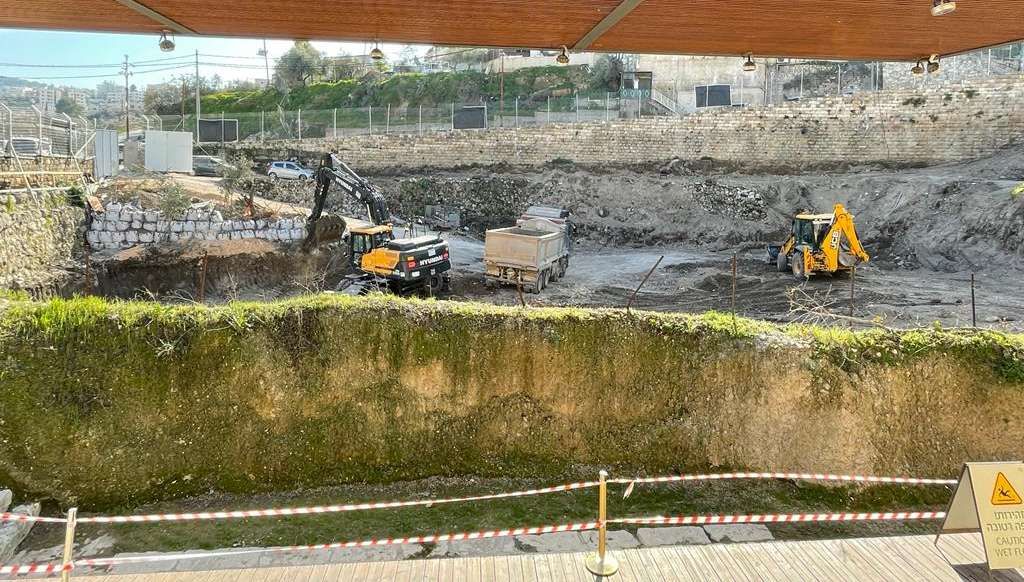
Pool of Siloam excavations Jan 2023

Pool of Siloam excavations Jan 2023b

Excavations at the Pool of Siloam this week; photos by John Black