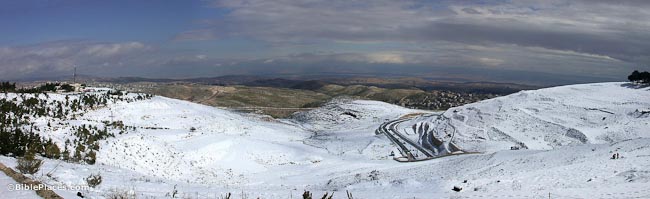
Norma Franklin asks, Why was Jezreel so important to the kingdom of Israel? Her claim that “there is no mention in the biblical narrative” of an Israelite palace is incorrect (1 Kings 21:1).

Another story on the excavations of Carchemish reports that the Japanese offered a million dollars for the opportunity to dig there.

The pigs in ancient Israel allegedly came from Europe.

Five historical monuments have been destroyed in Syria’s civil war. The photos show the damage.

How did ancient Greek music sound? The BBC reports on the research of Armand D’Angour.

How do you avoid losing what you learned on your trip to the Holy Land? Wayne Stiles suggests seven ways. My favorite is #4: Share with people what you have learned and experienced.

Leon Mauldin is doing a series on the cities of refuge. So far, he’s visited Kedesh, Shechem, and Hebron.

All of the entries from Skyview’s 2013 Creative Shot Contest are online.

The Batchelder Conference of Biblical Archeology at the University of Nebraska is scheduled for Thursday through Saturday.

Haaretz profiles the Mormon campus on the Mount of Olives, with details about the campus architecture and the “Non-Proselyting Agreement.”

HT: Jack Sasson

Brigham Young University on Mount of Olives, tb011612774
Brigham Young University campus in Jerusalem
Share:

Aviva and Shmuel Bar-Am tell the fascinating story of Moses Shapira and his alleged discovery of an ancient scroll of Deuteronomy. The Times of Israel article includes quite a bit of interesting information about Christ Church, even though it is not really relevant to the story. The question that has never been resolved is whether Shapira held the first discovered Dead Sea Scroll.

Christ Church was the first Protestant church in the entire Middle East, and the only evangelical church in the region. Outwardly resembling a grand European synagogue more than a Christian house of worship, it was erected in 1849 by the London Society for the Promotion of Jews to Christianity for the express purpose of drawing Jews into the Christian fold.
Before that time, simple proselytizing — and the promise of financial gain — had resulted in very few Jewish conversions; the Protestant Bishopric in Jerusalem hoped that an attractive, accessible church might facilitate the cause.
Church fathers wanted Jews to feel comfortable in the sanctuary, which is why the interior is replete with Jewish symbols.
Jewish students at the workshop manufactured the stunning olive wood communion table, decorated with both a Star of David and the Christian Alpha and Omega.
There were no crosses in the church; the cross on the table appeared in 1948, when Jordanians captured the Old City and Anglicans feared their sanctuary would be mistaken for a synagogue.
Moses Wilhelm Shapira, born Jewish in 1830, was 25 when he left his Russian homeland for the land of Israel.
Somewhere along the way, he converted to Christianity.

The full story is here. Shapira’s story is told in greater length in Neil Asher Silberman’s Digging for God and Country: Exploration, Archaeology, and the Secret Struggle for the Holy Land.

UPDATE: See the Jim Davila’s comments here.

Christ Church, tb011612801
Christ Church in Jerusalem
Photo from Pictorial Library of Bible Lands
Share:

The Caspari Center Media Review reports on a couple of items in the Israeli press of interest to this blog. The first is from an article in Haaretz on October 17.

The Catholic Church in Israel launched a petition demanding the removal of an electricity pole that was put up two years ago across from the Garden of Gethsemane, which is “one of the holiest [sites] to Christians – the place where tradition says Jesus and his disciples prayed together before Jesus was arrested by the Romans and crucified the next day.” The pole was put up at the request of Jewish settlers in East Jerusalem “who have asked to be disconnected from the Jerusalem District Electricity Corporation, which supplies electricity to Arab neighborhoods on the city’s east side.”
The Catholic custodian of the Garden of Gethsemane wrote in his petition that “the huge pylon obstructs the view of the Old City from the prayer garden of the church used by pilgrims. … One of the significant reasons for the popularity of the church is the unique view of the Temple Mount and the Old City, and the pylon utterly destroys this uniqueness.”
The judge presiding over this case criticized the placement of the pole, saying that “it was a beautiful corner of Jerusalem and in addition a holy place.” He later added, off the record, that the Israel Electric Corporation “would not have done it in the Kotel [Western Wall] plaza.” By the end of the hearing, “the two sides agreed to transfer the matter to the appeals committee of the Jerusalem Regional Planning and Building Committee.”

I do not have a photo of the pole, but if any of our readers do, you’re welcome to send it in and we’ll post it here.

UPDATE: See photo below.

The second is from HaModia and HaMevaser.

Prime Minister Binyamin Netanyahu will be traveling to Rome next week to meet with the pope; they will discuss, among other things, the transfer of certain holy sites to the custody of the Catholic Church. “It turns out,” says HaModia, “that the new pope has set a public declaration of the transfer as a condition for his promised visit to the land.” One of the sites in question is David’s Tomb, “which the Catholics have claimed as their own for hundreds of years.”
HaMevaser reports that Rabbi Haim Miller has appealed to Knesset Members in an effort to stop the deal from going through. Miller claims that it is better for the pope not to visit Israel than that the tomb be handed over to the Catholic Church, even if this causes a rift between the Vatican and Israel.

The full Caspari Center Media Review is here.

David's Tomb and Upper Room on Mount Zion, mat14676
David’s Tomb and the Upper Room on Mount Zion
Photo from Jerusalem

UPDATE: A.D. Riddle has sent along a photo that shows the electrical pole. On the right side of the photo, there’s a purple bush with the pole to the left.

Mount-of-Olives-and-Church-of-All-Nations-from-Old-City-wall,-adr1306224803
Church of All Nations and Garden of Gethsemane

UPDATE #2: Pat McCarthy notes that Haaretz has posted two photos of the pole.

UPDATE #3: Paul Mitchell points to Google Images which has a link to this image in an article dated to last year in the Jerusalem Post.

UPDATE #4: Shawn French has sent a photo of an old electric pole that tarnishes the view from Gethsemane.

clip_image002
View from Gethsemane towards Temple Mount, 2008
Photo by Shawn French
Share:

Yitzhak Sapir claims that Matthew Kalman has misrepresented the verdict regarding the ownership of Oded Golan’s artifacts. Kalman has responded briefly.

A report from this season’s excavations of the Roman camp of Legio near Megiddo is now online.

Wayne Stiles provides a perspective, with photos and video, from atop the walls of Jerusalem.

The lecture schedule for the Bible and Archaeology Fest is now online. There are many interesting topics planned.

New Orleans Baptist Theological Seminary is now offering a masters of arts in biblical archaeology in partnership with Mississippi State University.


Haaretz reports on students excavating in the port of Dor as part of a new English MA in Maritime
Civilizations at Haifa University.

An article at The Christian Science Monitor about Khirbet Qeiyafa is more interesting for its profile of Israel Finkelstein.

Barry Britnell suggests a number of opportunities to learn.

Britnell also links to a beautiful video on the Sky Above Jerusalem.

HT: Joseph Lauer, Jack Sasson

Dor harbor area from north, tb090506883
The ancient harbor of Dor
Photo from Samaria and the Center
Share:

The world’s largest Ark of the Covenant has been donated to Israel.

Leen Ritmeyer discusses the little-known Jewish excavation underneath the Temple Mount.

As for the recent challenge to the identification of Herod’s tomb at the Herodium, Ritmeyer sides with Netzer.

Have you been to Joseph’s tomb at Shechem? Ferrell Jenkins gives the biblical significance and a recent photo.

The Ephraim of Jesus’ day is modern Taybeh. There are more reasons to visit than ever before.

The “most popular photo” at The Bible and Interpretation is one our sunset shots over the Sea of
Galilee.

Tomb of Joseph, Nablous, ef0131
Joseph’s Tomb in Shechem
Photo source
Share:

A life-size statue of Ramses II was uncovered this week in Tell Basta in Egypt. The article does not note that Tell Basta is likely the site of biblical Bubastis (Ezek 30:17).

Israel has halted the auctioning of stolen Egyptian artifacts.

Ferrell Jenkins reports on recent vandalism in the Protestant Cemetery on Mount Zion.

Mark Hoffman has now shared his Google Earth Exercise for Biblical Geography (see here for the Google Maps Exercise).

The Encyclopedia of Ancient History (13 vols.) is reviewed by John Vanderspoel.

“In Israel, Dig Beneath the Headline for Archaeological Truth.” There are important things to be said concerning the sensationalism of archaeology and the truth of the Bible, but you won’t find them in this article at The Media Line.

Lucas L. Schulte will be lecturing on “Archeology of the Lands of the Bible: Illuminating Nehemiah” on Oct. 22, 4:30 p.m. at the Dumke Commons of Occidental College.

Wayne Stiles explains why you should send your pastor to Israel.

Aren Maeir reviews The Archaeology of Israelite Society in Iron Age II, by Avraham Faust.

“The British Museum and US-based Penn Museum are collaborating on the creation of a web
resource to display archaeologist Leonard Woolley’s Mesopotamian excavations from 1922-34.”

An op-ed in the LA Times argues that if you want to protect Syria’s antiquities, don’t buy them.

Today you can purchase the HCSB Study Bible on Kindle for just $2.99. The work includes several of our photos.

HT: Jack Sasson

Share: