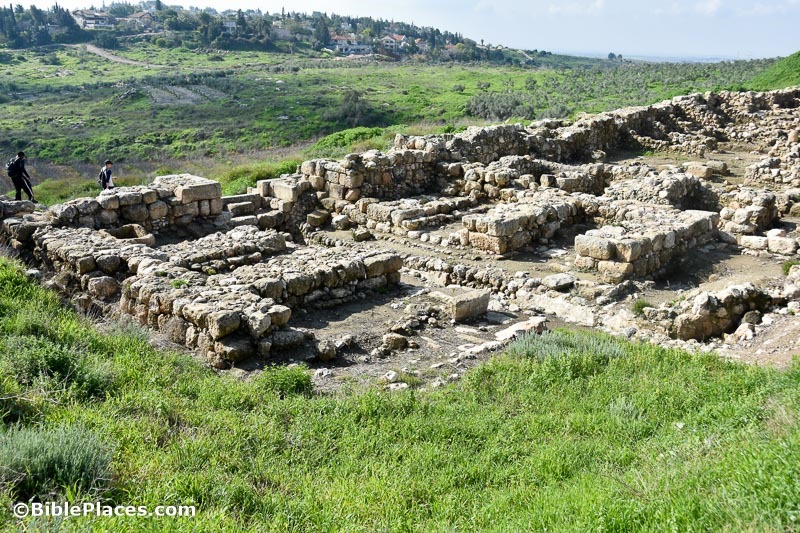
An inscription on an altar pedestal from the temple in Ataroth provides evidence for the Moabite conquest of the city. Christopher Rollston wrote more technical preliminary account in 2013. A journal article was published about the altar and another about the temple in the current issue of Levant.

“Archaeologists have discovered two ancient, unlooted chamber tombs dating from the Late Mycenaean period, (1400 – 1200 BC), near Nemea in the Peloponnesian Peninsula.”

“Located about 560 kilometers northwest of Cairo, Siwa Oasis is home to one of the most important burial sites dating to Dynasty 26, ‘The Mountain of the Dead.’”

The Tunisian government is bulldozing houses built over archaeological remains of Carthage, lest it lose its World Heritage status.

Ancient pottery is valuable for many things, including the preservation of the potter’s fingerprints.

Can you think of “three things in Susa that Esther likely saw”?

Wayne Stiles looks at the relationship between rain and the prayer of the righteous.

The Institute of Biblical Culture has some new courses lined up for the fall, and you can receive a 20% discount with the code “photos.”

The Albright Institute will be providing up to $200,000 in fellowships and awards for next year.

Mathematicians, have you heard of the “Josephus problem”?

HT: Agade, Alexander Schick, Joseph Lauer

Share:

Museums:

“Assyrians in the Shadow of Vesuvius” is a new exhibit at the National Archaeological Museum in Naples.

“Buried by Vesuvius: Treasures from the Villa dei Papiri” is now on display at the Getty Villa in southern California. The post discusses how the Getty Villa was designed after the Villa of Papyri.

“Last Supper in Pompeii” is a new exhibit opening later this month at the Ashmolean Museum.

A replica of the destroyed Lion of Mosul is going on display at London’s Imperial War Museum.

A major exhibition on Troy will open at the British Museum on November 21.

The Egyptian Museum, though losing much of its collection to the Grand Egyptian Museum, will undergo a three-year renovation with the hope of securing status as a UNESCO World Heritage Site.

A new exhibition on Tall Zira’a opened this week at The Jordan Museum.


Lectures:

Shahrokh Razmjou will be lecturing on “The Rise and Fall of Persepolis: A Wonder of the Ancient World” in London on July 23.

Twenty scholars will be speaking at the 22nd Annual Bible and Archaeology Fest in San Diego, November 22-24.


Tourism:

Jerusalem’s “Tomb of the Kings” will reopen to visitors for the first time since 2010, but the tombs themselves will be off-limits.

With restorations complete, Bethlehem’s Church of the Nativity has been removed from UNESCO’s list of endangered world heritage sites.

The Lahun Pyramid opened to the public for the first time last week.

Every year there’s a story that Carchemish will soon be opened to the public.

Babylon has been named a 2019 UNESCO World Heritage Site.

Adam Stewart Brown articulates well why you should visit the Holy Land.

HT: Joseph Lauer, Ted Weis, Charles Savelle, Agade, Explorator, Bill Krewson

Share:

I am excited to announce the release of the Photo Companion to Esther and the Photo Companion to Daniel. These books both lend themselves well to illustration, and yet acquiring relevant photographs is quite challenging for a number of reasons. Our team has been at work on these resources for more than a year, and we are very pleased with the results. Highlights of Esther include:

  • The exact spots where Mordecai overheard the conspiracy, Ahasuerus sat on his throne, and Haman waited early in the morning
  • Contemporary Persian reliefs depicting Ahasuerus, his officials, and his soldiers
  • Plans and models of the city of Susa and its palace that bring the story to life

Highlights of Daniel include:

  • Inscriptions, reliefs, and artifacts that shed light on the ancient Babylonian and Persian empires which Daniel served
  • Ancient images of lions, beasts, and human statues that provide the context for Daniel’s persecution and his visions
  • A march through Daniel 11, with images of nearly every king and queen prophesied by Daniel hundreds of years in advance

As always:

  • Satisfaction is guaranteed
  • Shipping in the US is free
  • Immediate download of everything you order

Here’s one early endorsement for Esther:

An amazing resource! The photographs and graphics included in this collection are not only beautiful, they’re also extremely helpful for visualizing the world of Esther and the events described in the book. The authors are to be commended for this remarkable volume.”

Anthony Tomasino, author of Zondervan Illustrated Bible Background Commentary: Esther and Evangelical Exegetical Commentary: Esther You can download Daniel 3 and Esther 4 to see the detail and abundance of these collections. Our introductory prices are the best, and today you can pick up Esther for $34, Daniel for $39, or the set for $59. We also offer a download-only version. We hope that these resources prove to be extremely valuable for studying and teaching these extraordinary books that testify to God’s sovereignty and care.

Share:

A 3rd-century milestone found on the road leading from Sussita to Caesarea Philippi attests to the existence of Emperor Maximinus Thrax. (Haaretz premium)

Yosef Garfinkel is claiming that he discovered the fortifications that Rehoboam built at Lachish (Haaretz premium).

A few spaces remain for this summer’s excavations at Shiloh.

Aren Maeir posts some new aerial photos of Gath.

David Bivin has updated his article on the history and identification of Emmaus.

Carl Rasmussen visits Nabi Shu’ayb, the holiest Druze site in Israel.

The village of Aphrodito provides a glimpse at daily life in southern Egypt in the 6th century AD.

Zahi Hawass identifies three tunnels in the Sphinx.

A newly published inscription describes the Assyrian king “Sargon’s conquest, occupation, and reorganization of Karkemish, including his rebuilding the city with ritual ceremonies usually reserved for royal palaces in capital cities.”

An Italian team is planning to begin a partial restoration of Persepolis.

A team from Greece is photographing thousands of ancient manuscripts at St. Catherine’s Monastery in Sinai.

“More than 300 artifacts from Queen Nefertari’s tomb are part of the National Geographic Museum exhibit ‘Queens of Egypt,’ which is on view in Washington through September 15.”

Rock&Gem explains the Minerals and Metals of the Bible (Part 1, Part 2)

The May/June issue of Biblical Archaeology Review includes articles on the Huqoq Synagogue, dogs in the biblical world, and the Assyrians.

The Biblical Archaeology Society is having a DVD Blowout Sale, with prices marked down 60-75%.

George Giacumakis died earlier this month.

HT: Agade, Joseph Lauer, Ted Weis, Chris McKinny, Steven Anderson

Share:

A 1st-century Jewish settlement is now being excavated near Beersheba, and one find is an early depiction of a nine-branched menorah.

Christopher Rollston offers some reflections on the Nathan-Melek seal impression, concluding that it is “most likely” that this is the same person mentioned in the Bible.

“Excavation work carried out in Ramses II’s temple in Abydos, Sohag, has uncovered a new temple palace belonging to the 19th Dynasty king.”

Hasmonean-era tombs near Jericho have been looted recently.

Conservation work was done on the Western Wall ahead of the Passover holiday.

“Ancient Color” is “a new exhibition at University of Michigan’s Kelsey Museum of Archaeology, dives deep into the material and application of pigment in ancient Rome, and in doing so highlights a colorful, international history.”

Opening today at the Peabody Museum: “Ancient Mesopotamia Speaks: Highlights from the Yale Babylonian Collection.”

With 40 inches of rainfall so far this year, the Sea of Galilee rose 6 inches last weekend.

Recent rains caused flash flooding near the tomb of Cyrus in Pasargadae.

David Moster explains “Telling Time in Ancient Israel” in a new 9-minute video.

Wayne Stiles has just announced a tour to sites in Turkey and Greece, including a 3-night cruise to the Greek isles.

Reported on April 1: the discovery of the world’s oldest break-up letter.

If you’ve been thinking about registering for the Institute of Biblical Context conference this June, note that the early bird discount ends on Wednesday.

This video shows footage of Jerusalem one month after the Six-Day War in 1967.

HT: Joseph Lauer, Agade, Alexander Schick

Share:

Excavations in the Sharafat neighborhood in west Jerusalem revealed a Hasmonean-era agricultural village. Haaretz (premium) has a longer article with more photos.

A study of the garbage dumps of the Byzantine city of Elusa in Israel’s Negev reveals that the city’s decline was the result of climate change.

The Malham Cave, under Mount Sedom near the Dead Sea, has been identified as the longest salt cave in the world.

The third artifact in the TMSP’s 12 object series is a fiscal bulla inscribed “Gibeon / to the king.”

Amnon Ben Tor will be awarded the Israel Prize in the field of archaeology.

Gabriel Barkay, an Israeli archaeology, recalls his experience in excavating Susa in Iran

The Anglo-Israel Archaeological Society will be hosting lectures in the coming months by Amihai Mazar (on Tel Rehov), Jonathan Price (on Beth Shearim), and Jürgen Zangenberg (on Horvat Kur).

Andrea Berlin will be lecturing in Rockford, Illinois, on April 1, on “Phoenicians and Jews — A Tale of Two Peoples in Israel’s Upper Galilee.”

“Striking Power: Iconoclasm in Ancient Egypt” is a new exhibit at the Pulitzer Arts Foundation in St. Louis. A review article explains why so may of the statues’ noses are broken.

The latest video by the Institute for Biblical Culture is on “Ancient Israelite Fashion.” New classes in April include “The Prophets of Ancient Israel” and “The Geography of Biblical Israel/Canaan II.”

The founder of Sirin Riders explains why Israel is a great place to ride horses.

James Papandrea is on The Book and the Spade discussing his new book, A Week in the Life of Rome.

HT: Agade, Ted Weis

Share: