Archaeologists have discovered engravings of ships and animals on the walls of a Roman-era cistern in Beersheba.

Rami Arav provides a summary of the 2018 excavation of et-Tell (aka Bethsaida). He believes that in the 11th–10th centuries, the site was a “full-fledged urban center, most probably the site of the king of the Geshurites.”

A new era has begun at Gath (Tell es-Safi) with the covering over of excavation areas that will not be conserved for visitors.

The new excavation at Kiriath Jearim and the family providing the financial backing are profiled by the Jewish News of Northern California.

Wayne Stiles recently visited the Gezer boundary inscriptions and he wonders how long it will be before they are no longer legible.

Aviv and Shmuel Bar-Am describe several sites of interest east of Jerusalem, including the Good Samaritan Museum and Ein Fawwar.

Israel’s Good Name shares his experience in volunteering for the Tel Dor excavation.

Israel set a new record with nearly half a million tourists in October.

The Israelite Samaritans Project is a new research venture of Yeshiva University.

Have you seen Carta’s new map bank? Individual digital maps of the biblical world are available for purchase.

HT: Agade, Joseph Lauer, Explorator, Charles Savelle, Ted Weis, Paleojudaica

Share:

After being closed for six years to protect artifacts during the civil war, Syria’s National Museum of Damascus has reopened.

A Haaretz premium article suggests that the Israelites at Dan worshiped the Lord. “Suggestive finds include seal impressions with Yahwistic names, temple architecture, and artifacts typical of Yahwistic temple rituals.”

The latest in Brad Gray’s Psalm 23 series looks at the rod and staff (and sling) of the shepherd.

Israel’s Good Name has written a couple of posts about the Autumn Raptor Migration.

Biblical Israel Ministries and Tours has begun a new series of short devotional videos: “It Happened Here—Life Lessons from Israel.”

A snake crawled out of the stones of the Western Wall above the women’s prayer area, creating a bit of a scare.

Glenn Corbett and Jack Green explain the tremendous value of the ACOR Photo Archive.

A new 17-minute film entitled “Paul in Athens” reconstructs the famous events of Acts 17. This documentary was created by Yaron Eliav and the University of Michigan TLTC Team.

John McRay, longtime professor of New Testament and Archaeology died in August. The Book and the Spade shares an archived interview with him about Athens in the Time of Paul.

HT: Ted Weis, Charles Savelle, Agade

Share:

Scholars are studying sites in the Jordan Valley to see if they are related to early Israelite settlement.

Zahi Hawass tells the story of the discovery of the Solar Boat of Khufu.

An 10-year-old boy hiking in Galilee discovered an ancient stone figure.

Aren Maeir has written an initial summary of this summer’s excavations of Gath. They found quite a bit related to Hazael’s destruction of the city.

Israel’s Good Name describes his excavation experience at Gath.

Gonzalo Rubio explains how eclipses were regarded as omens in the ancient world.

Yosef Garfinkel is lecturing on Khirbet Qeiyafa and Khirbet al-Ra’i on September 15 at the Lanier Theological Library in Houston.

Jerusalem Perspective has posted a lecture by Ronny Reich on “The Mikveh and Ritual Immersion in Jesus’ Day.” Reich is the leading expert on ancient Jewish ritual baths.

The J. Paul Getty Museum has posted a catalog of 630 ancient lamps in their collections.

“Tomb of Christ: The Church of the Holy Sepulchre Experience” will open on November 15 at the National Geographic Museum in Washington, DC. The website includes a digital guide for the exhibition.

Biblical Israel Ministries & Tours has launched an updated website, including a list of their upcoming Israel tours.

The NIV Biblical Theology Study Bible releases on Tuesday. This is a revision of the NIV Zondervan Study Bible, and one major improvement is the more-readable font. We contributed many of the photos, and I wrote the notes for 2 Kings. Westminster Bookstore has it on sale.

Accordance has many graphics collections for sale, including the American Colony Collection and Cultural Images of the Holy Land.

Wipf and Stock are offering 40% off their catalog with code LABOR40.

Now available in the US (from Biblical Archaeology Society):

HT: Agade, Joseph Lauer, A.D. Riddle, Alexander Schick, Paleojudica

Share:

Brian Peterson reviews the events and discoveries of Week 2 of the Shiloh excavations.

Scott Stripling is interviewed about the excavations at Shiloh on The Land of Israel Network (34 min).

Ferrell Jenkins looks at the importance of Shiloh, the longtime location of the tabernacle.


The Times of Israel has a lengthy follow-up on the study that suggests that the carbon-14 calibration scale for Israel is faulty.

ASOR has posted an update on the severe damage to the site of Ebla in Syria.

Israel is opening a new national natural history museum in Tel Aviv.

Israel’s Good Name went on a tour of the Tel Aviv Zoological Research Institute, a place not normally open to the public.

Aren Maeir has posted the lecture and field trip schedule for the Gath excavations.

The American Center of Oriental Research (ACOR) in Amman has posted 9,000 low- to medium- resolution watermarked images from Jordan and the surrounding region, including many taken by Jane Taylor.

Wayne Stiles writes about an important event at the Water Gate in Jerusalem.

Ron Traub writes about the Baram synagogue near the northern border of Israel.

Leon Mauldin is visiting Rome and sharing photos.

Mitchell First has written an article on “The Earliest Surviving Texts of the Torah” for Jewish Link of New Jersey.

The Vatican Library has made 15,000 manuscripts available online, with another 65,000 to come in the next couple of decades.

The ESV Archaeology Study Bible has some recent video posts of interest:

“The Biblical Archaeology Society is now accepting applications for the 2018 Joseph Aviram, Yigael Yadin, and Hershel Shanks fellowships that allow scholars to attend the annual meetings” of ASOR and SBL. (The announcement mentions that Aviram, at age 102, is still the president of IES!)

Norma Dever died on Thursday. William Dever writes an obituary that may surprise you.

HT: Charles Savelle, Agade, Joseph Lauer

Share:

I am home. I can’t say any more about it now, but those who follow our work will benefit from my trip in the months and years ahead. On to the first installment of what really amounts to a roundup for the month of May:

“Three extremely rare Jewish-minted coins dating from the 4th century BCE were recently discovered by the Temple Mount Sifting Project.”

“The study of four donkeys found buried under the houses of Canaanite merchants in the ancient city of Gath is giving archaeologists new clues about early international trade between ancient Egypt, Canaan and Mesopotamia 5,000 years ago.”

Infrared analysis has allowed researchers to view previously unknown text of some Dead Sea Scroll fragments.

“The Temple Mount Sifting Project takes its show on the road with a pilot program in which it uses dirt to connect students to the past and future of the Jerusalem holy site.”

A Bar Kochba Revolt coin discovered near Modiin suggests more widespread support for the rebellion than was previously believed.

An article in The Times of Israel addresses the sensationalized headlines about discoveries at Tel ‘Eton as well as some criticism from Israel Finkelstein.

David Gurevich looks at how archaeological discoveries in Jerusalem in recent decades affects our knowledge of the Great Revolt.

The Bible Lands Museum Jerusalem (which now allows photographs) has a new exhibit on the biblical tekhelet (blue).

Some scientists are calling for higher-resolution satellite imagery to be made available for Israel.

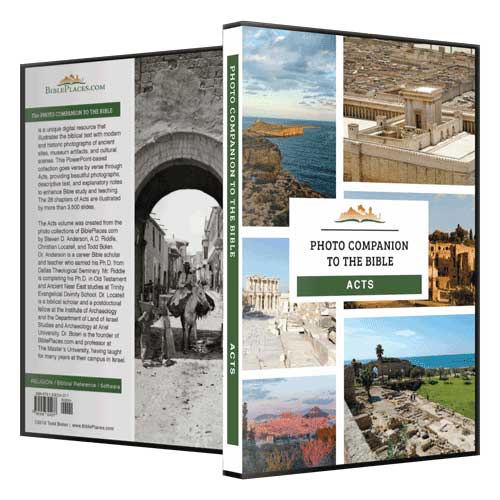
Mariusz Rosik interviews me about my photography work, including the new Photo Companion to the Bible. If you prefer the Polish translation, you can find it here.

HT: Joseph Lauer, Agade

Share:

A significant new visual resource that we developed for the Photo Companion to the Bible is images of old and ancient scrolls of Old Testament books. This is particularly useful in illustrating the Gospels because of the abundance of quotations and allusions to the Hebrew Scriptures.

Torah-Scroll-John1
For instance, when Jesus quotes from Deuteronomy three times in his temptation, we provide photographs from an old Torah scroll of the verses he quoted. When he gives the Sermon on the Mount and contrasts God’s intended meaning of the Law with the Pharisaic misinterpretation, we have photographs of the relevant verses in the Pentateuch. When some of Jesus’s listeners declare that “Surely this man is the Prophet,” the reader needs to understand that this is an allusion to Deuteronomy 18:18.
One time the Pharisees tested Jesus by asking him if it was lawful for a man to divorce his wife (Matt 19:1-6). Jesus responded by quoting Genesis 1:27 and 2:24. Having a photograph of these verses reminds us that Jesus knew the Scriptures, believed the Scriptures, and insisted that they were still authoritative. The Torah scroll we have used for many of the photographs is of Yemenite origin and was copied about 400 years ago. The Hebrew script, without the vowel pointings or chapter numbers, is similar to what Jesus would have used.
Genesis-1-cited-in-Matthew-19-Torah-Scroll
The Photo Companion to the Bible also includes images from the Great Isaiah Scroll. The entire scroll is available through Wikipedia, and we have spent considerable time in identifying the relevant portions to go with the Gospels and creating high-quality close-up shots with the verses marked.
Great-Isaiah-Scroll-ch61-marked
A favorite portion of the Isaiah scroll in Jesus’s ministry is the beginning of Isaiah 61 which Jesus quoted when he spoke in the synagogue of Nazareth. It’s amazing to think that this very scroll existed at the time when Jesus read these words!
Isaiah-61-Luke-4-Great-Isaiah-Scroll
There’s something else too that I love to point out to my students. The Great Isaiah Scroll was written in the 2nd century BC. That means that we have a document describing the Messiah before the birth of Jesus. There is no doubt that Isaiah spoke of a virgin giving birth and a Servant-King being killed and resurrected long before Jesus came. I think there is a powerful testimony in being able to see with our own eyes the text of Isaiah 53 written more than 100 years before Jesus was crucified and raised from the dead, just as Isaiah predicted!
Isaiah-53-allusion-John1-great-isaiah-scroll
The Photo Companion to the Bible provides valuable images that increase your understanding and save you time. In the case of Isaiah 53, you will find photographs of portions quoted or alluded to in many places, including Matthew 2:23, 8:17, 26:63, 27:12, Mark 9:12, 14:61, Luke 22:37, 23:33-34, 24:27, and John 1:29, 12:38.
Share: