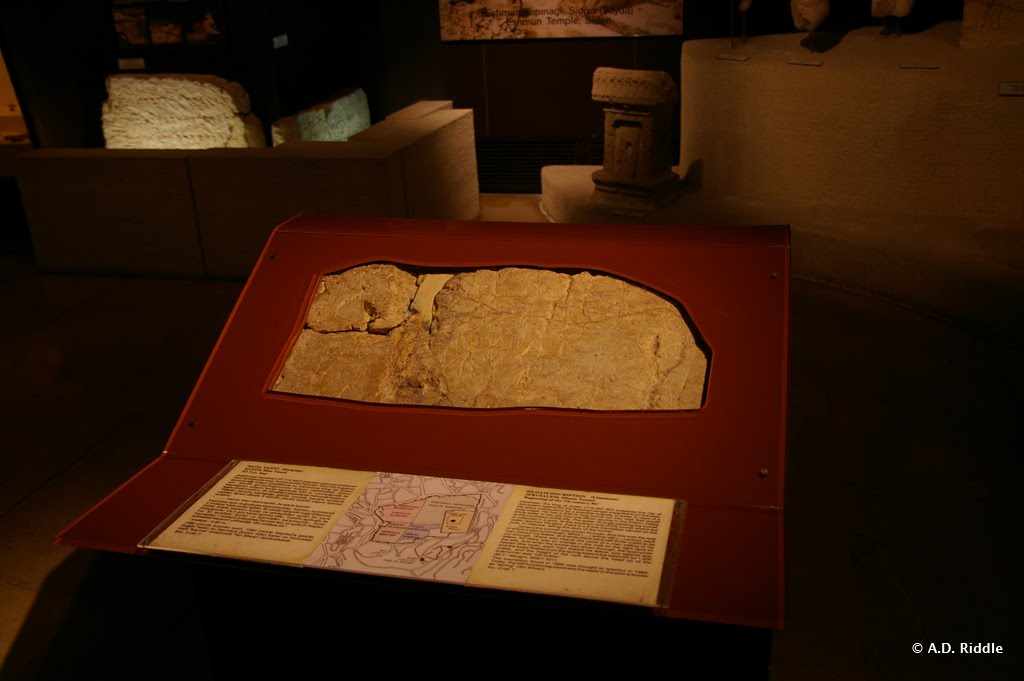
This week’s free item is the Archaeological Study Bible, published by Zondervan in 2005.  This resource has a website of its own, with lots of information and extra features.  If you haven’t done so already, check out the maps page, with 14 free medium-resolution images for free download.

The Bible is available for purchase from Amazon for $31.49, but when I went to verify the price, I was surprised to see that it is available for the Kindle for only $4!  You don’t need to have a Kindle to read it, as software is now available for the PC, Mac, BlackBerry, iPad, and iPhone.  If you wonder how it works, you can download the “first chapter” free.  (I’m assuming by that they don’t mean Genesis 1.)  In the interest of serving you, I just bought the Kindle version myself, but I am not impressed.  I’ve never used a Kindle book before, so my expectations may be flawed, but you may want to test the free chapter before spending your money.  Among other things, navigating seems quite difficult.  Maybe a Kindle reader can weigh in below if I’m missing something.

For the give-away, shipping is limited this week to US addresses.  All names and email addresses will be deleted after the drawing on Sunday, at 5 pm.  Those reading this by email will need to click through to the post to enter.  Two winners will be chosen.

UPDATE (12/12): Congratulations to winners Jess and Ronald.

Share:

What would you expect from a book entitled A Visual Guide to Gospel Events?  This new work certainly does not disappoint in the area of illustrations.  Every two-page spread has at least four images.  But while I enjoy good photos, maps, and artwork, the quality of a book really hangs on the text.

The work is subtitled Fascinating Insights into Where They Happened and Why.  Indeed this is what makes the book most valuable to me. 

There are plenty of Bible atlases, but it is the nature of reference works to present the “straight facts.”  Authors usually do not have a lot of room to present their new theory or exciting discovery. 

This book, like its predecessor, has no such restraints.A Visual Guide to Gospel Events That is particularly noteworthy when the authors are James Martin, John Beck, and David Hansen.  These scholars are well known for their creative insights and helpful interpretations of Scripture.

It is not easy to capture an argument in a few words, but as I read I marked a few observations that are characteristic of the contribution that this book makes.

From the section entitled, “Magi Follow the Star”:

The star functioned in much the same way as the pillar of cloud and the pillar of fire that guided Moses and the children of Israel to the Promised Land (Exod. 13:21-22).  In a similar way the star led the Magi to the Promised Land and to the very house of its promised King” (28).

From the section entitled, “Jesus Becomes a Rabbi in the Southern Jordan Valley”:

On his fourth attempt to curse Israel, Balaam spoke of a special child of Jacob….What the Lord had spoken through Balaam was now being fulfilled at Bethany beyond the Jordan with the baptism of Jesus….And so it was that Jesus was publicly proclaimed rabbi and Messiah in this place where the promise of his coming had been proclaimed” (41).

One more, from “The Problem with Pilate’s Quarters”:

This palace of Herod the Great, the one who had tried to kill Jesus as a child, became the setting for the trial that led to Jesus’s execution as an adult” (164).

The book has eight parts, each of which consists of about ten two-page sections:

  • The Birth and Early Years of Jesus
  • Jesus Reveals His Legitimate Authority
  • Jesus’s Parables and Teaching
  • Jesus in the World of the Gentiles
  • Jesus in and around Jerusalem
  • Jesus Faces the Cross
  • The Arrest and Trials of Jesus
  • The Crucifixion, Resurrection, and Ascension of Jesus

I cannot list all of the sections in each part (but Amazon will let you look inside), but in “Jesus in the World of the Gentiles” you’ll find:

  • Jesus, Jonah, and the Nazareth Ridge
  • Jesus Has to Travel through Samaria
  • Crossing Enemy Lines to the Other Side
  • Great Faith Found in Phoenicia
  • Seven Baskets in the Decapolis
  • Jesus Visits the Region of Caesarea Philippi
  • Fire from Heaven on a Samaritan Village
  • Ten Lepers on the Road to Dothan
  • Did Jesus Visit Sepphoris or Tiberias?

There is a lot to like about this book, including the easy-to-follow format, the scholarly research, and the high regard for Scripture.  This is not a book to buy to sit on your shelf, but it’s one that you’ll want to read through from cover to cover.  The lavish illustrations and the two-page sections make it a very easy work to pick up and read when you have a few extra minutes.  I recommend it to all who believe that history, geography, and archaeology can better help us to understand the Bible.  At only $20, it would make a great Christmas gift for a friend, pastor, or teacher.

Share:

Last month I pointed readers to a potentially great deal on a Logos Bible Software collection of works of early explorers.  That offer is still available and accepting bids, but I commented at the time that an even better collection could be created.  What are the best resources by 19th-century explorers of Palestine?  Below is what I suggest would be a dream collection.

Burckhardt, John Lewis. 1822 Travels in Syria and the Holy Land. London: John Murray.

Clermont-Ganneau, Charles. 1896 Archaeological Researches in Palestine During the Years 1873-1874. 2 vols. London: Committee of the Palestine Exploration Fund.

Conder, Claude R. 1878 Tent Work in Palestine. 2 vols. London: Richard Bentley & Son.

Conder, Claude R. 1889 Palestine. New York: Dodd, Mead & Company.

Dalman, Gustaf. 1935 Sacred Sites and Ways: Studies in the Topography of the Gospels, trans. Paul

P. Levertoff. New York: Macmillan. [This work is more recent than the others but uniquely valuable and out of copyright, I believe.]

Lynch, W. F. 1849 Expedition to the River Jordan and the Dead Sea. Philadelphia: Lea and Blanchard.

MacGregor, John. 1870 The Rob Roy on the Jordan, Nile, Red Sea, & Gennesareth, Etc.: A Canoe Cruise in Palestine and Egypt, and the Waters of Damascus, 2nd ed. London: John Murray.

Porter, J. L. 1882 The Giant Cities of Bashan and Syria’s Holy Places. London: T. Nelson and Sons.

Robinson, Edward and Eli Smith. 1841 Biblical Researches in Palestine, Mount Sinai and Arabia Petrea: A Journal of Travels in the Year 1838. 3 vols. Boston: Crocker & Brewster.  [This is probably the most important work in this list.]

Robinson, Edward and Eli Smith. 1871 Later Biblical Researches in Palestine, and in the Adjacent Regions: A Journal of Travels in the Year 1852, 2nd ed. Boston: Crocker & Brewster.

Rogers, Mary Eliza. 1867 Domestic Life in Palestine. Cincinnati: Poe & Hitchcock.  [Not as well known, but a fascinating read!  It has recently been reprinted.]

Smith, George Adam. 1909 The Historical Geography of the Holy Land. 26th ed. New York: A. C. Armstrong and Son. [This is a classic.]

Thomson, William M. 1880 The Land and the Book. Vol. 1: Southern Palestine and Jerusalem. New York: Harper & Brothers.

Thomson, William M. 1882 The Land and the Book. Vol. 2: Central Palestine and Phoenicia. New York: Harper & Brothers.

Thomson, William M. 1885 The Land and the Book. Vol. 3: Lebanon, Damascus, and Beyond Jordan. New York: Harper & Brothers.

Tristram, Henry Baker. 1868 The Natural History of the Bible: Being a Review of the Physical Geography, Geology, and Meteorology of the Holy Land, with a Description of Every Animal and 
Plant Mentioned in Holy Scripture, 2nd ed. London: Society for Promoting Christian Knowledge.

1874 The Land of Moab. London: John Murray. [This is in the current Logos offering.]
Twain, Mark. 1869 The Innocents Abroad. Hartford: American Publishing.

Wilson, Charles, ed. 1881 Picturesque Palestine, Sinai and Egypt. 4 vols. London: J. S. Virtue & Co.

[This has been published in non-Logos format at LifeintheHolyLand.com.]

I have excluded works specifically on Jerusalem from this list, as those would make up their own collection.  Also the size and challenge of digitizing another would surely necessitate a separate collection:

Conder, Claude R. and H. H. Kitchener. 1882 The Survey of Western Palestine, 11 volumes. London:

The Committee of the Palestine Exploration Fund. [For a list of volumes, see here.  A reprint edition now sells for about $4,000.  We have produced electronic editions of the maps and index.]

Two final comments: (1) All of the resources listed above were used extensively in the creation of the annotations in the American Colony and Eric Matson Collection.  (2) A Logos representative read my previous post and contacted me for this list.  I am hopeful that they will catch the vision and bring back these rare and valuable works for our and future generations.

Share:

This week’s give-away is a treat for several reasons.  First, this resource is brand new.  When I received it in the mail a couple of weeks ago, it was not even listed on the publisher’s website

Second, the value of this resource is much higher than any previous (or likely, future) give-away item.  The retail value is $375, though it is on sale until the 28th for $99.95.  Third, I have two copies to give away.

I would assume that most of my readers are familiar with The Great Courses.  This company finds the best professors to teach on popular subjects and then makes the audio and/or video lectures available for a fraction of the cost of tuition.  You don’t get credit, but you may save more than a thousand dollars from a comparable university course.

The latest course to be produced is entitled “The Holy Land Revealed.”  The instructor is Jodi Magness, professor at U of North Carolina at Chapel Hill.  She is well regarded for her historical and archaeological research, including her excellent book, The Archaeology of Qumran and the Dead Sea Scrolls

image

The course is only available in video DVD format, and the set includes 36 half-hour lectures on 6 DVDs.  You can see a complete list of the lectures in the right sidebar on this page, but I’ll just note a few of particular interest here.

  • Biblical Jerusalem’s Ancient Water Systems
  • Samaria and the Northern Kingdom of Israel
  • Discovery and Site of the Dead Sea Scrolls
  • Herod as Builder—Jerusalem’s Temple Mount
  • Monumental Tombs in the Time of Jesus
  • Masada—Herod’s Desert Palace and the Siege

I’ve only had time so far to watch three of the lectures.  I chose one of Magness’ specialities:
“Discovery and Site of the Dead Sea Scrolls.”  When that finished, I continued into “The Sectarian Settlement at Qumran.”  (The third: “Synagogues in the Time of Jesus.”)  Because I’ve studied this subject in some measure (and read Magness’ book), I did not expect to learn much.  But I wanted to see how the information was covered, how visual aids were used, and how effective I would judge the course to be overall for people without graduate degrees in the field.  Overall, I would rate these lectures at 9 out of 10.  The information was solid (no surprise) and the visual aids were generally helpful (but why no photo of Cave 1 when she was describing the discovery?).  The presentation was good too, though my first impressions were that it must be hard to lecture directly into the lens of a camera.  I think when The Great Courses calls me up, I’ll request to have a live audience.  (I’m not holding my breath!) 

Another quibble: the course is entitled “The Holy Land Revealed.”  This is a potentially ambiguous title.  I was expecting more of a geography-type course.  But this is clearly focused on archaeological discoveries that illuminate the land’s history.  Not only that, you should know that it is not evenly balanced across the periods.  This is not surprising if you know Magness’ expertise.  Naturally she is going to teach at greater length what she knows best. 

What that means is that only eight of the lectures cover the Old Testament period.  Four are from the Roman, Byzantine, and Islamic periods, leaving twenty-four covering the Second Temple period. 

That means that those who watch this course are going to get a great education in Pharisees, Maccabees, synagogues, Herod, and Jewish revolts.  But if your interest is exploring the archaeological world of the Old Testament in depth, you may want to wait for the next course.  I found on Magness’ university bio that she was preparing a 36-lecture course for The Teaching

Company entitled “The World of Jesus.”  I’m guessing that this is the same course, but they changed titles without modifying the content very much.  So if you think of this as a course primarily on “The World of Jesus,” I think you’ll be very satisfied.

There is much more information about the course here, and you can sign up for the free copies below.  The rules: one entry per person, deadline is Friday noon (PST), and after the winners are notified, all names and email addresses will be deleted.

UPDATE (12/3): Congratulations to winners Etti and Alexander.

Share:

A very powerful new Bible software program was released this weekend, with a special introductory sale beginning today.  The best introduction is the preview video at the ScrollTag website.  You can also get a quick sense for some of the program’s strengths and value from the Q&A below, which is a mixture of information from the website and my own reflections.

ScrollTag


What is ScrollTag, briefly?

ScrollTag is a Bible program which enables users to organize all of their notes, markings and tags on Biblical texts. Notes are tagged directly onto Hebrew, Greek, or English words, phrases or entire verses to allow easy retrieval and revision…

How does ScrollTag differ from Logos, Accordance, and other Bible programs?

ScrollTag has been designed to meet a need which we saw no other Bible programs meeting adequately (Tagging, Organizing, Block Diagramming and Marking the text). ScrollTag does not intend to directly compete with these other major software packages which focus on other strengths. We intend to keep our focus on what we do well, and not branch out to try to do everything.

The answer to this next question is increasingly important to me as my children get older and begin serious Bible study.


How many users can share a single copy of ScrollTag?
 

ScrollTag is licensed per household…


What does this program have to do with biblical places?

First, anything that helps us to understand the Bible better gets us excited.  We love the Bible first and the “places” second.  Next, the program includes three very high-resolution satellite maps.  The high resolution allows you to zoom in and use the maps for a variety of purposes. 

Third, we have known the author of this program for many years.  The programming genius is immediately obvious to those who watch the demo and read the notes, but we can attest to his love for people, his passion to know God’s Word, and his absolute integrity.  We marvel at the skill and hard work that he has used over the years to create ScrollTag.


Why does the program cost $150?

The introductory special reduces the cost to $125.  That includes paying required royalties for the various English, Hebrew, and Greek translations (e.g., USB4, AGNT, NASB, WHM).  You can also get just a taste for the amount of work involved by this explanation of the origin of the Greek text that the author did not even end up using. 

In addition, ScrollTag includes three high-resolution maps, a Hebrew Chartbook, and a Greek Chartbook.  The full name of these books: Charts for the Acquisition of Biblical Hebrew/Greek: A Natural Approach to Language Learning for the Biblical Exegete.  These two chartbooks contain a wealth of unique information and are recommended for students with or without ScrollTag (available separately here).  The collection is a tremendous value for all that you get.


What can I get for free?

The three satellite maps are available in medium-resolution.  The significantly improved Westcott and Hort electronic text is available here.  There are also several ways you can enter to win a free copy of ScrollTag.

Share: