Book and the Spade has posted its latest program, this one an interview with Eric Cline, entitled “Pseudo-archaeologists and the lost Arks.” The host, Gordon Govier, tells me that he has written an article about a similar subject in the May issue of Christianity Today. Cline has a related book that came out last year: From Eden to Exile: Unraveling Mysteries of the Bible.
I recently worked on a project that required me to create some maps and I thought I might share a few tips for those who might be interested in making their own.
First, I’m using Bible Mapper. This program has lots of functions which makes it easy to add and remove cities, put labels, etc. The program used to cost $35, but it is now free. It does requires a free registration key from the author to unlock all of the features. (No technical support is available.)
Next, let’s say I want to make a map of Turkey. I only want to include certain places. This requires that I remove some of the ones listed. That’s easy. Adding sites that aren’t already defined is a bit more work. But this too is not hard with several free resources.
Let’s say I want to put Catal Huyuk on the map. This is an important Neolithic site, but it’s not already in the map program (I had to pick a lesser-known site like this one, because all of the biblical sites are already listed; if you’re just teaching about the biblical sites, you may never have to do this).
To get the location coordinates for it, I go to the Wikipedia article. I can then copy the coordinates to Google Earth, if I want to get a close-up look at the site with a satellite view (or to verify the coordinates). Alternately, I can click on the coordinates in Wikipedia which brings me to a list of maps that I can locate the site on, including Google Earth. It also gives the coordinates in decimal form which I can copy over to Bible Mapper.
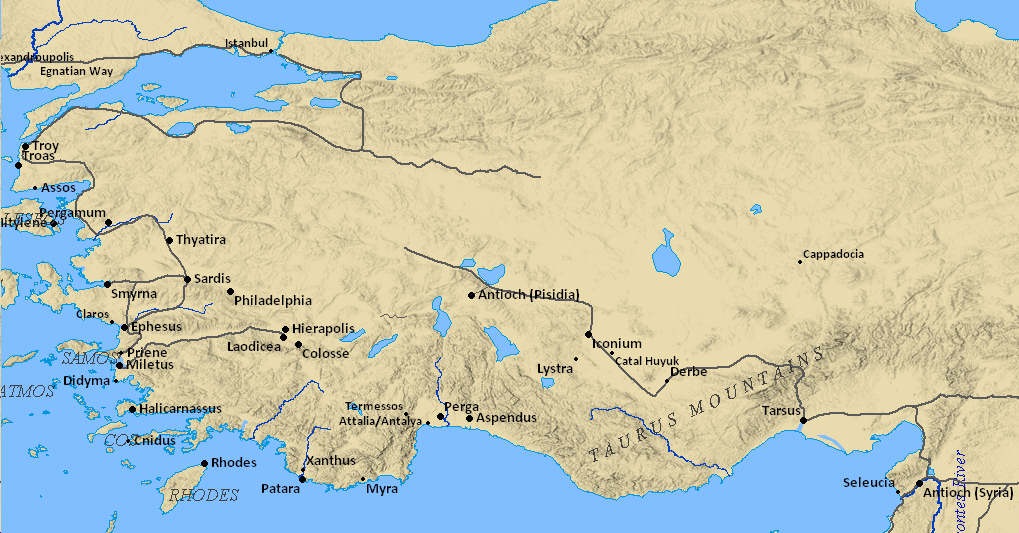
Here’s the map I made of Turkey. It took me about 30 minutes to create, but it would take less time for those who don’t have as many specific needs as I do. There is a learning curve in using the Bible Mapper program, which means that it’ll take you a little longer when you start. Undoubtedly more savvy individuals can make a much nicer map with all of the options available.
One day I hope to add maps like these to BiblePlaces.com so that one can click a site on the map and immediately go to the relevant page of photos.
Which reminds me – and this is a great feature of Bible Mapper – you can use the maps you create for anything! (From the license: “No copyright restrictions are placed on any maps created with Bible Mapper.”) Most maps and map programs have restrictions on them, which can make your maps of limited usefulness. Among its many other features, this makes Bible Mapper a terrific tool.
It has been noted on the ANE-2 list that the 5th (Supplement) volume to the New Encyclopedia of 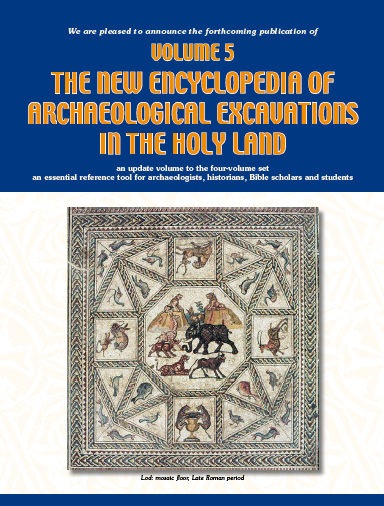 Archaeological Excavations in the Holy Land (NEAEH) is off the press. The book is co-published by the Israel Exploration Society and the Biblical Archaeology Society, which should make it easy to buy in either the US or Israel. Neither site yet has it listed for sale. When it becomes available, I’ll note it here. I commented on the original set previously here.
Update (4/8): The Israel Exploration Society has a 4-page pdf file describing the new volume. On this side of the ocean, Eisenbrauns has it listed for sale (but not yet shipping). The volume is 600 pages and costs $150 (which is the same as the price for the entire 4-volume set).
Update (4/9): The Biblical Archaeology Society is selling it now for $120 plus $10 shipping. The first 25 orders get a free copy of The City of David, Revisiting Early Excavations (reg. $150). There doesn’t seem to be a way to indicate if you are in the first 25 or not, so I would assume that once 25 orders have been taken, they will remove the red print of the special offer so as to not mislead customers into thinking that they might qualify.
Update (4/16): BAS has extended the special offer to the first 115 orders. For those more advanced in their interest of archaeology in Israel and Jerusalem, this is a great deal.
The first excavation in Israel to have a running blog is the The Tell es-Safi/Gath Excavations Official (and Unofficial) Weblog. But it’s been several years and no one else seems to have caught on. Until now. The Tel Dan Excavations has started a new blog. At this point, the blog looks more like a website, with static pages but not daily updates. Presumably, with the start of the season this summer, they’ll keep us regularly informed of the progress.
Permit me one comment on the recruiting banner, as they encourage volunteers to sign up. The slogan says, on top of the graphic: “The 2008 season begins June 22! Will you find the missing pieces of the David inscription? Mail your volunteer application soon.” That’s certainly a tantalizing suggestion. Even though it’s been 14-15 years since the three fragments were found, there certainly could be more. And if more are discovered, you can bet that many of the scholarly theories about the Tel Dan Inscription (TDI) will be cast aside. In fact, here’s something that I had not picked up on until research last week. Perhaps you know that the TDI was probably written by the Aramean king Hazael and it mentions his killing of King Jehoram of Israel and King Ahaziah of Judah. This appears to contradict 2 Kings 9 which says that Jehu, not Hazael, killed these two kings. But here’s what I didn’t realize: the contradiction entirely hangs on two hypothesized words and letters in the TDI (they are reconstructed because the fragment breaks off at these points). In other words, we only know that it says “I killed Jehoram” because scholars hypothesized the words “I killed.” Of Ahaziah, it says “killed Ahaziah,” but the “I” is reconstructed. Whether this is a reasonable or unreasonable guess, it is only a guess. I sure hope they find more fragments. Maybe it’ll be you.
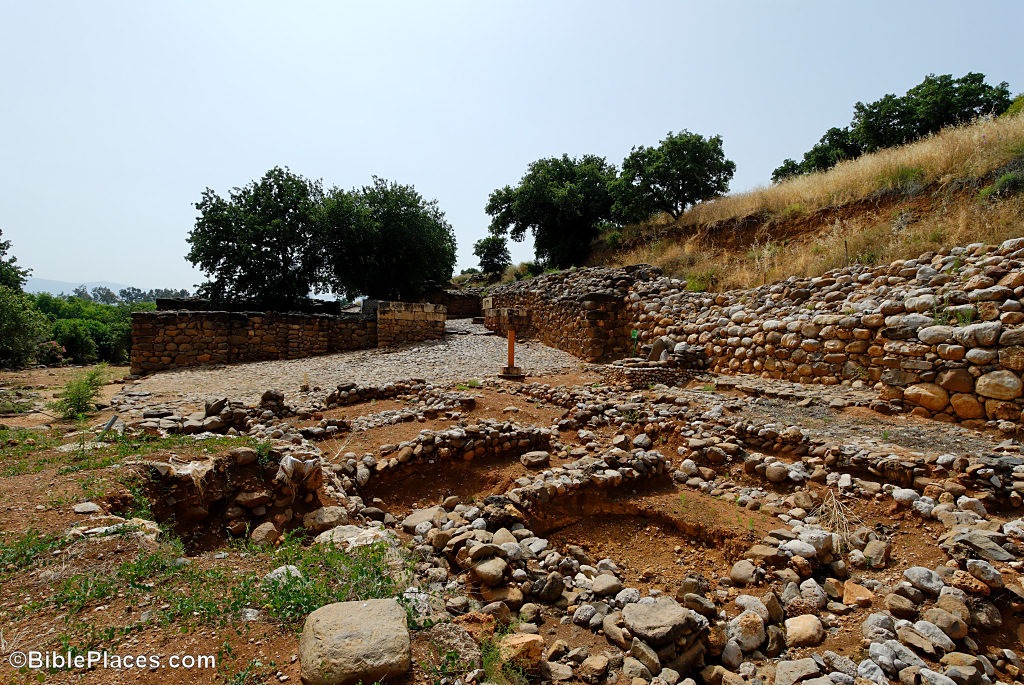
Iron Age gate and plaza at Dan