Unless you’re in the Israeli military, the best maps of the country are those produced by the Survey of Israel in the 1:50,000 series. The 20 maps cover the land from Dan to Eilat and cost about $20 each. The maps are very detailed and include all the dirt roads and hiking trails, making it ideal for 4x4ers and backpackers. They are in Hebrew only, but if you can read the Hebrew alphabet, the maps are useful. I love ’em and use them all the time. No GPS needed!

A couple other maps worthy of mention from the same website:
Israel-Jordan (1;400,000) – believe it or not, this is the best map of Jordan available anywhere. In English.

South Sinai (1:250,000) – another Israeli map that is better than anything produced by the country itself. In English.

Road Atlas – the easiest one for use when driving around in a car. Not as detailed as the 1:50,000, but if you’re staying on paved roads, this will suffice. It’s a spiral-bound book, similar to the Thomas Guides or Rand McNally atlases. In English.

Two other resources worth noting:

Survey of Western Palestine – maps from the 1870s, at a scale of 1:63,000. Considered the best source for knowledge of the country before the modern population explosion. Available as part of an 11-volume set for $4,000 here, or in electronic format from us for $35.

Maps of British Mandatory Palestine – maps from the 1940s, showing the current status of Arab and Jewish settlements. We’re not sure if these are available for sale anywhere, but BiblePlaces.com is working on publishing an electronic version of them. If you’re impatient, contact us directly.

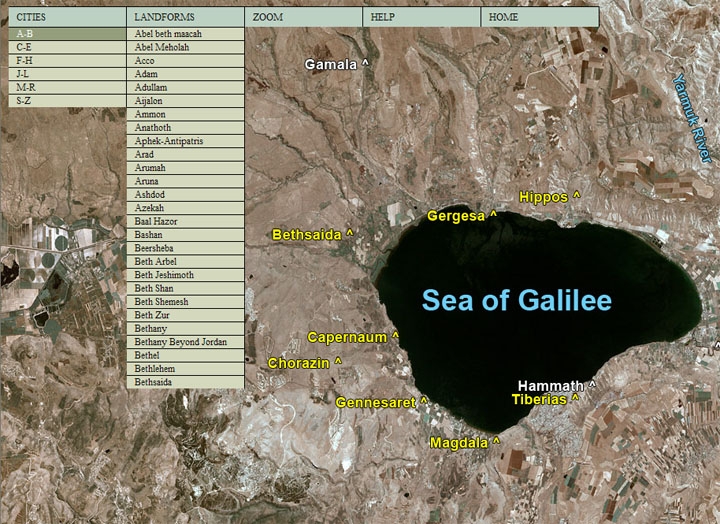
If you’re looking more for maps to use in teaching contexts, see our review of “Electronic Maps for Bible Teaching, Part 1.” Part 2 has not yet been completed.

Share:

I mentioned this some months ago, but the 2nd edition of the Encyclopedia Judaica will soon be available for purchase. The 22-volume work includes 21,000 entries in 17,000 pages at a cost of $1,995. One entire volume is on Israel, and the Holocaust is the second longest entry. The Jerusalem Post has more details, or you can see the official website (one page only at this point), or pre-order it at Amazon. It’s due out December 8.

Share:

I have a lot of books in my office, but only a few are within arm’s reach. Those are ones that I refer to most often. One of the best research tools for biblical sites is the New Encyclopedia for Archaeological Excavations in the Holy Land. I use this four-volume set frequently, as it is the single best source for detailed information about archaeological data about sites in Israel. In looking over my online “book list,” I noticed that the price is now lower than it ever has been – $150 with free shipping at Eisenbrauns (compared to Amazon’s $335). I also see that there are only 4 in stock. I don’t know if that’s the last four or if there are more that they can order. In any case, I highly recommend it for $335; at $150, it is a great deal! I am told that there is a “fifth volume” with updates of certain sites in process, but as far as I know, it hasn’t been released yet. Here are the full details from Eisenbrauns.

The New Encyclopedia of Archaeological Excavations in the Holy Land - 4 Volume Set

The New Encyclopedia of Archaeological Excavations in the Holy Land – 4 Volume Set

Edited by Ephraim Stern
Carta, Jerusalem, 1993
1552 pages with 3000 photos + 32 plates + 700 maps, charts, drawings, English
Cloth
ISBN: 0132762889
List Price: $335.00
Your Price: $150.75
http://www.eisenbrauns.com/wconnect/wc.dll?ebGate~EIS~~I~STENEWEN

Share:

If you’re wondering when the next BiblePlaces Newsletter will come out, the editor is as well. Soon, hopefully. It’s not the war, it’s other things like family, vacations, projects, and real work.

I can, however, recommend another free newsletter which is faithful to its monthly schedule. The ABR Electronic Newsletter is published mid-month, every month, by the Associates for Biblical Research. In keeping with the twin foci of the organization, the newsletters usually have articles on biblical archaeology and creation/evolution issues.

This month’s issue, which came out today, has the best report on the 2006 season at Hazor that I’ve seen anywhere (without the puff that seems to typify mainstream news sources on archaeology digs this summer). And there’s a column on the religious origins of the “Big Bang” theory. Unlike some other e-newsletters, the commercial aspect of it is minimal.

I do not see how you can get a copy of this month’s newsletter; it is apparently not online. But you can subscribe by sending a blank e-mail to abrnews at dejazzd.com with the subject line “Newsletter” (without quotes).

UPDATE: G.M. Grena has found an archive of all back issues of the newsletter.

Share:

The most popular archaeology magazine for biblical discoveries is Biblical Archaeology Review. Another magazine that covers similar topics is Bible and Spade. Produced by the Associates for Biblical Research and edited by Dr. Bryant G. Wood, Bible and Spade has a much more conservative perspective than BAR. I recommend a subscription (sample pdf issue here).

This week Galaxie Software announced an electronic collection of all back issues of Bible and Spade. All 31 years (1972-2005) are available for $80, but until July 31, there is a special of $50.

So for the cost of a 3-year subscription, you get all 31 years. And the electronic edition is of course much better. To get the deal you have to order it from this page and enter code 5454. Not later than July 31.

Share:


BiblePlaces now speaks French. It’s taken about a year and the heroic efforts of Mr. Philippe Viguier, but BibléLieux is now ready to share the best photos and descriptions of biblical sites to readers in France, Algérie, Bénin, Burkina Faso, Burundi, Cameroun, Cap vert, Centrafrique, Comores, Congo Brazzaville, Côte d’ivoire, Djibouti, Gabon, Guinée, Guinée-Bissau, Guinée-Equatoriale, Haiti, La Réunion, Les Seychelles, Madagascar, Maurice, Mali, Maroc, Mauritanie, Monaco, Niger, République démocratique du Congo, Rwanda, Sénégal, Suisse, Tchad, Togo, Tunisie and Québec.

If you’re a French speaker, hop on over and explore the biblical world.

If you’re an English speaker, you can do one of the following:

  1. Practice your French and see beautiful pictures at the same time.
  2. Tell all of your Canadian, African and French friends about it.
  3. Take a few minutes to learn something (in English) about a biblical site that you don’t know much about, such as Aphek, Edom, Laodicea, or the Nahal Besor.
Share: