The Jerusalem Post has some details about the inscription from today’s archaeology conference in Jerusalem.  Some extracts:

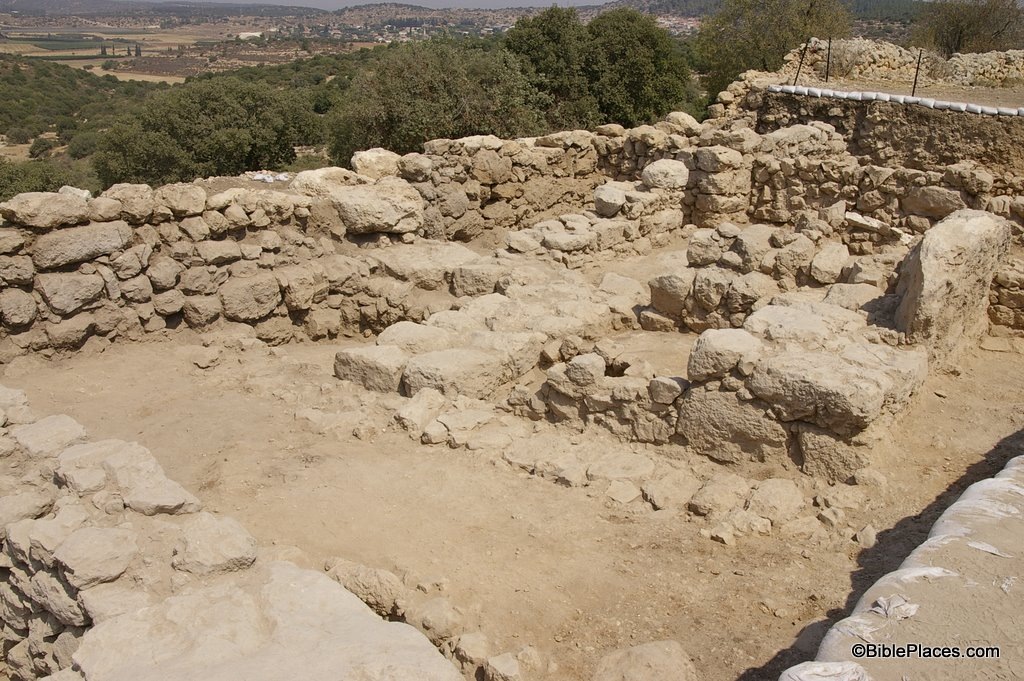
A teenage volunteer found the curved pottery shard, 15 centimeters by 15 centimeters, in July near the stairs and stone washtub of an excavated home. It was later discovered to bear five lines of characters known as proto-Canaanite, a precursor of the Hebrew alphabet. Carbon-14 analysis of burnt olive pits found in the same layer of the site dated them to between 1,000 and 975 B.C., the same time as the Biblical golden age of David’s rule in Jerusalem. Scholars have identified other, smaller Hebrew fragments from the 10th century B.C., but the script, which Garfinkel suggests might be part of a letter, predates the next significant Hebrew inscription by between 100 and 200 years…. The shard is now kept in a university safe while philologists translate it, a task expected to take months. But several words have already been tentatively identified, including ones meaning "judge," "slave" and "king." The Israelites were not the only ones using proto-Canaanite characters, and other scholars suggest it is difficult – perhaps impossible – to conclude the text is Hebrew and not a related tongue spoken in the area at the time. Garfinkel bases his identification on a three-letter verb from the inscription meaning "to do," a word he said existed only in Hebrew. "That leads us to believe that this is Hebrew, and that this is the oldest Hebrew inscription that has been found," he said…. If the inscription is Hebrew, it would indicate a connection to the Israelites and make the text "one of the most important texts, without a doubt, in the corpus of Hebrew inscriptions," Maier said. But it has great importance whatever the language turns out to be, he added.

The full story is here.

Share:

The New York Times has an article in tomorrow’s print edition about Khirbet Qeiyafa (with thanks to Joe Lauer for pointing it out).  The article appears to me to be a teaser, released on the same day of the excavator’s lecture in Jerusalem, which likely will include some new revelations.  The article quotes a number of archaeologists, but most of the information is already known to those who have followed the excavation here or elsewhere.  I’m going to comment on some portions of the article, but you’ll do best the read the article in its entirety first, and then read my comments.

Five lines on pottery uncovered here appear to be the oldest Hebrew text ever found and are likely to have a major impact on knowledge about the history of literacy and alphabet development.

This is a dramatic statement, but the rest of the article ignores the inscription.  The “competition” for the earliest Hebrew text would be the Izbet Sartah inscription (11th century), the Gezer Calendar (10th century), and the Tel Zayit Inscription (10th century).  Interestingly, all of these inscriptions are from the same general vicinity (the western foothills, aka Shephelah).

A great power [like that described of David and Solomon], they note, would have left traces of cities and activity, and been mentioned by those around it. Yet in this area nothing like that has turned up — at least until now.

Hold on here.  Gezer is only a few miles up the road, and the excavations there were pretty decisive that it was a well-fortified city in the time of Solomon.  This is an example of trying to make the site more important by denigrating the significance of others.

Another reason this site holds such promise is that it was in use for only a short period, perhaps 20 years, and then destroyed — Mr. Garfinkel speculates in a battle with the Philistines — and abandoned for centuries, sealing the finds in Pompeii-like uniformity.

This is very important.  The problem with other sites is that they may be used for a long period of time, making it difficult to distinguish exactly what was going on at an earlier point it is history.  For that reason, archaeologists love destructions.  Even better is a single period site with a relatively short-lived occupation.

“The fortification required 200,000 tons of stone and probably 10 years to build,” he said as he walked around the site one recent morning. “There were 500 people inside. This was the main road to Jerusalem, the key strategic site to protect the kingdom of Jerusalem. If they built a fortification here, it was a real kingdom, pointing to urban cities and a centralized authority in Judah in the 10th century B.C.”

These are some numbers that I had not seen before.  It does seem strange that a fortress that took 10 years to build would only be in use for 20 years.  Why was it not rebuilt?  Was it because it was captured by the Philistines?  Or was it because David’s kingdom was strong enough (and its border now further away) that this fortress was no longer necessary?

“This is an important site, one of the very few cases from the 10th century where you can see a settlement fortified in a style that is typical of later Israelite and Judean cities,” said Amihai Mazar, a professor of archaeology at Hebrew University. “The question is who fortified it, who lived in it, why it was abandoned and how it all relates to the reign of David and Solomon.”

Mazar certainly asks the key questions.  It’s important to remember that many of these things are interpretive, which means that an archaeologist can interpret the finds one way and another archaeologist can come to a different (even opposite) conclusion.  If only the stones could speak.

The Philistines had a huge city, Gath, some seven miles away, but pottery found there looks distinct from what Mr. Garfinkel has found here.

This suggests that Qeiyafa was an Israelite fort.  That’s a real question because the Shephelah at this time was contested by the Philistines and Israelites.

Seymour Gitin, an archaeologist and a director of the Albright Institute in Jerusalem, a private American institution, who has seen the finds, said: “The real value is that there was an urban center in the 10th century. You can extrapolate and say this helps support a kingdom, a united monarchy under David and Solomon. People will rightly use this material to support that.”

What Gitin is saying is that a fortress like this doesn’t come out of nowhere.  There must be some sort of strong organizing force (government) that financed and directed it.  This compound wasn’t built by three bored Israelites one Sunday afternoon.

“Some of us look at things in a very ethnocentric way — everything is Israelite or Judahite,” [Israel Finkelstein] said. “History is not like that. There were other entities playing a big role in the southern part of the country. And even if it belongs to Jerusalem, fine. So there is a late 10th-century fortified structure there. I don’t believe that any archaeologist can revolutionize our entire understanding of Judah and Jerusalem by a single site. It doesn’t work that way. This is a cumulative discipline.”

Whoops!  Look at how quickly Finkelstein re-dated the whole enterprise by approximately a century. 

Earlier in the article the fortress is dated to 1050-970 B.C.  Finkelstein makes it late 10th-century with a wave of his hand.  This is not accidental, as his recent publications are built upon the theory that the biblical history was written very late and is entirely unreliable.  Any discovery which suggests a strong central government in Judah in the 10th century is very inconvenient for his views.

He [Garfinkel] says with some 96 percent of this site still to be unearthed, a process likely to take 10 years, he hopes that more writing, more olive pits and more pottery will be uncovered, and add depth to what he believes is a revolutionary find.

Most critical in the whole discussion is this note of caution.  Too often absolute and sensational conclusions are made after the first discoveries.  We have time.  Any discoveries heralded now, of course, certainly makes recruiting slave labor volunteers much easier.

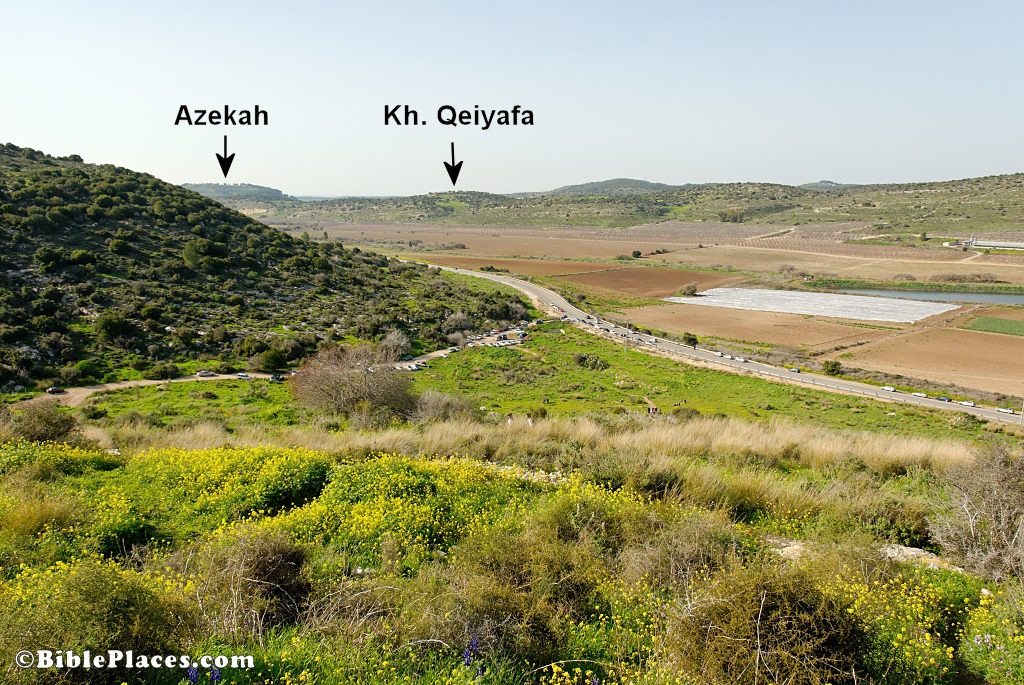
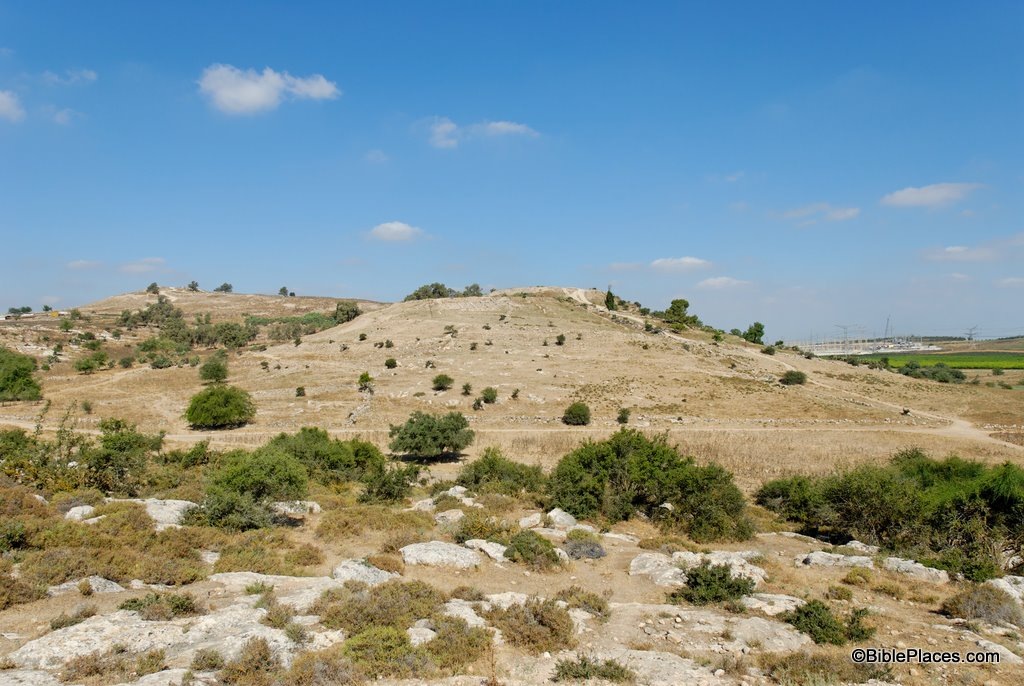
The New York Times does not have any photos of the site, but we do.  For more photos of the site in relation to the Elah Valley, and my speculation before the Times article or Garfinkel’s lecture, see this previous blog post.  The Times article does not mention the possibility that Khirbet Qeiyafa is Ephes Dammim.

Khirbet Qeiyafa, 10th c four chambered gate, ar080731447

Khirbet Qeiyafa four-chambered gatehouse (10th century B.C.)
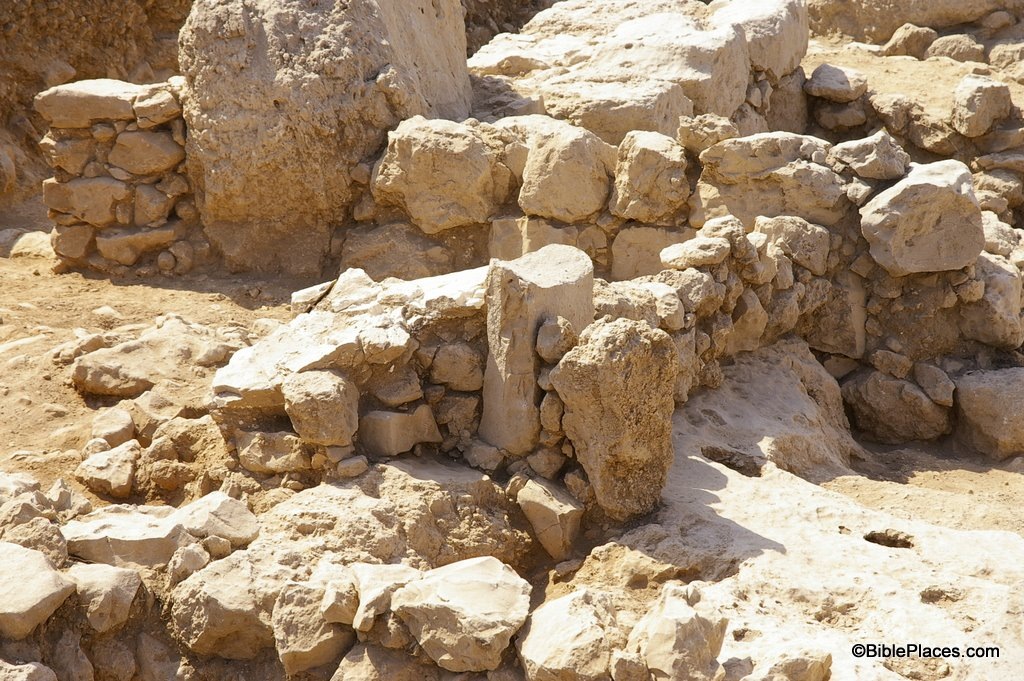
Khirbet Qeiyafa stele fragment, ar080731446  Khirbet Qeiyafa excavations with stele fragment
Share:

An update for the 2008 season at Gath (Tell es-Safi) is now posted at The Bible and Interpretation website.  Director Aren Maeir has summarized the discoveries and it’s worth reading in full.  Some of the highlights:


Early Bronze Age: the site was apparently huge


Middle Bronze Age: more excavation of the city wall and glacis


Late Bronze Age: a very large building, with rich collection of pottery


Iron Age I: remains of plants and animals could help determine the Philistines’ diet; Mycenaean IIIC pottery found


Iron IIA (1000-800 B.C.): – all bullet points are direct quotations from the article

  • clear early Iron IIA pottery
  • a well-dated fragment of a seal impression (of the late 21st Dynasty in Egypt, ca. mid-10th cent BCE)
  • several nice clusters of carbonized grape pips. This latter find should be able to provide robust 14C datings for this phase
  • One cannot overemphasize the importance of the finds in this level, since it may provide the first concrete, well-dated (from several perspectives) context from the early Iron Age IIA in Philistia. In fact, the finds from this level may serve as a central key to solving the “hot debate” on the chronology of the Iron Age, raging for now for more than a decade. Hopefully, the 14C results will be available by late 2008.
  • these finds demonstrate conclusively that our original assumption that the city of Gath was very large during the Iron Age IIA, reaching ca. 45-50 hectares [108-120 acres] in size, was correct. This makes it perhaps the largest site in Philistia, and perhaps in the entire Land of Israel during this period. As such, it appears to match the image of Gath that is portrayed in the biblical texts that relate to the early monarchy, in which the city is described as the largest and most important of five cities of the Philistine Pentapolis, the primus inter pares among the five cities.


Iron IIB (c. 700 B.C.): two destruction layers, possibly related to Sargon II and Sennacherib


Methodology: “in-field laboratory (including an IR spectrometer in the field), which was supplemented by the additional laboratories back in the base camp, provided us with “on-line” results of these analyses – which enabled “real-time” understanding of the archaeological finds. This joint program is unparalleled at ANY excavation in Israel, and in fact, in the world. The close integration of a “regular” excavation team with a wide team of archaeological scientists IN THE FIELD, is simply unparalleled anywhere.”

For many reasons, this excavation looks like it will be extremely beneficial for archaeological and biblical studies.

Gath, Tell es-Safi, from east, tb060906175 Gath, view from the east
Share:

If I were teaching a course in historical geography now to advanced students, I’d cancel one of the assignments and have them write a paper on the site identification of Khirbet Qeiyafa.  They would be required to use all of the available data in suggesting possible candidates.  Since I’m not teaching such a class, I can post my own thoughts here without fear of hindering their research.

It’s been a few weeks since I wrote about Kh. Qeiyafa, so a brief review is in order:  Located next to the Elah Valley where David fought Goliath, Kh. Qeiyafa has been excavated the last two seasons (2007-08).  This summer a 10th century B.C. inscription (ostracon) was discovered (photo), the contents of which have not yet been revealed, but may be very interesting.

The place to start in identifying Kh. Qeiyafa with a known historical place name is to look at the general area of the site.  Kh. Qeiyafa is located on the north side of the Elah Valley, roughly north of probable Socoh (Kh. Abbad/Kh. es-Suweikeh) and east of probable Azekah (Tell Zakariyeh).  Those last two identifications are generally agreed upon by scholars, but as far as I know there’s no certain proof of either identification (for a good discussion of Socoh and Azekah, see The Sacred Bridge, page 147).  That’s important to keep in mind as we proceed under the assumption that Abbad = Socoh and Zakariyeh = Azekah.

Early explorers who identified sites like Hazor, Beth Shemesh, and Beth Shean did not have the advantage of aerial photographs and Google Earth.  But since we have those at our disposal, we will put them to use.

You can locate Qeiyafa on Google Earth using this kmz file.

You can locate Qeiyafa on Google Maps with this link (via G. M. Grena)

You can see the site in relation to Socoh (Abbad) and the Elah Valley on the photo below.

Elah Valley aerial from west, tb011606772_marked

Archaeology is critical in determining site identification, and Qeiyafa has remains dating to the early 10th century and to the Hellenistic period.  To do a thorough job in my little exercise, one would need to investigate Hellenistic sources concerning sites given in this area.  Because the occupation gap is so large (c. 800 years), it is possible that the Iron Age name was not preserved.  Since I am less knowledgeable about Hellenistic sources, and don’t have the necessary time, I am going to ignore this part of the equation.

The textual sources that we have for this time period are limited.  The Bible is the obvious place to start, though as I’ll note, some scholars question the traditional dates given to biblical texts.  Another source is the ostracon previously discussed.  It is possible that this ostracon has one or more place names and may single-handedly answer this question.  (Well, not really single-handedly, as it has to be in agreement with the rest of the data, but its relative importance is potentially great.)  Another possible source is Shishak’s conquest list as given on the Bubastite Portal in the Karnak Temple.

Since no other sites in the vicinity of the Elah Valley appear to be mentioned by Shishak, I am going to ignore that for now.

What can we learn from the Bible?  It might be instructive to note first that many scholars these days would sneer at this question.  It then would be worth reviewing just how many hundreds of accurate site identifications were made in the last 150 years, using the Bible as the primary source.  That is how Edward Robinson did it, as well as many successors on down to Yohanan Aharoni and his students and “grandstudents” (among whom I count myself).

A good place to start is with the passage of the battle of David and Goliath, as this was situated in the Elah Valley.  The setting is given in 1 Samuel 17:1:

Now the Philistines gathered their armies for battle. And they were gathered at Socoh, which belongs to Judah, and encamped between Socoh and Azekah, in Ephes-dammim (ESV).

Elah Valley aerial from west, tb011606779b
Aerial view of Elah Valley, view to southeast

While the locations of Socoh and Azekah are generally agreed upon (see above), the location of Ephes-dammim is uncertain.  Based on the above text, it seems that it is located “between” the two sites.  “Pas Dammim” is mentioned in 1 Chronicles 11:13 and could well be the same place, though the event described there is a different one than the David and Goliath story.  A parallel to 1 Chron 11:13 is given in 2 Samuel 23:9; the place name is lacking in the Masoretic Text but is given as “Pas Dammim” in the Septuagint.  These are the only references to Ephes/Pas Dammim in the Bible.

In teaching the David and Goliath story, I’ve pointed to the “gas station” (labeled on the first photo above) as a possible place for Ephes-dammim.  There’s no evidence for this, but since no other site has been identified and this sits neatly between Azekah and Socoh on the southern ridge of the valley, it was a convenient marker.

But now a new possibility arises: Could Khirbet Qeiyafa be Ephes-dammim?  There are three points in favor of this identification:

1) Like Ephes-dammim (ED), Qeiyafa is “between” Azekah and Socoh;

2) Like ED, Qeiyafa was inhabited in the 10th century;

3) Since the only textual references to ED are in the 10th century, and Qeiyafa was inhabited only in the 10th century (during the time of the Bible), this too would match. [Note: the biblical chronology seems to put the David/Goliath battle in the late 11th century, but the difference is only a few decades here and archaeology is usually not able to be very precise, especially at this period of time.]

swpelah Kiafa (Qeiyafa) is clearly between Azekah and Socoh; map from Survey of Western Palestine (1870s)

Some have suggested that the modern site of Damun preserves the name of Ephes-dammim, but as Steven Ortiz notes in the Eerdman’s Dictionary of the Bible (p. 411), Damum is 4 miles (6.5 km) northeast of Socoh when one would expect it to be west (and east of Azekah).

Another possible text that lists cities from the 10th century (though many scholars think it dates to much later) is the list of Rehoboam’s fortifications (2 Chronicles 11:5-10): “Rehoboam lived in Jerusalem and built up towns for defense in Judah: Bethlehem, Etam, Tekoa, Beth Zur, Soco, Adullam, Gath, Mareshah, Ziph, Adoraim, Lachish, Azekah, Zorah, Aijalon and Hebron.”  The location of nearly all of these sites is pretty well agreed on, not suggesting another possibility for Qeiyafa.

A text that many scholars would go to for sites is the city list of Judah from Joshua 15.  Clearly this is the best geographical list for the area, but I didn’t start there because I believe (hold your breath) that this list dates hundreds of years earlier than the 10th century.  Most scholars do not, and accordingly, I will not ignore it. Joshua 15:33-36 lists cities of Judah: “In the western foothills: Eshtaol, Zorah, Ashnah, Zanoah, En Gannim, Tappuah, Enam, Jarmuth, Adullam, Socoh, Azekah, Shaaraim, Adithaim and Gederah (or Gederothaim)—fourteen towns and their villages.”  The location of many of these cities is not positively identified.  Based on the sites whose identification is generally agreed on (Eshtaol, Zorah, Jarmuth, Adullam, Socoh, Azekah), the list seems to proceed from north to south.  The Elah Valley sites are all known (Adullam, Socoh, Azekah), and do not give us an extra name to associate with Qeiyafa, particularly between Socoh and Azekah as we might expect from 1 Sam 17:1.  If Joshua 15 is a pre-10th century text, then this is not surprising.

The “prophet of the Shephelah” is Micah, who lived in the late 8th century.  His hometown is given as Moresheth (probably known elsewhere as Moresheth-gath) in Micah 1:1.  He pronounces judgment on many cities in the Shephelah from 1:10-16, a number of which are unknown (particularly in vv. 11-12).  Too little is stated to pin down locations for these (Beth Ophrah, Shaphir, Zaanan, Beth Ezel, Maroth), but none is mentioned in connection with Adullam, a city on the eastern end of the Elah valley.  Again, I wouldn’t expect to find a relevant name here since Qeiyafa was apparently abandoned several hundred years earlier.

Elah Valley and Azekah view nw from Socoh, tb021707830 View from Socoh looking west towards Azekah

Are there other possibilities?  A quick check of Ahituv’s Canaanite Toponyms in Ancient Egyptian Documents, Tabula Imperii Romani, and Eusebius’s Onomasticon do not seem to suggest any other potential site names.

Was Kh. Qeiyafa a Philistine outpost?  This summer the excavations discovered a four-chambered
city gate and a 13-foot-wide (4 m) casemate wall. (Photos of excavations here and a 4-minute video of mostly still photos here.)  It certainly was a stronghold, and the only two known powers of the region at this time were the Philistines and the Israelites.  The Egyptians were back home enjoying their Third Intermediate Period, and there does not seem to be any strong contingent of Canaanites in the Shephelah (those would have likely migrated to where there were fewer enemies, such as the Jezreel Valley).

We can speculate further.  Perhaps Kh. Qeiyafa was Ephes-dammim, and it was constructed by the Israelites in the 11th century as they competed with Philistia for the Shephelah.  But one day the Philistines succeeded in capturing the fortress.  That brought Saul and the Israelites down to battle to regain their stronghold.  That could explain the otherwise curious reference in 1 Sam 17:1 to Ephes-dammim, as well as to giving its specific coordinates (since it was not well-known, then or later).

Unfortunately for the Israelites, Goliath wanted to make the battle a contest of champions and there was no one brave enough among the Israelites to respond.  The Israelites were encamped opposite the Philistines on the south side of the valley (which is the opposite of how I have always pictured it), or possibly in the hill country to the east.  David’s victory sent the Philistines fleeing towards Gath and Ekron (1 Sam 17:52), which makes perfect sense given the location of Kh. Qeiyafa.

While the above paragraph is speculative, the data that connects Qeiyafa with Ephes-dammim seems to me to be stronger than that which exists for many biblical sites.  The biblical text is very specific, and Qeiyafa matches exactly.  The dating of the fortress to the early 10th century is very close as well.  It’s certainly intriguing to consider.  Perhaps the ostracon discovered this summer will help to relate Kh. Qeiyafa to the biblical narrative, or even to confirm/deny the possibility that the site is biblical Ephes-dammim.  We’ll be interested to learn more when details are released.

Share:

I’m working on a lengthy (or two-part) post on Khirbet Qeiyafa, but in the meantime, the excavator of the site has given an update, summarized by G. M. Grena and posted on biblicalist:

Prof. Yossi Garfinkel, co-director of the excavation, has given me permission to share his team’s tentative publication schedule (quotes mark his exact words): 1) Their website "is under reorganization and shortly many photos of the site and the excavation will be available to the public." 2) They are still working on an official press release that should be ready "in a week or so." 3) They have already given the Israel Exploration Society "a preliminary text and 7 photos" for the "Notes and News section" of their journal, IEJ. 4) "A larger Hebrew article with 14 photos was given to a book conference to be published in 2 month[s]", but he wasn’t sure about the official name of the book yet. "The conference is a cooperation between the Institute of Archaeology of the Hebrew University and the Jerusalem district of the IAA. It will present to the public the latest results of research and excavations carried out in the Jerusalem area in the last year." http://www.elahfortress.com/
http://qeiyafa.huji.ac.il/
http://israelexplorationsociety.huji.ac.il/iej.htm
http://archaeology.huji.ac.il/

In a later post, the location of some new photos of a pottery presentation is given.

Share:

With regard to the Khirbet Qeiyafa inscription, there are those who know and those who don’t.  Those who know have been sworn to secrecy, leaving only those of us who don’t know to speculate.  I am happy to oblige and suggest below some reasons on why this inscription is significant, thereby possibly fueling more speculation by others also in the dark.

What is not speculation is the fact that the inscription is being studied by Haggai Misgav, a Northwest Semitic epigraphist (source).  Given the location of its discovery, this is no surprise, but it clearly rules out the possibility that inscription was written in another language.  Misgav Haggai says at present that his conclusions are “doubtful and temporary” and he does not know when he will be ready to publish (reported by Jim West).  That suggests that the inscription is difficult.  I offer some ideas that may explain archaeologist Aren Maier’s comment that this inscription “is going to be
VERY INTERESTING!!!!”

1. The inscription is long.  This is a guess based upon a photograph of the potsherd and a friend’s report that the inscription is 4-5 lines long.  Too many inscriptions are known only from a small portion preserved.  The recent ostracon found at Gath with a name similar to Goliath received much attention, but it contained only two words.

2. The inscription is meaningful.  This is in contrast to other early inscriptions, such as the Tel Zayit abecedary (10th c.) and the Izbet Sartah abecedary (11th c.).  Certainly alphabetic inscriptions are meaningful, and scholars can write much about them.  But the primary reason why they get so much attention is because there are few other contemporary inscriptions.  Sometimes conclusions about the state of writing are made that may be without warrant.  The combination of a brief or ambiguous text with a lack of contemporary material makes possible many wrong interpretations.

3. The inscription was discovered in a stratified context.  This is in contrast to the Gezer Calendar,
which was found in the debris pile in 1908.  The Tel Zayit abecedary was found in a wall, not in its original context.  Archaeologists do not have a clear stratigraphical context for many important inscriptions. 

4. The inscription is early.  Khirbet Qeiyafa has occupation from the 10th century and then a gap until the Hellenistic period (2nd c.).  The inscription certainly dates to the time of the settlement, which guarantees a 10th century date (assuming that the site itself has been correctly dated).  There are very few 10th century inscriptions in Israel, and all have some problems.  (The only 10th c. inscriptions from Israel that come to mind are the Gezer Calendar, Tel Zayit abecedary, and the Shishak inscription, but there are probably others.)  The significance of an inscription increases exponentially each century that you go back in time.  A seal impression in the city of David from the 6th century is less rare and thus less valuable than a letter or poem from the 10th century.

5. The inscription dates to a period now highly controversial in biblical archaeology.  In the mid-1990s Israel Finkelstein proposed a “Low Chronology,” which essentially re-dated all material believed to be from the 10th century to the 9th century.  The poor material culture from the 11th century was brought down to the 10th century.  Historically, then, Israel and Judah were impoverished and weak, or, more likely, non-existent (according to Finkelstein) at the time when the Bible describes the great United Monarchy.  Like so many theories in biblical archaeology, this one is highly dependent upon a large amount of “white space,” in which one’s own ideas can be inserted. 

Almost certainly this new inscription will fill in some of the gaps, as well as spawn its own controversies.

More speculating remains to be done on the site identification of Khirbet Qeiyafa, but that will need to await a future post.

Share: