iPhone users in Israel can now download an application that provides detailed information about tourist sites in Israel.  The free application is called iSrael and has been developed by the Israel Ministry of Tourism.  From the Jerusalem Post:

The application has three main sections: sites, tracks and accommodations. Each section can be navigated either by operating the “Around Me” option, which detects the user’s geographic location via GPS and arranges the information by distance from the user’s location; or by choosing the “By Region” option, which presents information according to the part of the country the user wishes to explore. Once a location is selected, users can choose from a list of sites according to their interests. The list includes themes such as archeology and history, nature and animals, holy places, national sites and parks and gardens. Choosing a category opens a list of all the relevant available attractions in the area and users can select a specific site out of the options offered. Clicking on a site opens a new page, which provides a photo and a description of the site as well as helpful information like contact details, hours of operation, a map of the area, a precise address and a link to the attraction’s website. The tracks section allows users to locate tours based on their interest and physical abilities. The section is divided into hiking tours, bicycle tours, vehicle tours and tours for people with disabilities. Each tour contains a description of the sites along the way and a map of the route. For now the selection is fairly limited, but Tourism Ministry officials said that more tours will be available as more are uploaded by the ministry and as other tourism bodies contribute suggested tours.

The full article is here.

Google Earth is a fantastic tool that combines high-resolution aerial imagery with a “flying” engine so that users can travel anywhere in the world in seconds.  The problem is that most people don’t know where they’re going.  Jay Baggett is on the way to solving this problem for students and teachers of the Bible.  His new website, Land of the Bible, features more than a dozen video tours through the 3-D landscape of Israel and Jordan.

After you get an introduction on the home page, you can see a list of the flights in the left sidebar. 

You’ll notice that Jay has plans to create many more in the future.  If you want a short tour, you can start with “David & Goliath,” which begins David’s hometown in Bethlehem and brings you down to the Elah Valley and the stage for the famous battle.  As the video proceeds, the “tour notes” on the right make it clear what you are seeing and why it is important.

landofthebibleFly-over tour at landofthebible.com

For a longer tour, click “From Dan to Beersheba.”  This is a great way to get a feel for the whole land and how one site is related to another.  If you want to “pick up the pace,” you can always click the “fast-forward” button; each click doubles the speed of the video.

Most of the tours are located in the “Pilgrim’s tour of Israel and Jordan.”  Since most visitors see similar sites on the same basic route, this tour will be useful to many tourists even if they were not on Jay’s trip last year.

The videos require a Google Earth plug-in and they do not seem to work in Firefox.  This is a great tool and I look forward to seeing the new fly-overs as Jay finishes them.

One of my favorite book catalogues to browse is that published each year by Carta.  As the premiere publishing company devoted to the historical study of the land of Israel, Carta can quickly fill up my wishlist.  Among Carta’s best known publications is The Sacred Bridge, by Anson F. Rainey and R. Steven Notley.

If you live in the States (or anywhere outside of Israel), accessing Carta’s products is not easy.  They have apparently chosen not to work through the regular publishing channels in the US, thus making it difficult to order their works through bookstores or AmazonEisenbrauns has served as their exclusive US outlet for some years, carrying a certain portion of Carta’s publications.

Carta is now going directly to the public through the creation of their own website and webstore

Now all of their materials are available for easy purchase, though since the company is based in Jerusalem, shipping costs and time reflect international travel.  Yet if you plan ahead, order several items at once, and don’t need to return anything, you can now purchase what before required a trip to the bookstores of Israel. 

Here are some books and other publications that I would recommend from various categories:

Some of these may be available through Amazon-type stores, and even more may be purchased from Eisenbrauns.  For the full catalogue, the place to go is http://www.bible-books-maps.com/.

I haven’t even made it to what I expected to be the main point of this post, but given limitations of time (mine and yours), I’ll save that for another day.

A friend tipped me off that my summer travels this year would have me near Chautauqua Institution in western New York, the location of Palestine Park.  Originally built in 1874, the model of the land of Palestine (as it was then known) has been reconstructed and enlarged over the years to its present size of 350 feet long (110 m) at a scale of 1.75 feet to the mile (0.34 meters to the km).

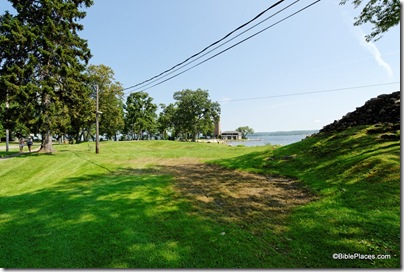
The model blends into its surroundings and you don’t realize you’ve arrived until you’re standing in it.  This is a view of the area from the “north” with the edge of “Mount Hermon” visible on the right.

100802340tb Approaching Palestine Park

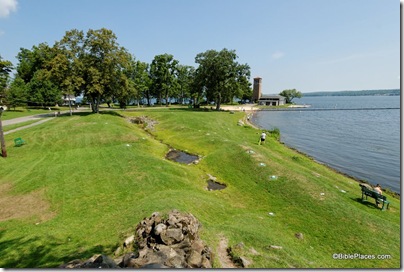
The best view of the model is from the top of Mount Hermon.  Lake Chautauqua stands in for the Mediterranean Sea, but since the park is on the lake’s western shore, the sun rises on the wrong side of this “world.”

100802338tb Palestine Park overview from north

The model includes major landmarks such as Mount Tabor, the Hill of Moreh, and the Jezreel Valley, but I found it difficult to easily identify the physical features because of the uniform shade of the green grass.

100802308tb Palestine Park view north

In the photo below, you can see the Sea of Galilee distinctly, and in the foreground the labeled sites are Nain (left) and Mt. Moreh (center).

100802302tb Palestine Park northern hills

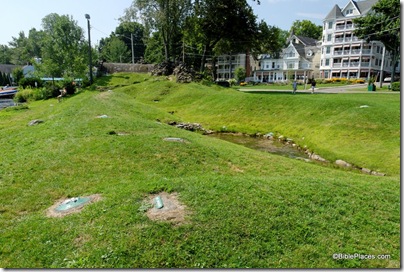
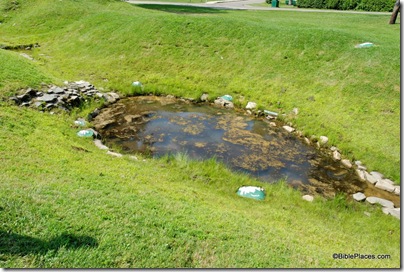
The two major lakes are the most easily identifiable features and both are shaped appropriately.  The Sea of Galilee (below) is surrounded by biblical cities (not exactly in the right places), including Tiberias, Magdala, Capernaum, Bethsaida, and Gergesa.  Perceptive visitors may wonder why the “Mount of Beatitudes” is placed on a high mountain on the lake’s west side.  This reflects a 19th-century view that Jesus gave the Sermon on the Mount at the place today known as Mt. Arbel.

100802303tb Palestine Park Sea of Galilee

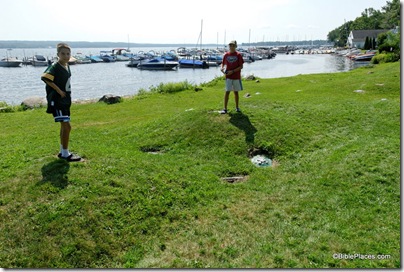
Every Sunday and Monday evenings a local pastor, allegedly in costume, gives presentations of the model using biblical stories.  Mounts Gerizim and Ebal, located under the boys, would provide an ideal place for many wonderful and important history lessons.

100802307tb Palestine Park Mt Gerizim and Mt Ebal

Jerusalem is uniquely marked on the model with a depiction of the (modern) Old City walls.  The model labels a mixture of sites from the Old Testament, New Testament, and later periods. 

Approximately sixty sites are identified, including the Mount of Olives and Bethany (behind Jerusalem in the photo below).

100802310tb Palestine Park, Jerusalem, Mount of Olives

The model also includes the rugged hill country of Transjordan and labels sites including Macherus, Mt. Nebo, Ramoth-gilead, and Gerasa.  The large lake shown below is the Dead Sea.  For a better photo that includes the lisan peninsula, see yesterday’s post.

100802323tb Palestine Park, Dead Sea, Transjordan

For more information about the premises where the model is located, you can visit the website of the Chautauqua Institution (but Palestine Park is ignored on the site).  The entrance fee for the morning was $16, which I felt was a bit unfair, especially since I only spent about 15 minutes at the model (but more than that walking in from the parking lot).  Wikipedia has a brief article about the place, and you can quickly locate the site on Google Maps here.  If you visit in the summer on a Sunday or Monday evening, you can join the free tour (weather permitting).  At other times , you can enjoy a self-guided tour with the assistance of either a cassette tape or a booklet.

A connection I only learned when writing this post is that the man who directed the creation of the park, John H. Vincent, co-wrote Earthly Footsteps of the Man of Galilee, one of the first works that I selected for the Historic Views of the Holy Land series.  He is listed on the title page as the “Chancellor of Chautauqua.”  There is a whole history of American interest in the Holy Land in the 1800s of which I have been ignorant. 

If you have visited Palestine Park and have any observations or suggestions for potential visitors, feel free to comment below.

From ICEJ News:

Israel’s Tourism Ministry announced on Monday that 1.9 million tourists visited the country between January and July, keeping 2010 on track to be a record year for incoming tourism and breaking the magic number of 3 million. The numbers are already a 34% improvement over last year, and also include data indicating tourists are highly satisfied with the quality of local tour guides, the historic sites they were taken to see, and services offered in restaurants, bus lines, gift shops and hotels. “The consistent growth in incoming tourism over recent months, alongside the increasing satisfaction tourists feel toward the service they receive in Israel, should not be taken for granted,” said Tourism Minister Stas Meseznikov. “This is the result of large investments in marketing, public relations, infrastructure development, encouraging investors and upgrading the training and service frameworks.

Who should pay for the water drunk by visitors to the Church of the Holy Sepulcher in Jerusalem? 

The church should, according to a new decision by the city’s water company.

From the Jerusalem Post:

“We are providing water to the pilgrims and tourist for free,” says doorkeeper Jawal Hussein. “It’s not fair. We should not have to pay.”
Slumped on a small stone bench at the entrance to the Church of the Holy Sepulchre, Hussein reflected on reports that the Jerusalem water company had decided to end a centuries-old tradition and is now demanding the church pay for its water.
Gihon, the public water company in Jerusalem, has also reportedly demanded the church pay its back bill dating to 1967, when Israel assumed control of east Jerusalem and the walled Old City from the Jordanians. According to AsiaNews.it, a Christian news site, the decision would break a tradition honored by both the British and Jordanian rulers who had controlled the site in the past century.

There is, however, a significant problem: who do they send the bill to?  There is no single authority over the property, and the various church groups are hardly able to work things out between them. 

There is also the question of fairness.

A Franciscan monk aiding a group of pilgrims from South Korea through the church paused to contemplate the water bill.

“I have heard about it but I don’t understand why the government wants to discriminate against us,” said the monk, who asked not to be named due to the sensitivity of the matter. “Are the synagogues and the mosques paying?” “We are doing a favor to the pilgrims and tourists,” he added. “The government must be earning something from [their visit]. We are doing them a favor.”
“But if the synagogues and mosque have to pay, then I guess we have to pay as well,” the monk added.
The Gihon water company issued a statement saying that they have not, “as of this moment,” cut off the water supplies of any religious institution.
It added that it was charging a standard price of about $4 dollars per cubic meter for water from all religious institutions in the Old City, including mosques, synagogues and churches.
“It should be stressed that this is a uniform fee for all,” the statement said.

Is this true?  Does the rabbinate pay for the water that comes from the fountains at the Western Wall? 

It seems to me that the rules should be the same for the two places, as both are religious landmarks freely open to the public.  

Holy fire ceremony from dome, mat14517

Holy Sepulcher rotunda with visitors for Ceremony of Holy Fire (source)