Gordon Govier lists his top 10 discoveries in biblical archaeology in 2016.

The Biblical Archaeology Society has selected its top 10 biblical archaeology discoveries of the year.

LandMinds has a one-hour video podcast discussing the list.

Haaretz provides a list of the best archaeological finds in Israel in 2016.

Live Science suggests the 9 biggest archaeology findings of 2016. And they identify 5 big archaeology stories to watch for in 2017.

Brandon Marlon writes about 18 interesting sites that most tourists to Israel miss.

ASOR is offering a free e-book of the “5 Most Popular Biblical Archaeology Articles from The Ancient Near East Today” to subscribers to the weekly newsletter.

Recent excavations in Paphos, Cyprus, have discovered fortifications and a thick layer of crushed murex shells. “Team leader Maria Iacovou noted that this is the first time that archaeological evidence for the production of the highly valued purple dye from murex shells has been found in
Cyprus.”

A marble sculpture of a Roman noblewoman was discovered by a farmer in Crete following a recent storm.

Twelve tombs from the 18th Dynasty have been discovered in Gebel el Silsila.

A study of a toy Roman chariot reveals that ancient charioteers affixed an iron strip to the right wheel in order to improve their chances of winning.

As tourism in Egypt continues its lull, officials are trying new ways to attract visitors.

There is only one archaeobotanist in Egypt, but he is hoping this will change.

Ongoing work at Laodicea has uncovered the sacred agora.

This May: Archaeology and History of Lydia: From the Early Lydian Period to the Late Antiquity (8th century B.C.-6th Century A.D.): An International Symposium.

Robert Alter will be lecturing in Nashville on January 30.

The Anglo-Israel Archaeological Society has a lecture series scheduled for the coming months.

HT: Ted Weis, Agade, Joseph Lauer, Explorator, Paleojudaica

Share:

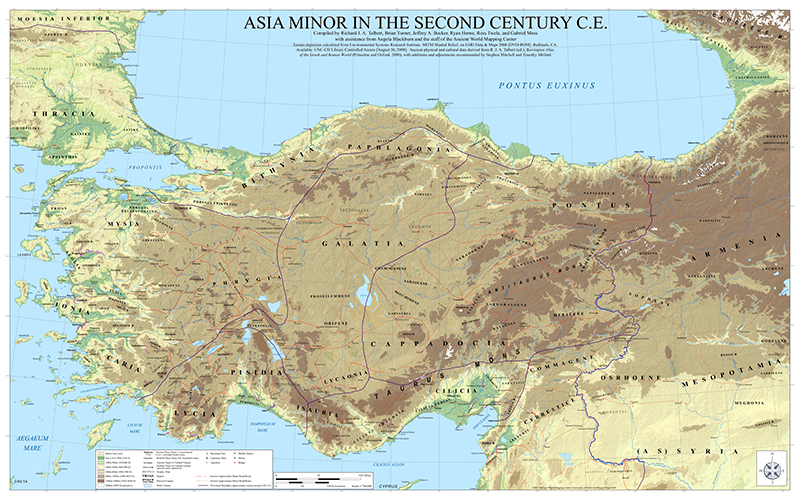
At last month’s meeting of the Evangelical Theological Society, Mark Wilson suggested in a lunch gathering sponsored by Tutku Tours that Paul’s original destination on his first journey was not Galatia but Alexandria. This talk was based on an article that he co-authored with Thomas W. Davis that is available at the website of Pharos Journal of Theology. I thought that a brief sketch of their argument might be of interest to readers here.

The discovery that the proconsul Sergius Paulus hailed from Antioch near Pisidia has previously led to speculation that it was his influence that led Paul and Barnabas to travel there from Paphos. This seems even more reasonable given an understanding of the island of Cyprus. Paphos had strong ties with Alexandria, a situation encouraged by the prevailing winds which made sailing south from Paphos the norm, but sailing north to Perga unusual. If Paul had been intending to head north, Wilson argues that he would have traveled not to Paphos but to Cyprus’s northern coast.

John Mark’s desertion at Perga also may suggest that Paul’s plan had changed. With the new itinerary, Mark may have felt freed from his commitment to serve the team. Later Paul and Barnabas parted ways because of their disagreement over Mark, and Barnabas took his cousin back to Cyprus. It could well be that from there Barnabas and Mark continued on to the original destination of Alexandria.
That Mark did missionary work in Alexandria and North Africa is supported by his Gospel and church tradition. In Mark 15:21, the writer mentions Simon of Cyrene (in North Africa) and his sons Alexander and Rufus, a comment that suggests personal acquaintance. The church historian Eusebius writes that Mark started the church in Alexandria and was later martyred there. His tomb is located in Saint Mark’s Coptic Orthodox Cathedral in Alexandria. This suggests that Mark did indeed spend time here, and it may support the theory that Paul’s original destination was Alexandria. As for why Paul never traveled to this city, given that it held one of the largest Jewish populations in the world, it may be that by the time that Paul turned his gaze back in that direction, he recognized that this was no longer an area “where Christ was not known” and so he opted to travel elsewhere.

You can read the full argument of Davis and Wilson in their journal article. You might also enjoy Wilson’s 2016 article in Adalya, “Saint Paul in Pamphylia: Intention, Arrival, Departure,” available through his academia page.

Alexandria, Saint Mark's Cathedral, adr1603268481
St. Mark’s Coptic Orthodox Cathedral in Alexandria
Share:

An ancient Christian “crossword puzzle” has been discovered in the agora of Smyrna.

A sewage system in the Urartian city of Van that dates to 800 BC has been fully excavated.

You missed the first-ever “Swim the Corinth Canal” event, but perhaps you can join next year.

Greece’s National Archaeological Museum is celebrating its 150th anniversary.

At the ASOR Blog, the executive producer of a new documentary about Gertrude Bell provides some background. You can also watch the trailer.

New paper at Academia: “Computer Experiments on the Khirbet Qeiyafa Ostracon,” by Eythan Levy and Frédéric Pluquet.

Nigel Fletcher-Jones considers the ethical problem of the public display of mummies and alternative approaches.

A French-Egyptian citizen turned over a golden mummy mask to the Egyptian government.

The November/December issue of Biblical Archaeology Review is now online.

If you’re a subscriber to the Wall Street Journal, you can read Roger Toll’s “The Real Adventurer’s Guide to the Ancient City of Petra.”

I made it into Wayne Stiles’s post this week about the Dead Sea Scrolls. Check out the great quote by Frederic G. Kenyon.

Shmuel Browns shares a couple of photos he took at Machtesh Qatan.

The extraordinary Bible collection of the late Charles Ryrie is being auctioned off by Sotheby’s.

HT: Charles Savelle, Agade, Joseph Lauer, Ted Weis, Paleojudaica

UPDATE: Next weekend’s roundup will be delayed by several days.

Share:

A couple of Israeli scholars are suggesting that the Hasmonean Hall (aka “Hall of the Freemasons”) in the Western Wall Tunnels may have served as a triclinium for Jerusalem’s city council.

Scientists working in Galilee have discovered caves used by rebels in the Jewish Revolt. For a more academic study, see this journal article.

The eastern temple of Ramses II at Karnak has been opened after restoration.

Excavations at Petra have revealed new information about the water systems that kept the city alive 2,000 years ago.

Municipal workers in Turkey’s Çanakkale province discovered gold jewelry in an 8th century BC sarcophagus.

Russia is sending a team of scientists to investigate World Heritage sites in Syria allegedly destroyed in the civil war.

The Basrah Museum is opening soon in a former palace of Saddam Hussein.

The Archaeological Museum of Kos re-opened up last month after renovation.

A competition is being held for the architectural design of the new Cyprus Museum in Nicosia.

The International Criminal Court in The Hague has ruled that destroying cultural antiquities is a war crime.

Wayne Stiles’s new post on the history and significance of Eilat is filled with lots of photos I really like.

Ferrell Jenkins shares a photo of a beautiful sunrise over the Sea of Galilee.


Haaretz reviews the best of archaeology in Israel this past (Jewish) year.

John S. (Jack) Holladay died last week. He was a long-time professor at the University of Toronto and he was involved in excavations at Gezer and in the Wadi Tumilat Project.

HT: Agade, Charles Savelle, Joseph Lauer

Share:

Digital imaging technology has virtually opened an ancient scroll from En Gedi to reveal the first two chapters of Leviticus. The publication in Science Advances includes a number of photos. Another article published in Textus is also online. The portions deciphered so far exactly match the Masoretic Text, but the radiocarbon date of 3rd-4th centuries AD differs from the paleographer’s date to the 1st or 2nd centuries.

The discovery of a menorah at Abila provides the first evidence of Jewish presence at this city of the Decapolis.

2,000-year-old human skeleton remains have been found buried at sea near a shipwreck at Antikythera, Greece.

A fisherman’s house from the Ottoman period was discovered along the beach in Ashkelon.

Bedouin youths have helped to excavate Byzantine-era farm buildings in the Negev.

A new virtual reality tour in Jerusalem takes “visitors” inside the Temple. There’s a short video clip here.

Archaeologists plan to finish reconstruction work on Laodicea’s Hellenistic theater within three years.

The Malawi Archaeological Museum in Minya was reopened this week after three years of renovation.

Omar Ghul, an epigrapher at Yarmouk University, discusses important inscriptions discovered in Jordan.

Laïla Nehmé is interviewed by Ancient History Etc. about the history of the Nabateans.

Ferrell Jenkins concludes his series on Iznik (Nicea) with a post on the modern city and its vicinity.

Wayne Stiles considers the history and the lessons from Hezekiah’s Tunnel.

Chris McKinny will be lecturing at Texas A&M Corpus Christi on October 3 on the Late Bronze finds from Tel Burna.

On sale for Kindle for $2.99: Do Historical Matters Matter to Faith?, edited by James K. Hoffmeier and Dennis R. Magary. I require several of the chapters for at least one course I teach.

Mordechai Gichon died this week.

Ferrell Jenkins remembers Erle Verdun Leichty on the announcement of his passing.

HT: Joseph Lauer, Agade, Ted Weis, Charles Savelle

Share:

A stone weight from the first century with the name of the high priest has been discovered in Jerusalem. Ynet has more photos and a video in Hebrew.

Israel’s largest archaeological garden was opened this week on a military base in Tel Aviv.

Archaeologists working at Petra have discovered two statues of Aphrodite.

“Excavations in the volcanic desert of Jordan have uncovered three surprisingly advanced fortified settlements with artificially irrigated terraced gardens, dating to 6,000 years ago.”

Someone is claiming to have discovered one of the stones from the high priest’s breastplate.

“Excavations at Tatarlı Mound in the southern province of Adana’s Ceyhan district have unearthed an impression seal from a monumental Hittite-era structure.”

Aviv and Shmuel Bar-Am provide a virtual tour of the excavations of Ramat Rahel.

Israel’s Good Name describes a recent visit to Chorazin (Korazim) and the first century Galilee boat.

Wayne Stiles suggests that the Transjordanian tribes settled for “second best” and he applies that principle for us today.

Leen Ritmeyer analyzes the paving stone tiles released by the Temple Mount Sifting Project and
suggests they came from “the interior of some of the many buildings that surrounded the Temple and/or from under the colonnades around the smaller courts.”

The Hebrew Music Museum opened earlier this year in Jerusalem and features 260 instruments.

This week Southern Adventist University opened a new exhibit entitled “A World in Miniature:
Creation, Cosmos, and Ecology on Seals from Biblical Times.” The museum’s website does not appear to have information yet on this new display.

The ASOR Blog identifies their five most popular posts of the summer.

The British Institute at Ankara has published nine volumes in the series Roman Roads and Milestones of Asia Minor, all available without charge in pdf format.

HT: Joseph Lauer, Ted Weis, Charles Savelle, Agade

Share: