(Guest post by A.D. Riddle)

In addition to taking a trip to Israel or attending a class, museums are another excellent way to learn about the world of the Bible, but sometimes you do not always know what to look for or how to connect it to the Bible.

Clyde Fant and Mitchell Reddish, noted before on this blog for their guidebook to biblical sites in Turkey and Greece, have produced a book (a few years ago) that will help with just that:

Clyde E. Fant and Mitchell G. Reddish, Lost Treasures of the Bible (Grand Rapids: Eerdmans, 2008).

The subtitle of the book is more informative: “Understanding the Bible through Archaeological Artifacts in World Museums.” The book’s contents are divided into eight sections that correspond to historical periods or to types of biblical literature.

Creation and Flood Stories
Israel’s Ancestral, Exodus, and Settlement Periods
The Period of the Monarchy
The Period of the Babylonian Exile
Poetry and Wisdom Literature
The Persian Period
The Hellenistic Period
The Roman Period

Two additional sections cover “Ancient Biblical Texts” and “Sensational Finds: Genuine or Forgery?”

The richest sections are “The Period of the Monarchy” and “The Roman Period.” Within these ten sections, the book contains 107 entries, with some entries covering a single museum object and other entries covering a group of related objects. Each entry is about four-five pages in length and nearly all of the entries include a black-and-white photograph of the museum object. Entries begin with a description of the object(s): dimensions, language (if inscribed), provenance, date, museum location and number. This is followed by a prose description of the discovery of the object and its historical context. The authors provide a satisfying amount of detail in this section and it seems to be well-researched. The final section for each entry discusses the “Biblical Significance” of the object. Some objects, of course, have a more direct biblical connection than others, but others will draw your attention to details of the Bible that maybe you have not noticed before. Where the biblical significance is (or has been) disputed by scholars, Fant and Reddish present the options in a fair-handed way. For example, it used to be argued that the creation account in Genesis directly depended on Mesopotamian creation accounts, but Fant and Reddish are careful to point out both the comparisons and the contrasts.

The book includes objects from about 30 museums in the U.S., Britain, Germany, France, Israel, Turkey, Greece, and elsewhere. The book is made even more useful by including a scripture index, an index of museum numbers, and an index of objects organized by museum. So, for example, say you are going to visit the Oriental Institute Museum in Chicago, you can look up the museum in the index and see a list of objects on display so that you have an idea of where you might want to concentrate your attention while you are there. Or, say you are studying Acts and want to show how Luke was quite accurate and precise in many of the details he gives, you can use the scripture index to look up relevant entries.

There are, of course, many more objects and other museums that could have been included, but Fant and Reddish give good coverage of the most important objects (and many less familiar ones) and the most important areas of connection with the Bible. I think you will be pleased and impressed with the level of detail and the quality of research.
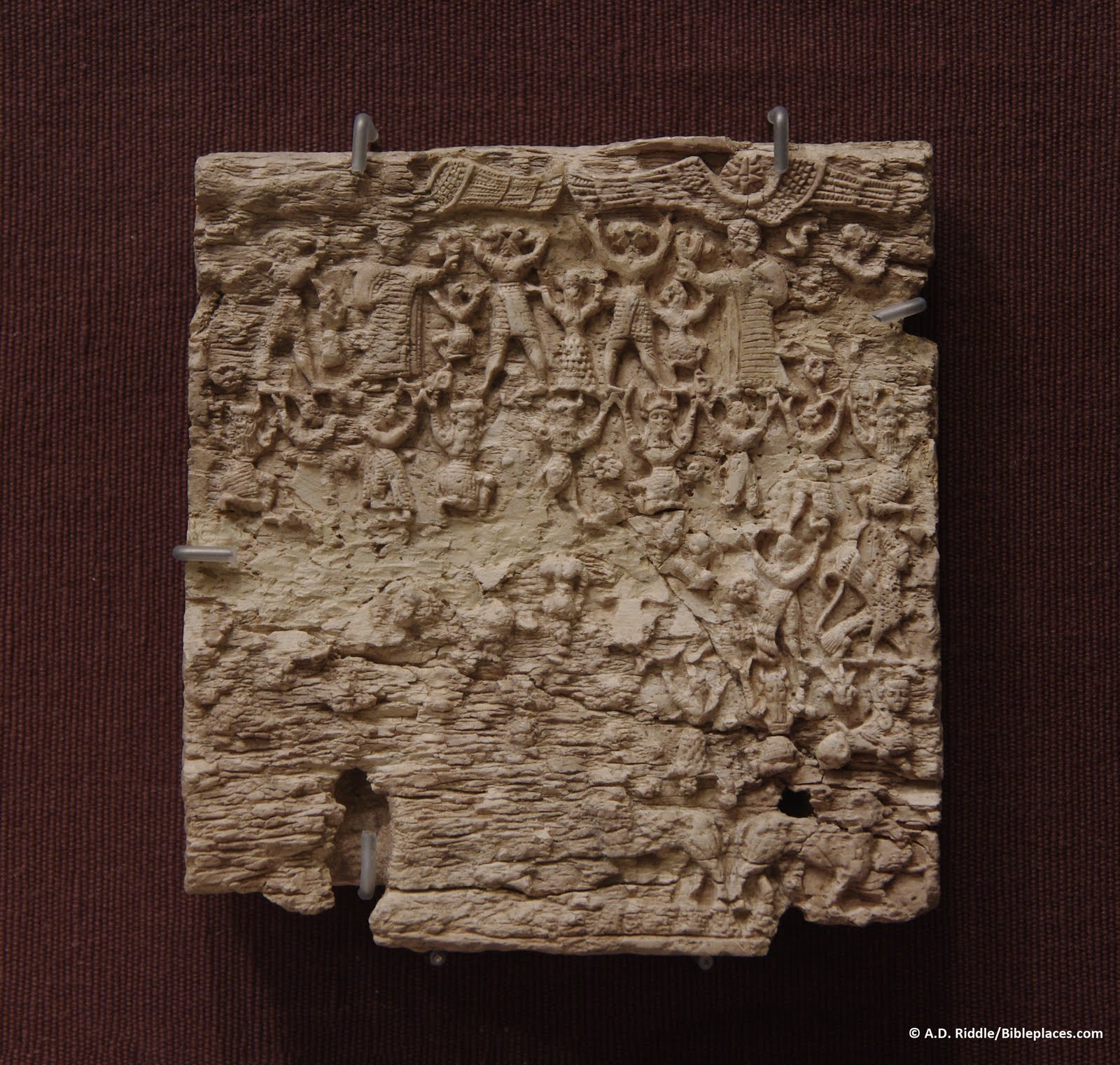
A Hittite plaque made of ivory from Late Bronze Megiddo,
Oriental Institute Museum, Chicago.
Not included in Lost Treasures of the Bible.
Share:

(Guest post by A.D. Riddle.)

At Urartian sites in northeast Anatolia, archaeologists have discovered geometric “rock signs” that were cut into bedrock. Some 134 signs have been found at 20 different sites (fortresses, canals, graves) in modern Turkey, Armenia, and Iran. The signs are circular, “U”-shaped, “V”-shaped, or sickle-shaped, and they are dated to the 8th and 7th centuries B.C. Regardless of location, the signs are all very similar in shape and dimensions to one another, with the signs from the later period being slightly smaller than the earlier ones.

Belli 2001: 365, fig. 2

Belli 2001: 367, fig. 7

It was originally thought the rock signs were used for grape presses, but this has been ruled out. Other ideas included quarries, hieroglyphs, or some religious function, but the conclusion is “there are no definite answers for now” (Belli 2001: 368).

In 2006, Erkan Konyar suggested that the rock signs were molds for shaping wooden chariot parts, and perhaps other wooden implements. (A pdf of his essay can be downloaded here.) He was able to identify the same component parts in depictions of chariots in Urartian and Assyrian reliefs, and the rock signs appear to correspond in shape and dimension to wheels, axle-braces, spokes, yokes, and hooks.

If he is correct, the “V”-shaped signs would have been molds for braces, spokes, and/or yokes.

Belli 2001: 367, fig. 8

The dimensions of the “V”-shaped signs are fairly close to the dimensions given for the “V” marks in the City of David (see here and here). The City of David marks are 5 cm deep and the Urartian rock signs are 4-10 cm deep. The City of David marks are 50 cm in length, and the Urartian “V” rock signs vary between 60 and 70 cm in length.

So, could the City of David marks be molds for shaping wooden implements? The wood would have to be softened in water first, and the marks appear to be conveniently located near Jerusalem’s water source. It would be irresponsible to suggest anything further at this point since we still have not heard many of the details about the marks from the City of David’s excavators, but the similarities with Urartian signs and the interpretation of them by Konyar are intriguing.

REFERENCES

Belli, Oktay.

2001 “Surveys of Monumental Urartian Rock Signs in East Anatolia.” Pp. 365-369 in İstanbul University’s Contributions to Archaeology in Turkey (1932-2000). Ed. O. Belli. Istanbul: İstanbul University Rectorate Research Fund.

Konyar, Erkan.

2006 “An Ethno-Archaeological Approach to the ‘Monumental Rock Signs’ in Eastern Anatolia.”
Colloquium Anatolicum 5: 113-126.

Share:

On Tuesday, August 2, nineteen small objects from the Metropolitan Museum of Art in New York will arrive in Egypt. The agreement to return the objects was negotiated in November 2010 when Zahi Hawass was Secretary General of the Supreme Council of Antiquities of Egypt, a post now held by Mohamed Abdel Maksoud. The objects come from the tomb of Tutankhamun and were purchased by the Metropolitan Museum of Art in the early 20th century from the estate of Howard Carter, who discovered the tomb.

The story is being reported in several outlets, including here and here and here.

HT: Jack Sasson

Share:

Unreported Heritage News reports on a lion statue discovered at Tell Tayinat. The excavation season began June 21 and will continue through August. The basalt statue is 1.5 meters tall and weighs 2 tons and depicts a seated, roaring lion. So far, it seems only to have been reported in the Turkish media, and so we rely on images and Google Translate to sketch out some of the story.

The Tayinat Archaeological Project official website has some small photos at the bottom of their homepage. The dating of the statue is 9th-8th century B.C.

Turkish Journal has a still photograph of the statue being moved. (The Google translation is kind of dicey.)

Heberler has a five minute video of the lion being moved to the Antakya museum. At about 3:28 in the video, Timothy Harrison, the director of the Tayinat Archaeological Project, talks about the find to Turkish reporters via an interpreter. He states that they are excavating beneath the new temple which was discovered in 2008 (where the Esarhaddon treaty tablet was found). The lion apparently came from these earlier levels beneath the temple.

HT: Jack Sasson

UPDATE (Aug 9): The University of Toronto has now issued a press release on the lion statue.

Share:

In earlier posts (here and here), we noted plans to renew excavations at the site of Carchemish, perhaps even as early as this year. The ancient city straddles the modern Turkey-Syria border with the citadel and inner town in Turkey and most of the outer town in Syria.

A recent article at Antiquity’s Project Gallery describes ongoing work on the Syrian side of Carchemish. Since 2006, Tony Wilkinson, a specialist in landscape archaeology, along with Edgar Peltenburg, has been conducting surveys of the Carchemish region as part of the Land of Carchemish (Syria) Project. In 2009, that project has expanded to include the site of Carchemish itself with the initiation of the Carchemish Outer Town Project. The Antiquity article provides a description and preliminary report on the 2009 and 2010 seasons of the Carchemish Outer Town Project. The project has been conducting surface surveys, photographing features, and utilizing remote sensing data to map out the site.

We determined that the outer town ramparts were much more substantial than Woolley had surmised….Artefacts collected during 2009 and 2010 indicate a dominance of ceramics contemporaneous with Iron Age 2 levels at other sites in the region…Most parallel types appear in later eighth- and seventh-century contexts on these sites…The main phase of occupation was later than that suggested in the original excavation reports; our material suggests that it derives mainly from the time when the city was under Assyrian control, namely after their installation of a governor in 717 BC until the conquest of the city by the Babylonians in 605 BC. The surface ceramics imply that the Assyrians were responsible for the enlargement of the city, and that Carchemish was more significant in that period than has been previously assumed. Evidence of occupation in the periods preceding the Iron Age consists of a handful of sherds of possibly Middle Bronze Age date. The post-Iron Age ceramics are represented by small amounts of Hellenistic and Roman wares, making it difficult to determine the scale of the settlement in these periods.

See the Antiquity article for photographs, maps and more details about the project.

Share:

Aren Maeir reports today on the Tell es-Safi/Gath blog that a two-horned altar was discovered about one-and-a-half weeks ago at Tell es-Safi. It was found in a destruction level dated to the 9th century and attributed to Hazael, the king of Damascus.

1) It is the earliest stone altar from Philistia, a precursor of the many stone altars that are known from 7th century Tel Miqne-Ekron.

2) It is one of the largest altars known (save for the Tel Sheva altar [which though is made of many stones] and an altar from Ekron which was found out of context).

3) It is one of the earliest such altars from the Iron Age, save for those from Megiddo which are late 10th-9th cent. BCE.

4) It has TWO and not four horns – quite unusual for such altars. This is VERY interesting, since this may very well confirm a theory put forward by our team member Louise Hitchcock that there is a connection between the Minoan/Cypriote “Horns of Consecration” and the horned altars – perhaps brought by the Philistines.

5) Its dimensions are virtually identical to the dimensions of the incense altar in the biblical tabernacle (1X1X2 cubit) in Exodus 30!

6) Quite surprisingly, the back part of the altar, and part of the top is unfinished! While the back part might have been “built-in” to a niche behind it (and this could explain the unfinished parts) the top is hard to explain.

7) No evidence of burning or residues were found on top of the altar, although a very nice Cypriote “Black on Red” flask was found right near it. Perhaps it originally stood on top of the altar!

8) Surrounding the altar we found large concentrations of various types of vessels and several concentrations of astragali.

For more details and several photos of the altar’s discovery, read Aren’s full announcement.

UPDATE: Joe Lauer sends along notice that the Foundation Stone website has a photo showing the newly discovered altar from another angle. There is also information about a radio interview with Aren Maeir on the LandMinds show, set to broadcast on Wednesday.

Share: