From the Caspari Center Media Review:

The Yardenit Baptism Site, situated on the Jordan River, is to undergo extensive development in the coming year. In order to improve the site, a fourth baptism station will be opened up, and “10 new ceramic wall hangings with the text from the Book of Mark 1:9-11, which speaks of John baptizing Jesus, [will be] added to the 70 plaques” that constitute the “Wall of New Life.” A representative from the site says that “the guiding principle underlining Yardenit … is the fact that it is totally non-denominational, and pilgrims are welcome to perform their baptism rituals in accordance with their particular beliefs and traditions.”

This must mean that business is good. In the meantime, it may be more difficult to get photos of the river without bulldozers and rebar.

The above article is not yet online. Copyright of the article remains with the Caspari Center.

Jordan River baptism at Yardenit baptismal site, tb011406482

Jordan River baptismal site at Yardenit
Photo from Galilee and the North
Share:

The German Protestant Institute of Archaeology announces the upcoming lectures:

Wednesday, February 6, 2013: Florian Lippke (Universität Bern, Schweiz) “Comparative remarks on Late Persian iconography: The case of Samaria.”

Monday, February 18, 2013: Dr. Shimon Gibson (University of the Holy Land) “The Bethesda Pool Excavations, 1863 – 1967: A Re-assessment.”

All lectures takes place in the institute (Auguste Victoria Compound, Mount of Olives) at 5 pm.

Source: The Agade list

Share:

One of the most head-shaking stories of early explorers in Jerusalem is that of Montague Parker’s expedition to discover the Ark of the Covenant. Stephen Gabriel Rosenberg tells the story in the Jerusalem Post, and if you haven’t heard it before, it’s worth the read. Here’s an excerpt:

With the help of his two Turkish supervisors, Parker and his men claimed an area of ground near the entry to the Gihon water system, known at the time as the Virgin’s Spring, which was then fenced off and guarded by Turkish troops, who did not allow entry to any locals or other visitors. The Jerusalem Pasha Azmey Bey had been suitably bribed to turn a blind eye to the work.
Parker’s activity naturally aroused the intense concern of the local archeological community. The Germans, French and British all had their missions in Jerusalem, but Parker would give out no communication and allow no inspection. His men proceeded with the digging, but they were amateurs and it went slowly and with little result.
Back in London, the Finnish scholar Juvelius had hired an Irish medium, who studied the documents and sent directions to the team about suitable locations. He advised Parker to search the long water tunnel, so Parker sent to London to obtain the services of two mining engineers who had worked on the Metropolitan Railway, the first line of the London Underground. Then he made another excellent move.

The full account is here. If you like stories like this, I recommend Neil Asher Silberman’s Digging for God and Country. The book is  out of print, but still available in used bookstores.

HT: Joseph Lauer

Gihon Spring, tb031003202
The Gihon Spring of Jerusalem
Share:

Luke Chandler:

I’ve used Todd Bolen’s Pictorial Library of the Bible Lands collection for several months. I’ve tried it with Bible classes, history classes, sermons, etc. and my conclusion is…
Wow.
I posted on the new expanded set a few months ago before I had actually obtained it. It was clearly a useful product. Now that I’ve used it, I can’t imagine life without such a valuable, enriching tool.
The Pictorial Library set includes some 17,500 photos of nearly everything you could imagine in the Bible Lands. For me, the best part is the 400+ PowerPoint presentations included with the set. The PowerPoint files contain all of the photos ready-to-go. They are organized by location and contain great slide notes that inform and complete your presentation.

You can read all of Luke’s assessment at his blog.

You can learn more about the new Pictorial Library of Bible Lands here, download a free PowerPoint presentation of Caesarea here, and place an order here. Individual volumes cost $24-$39. The complete set of 18 volumes is now marked down to $389 (a 35% discount). Larger discounts are available for upgraders.

BiblePlacesProduct-PLBL

Share:

(Post by Seth M. Rodriquez)

Having worked through the revised and expanded edition of the Pictorial Library of Bible Lands in this series, we will begin highlighting pictures in a lesser known (but extremely fascinating) series called Historic Views of the Holy Land.  This is a sister collection to the PLBL and is featured in a website called LifeInTheHolyLand.com.

Here is a brief description of the series from the website:


The Historic Views of the Holy Land series is an extensive collection of thousands of photographs, drawings, and maps of the biblical lands from the 19th and 20th centuries.   


The collection, upon which this website is based, features  

  • the most detailed and accurate maps of Palestine made before the birth of the state of Israel  
  • pictures from award-winning photographers who traveled through Egypt, Palestine, Lebanon, Syria, Turkey, and Greece in the 19th century  
  • photographs and drawings which illustrate biblical scenes, including Psalm 23, the Good Samaritan, and the Woman at the Well.

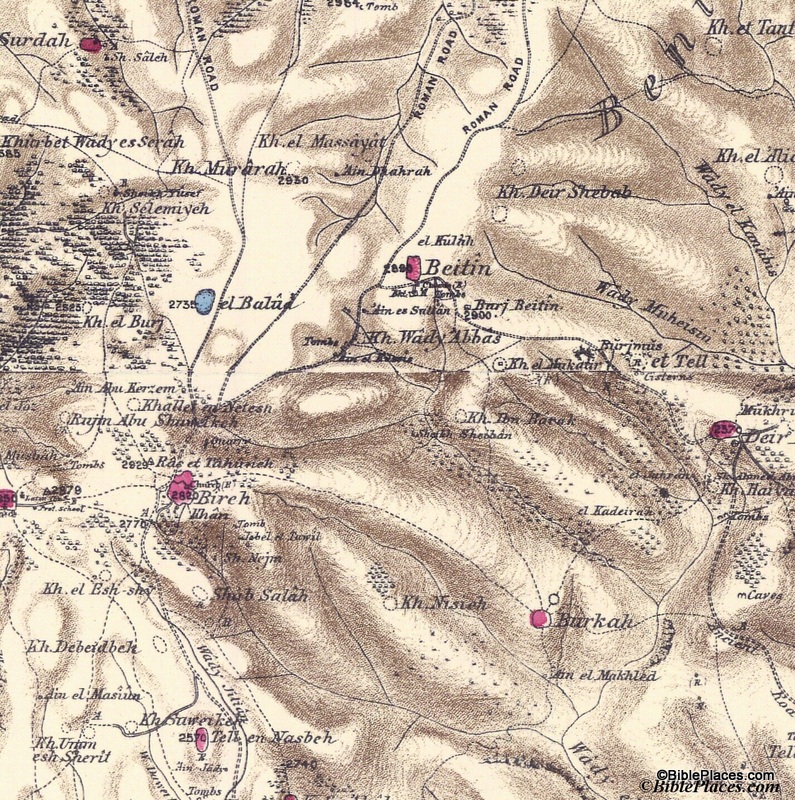
The first bullet point relates to our “Picture of the Week.”  These are the maps created by the Palestine Exploration Fund in the 1870s and published as the Survey of Western Palestine.  The maps contain an amazing amount of detail, were the most accurate maps produced in its day, and were created before the massive political and cultural changes were made in the country during the 20th century.  Produced at a scale of 1 inch to 1 mile, these maps are a treasure trove for students and scholars interested in biblical geography.  A full explanation of the maps and their value can be found here.

Our picture this week focuses on one small area of the maps: the region of Bethel and Ai.

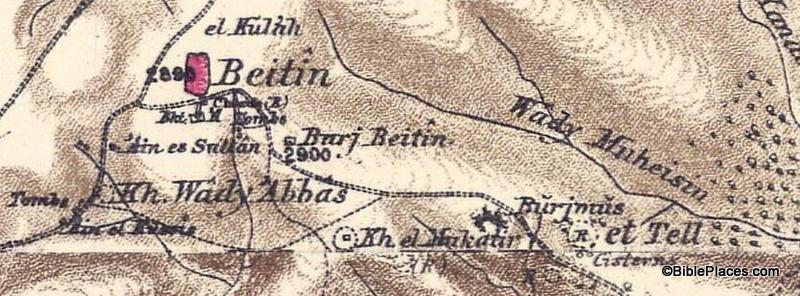
This section shows Beitin as a pink oval in the upper center of the map, which is usually identified as Bethel. It also shows et Tell in the right center and Khirbet el Mukatir to the east of et Tell.  The city of Ai (Gen. 12:8; Josh. 7:2) is identified by many scholars as et Tell, but the Associates for Biblical Research have been conducting excavations at Khirbet el Mukatir over the last couple of decades to investigate the possibility of identifying that site as Ai instead.  Below is an enlargement of the section of the map that shows Beitin, Kh. el Mukatir, and et Tell so that you can see the relationship between the three sites (click on the picture for a higher resolution):

This is just one example of the many uses of the Survey of Western Palestine Maps.  The originals of these maps are not easily accessible in libraries, but the electronic versions are available to all through the Historic Views of the Holy Land collection.

Further information and other images of the Survey of Western Palestine Maps can be found here.  You can download the index to the maps for free here, and you can purchase the maps by visiting here.  For another example of how these maps can be used, see my post on the Wild Olive Shoot blog here.

Share: