An undisturbed 3,500-year-old soldier’s tomb with enormous treasures has been found in southwest Greece.

A secret tunnel built by the Hittites has been discovered in central Turkey.

Twenty two ancient shipwrecks have been discovered off the coast of Turkey.

A fine first-century marble head of the mythical greek hero Hercules has been acquired by the Dallas Museum of Art.

Charles Jones has posted a preliminary bibliography of autobiographies of scholars of the greater Ancient Near East.

Haaretz: “How Did a Judean Seal End Up in a 2,000-year-old Russian Warrior Woman’s Grave?”

The Cuneiform Digital Library Initiative has added to its library works from the Detroit Institutes of Arts.

“Scan Pyramids” is a new study by Egyptian and foreign experts that will use modern infra-red technology to map four pyramids and search for hidden secrets.

David Moster identifies 10 great biblical artifacts in the Bible Lands Museum Jerusalem.

Lenny Ben-David shares a photo essay entitled “Secrets under the Al-Aqsa Mosque.”

The Jordan Times reports on restoration efforts at Macherus. The Hungarian team plans to excavate
until 2029 and to create a visitor’s center in a Herodian cistern.

HT: Joseph Lauer, Ted Weis, Keith Keyser, Wayne Stiles, Agade

Share:

Israel’s Ministry of Foreign Affairs has posted an initial list of excavations in 2016. There are a couple of options if you’d prefer to avoid the hot temperatures and high airfares of the summer.


WSJ: A Boy’s Discovery Rebuts Temple Mount Revisionism

The Temple Mount Sifting Project provides an update on their crowd funding campaign. Even a small contribution would be appreciated.

Omer Eshel takes a look at “The Hidden Gems of Israel” on The Land and the Book radio program with Charlie Dyer.

If you’re an American non-tenured faculty member, you may qualify to apply for a $7,000 travel award to experience archaeology in Israel.

The Book and the Spade remembers Adam Zertal with the re-broadcast of a 1993 interview (mp3).

Available now via Luke Chandler: “King David’s City at Khirbet Qeiyafa: Results of the Second
Radiocarbon Dating Project,” by Yosef Garfinkel, Katharina Streit, Saar Ganor, and Paula J. Reimer.

The samples date to ~1000 BC.

A Byzantine winepress was discovered on the Sharon Plain following a severe rainstorm.

“You tithe mint, dill and cumin…but neglect…justice, mercy, and faithfulness.” Ferrell Jenkins explains and illustrates.

Alexander Schick will be lecturing on November 4, 6:30 pm for the University of the Holy Land in

Room 211 of the Rothberg Institute. The title: “Genius or Thief? Constantine Tischendorf turns two hundred – the life of the famous Bible hunter and the case of the Codex Sinaiticus in the light of newly discovered documents from his personal archives.” For more on this subject, see here.

Share:
by Chris McKinny

Many visitors to Israel have visited the Nahal Zin and hiked into Ein Avdat. While witnessing the canyon’s spectacular views and wildlife, visitors will probably be informed that Nahal Zin was the southern border of the promised land (and thereby Canaan and the tribe of Judah) based on a connection between the large, continuous canyon (Arabic – Wadi el-Marra) and the southern boundary descriptions in the Bible (Num. 34:4; Josh. 15:3).
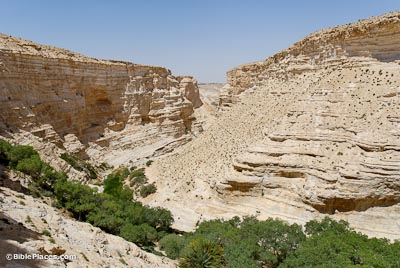
Ein Avdat – BiblePlaces.com

The identification of Wadi el-Marra with part of the Wilderness of Zin seems to be very plausible, even if the name “Nahal Zin” is a modern construction. Essentially, the identification of Wadi el-Marra with the southern boundary is based on the following two pieces of evidence: 1.) Wadi el-Marra is the only natural topographic boundary in the region and 2.) it is located between the Ascent of Akkrabim and Kadesh-barnea (Ein el-Qudeirat), which fits the biblical description. However, there is an additional piece of evidence that seems to make this identification even more secure – the location of Mount Halak at Jebel Halaq. Update – see here for Musil’s description of Jebel Halaq (German).

Southern Boundary Markers of Canaan/Judah on Karte Von Arabia Petraea (A. Musil 1906)

This identification was made over a century ago by Alois Musil in his Karte Von Arabia Petraea who was told that the northern cliff face of Wadi el-Marra (i.e. Nahal Zin) was called Jebel Halaq by the local population. Since “jebel” means “mountain” in Arabic and the second part of the name is identical to the biblical place name, this identification was generally accepted. However, since the early cartographic projects did not cover the Negev Highlands (e.g., the Survey of Western Palestine, Van De Velde’s Map) most are unaware of this connection and its implications for biblical geography. Mount Halak is mentioned twice in the book of Joshua, in both cases it is within a north-south boundary description describing the territory that Joshua conquered.

“So Joshua took all that land, the hill country and all the Negeb and all the land of Goshen and the lowland and the Arabah and the hill country of Israel and its lowland from Mount Halak, which rises toward Seir, as far as Baal-gad in the Valley of Lebanon below Mount Hermon. And he captured all their kings and struck them and put them to death. Joshua made war a long time with all those kings.” (Josh. 11:16–18 ESV) 

“And these are the kings of the land whom Joshua and the people of Israel defeated on the west side of the Jordan, from Baal-gad in the Valley of Lebanon to Mount Halak, that rises toward Seir” (Joshua 12:7 ESV)

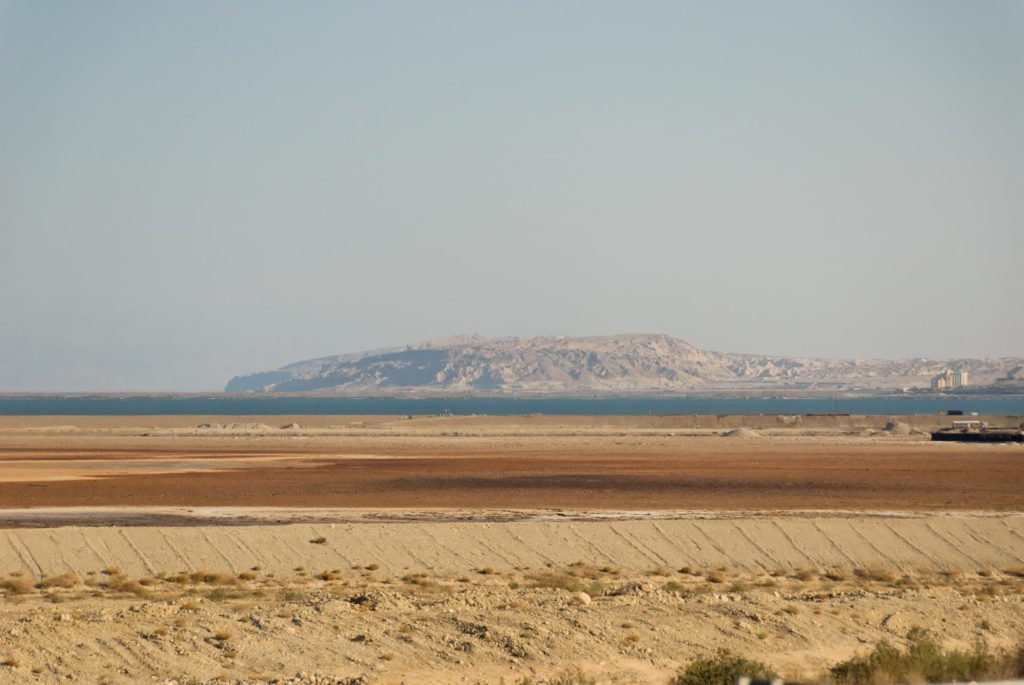
Aerial view of Nahal Zin with view of Mount Halak (Jebel Halaq), photo by Bill Schlegel

Jebel Halaq faces towards southern Jordan and the mountains of Edom (i.e. Mt. Seir), which matches the passages from Joshua. When we add Mount Halak (Jebel Halaq) to the accepted identifications of Tamar (En-Hazeva), the Ascent of Akkrabim (Roman road west of Tamar rising to Mamshit), and Kadesh-barnea (Ein el-Qudeirat), it is clear that the various boundary descriptions were describing the same border, which they demarcated using various topographical features (oases, mountains, and natural roads). 

For those who visit the Nahal Zin/Ein Avdat, Mount Halak (Jebel Halaq) can be seen either on the bus ride down to the hike or at the Ben-Gurion tomb, which overlooks the Nahal Zin. Be sure to look that way next time you make it down there!
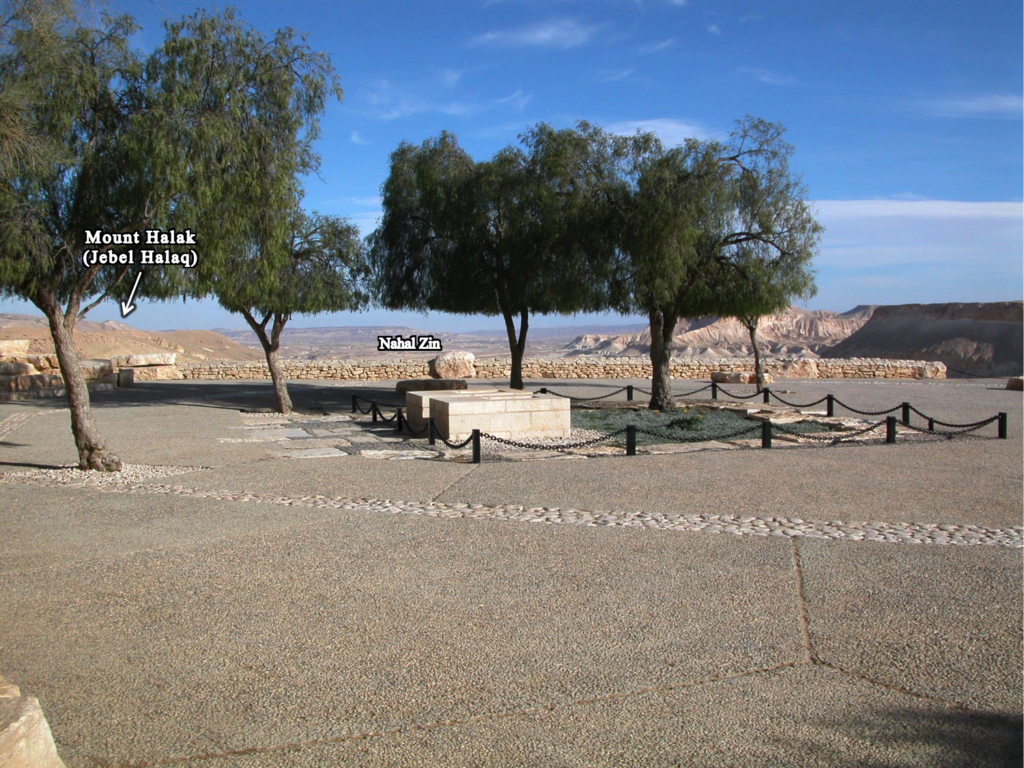
Ben-Gurion tombs with Nahal Zin and Mount Halak in background
Share:

A new study claims that an Egyptian text is the oldest known abecedary.

Haaretz‘s report on Gabriel Barkay’s Temple Mount sifting project include several pictures of findings.

A UNESCO resolution that claimed the Western Wall prayer plaza as an Islamic shrine has made some people unhappy.

German experts are restoring the golden mask of King Tut after its beard was broken off and clumsily repaired.

The Journal of Near Eastern Archaeology reports that there are groups other than the Islamic State who are destroying and plundering antiquities in Syria.

The Getty Villa in Los Angeles is exhibiting 1800’s era watercolor paintings of Greece, many offering insight into how ancient sites looked in the early 19th century.

Emily Corrigan shares her experience of a summer on the Jezreel Expedition.

Egyptian authorities are investigating the embezzlement of $20 million from construction funds for the Grand Egyptian Museum.

Zahi Hawass throws cold water on the proposal that Nefertiti’s tomb has finally been located.

Ferrell Jenkins shares a photo he took of a fishing boat on the Sea of Galilee as the sun was rising.

The newly renovated Waldorf-Astoria in Jerusalem has been ranked the top hotel in the Middle East in a survey by Condé Nast Traveler.

Test your knowledge about Petra with 10 questions at the ASOR Blog.

The newly released NIV Zondervan Study Bible, edited by D. A. Carson, is on sale now for Kindle for $7.99. (I wrote the notes for 2 Kings.)

Chris McKinny has made available on Academia his presentation on “Kiriath-Jearim (Deir el-‘Azhar): Archaeological Investigations of a Biblical Town in the Judean Hill Country.”

Conference at Hebrew U on Oct 29: “I Know What You Did Last Summer: A Glimpse at the Excavations and Surveys of the Institute of Archaeology, 2015 Season.”

Adam Zertal died on Sunday at the age of 79. He was best known for his survey of the hill country of Samaria and his identification of a structure on Mount Ebal as the altar of Joshua.

Thomas Schaub died on Monday at the age of 82. Schaub excavated Bab edh-Dhra.

HT: Ted Weis, Charles Savelle, Joseph Lauer, Agade, Paleojudaica

Share:

Archaeologists working on the Gezer water system have new evidence supporting its dating to the Middle Bronze period. Volunteers are invited for next season’s dig.

A court has ruled that Elad can continue to run the Jerusalem Archaeological Park in the City of David.

The Museum of the Bible has announced plans to excavate Tel Shimron in Galilee.

Palestinians have set fire to the traditional tomb of Joseph in Shechem.

Nearly 1,000 riders completed a three-day bike race in northern Israel. Dates have been announced for Epic Israel 2016.

Nehemia Gordon shares his experience in working on the Temple Mount Sifting Project. You can donate to the effort here.


The New York Times has issued a correction for their article on the Temple Mount. Jodi Magness’s letter to the editor is here.

ISIS’s destruction of the Roman Arch of Triumph in Palymra made some Russians unhappy.

Egypt is opening a small museum at the Cairo airport later this month.

Volume 3 of NGSBA (Nelson Glueck School of Biblical Archaeology) Archaeology has been released. The articles are primarily about the excavations at Yehud and Maresha. The entire issue can be downloaded for free. Previous volumes are available here.

The Oriental Institute has begun posting their photo archives online. Images are now available from Egypt, Iran, Iraq, Syria, and Lebanon. As far as I can tell, the images are all low-res.

Jodi Magness reviews The Tomb of Jesus and His Family?, edited by James H. Charlesworth. She provides a summary of the articles, including the one by A. Kloner and S. Gibson, excavators of the Talpiot tomb. Ben Witherington provides an abbreviated version of her review.

Brent Seales is on the Book and the Spade to talk about the technology that enabled reading the oldest biblical text outside the Dead Sea Scrolls. Listen here.

Here’s a unique tour of Israel: the Life and Land of Jesus, with Wayne Stiles. This should be particularly attractive for those who want to return but don’t want to visit the same places as every time before.

HT: Agade, Joseph Lauer, Paleojudaica

Our most popular Facebook post and tweet of the week:

Mount of Beatitudes aerial from northeast, ws011415241
The Mount of Beatitudes, Tabgha, Gennesaret, Arbel – so much of Jesus’s ministry right here!
Share:
by Chris McKinny

Yesterday, Huffington Post released a story that re-hashed the equation that Tall el-Hammam may be identified with biblical Sodom proposed by S. Collins. While there is nothing new to report from the story and Todd and Bill Schlegel have clearly illustrated many of the difficulties with this identification, I would like to take it a step further and point out an additional geographical/toponymic problem with the Tall el-Hammam = Sodom viewpoint.

Mount Sodom (Jebel Usdum) from north – copyright BiblePlaces.com

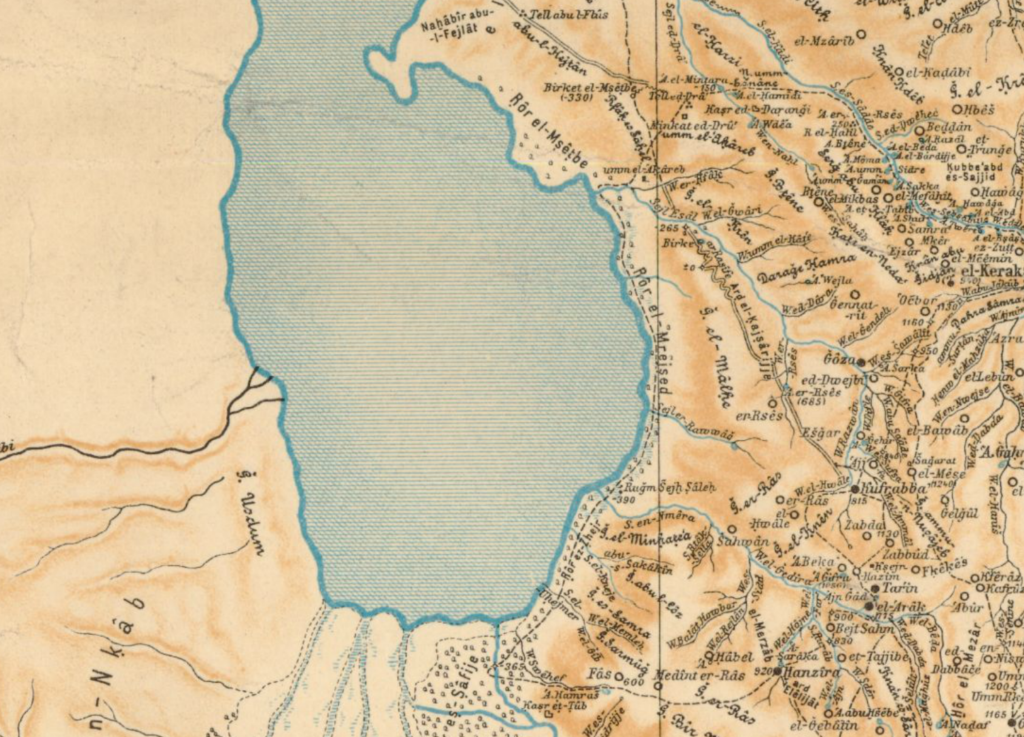
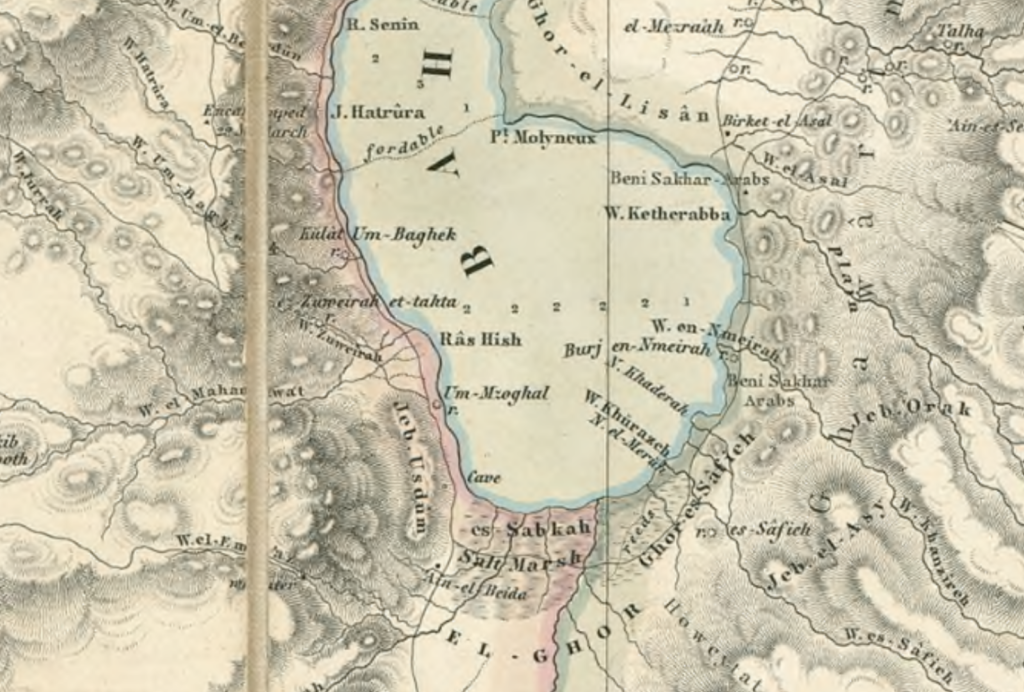
Simply put, there appears to be good toponymic evidence for the traditional references to “Mt. Sodom” that is located on the southwestern side of the Dead Sea. Researchers may be unfamiliar with this evidence, because it is absent from both the well-known Survey of Western Palestine Maps (which did not survey this part of Palestine) and the later British Mandate Map of the Negev prepared by S.F. Newcombe. In fact and somewhat ironically, this area is a bit of a black hole in the early cartographic sources of 19th and early 20th century Palestine. However, at least two sources clearly show the name “J. Usdum” in the area that is commonly referred to as Mt. Sodom. One of these sources is the lesser known map of Arabia and Petrea prepared by Alois Musil in 1900, which can be found online in three parts here. The other is a very important map prepared by Charles Van de Velde that includes the mid-19th century explorations of Edward Robinson and Charles Van de Velde and also shows the name “Jeb. Usdum” on the rocky scarp above the western shore of the Dead Sea.

Section of Musil 1900 – Karte von Arabia Petraea – see “J. Usdum” on left side near Dead Sea
Section of Van de Velde 1865 – Map of the Holy Land – see “Jeb. Usdum” on left side near Dead Sea

To those unfamiliar with Arabic toponymy and its relation to biblical place names – Jebel Usdum would seem to clearly preserve the name “Sodom.” The toponym’s proximity to the southern candidates (e.g., Bab edh-drah, Numeirah, etc.) would at least plausibly connect them to the cities of the plain or perhaps to destroyed and then submerged cities within the Dead Sea (as originally suggested by Albright 1924:2-12). This connection finds further support in Eusebius’ description of the “Lasan” (Hebrew = Lisan [tongue]) that he describes as being “near Sodom” (Onom. 120.3). The Lisan is the boundary of the promised land below the Dead Sea (Josh. 15:2). In light of this evidence and regardless of one’s opinion regarding the historicity or chronology of the patriarchal narratives that mention Sodom, the occurrence of Jebel Usdum on the southwestern shore of the Dead Sea together with the early Christian witness to Sodom near the “Lisan” would seem to be (more) compelling evidence that Sodom and the cities of the plain should be located on the southern end of the Dead Sea.


Bibliography

Albright, W. F. 1924. The Archaeological Results of an Expedition to Moab and the Dead Sea. BASOR 14: 2–12.
Share: