(Post by A.D. Riddle)

Oftentimes, while researching archaeological sites and/or biblical places, I come across things like this:

map reference 193.142
M.R. 219156
1972 1954

These are grid coordinates for sites. One encounters them in key works such as The New Encyclopedia of Archaeological Sites in the Holy Land (5 vols.), Anchor Bible Dictionary, or the volumes from the archaeological survey of Israel. I want to locate these sites in Google Earth, but how do I convert them? (This subject came to mind while reading Chris McKinny’s post on Shaaraim [see here].)

There are two coordinate systems for Israel, the Old Israeli Grid and the New Israeli Grid. Sometimes these are abbreviated OIG or NIG, but typically no indication is given as to which coordinate system is being used. (To read more about OIG, see this page, and for NIG this page.) I have found that most coordinates are according to OIG, even in newer publications. I am going to assume we are using OIG. (If not, hopefully the results are so wrong that one can tell right away that they are not OIG. This point highlights the fact that you need already to have some kind of rough idea where the right location is so that you can verify the results.)

The coordinates should have an even number of digits. Sometimes they are divided in half by a space, period, or slash, but other times there is nothing separating the string of digits.

If you are given six digits, then the first three digits give one coordinate and the second three digits give the other coordinate. If you are given eight digits, then the first four are one coordinate and the second four are the other. And so on.

The first coordinate gives the easting position (think longitude or x-axis), and the second coordinate gives the northing position (think latitude or y-axis). In other words, the coordinates give you lon/lat. This is the opposite order we normally use of lat/lon for geographic coordinates.

The first (easting, x) coordinate is actually always six digits. If you are only given three digits, then you need to append three zeros to the right side. If you are given four digits, then append two zeros to the right side.

The second coordinate, on the other hand, can be six or seven digits, and is a little more complicated. For the second (northing, y) coordinate, if you are given three digits, then you have to append a “1” to the left side and three zeros to the right side.

With these expanded coordinates, you can now make the conversion using a fantastic website named “The World Coordinate Converter.” (Thanks to Shawn French for finding this gem.) In the top right, from the first dropdown list, scroll down to Israel and select Israel 1923. This is the Old Israeli Grid.

Then, paste the coordinates into the fields. Below this in the second dropdown list, you will need to select “WGS 84/Pseudo-Mercator.” It is found under *World, which is the first group of reference systems. This is the datum used by Google Earth. Finally, click Convert and voila! you have coordinates that you can copy/paste into Google Earth/Maps.

Here are three examples.

Khirbet Jazzir

  1. Anchor Bible Dictionary gives the coordinates 219156 for Khirbet Jazzir. This is thought to be the most likely site for the Levitical city Jazer.
  2. The easting (longitude, x-axis) coordinate is 219. We need to add three zeros to make this a six digit number, namely 219000.
  3. The northing (latitude, y-axis) coordinate is 156. We need to add a “1” to the left and three zeros to the right to get 1156000.
  4. Now go to “The World Coordinate Converter,” select Israel 1923, and paste in the expanded coordinates in the same order they were given to us, 219000, 1156000. Make sure you are converting to “WGS 84/Pseudo-Mercator” and click the Convert button.
  5. The converter generates the following lat/lon coordinates that I can then paste right into Google Earth: 31.996063441518004, 35.728730514891744. Make sure lat is first, and lon is second.

Tell el-Maṣfā

  1. In an article by Israel Finkelstein, Ido Koch, and Oded Lipschits, entitled “The Biblical Gilead: Observations on Identifications, Geographic Divisions and Territorial History,” it is proposed that Mizpah of Gilead be identified with Tell el-Maṣfā.
  2. The coordinates given are 227193.
  3. This gets expanded to 227000, 1193000.
  4. The convertor returns 32.32932657748971, 35.815608335148326 which can be used in Google to locate the site. (We note that these coordinates do not correspond to the hill that they have marked on the p. 143 photograph. It looks to me like their arrow needs to be moved about 1 inch to the left.)

Karm er-Ras

Finally, I was recently asked to make a map that shows Karm er-Ras in Galilee. The Hadashot Arkheologiyot article for this site gives very precise coordinates for each excavation area, both NIG and OIG. The OIG coordinates for Area A are 181580/239335. These are already six digits, so all I need to do is paste them into “The World Coordinate Converter” to get 32.74860752349965, 35.33387296365357.

Additional Notes

The OIG and NIG coordinates are measured in meters. If you are given three digit coordinates, then the accuracy could be off by about half a kilometer. If you are given all six digits, then your accuracy is sub-meter.

If the “The World Coordinate Converter” fails to load the Converter, you can still use the website to get the information you want. Once you select Israel 1923 and paste in your coordinates, a placemark will appear on the map with an info-window. The lat/lon coordinates that you can use in Google Earth appear within this info-window.

For batch conversions, you can supposedly import a CSV into Eye4Software Coordinate Calculator 3.2 (Windows only).  I have not successfully completed a batch conversion, but the software claims it can do so.

Share:

Of the latest concerning “the tomb of Jesus,” the evidence doesn’t add up, according to professors at Yale and Notre Dame. Other scholars agree.

Jeffrey Zorn’s talk on Storage Bins at Tell en-Nasbeh (biblical Mizpah) is now online (20 min).

Archaeologists from the University of Manchester are busy excavating a site in Iraq in an effort to save history from ISIS terrorists.

In fear of ISIS’s advance, monks at the Mar Matti Monastery in Iraq hid their collection of ancient manuscripts.

An opinion piece in the New York Times calls on the world to use force to stop ISIS’s campaign against historic sites and artifacts.

Should antiquities be repatriated to countries unable to protect them?

The latest podcast from Exploring Bible Times focuses on the Hill of Moreh.

Yossi Garfinkel’s talk from last fall at Florida College is now online.

HT: Agade

Share:

The Holy Fire ceremony was celebrated in the Church of the Holy Sepulcher today.

It snowed on Mount Hermon this morning. The annual precipitation in Israel this year is close to average.

Hershel Shanks is a guest on The Book and the Spade talking with Gordon Govier about 40 years of publishing Biblical Archaeology Review.

Leen Ritmeyer is interviewed on the Voice of Israel about his involvement in the archaeology of Jerusalem and the Temple Mount.

The Mujib Biosphere Reserve (biblical Nahal Arnon) is open for another adventure season.

Wayne Stiles provides a spiritual lesson from the skeleton that today stands on ancient Gibeah.

New Bible atlas: The Historical and Geographical Maps of Israel and Surrounding Territories, by
Arnold G. Fruchtenbaum, with $10 off the $89 price through April 30.

We’re sharing our favorite 12 sites in Galilee on Facebook and @BiblePlaces.

HT: Steven Anderson

Holy fire ceremony from dome, mat14517
The Holy Fire ceremony in the Church of the Holy Sepulcher
Photo from The American Colony Collection, ca. 1941
Share:

The declining water level of the Dead Sea is creating sinkholes which are in turn threatening roads, campsites, and beach areas. This past winter two free beaches along the western shore of the Dead Sea have been closed, leaving visitors with fewer and more expensive options.

Nir Hasson writes in Haaretz on the damage to the area, including this part about the En Gedi area.

About two months later it was decided to close the part of the highway opposite Kibbutz Ein Gedi, which is prone to sinkholes, to be replaced by a bypass road. This has led to transportation snarls. Thousands of day-trippers were stuck in a kilometers-long traffic jam. For the kibbutz members every trip takes between 10 minutes to an hour and a half longer. Nimrod Hacker, the head of the community, says that people reserve a room in the hotel and are unable to get there, goods are stuck, farmers who go down to the orchards get stuck in traffic jams.
The 1.5- kilometer section of highway between the nature reserve and the kibbutz must be the most expensive section in the history of the country. In the past decade tens of millions of shekels have been invested, most of which went to waste because of the sinkholes. In 2009 a new and very expensive bridge was dedicated above Nahal Arugot. In recent years the bridge had been “attacked” by sinkholes, and it was recently put out of service along with the section of the highway.
Many solutions have been proposed, any one of which would require an investment of hundreds of millions of shekels, and perhaps over a billion ($255 million), for a 1.5 kilometer section.
It’s no longer sinkholes, it’s massive sinking of land along 700 meters. The wild animals and the Nahal David and Nahal Arugot nature reserves are also liable to suffer from the road that will be dangerously close to them.
Another blow for Ein Gedi came when the Tamar Regional Council and Netivei Israel, the transportation infrastructure company, decided to close the last free beach at the Dead Sea, along with the gas station, the kiosk and the new camping area that were inaugurated on Sukkot. The regional council invested 4 million shekels in improving the beach, and a festive opening was planned for Passover. In addition, a large percentage of the kibbutz’s date orchards, as well as camping grounds, were abandoned years ago because of the sinkholes.
Closing the last free beach now presents a major challenge for those who want to bathe in the Dead Sea. The last organized beaches charge dozens of shekels per person, and bathers also have to descend steps and terraces or travel in a special train, whose route lengthens by the year, in order to reach the water. In the hotel area you can still swim in Dead Sea water – not at the beach but in the industrial swimming pool built by the Dead Sea Works.

The full article is here.

En Gedi new bridge over Nahal Arugot, tb010810115
Bridge over Nahal Arugot, after dedication in 2009; this bridge is no longer in use.
Dead Sea beach, tb100403500
Dead Sea beach at En Gedi, now closed
Share:

Ben Witherington responds to the latest claim by Simcha Jacobovici that the James Ossuary came from the Talpiot Tomb, thereby proving that this was the burial place of Jesus the Messiah.

Of course [Aryeh] Shimron has not published his results yet, nor has there been peer review of them by other scholars, but nonetheless another Jacobvici movie is already in the works. This is not how proper and objective scholarship is done, either in terms of the financing, nor in terms of the announcements of results. You don’t sort of make a bombshell announcement of conclusions to the press on Easter weekend before other peers have had a chance to weigh in on the evidence, unless of course you are trying to make an impression of a certain sort. And there is little doubt that a certain agenda is being pursued here, as has been clear before with previous films, and in all likelihood with the forthcoming one. Disinterested pure science this is not.

James Tabor responds to Witherington here, but he does not address the issues that Witherington has raised in the paragraph above. If the scholarship is so solid, why use such unscholarly methods?

HT: Ted Weis

Share:
(Post by A.D. Riddle)

Yesterday we mentioned the Royal Inscriptions of the Neo-Assyrian Period publication project. The Neo-Assyrian kingdom (sometimes empire) began with the reign of Tiglath-pileser II ca. 966 B.C. and continued for 3-1/2 centuries until 609 B.C. when the Assyrians were definitively defeated by the Babylonians.

The first Neo-Assyrian king to have direct contact with Israel was Shalmaneser III, who ruled 858-824 B.C. Shalmaneser III is not mentioned in the Bible, but he mentions two kings of Israel in his inscriptions. A version of Shalmaneser III’s royal annals was inscribed on the Kurkh Monolith, a stele found at the base of the tell at Kurkh (now modern Üçtepe), near the Tigris River in Turkey. The annals recount (among other things) Shalamaneser III’s campaign in 853 B.C. to Qarqar where he fought a coalition of kings including Irhuleni of Hamath, Hadad-ezer of Damascus (possibly Ben-Hadad II), and Ahab of Israel. See Michael Caba’s post about the Kurkh Monolith here.


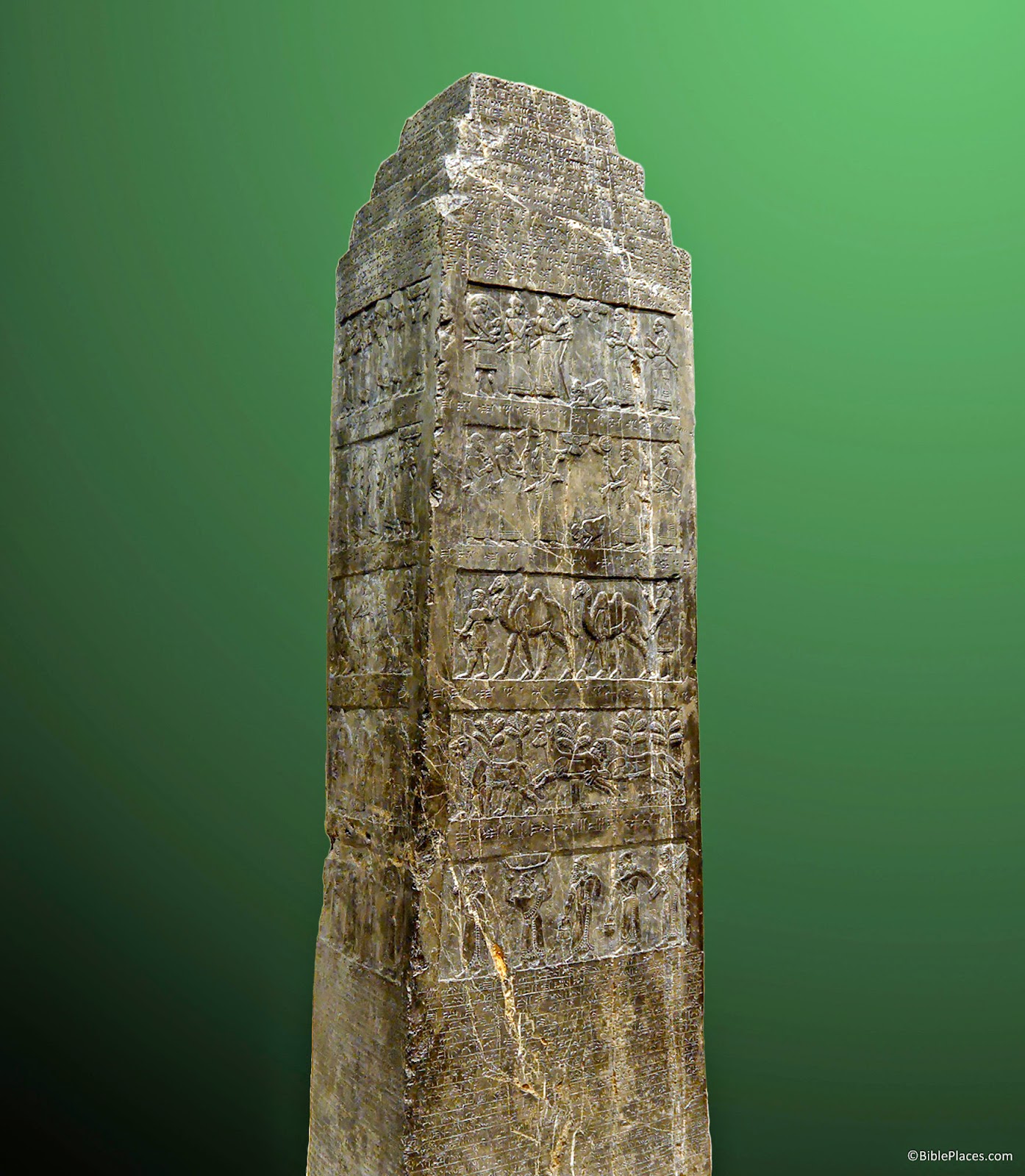
This same Neo-Assyrian king about 12 years later, in 841 B.C., campaigned against Damascus and in the process received tribute from Jehu of Israel. The event is recorded in several of Shalmaneser III’s inscriptions and is pictorially represented on the Black Obelisk. Again, see Michael Caba’s post about this monument here.

Black Obelisk (British Museum).

Following were a series of five kings who oversaw a period of relative weakness in the Neo-Assyrian monarchy: Shamshi-Adad V, Adad-nerari III, Shalmaneser IV, Ashur-dan III, and Ashur-nerari V. Although military campaigns were still conducted, this period saw rebellions in the heartland of Assyria, increase in the number of years the Assyrian king did not go on campaign, the rise in power of Assyrian governors who in some ways behaved as kings in their own right, and the massive expansion of Urartu to the north which posed a threat to Assyria.

None of these five kings are mentioned in the Bible, and only Adad-nerari III mentions a biblical king. During a campaign against Damascus in 796 B.C., Adad-nerari III received tribute from Jehoash of Israel.

The next king of Assyria, Tiglath-pileser III, paved the way for the Assyrian empire’s greatest expansion and he initiated the demise and eventual fall of the northern kingdom of Israel. Tiglath-pileser III and the next five kings are all mentioned by name in the Bible. Furthermore, these kings mention several kings of Israel and Judah in their inscriptions.

  • Tiglath-pileser III
    • 2 Kings 15:29; 2 Kings 16; 1 Chronicles 5:26; 2 Chronicles 28:20
    • Mentions Menahem of Israel, Pekah of Israel, Hoshea of Israel, Uzziah/Azariah of Judah, and Ahaz of Judah
  • Shalmaneser V
    • 2 Kings 17:3; 2 Kings 18:9
    • Conquers the northern kingdom of Israel in 722/721 B.C.
  • Sargon II
    • Isaiah 20:1 = campaign to Ashdod in 712 B.C.
  • Sennacherib
    • 2 Kings 18–19; 2 Chronicles 32; Isaiah 36–17
    • Mentions Hezekiah of Judah (see Michael Caba’s post here)
  • Esarhaddon
    • 2 Kings 19:37; Ezra 4:2; Isaiah 37:38
    • Mentions Manasseh of Judah
  • Ashurbanipal
    • Ezra 4:10
    • Mentions Manasseh of Judah
Stele of Tiglath-pileser III from Iran in which he mentions Menahem (Israel Musum).

There were at least four more kings after Ashurbanipal, but none of these are mentioned in the Bible, nor do any of them mention kings of Judah, for the Neo-Assyrian kingdom collapsed and ceased to exist within 18 years. The Medes captured the city of Ashur in 614 B.C., and the city of Nineveh in 612 B.C. The Babylonians pursued the Assyrians westward, defeating them at Harran in 610 B.C. and finally at Carchemish in 609 B.C.

Share: