The February 2014 issue of the BiblePlaces Newsletter was sent yesterday (you can read it here, or sign up for future newsletters here). After it went out, A.D. Riddle alerted me to the availability of three of the missing volumes of the Survey of Western Palestine, now online for free. We’ve now updated that article to include all of the available volumes. If you simply want to access the volumes we just added to the list, you can do that with these links: Special Papers on Topography, Archaeology, Manners and Customs, etc. (1881), by C. Wilson, C. Warren, C. R. Conder, et al. (pdf) The Survey of Western Palestine: Memoir on the Physical Geology and Geography of Arabia Petraea (1886), by E. H. Hull (pdf) Survey of Eastern Palestine: Topography, Orography, Hydrography and Archaeology: The Adwan Country (1889), by C. R. Conder (pdf) We’ve also updated the single file download of all 10 available volumes in pdf format. If you want the maps to go along with them, you can get high-quality scans along with a number of other valuable features in our collection here ($35).
The sensational discoveries get all the media (and blog) attention, but too little is reported when the initial claim falls short. One example is the papyrus fragment that mentions “Jesus’ wife” which Harvard University probably wishes would just quietly be forgotten. (More than a year later, there is still no report from a test that was supposed to take weeks.)
Another case is that of the “Jesus family tomb” in Talpiot. There was a barrage of sensational press coverage when the movie was released, but what do scholars say once they’ve had a chance to evaluate the evidence?
Eerdmans has just released a volume based on a conference convened in Jerusalem in 2008. The Tomb of Jesus and His Family?: Exploring Ancient Jewish Tombs Near Jerusalem’s Walls was edited by James H. Charlesworth, and the 600-page volume includes 28 chapters written by several dozen contributors. The work is selling on Amazon for $34. Here are a few of the chapters:
The Talpiot Tomb Reconsidered: The Archaeological Fact
s, by Amos Kloner and Shimon Gibson
Identifying Inscriptional Names in the Century Before 70:
Problems and Methodology, by André Lemaire
Demythologizing the Talpiot Tomb: The Tomb of Another Jesus,
Mary, and Joseph, by Stephen Pfann
On the Authenticity of the James Ossuary and Its Possible Link to ‘the Jesus Family Tomb,’ by Amnon Rosenfeld, Howard R.
Feldman, and Wolfgang E. Krumbein
The Burial of Jesus in Light of Jewish Burial Practices and
Roman Crucifixions, by Lee Martin McDonald
Polemics, Irenics, and the Science of Biblical Research, by James H. Charlesworth
The full table of contents is available via the preview in Google Books.
Eerdmans has also produced a 22-minute video interview with James Charlesworth.
- Tagged Resources, Tomb of Jesus
The Tan Institute for Jewish Studies at Emory University is hosting a symposium to honor Professor Oded Borowski on Tuesday, February 4. Full details are here.
It appears that the conference proceedings will be published, and the first three chapters I plan to read are:
Christopher A. Rollston, Judean Foreign Policy in the Eighth Century BCE: Epigraphic Evidence for Political Engagement with the Great Empires
Andrew Vaughn, Should All of the LMLK Jars Still Be Attributed to Hezekiah? Yes!
K. Lawson Younger Jr., The Assyrian Impact on the Levant in Light of Recent Study
The website includes a full list of lectures along with a statement honoring Oded Borowski. His most popular books are well known to those who love ancient Israel:
Agriculture in Iron Age Israel (1987, 2009)
Every Living Thing: The Daily Use of Animals in Ancient Israel (1997)
Daily Life in Biblical Times (2003)
HT: LMLK Blogspot
- Tagged Lectures
With the cooperation of local landowners, a new national park may be established at Tal al-Umayri (el-Umeiri) in Jordan.
Archaeologists have discovered what may be the oldest Roman temple at the foot of Capitoline Hill in Rome.
“The remains of a bustling port and barracks for sailors or military troops have been discovered near the Giza Pyramids.”
Archaeologists working at Tell Abu al-Kharaz in the Jordan Valley believe they have evidence that some of the Sea Peoples settled there ca. 1100 BC.
A new computer system in use by the Israel Antiquities Authority will enable archaeologists to create “a national database of sherds, a kind of sherd Google.” (Haaretz; registration required)
Some of Syria’s historic sites are being destroyed for political reasons.
A Study Guide of Israel: Historical & Geographical, by Arnold Fruchtenbaum is on now on sale at Logos for $18. ($52 used at Amazon.)
The HCSB Study Bible is on sale for the Kindle for $3.
This diagram shows Paul’s missionary journeys in the form of a London subway map.
Leona Glidden Running, co-author of a biography of W. F. Albright, has died.
HT: Joseph Lauer, Jack Sasson, Mark Hoffman

Photo by AERA.
- Tagged Discoveries, Egypt, Jordan, Resources, Syria, Technology, Weekend Roundup
(Post by Seth M. Rodriquez)
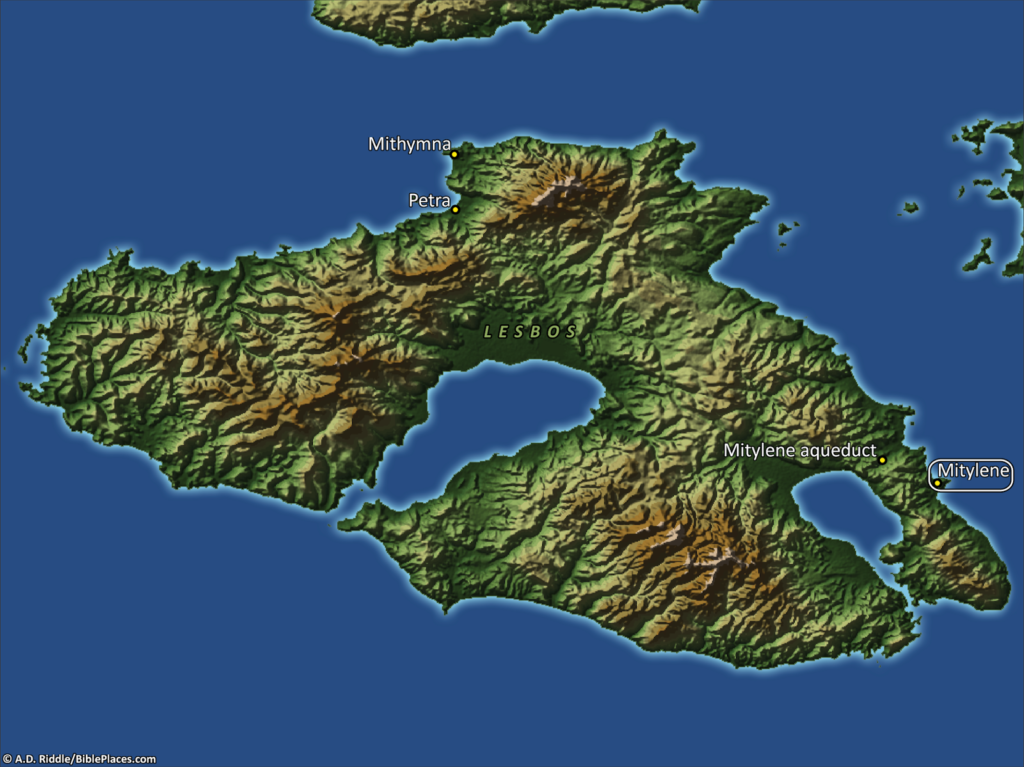
Our “obscure site” for the week is the Roman city of Mitylene, a city that Paul visited during his third missionary journey. (Click on the map above to see its location on an island off the coast of modern Turkey.) If you don’t remember reading about this city in the New Testament, don’t feel too bad. It is only mentioned in passing and Paul spent less than a day there while he was traveling back to Jerusalem. Perhaps the best way to remember it is to tie it to the story of Eutychus.
Eutychus was the young man (or boy) who fell asleep while listening to Paul preach late into the night. Unfortunately, Eutychus was sitting in a window sill and fell to the ground from the third floor after he dozed off. Luke writes that he was “picked up dead” (Acts 20:9, NASB). But fortunately Paul miraculously brought him back to life (Acts 20:10-12). This happened in Troas on the western shore of Asia Minor (modern Turkey). Paul left Troas the next day, walked twenty miles to the city of Assos, and then boarded a ship where Luke was waiting for him. Luke continues the story by saying:
And when he met us at Assos, we took him on board and came to Mitylene. Sailing from there, we arrived the following day opposite Chios; and the next day we crossed over to Samos; and the day following we came to Miletus. For Paul had decided to sail past Ephesus so that he would not have to spend time in Asia; for he was hurrying to be in Jerusalem, if possible, on the day of Pentecost. (Acts 20:14-16, NASB)
So only a few days after raising Eutychus, we find Paul in Mitylene. This passage makes clear that Paul was quickly moving through this territory and it is not even clear that he set foot on the island of Lesbos where this city is located. Consequently, the city finds itself on our list of “obscure sites in the Pictorial Library of the Holy Land” instead of prominently displayed on the BiblePlaces website along with Samos, Miletus, and Ephesus.
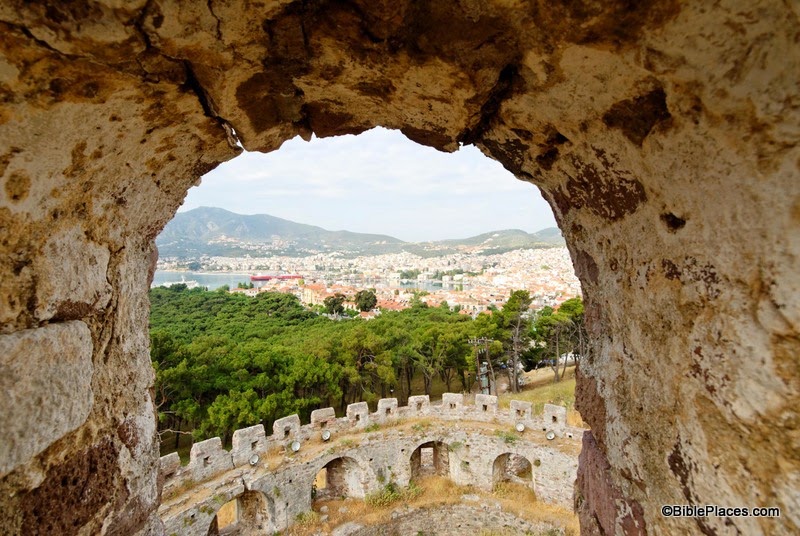
In the image above, you can see the modern city of Mitylene through the window of a medieval castle that sits on the city’s peninsula. This peninsula is actually man-made, similar to the one at Tyre. The castle sits on what was once an island that stood a short distance from the shore. At some point in the city’s history, a causeway was constructed from the shore to the island, and subsequently two harbors were formed (one of which probably sheltered Paul’s ship during the night he was there). The ancient city was inhabited from about 1200 B.C. until A.D. 151 when it was destroyed by an earthquake. In addition to the apostle Paul, the city also played host to Aristotle and Epicurus during its long history.
Now, you probably did not get up this morning and expect to read a blog post about the obscure city of Mitylene or the biblical story of Paul and Eutychus, but this post illustrates an interesting phenomenon … We are curious creatures and images have a way of drawing us into a story. They lead us to want to know more. If you are a teacher, a preacher, a professional in the corporate world … someone who stands up in front of people and delivers information verbally … you should take note of this and use it to your advantage. We live in a visual culture. We also live in a generation that has resources which previous generations could only dream of, if they could imagine them at all. We have at our fingertips photographs and illustrations of places and things all over the world! So the next time you stand up to talk about obscure (or not-so-obscure) topics, start with a photograph. Draw your listeners in by using an image as a springboard to your discussion. Equip yourself with collections such as the Pictorial Library of Bible Lands, Historic Views of the Holy Land, or something similar that exists in your field of expertise. Then use people’s natural curiosity to lead them where you want them to go. Once you have their attention, you can take them anywhere.
This photo is available in Volume 12 of the Pictorial Library of Bible Lands and is available here for $24 (with free shipping). This volume focuses on the Greek Islands, and includes the islands of Samothrace, Samos, Patmos, Cos, Rhodes, and others.
- Tagged Obscure Sites, Picture of the Week
(Posted by Michael J. Caba)
The BiblePlaces Blog provides updates and analysis of the latest in biblical archaeology, history, and geography. Unless otherwise noted, the posts are written by Todd Bolen, PhD, Professor of Biblical Studies at The Master’s University.
As an Amazon Associate we earn from qualifying purchases. In any case, we will provide honest advice.