The site identified as the most eroded site in Israel is Tell Jemmeh, located on the bank of the Nahal Besor about 7 miles (12 km) due south of the city of Gaza. The site was identified as biblical Gerar by W. J. Phythian-Adams and Sir Flinders Petrie. Benjamin Mazar’s suggestion that Tell Jemmeh is Yurza is now commonly accepted. Yurza is mentioned in Egyptian and Assyrian texts but not in the Bible. The source of the quotation is the “Jemmeh, Tell” article by the late Gus W. Van Beek in The Anchor Bible Dictionary, volume 3, page 677.

We had a number of good responses in the comments yesterday, all of which show that there are many severely eroded tells in Israel. The correct answer was given by Dr. Carl Rasmussen, but if you’re feeling bad that you lost out, you can take comfort in the fact that you lost to someone who has written one of the best Bible atlases!

Tell Jemmeh side washed out by Nahal Besor, tb050701352
Tell Jemmeh, showing erosion caused by the Nahal Besor.
Photo from the Pictorial Library of Bible Lands,
volume 5
Share:

Can you identify this site?

“[The site] originally occupied a mesa encompassing an area of 4.92 hectares (12.15 acres). It is the most-eroded major site in Israel, the N end having been destroyed by flash floods in Nahal [X], and the S end by severe erosion. The area on the top of the mound is now reduced to 0.26 hectares (0.64 acres) from an estimated original area of 3.04 hectares (7.51 acres). The site is the highest point in the landscape, reaching a height of 22 m (71 feet) above present ground level. Its upper 15.50 m (50 feet) is occupation debris of successive towns.”

If you know the answer, you’re welcome to post it in the comments below. If you discover the answer by research, please do not post it in the comments below. I’ll post the answer, source of the quotation, and a photo tomorrow.

Share:

The best way to get up to speed on the major discoveries at Hazor from the Bronze Age is with Amnon Ben-Tor’s article on the ASOR Blog.

A brief report of the finds and surprises from the season at Gezer has been written by the excavators.

This year’s excavations of Gath are over, but Aren Maeir is making us wait for a summary of “one of the most productive, interesting and overall great seasons we have had since the project began (in 1996…).” Check out the rest of his blog for season-end photos.

Though most tourists skip Ashkelon, this Haaretz article reveals how the site is “a treasure full to bursting.”

I failed to note previously a couple of articles following up on the discovery of the “palace of David” at Khirbet Qeiyafa. A Baptist Press article provides some balanced coverage. And excavation volunteer Luke Chandler gives his personal perspective.

The theater in Assos is being renovated to accommodate events for up to 5,000 people.

Mark Wilson provides some background for 1 Corinthians 3:17 from the destruction of the Ephesian temple of Artemis.

The Oxford Encyclopedia of the Bible and Archaeology is now reduced to $235. It’s currently out of
stock, and I don’t know how long the discount will last. (This is an unusually large discount when compared with other Oxford sets such as OAENE, OEAGR, and OEBB.)

HT: Jack Sasson

Assos theater and acropolis from below, tb041605082
The theater and acropolis of Assos
Photo from the Pictorial Library of Bible Lands, Western Turkey
Share:

(Post by Seth M. Rodriquez)

In the 1970’s and 1980’s, the remains of several ancient harbors were identified around the Sea of Galilee. At least 13 harbors have been identified, all of which most likely date to the Hellenistic and Roman Periods. A map of the various harbors can be seen here. The work of archaeologists in this area (most notably, the labors of Mendel Nun) have provided us with significant insights into what life was like for fishermen who worked on the Sea of Galilee during these periods.

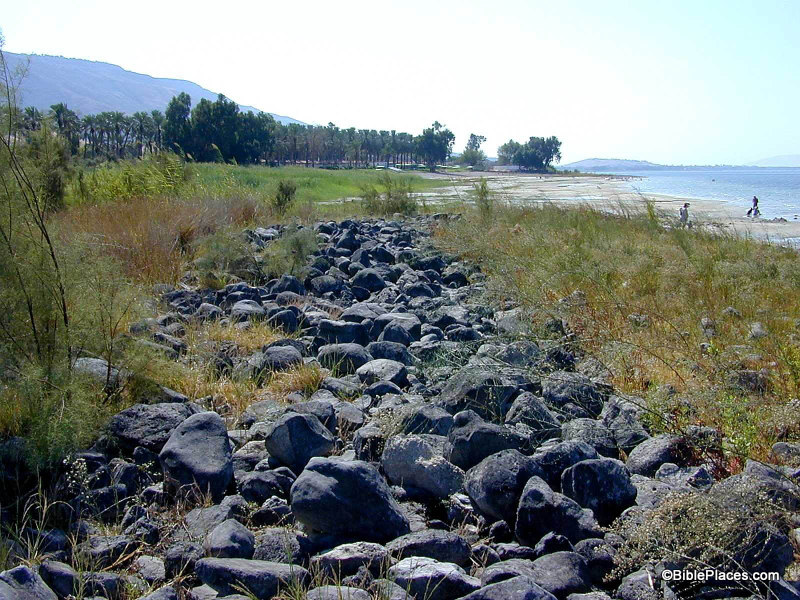
Our picture of the week comes from Volume 1 of the Pictorial Library of Bible Lands, and shows the remains of the main breakwater of the harbor of Susita (a.k.a., Hippos) on the southeastern shore of the Sea of Galilee. The photo was taken at a time when the water level in the lake was extremely low, so the breakwater stands several meters from the shore. However, in ancient times this breakwater would have provided boats with shelter from dangerous storms that can occur on the lake (for example, see Matt. 8:23-27).

This harbor was a typical one on the Sea of Galilee during this period. The breakwater was man-made and extended from the shore, enclosing an area of about an acre with a gap on the south end for boats to pass in and out.  In the map referenced above, the Hippos harbor can be seen at the bottom right.  Mendel Nun, in his book Ancient Anchorages and Harbours Around the Sea of Galilee (Kibbutz Ein Gev, Israel: Kinnereth Sailing Co., 1988), describes this harbor in the following way:

The harbour of Susita was built to fit the conditions of the sandy shore. The central breakwater is 120 meters long; its base is five to seven meters wide. The stone breakwater projecting from the shore turns to the south and runs nearly parallel to the shore at a depth of -211.25 meters [693 feet below sea level] for another 85 meters.

At the far end it curves sharply to the west and extends into the lake to a depth of -212.5 meters [697 feet below sea level]. This shape makes for a long inner area open to the south; a second breakwater was therefore constructed which extends from the shore for 40 meters. The inner part of the harbour thus formed a closed basin enclosing an area of about an acre. A small jetty leading north from the breakwater was for passengers embarking and disembarking, saving them the tedious procedure of passing through the narrow harbour entrance.  Indications that this entrance was deepended [sic.] may still be seen.

The total lenght [sic.] of all the breakwaters in this harbour comes to 180 meters.  The sides were built of rows of stones, the interstices filled with smaller rocks, re-used building stones, fragments of lime columns. During the past few years of low water, the silt filling the harbour has been overgrown by shrubbery.  (Nun, Ancient Anchorages and Harbours, pp. 13-14.)

Harbors such as this bear witness to the thriving economy around the lake during the time of Christ. Although people have probably always fished in the lake, the Roman Period was a time when fishermen were especially active and an unusually high number of settlements were constructed around the Sea of Galilee. According to Mendel Nun, “all settlements on the shores of the Sea of Galilee, even the smallest, had an anchorage, each built to suit local conditions and requirements.” (Ibid., p. 27.) So harbors such as this would have been part of the everyday life of people living next to the lake. Insights such as this add color to our reading of the stories in the Gospels.

This photograph and over 1,100 others are available in Volume 1 of the Pictorial Library of Bible Lands, and is available here for $39 (with free shipping).  Additional images of the Sea of Galilee can be found on the BiblePlaces website here and here, and on LifeintheHolyLand.com here.  Images and information about fishermen on the Sea of Galilee in the 19th century can be found here on LifeintheHolyLand.com.  Additional information about the ancient harbors around the Sea of Galilee can be found here.

Share:

The discovery of an ancient olive press in Jerusalem was announced yesterday.

The “Naked Archaeologist” is suing one of its many critics in Israeli court.

Megiddo V: The 2004-2008 Seasons is now available from Eisenbrauns.

The warm springs of Sachne/Gan HaShlosha are one of the best places to swim in Israel, particularly on a school day when the crowds are absent.

The BibleMap App connects every chapter of the Bible with Google Maps.

Chris McKinny has been leading students from The Master’s College IBEX program at the Tel Burna Excavation Project for several years. His work is the subject of a new article on the college’s website.

Luke Chandler shares a 7-minute video of a recent field trip to the important site of Gezer.

Tourists will surely be affected by the massive renovation of Highway 1 between Tel Aviv and
Jerusalem.

Sachne warm springs, tb103002104
The warm springs of Sachne/Gan HaShlosha
Photo from the Pictorial Library of Bible Lands
Share:

Whenever you see a sensational claim such as the discovery of a specific item mentioned in the Bible, you should be suspicious. In most cases, the archaeologist seems to be driven more by a desire for attention than by the evidence (e.g., the Cave of John the Baptist, the palace of David, or anything announced by Yosef Garfinkel in the last six years).

This one is immediately different than others in that the archaeologist is Amihai Mazar, a scholar of impeccable reputation. On the other hand, it was first reported by CBN, a ministry under the leadership of Pat Robertson. (As of this writing, it is not reported in any other news outlets. A carefully prepared CBN video of the story is here.)

Mazar has suggested that a room found in his excavations at Tel Rehov was inhabited by Elisha on the basis of (1) two incense altars found nearby, (2) a table and a bench discovered in the room, and (3) a fragmentary inscription reconstructed to read Elisha. In addition, the location of Tel Rehov is situated along a route that Elisha traveled between his home in Abel Mehola and the woman’s house in Shunem (2 Kings 4:8ff). According to the article, Stephen Pfann “calls the evidence compelling.”

The article does not attempt to evaluate this sensational claim. While there are or will be critiques by scholars who dismiss the veracity of the biblical account, this analysis comes from one who believes in the accuracy of the Old and New Testaments.

Before accepting the suggestion that the home of Elisha has been discovered at Tel Rehov, you
should consider the following:

1. The inscription that mentions Elisha is incomplete and the reading is reconstructed. This article does not make it clear how many letters are missing, but some have been supplied by scholars. This conjecture may or may not be correct.

2. There is no reason to believe that there was only one person named Elisha in ninth century Israel.

Though only one is named in the Bible, others may well have existed.

3. Even if this inscription reads Elisha, there is no reason to believe that Elisha inhabited the building where it was found. Many other scenarios can be imagined apart from his residence here. 

4. There was presumably more than one room in ninth-century Israel that had a table and a bench.

Though 2 Kings 4:10 says that Elisha’s room in Shunem had a table, bed, chair and lamp, this does not indicate that every room in Israel with a table and a bench belonged to Elisha.

5. The presence of incense altars is not particularly unique as they have been found in many locations. I would argue that the presence of such altars is evidence against Elisha’s presence, for surely he would have advised for their destruction because they violated God’s law (cf. 1 Kgs 3:3; 2
Kgs 12:3).

6. While the location of Tel Rehov seven miles (12 km) from Elisha’s hometown of Abel Meholah is interesting, it seems an unlikely place for Elisha to have a lodging place only a two-hour walk from home. 2 Kings 4 says that the Shunamite woman prepared a room for Elisha and this makes sense given its position midway between his destinations of Abel Meholah and Mount Carmel. It is not clear why Elisha would need another one, and there is no evidence in the Bible that he stayed at Tel Rehov.

It is not impossible that this discovery is everything that the article suggests, but adding improbability to improbability does not make the case stronger. The quotation near the end that this is “one more proof [of biblical accuracy] for what we call the doubting world” is an all-too-common example of failing to analyze the data when the proposal fits your beliefs. It happens on both sides, but it bothers me more when it happens on mine.

HT: Joseph Lauer

Tel Rehov aerial from east, tb121704086
Tel Rehov, aerial view from east
Photo from the Pictorial Library of Bible Lands, volume 2
6.5-Elisha-Jehoram-Jehu-Aram-Satellite-Bible-Atlas-Schlegel
Area of Elisha’s ministry; Tel Rehov is near Beth-shan.
Map from the Satellite Bible Atlas
Share: