Archaeologists working in Pompeii have “discovered four skeletons and gold coins in the ruins of an ancient shop in Pompeii.”

Archaeologists working at Carthage have uncovered a “smart cooling system” for chariot racers.

As restoration work on the Roman Colosseum moves from outside to inside, officials hope to use it one day for cultural events.

A stele depicting childbirth won an Egyptian Antiquities Ministry poll.

Digital scanning is revealing previously unseen portions of the Dead Sea Scrolls and raising new interpretive questions (Haaretz premium).

The latest issue of Biblical Archaeology Review includes stories on Paul’s riot in Ephesus, Eilat
Mazar’s excavations in the City of David, and the reconstruction of the Umm el-Qanatir synagogue.

The Syrian military has cleared thousands of booby traps from Palmyra, yet some are claiming that they are looting. Franklin Lamb has a detailed first-person report in two parts.

Barry Britnell reports on his recent visit to the Biblical History Center (formerly the Explorations in
Antiquity Center) in LaGrange, Georgia.

Ferrell Jenkins shares a couple of photos related to the Story of Sinuhe.

Duane W. Roller reflects on geography in the ancient world.

The Associates for Biblical Research are looking for a Pre-publication Editing Assistant Volunteer for Bible and Spade.

We’ll be taking a couple of weeks off from roundups, but we’ll include any stories you suggest when we return.

HT: Charles Savelle, Ted Weis, Agade, Joseph Lauer

Repairs inside the Dome of the Rock are complete, and when they took photos this week, it was revealed that the reconstruction of the tile floor proposed by the Temple Mount Sifting Project is accurate.

The study of fish bones found in a 7th-century AD shipwreck near Dor indicates that a now-extinct subspecies of St. Peter’s fish was being transported on the boat (Haaretz premium).

Scholars are offering competing explanations for the massive trash dump in the Kidron Valley from the first century AD (Haaretz premium).

A jogger along the shore of Ashkelon discovered a 12th-century AD oil lamp.

Aren Maeir is providing daily updates of the excavation of Gath.

The Tel Burna team gives an update from the first two weeks of their season. Chris McKinny’s work on the LB cultic building looks particularly promising in the remaining two weeks.

Jennie Ebeling and Norma Franklin discuss several important facets of their excavations at Jezreel.

Luke Chandler discusses the possibility of a Judahite water system at Lachish and the need for funds to excavate it.

If you’re interested in a brief, well-illustrated study of the world’s largest stones used in construction projects, check out Tom Powers’s latest post.

Felicity Cobbing of the PEF was present at the opening of the Palestine Museum in Ramallah and shares her perspective.

The senior staff of the Ashkelon excavations is wrapping up their final season this month and beginning a new project at Tel Shimron with a geophysical survey this summer.

Appian Media was recently filming in Israel for their upcoming Following the Messiah video series.

They are posting updates on the project and their travels on their blog.

The Fifth Gospel is a new iBook that explores the land, the culture, and the archaeology of the Bible. It was designed for high school students and features maps, interactive quizzes, photos, and short film clips. Check it out on iTunes.

HT: Agade, Joseph Lauer

From the Jerusalem Post:

A Roman gate discovered during excavations by the University of Haifa in the ancient city of Hippos, located at Sussita National Park, may cast light on the mystical bronze mask of Pan, considered by archeologists to be the only object of its kind in the world.
Researchers from the university’s Zinman Institute of Archaeology announced on Monday that they believe the gate may have led to the compound of Pan, the god of shepherds, after unearthing it during last year’s excavation season….
“Now that the whole gate has been exposed, we not only have better information for dating the mask, but also a clue to its function. Are we looking at a gate that led to the sanctuary of the god Pan or one of the rustic gods?”
[…]
The researchers concluded that the original gateway was over 6m. high, while the building (propylaeum) itself was even taller,” the archeologist said.
“The propylaeum can probably be dated to the period of the emperor Hadrian, who reigned from 117 to 138 CE, or slightly earlier,” Eisenberg said. “The mask was presumably fixed to a wall or altar at the compound, as its rear side included remnants of lead used for stabilization purposes.”

The full story, including photos, is here. A 3D model of the gate is here.

HT: Joseph Lauer, Charles Savelle
776A0663
Gateway at Hippos

Archaeologists working at Jerash (biblical Gerasa) have discovered part of a life-size statue of Aphrodite.

“American and Egyptian archaeologists have discovered a rare structure called a nilometer in the ruins of the ancient city of Thmuis in Egypt’s Delta region.” It was built in the 3rd century BC and used for 1,000 years.

British archaeologists have identified the remains of a 16- to 18-week-old mummified fetus that was found in Giza nearly 100 years ago.

The Antiquities Ministry of Egypt has completed a project to lower the groundwater at the Edfu Temple.

A plan has been approved that will remove all the mines around the traditional area of John’s baptisms on the Jordan River.

Haaretz (premium) visits the site of Tell el-Ajjul, once a prosperous Canaanite city south of Gaza but today at risk of complete destruction.

“Those who trust in the Lord are as Mount Zion which cannot be moved but abides forever” (Psalm 125:1). Wayne Stiles uses photos to explain what this means today.

Two archaeology students have crowdsourced images to create a VR reconstruction of the Mosul museum. The article includes a cool YouTube 360 video.

The Palestinian Museum opened this week in Bir Zeit, but it has no exhibits.

The enforcement of a new antiquities law is making it harder for black market antiquities to be sold in Israel.

Israel will be returning two Bronze Age wooden anthropoid sarcophagus lids found by IAA agents in an Old City dealer’s shop.

Of 28 Egyptian obelisks standing today, only 6 are in Egypt. That’s one of many interesting facts about obelisks in a WSJ article that is based on a book by Bob Brier entitled Cleopatra’s Needles.

Allison Meier reviews the new exhibition in NYC, “Gods and Mortals at Olympus: Ancient Dion, City of Zeus.” The article includes many photos.

Charles Jones has recently updated the list of titles in JSTOR which focus on Antiquity. It now includes 243 titles.

Dubgallu is a new forum for scholars of the ancient Near East. Registration is free, and open to anyone who academically studies the ancient Near East.

There’s a sale on for various electronic editions of the Zondervan Illustrated Bible Backgrounds Commentary, Old and New Testaments Logos, Accordance, and Olive Tree.

The Atlas of Palestinian Rural Heritage looks interesting. Some themes covered: Tilling – Harvesting – Moving the Harvest – Threshing – Sifting – Grinding – Making Dough – Baking Bread – Cooking – Making Grape Syrup – Sesame Oil – Olives and Olive Oil – Storage – Bard – Domestic Birds – Honeybee Farming – Milk – Shepherd – Washing – Water – Gathering Rainwater.

If you have a passion for biblical geography, perhaps you would consider supporting Seth Rodriquez to go to Zimbabwe to teach future pastors about the land of Israel. This is a great opportunity to help others learn about what we love.

I’ll be traveling for a few weeks and the regular roundups will resume when I return.

HT: Agade, Joseph Lauer, Steven Anderson

Old City from west, db6605212212
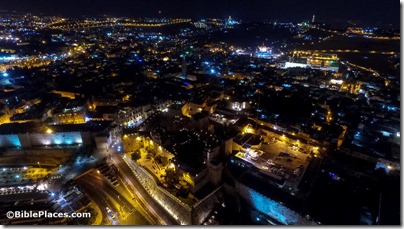
On this day 50 years ago, David Bivin took this photo while standing on the edge of no man’s land looking toward the Old City of Jerusalem, then occupied by Jordan. Photo from Views That Have Vanished.

Two scuba divers made the find of a lifetime last month when they discovered a shipwreck dating to the 4th century AD. In what has been called the most extensive underwater discovery in Israel in 30 years, the divers found statues, anchors, and lumps of coins, all remarkably well preserved on the seabed near Caesarea. The following quotations and photos are from the IAA press release.

“Many of the artifacts are bronze and in an extraordinary state of preservation: a bronze lamp depicting the image of the sun god Sol, a figurine of the moon goddess Luna, a lamp in the image of the head of an African slave, fragments of three life-size bronze cast statues, objects fashioned in the shape of animals such as a whale, a bronze faucet in the form of a wild boar with a swan on its head, etc.”

1

Bronze artifacts discovered in Caesarea

“One of the biggest surprises in particular was the discovery of two metallic lumps composed of thousands of coins weighing c. 20 kilograms which was in the form of the pottery vessel in which they were transported.”

9

Two lumps of coins, together weighing about 45 pounds

“‘The location and distribution of the ancient finds on the seabed indicate that a large merchant ship was carrying a cargo of metal slated recycling, which apparently encountered a storm at the entrance to the harbor and drifted until it smashed into the seawall and the rocks.’ A preliminary study of the iron anchors suggests there was an attempt to stop the drifting vessel before it reached shore by casting anchors into the sea; however, these broke – evidence of the power of the waves and the wind which the ship was caught up in.”

DCIM100GOPROGOPR0297.

The ship’s anchor

“Metal statues are rare archaeological finds because they were always melted down and recycled in antiquity. When we find bronze artifacts it usually occurs at sea. Because these statues were wrecked together with the ship, they sank in the water and were thus ‘saved’ from the recycling process.”

7

A figurine of Dionysus, the god of wine

“As soon as they emerged from the water divers Ran Feinstein and Ofer Ra‘anan of Ra‘anana contacted the Israel Antiquities Authority and reported the discovery and removal of several ancient items from the sea.”

צילום-מועדון צלילה קיסריה העתיקה.2

The divers, Ran Feinstein (right) and Ofer Ra’anan after the discovery. Photo by The Old Caesarea Diving Center

The IAA press release includes a 2.5-minute video. All of the high-resolution photos may be downloaded here. Unless otherwise credited, all photos are by Clara Amit, courtesy of the Israel Antiquities Authority.

The story is also reported by The Times of Israel, Haaretz, and others.

HT: Joseph Lauer

Caesarea harbor aerial from west, tb121704936

Caesarea harbor, aerial view from the west
Photo from the Pictorial Library of Bible Lands

A mosaic found in Antioch on the Orontes from the 3rd century BC reads “Be cheerful, enjoy your life.”


The Washington Post has more on the discovery of a waystation built during the early years of Queen Hatshepsut.

A scholar believes he has found the oldest depictions of demons in ancient Egypt.
Atlanta Jewish Times has a story on Jodi Magness’s on-going work at the Galilean village of Huqoq.

New book: Hazor: Canaanite Metropolis, Israelite City, by Amnon Ben-Tor. Available from the Israel Exploration Society.

The Hazor Expedition needs more volunteers this summer. Get all the details here.

A recent donation to the Yale Babylonian Collection includes 360 cylinder seals from the third and fourth millennia BC.

ISIS has destroyed two gates of Nineveh, but most of what they bulldozed is modern reconstruction work.

Most of the 200 objects displayed on the ground floor of the Palmyra Museum were destroyed, including the famous Lion of Allat.

The US Senate has voted to ban all imports of antiquities from Syria in order to discourage looting.

Archaeologists are trying to solve the mystery of why 150 people were buried with shackles near the port of Athens.

An article by Philippe Bohstrom in Haaretz (premium) traces the history of writing materials from clay tablets to wax tablets.

Construction workers in Spain discovered a trove of 1,300 pounds of Roman coins dating to the 3rd and 4th centuries.

A replica of Noah’s Ark will sail from the Netherlands to Brazil before coming to the United States.

Another reason to visit Jordan: Jordanian Food: 25 of the Best Dishes You Should Eat

Wayne Stiles explains why the Judean wilderness is a perfect place to escape.

HT: Charles Savelle, Joseph Lauer, Agade, Ted Weis, Steven Anderson