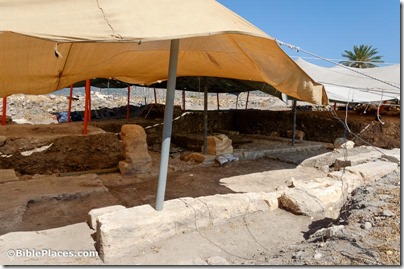
A 12th-century BC inscription from Lachish is shedding light on the
development of the alphabet.

The BASOR article is available through JStor (subscription required).

The New York Times reports on questions raised by the Magdala Stone.

The city of Beit Shemesh has discarded plans to build a neighborhood near Khirbet Qeiyafa.

The Temple Mount Sifting Project is seeking suggestions for the significance
of a design
incised on an ancient potsherd.

A golden medallion with a depiction of a menorah is on display at the Israel
Museum for the first time.

The latest issue of Biblical Archaeology Review includes articles on upcoming excavations, a Jewish building in Turkey, and the Jerusalem model’s 50th anniversary.

The latest Near Eastern Archaeology is a special issue on “Crime and Punishment in the Bible and the Near East.”

Carl Rasmussen recommends some websites he checks each day.

Ginger Caessens is teaching Historical Geography of Jordan this summer. This is the best way to learn about “the other half” of the biblical lands.

The Palestine Exploration Fund Blog is beginning a series on Duncan
Mackenzie’s work at Beth Shemesh
.

Wayne Stiles shows how a Bible story at Ein Kerem helps us to wait
on God
.

New Inscriptions and Seals Relating to the Biblical World, edited by Meir
Lubetski and Edith Lubetski is positively reviewed in the RBL.

Amazon is offering 25% off any one book (up to $10 off), good through Sunday.

HT: Agade, Joseph Lauer, Ted Weis

Share:

Archaeologists have found another ancient olive press at Shiloh.

The oldest known artifact of smelted lead has been discovered in a burial cave in the Negev.

George Athas provides some analysis of the Hezekiah seal impression.

Hoards: The Hidden History of Ancient Britain,” an exhibit at the British Museum, illustrates the action of the parable in Matthew 13:44.

HaDavar Biblical Museum is now under construction in Hong Kong.

The Associates for Biblical Research have cancelled their Winter Dig for this year and are considering postponing next summer’s excavation.

PEF and the Early Exploration of the Holy Land is the title of a conference being held at the University of Haifa in December.

The Mount Carmel forest fire led to the discovery of a farming community from the first century.
‘Atiqot 83 is now online.

Wayne Stiles explains the providential irony in the discovery of the Tel Dan Inscription.

The government is appealing the transfer of the Davidson Center Archaeological Park to management by Elad.

ASOR will be posting some of the presentations from the Annual Meeting on their website.

Andy Naselli recommends the Jerusalem IMAX movie, now on DVD. I agree.

CBD is running a big sale on Craig Keener’s 4-volume commentary on Acts through Monday ($138; Amazon: $192).

A free (pdf) book from HCSB: Exalting Jesus in Exodus (requires email address).

Logos Bible Software is also giving away a free book a day during Advent.

Happy Hanukkah!

HT: Agade, Charles Savelle

Share:

A personal seal impression belonging to King Hezekiah has been discovered in excavations south of Jerusalem’s Temple Mount. The tiny inscription reads, “Belonging to Hezekiah (son of) Ahaz king of Judah,” and is the first of its kind to be discovered in an excavation.

From a press release from the Hebrew University:

Measuring 9.7 X 8.6 mm, the oval impression was imprinted on a 3 mm thick soft bulla (piece of inscribed clay) measuring 13 X 12 mm. Around the impression is the depression left by the frame of the ring in which the seal was set.

The impression bears an inscription in ancient Hebrew script:

“לחזקיהו [בן] אחז מלך יהדה”
“Belonging to Hezekiah [son of] Ahaz king of Judah”

and a two-winged sun, with wings turned downward, flanked by two ankh symbols symbolizing life.

hu151202_Mazar_Tadmor_big

The bulla originally sealed a document written on a papyrus rolled and tied with thin cords, which left their mark on the reverse of the bulla. This bulla came to light, together with many pottery sherds and other finds such as figurines and seals, in Area A of the excavations (2009 season), supervised by Hagai Cohen-Klonymus.

The bulla was discovered in a refuse dump dated to the time of King Hezekiah or shortly after, and originated in the Royal Building that stood next to it and appears to have been used to store foodstuffs. This building, one of a series of structures that also included a gatehouse and towers, was constructed in the second half of the 10th century BCE (the time of King Solomon) as part of the fortifications of the Ophel — the new governmental quarter that was built in the area that connects the City of David with the Temple Mount.

Photo courtesy of Andrew Shiva

The bulla was found together with 33 additional bullae imprinted from other seals, some bearing Hebrew names, their reverse showing marks of coarse fabric and thick cords that probably sealed sacks containing foodstuffs.

The full press release, along with a 10-minute video, is posted here.

Share:

An 8-year-old boy discovered the head of an Iron Age figurine while visiting the site of Beth Shemesh.

A mosaic with an inscription from Isaiah 65 has been discovered near Adana, Turkey.

Archaeologists have found a “giant fence” at Tell ed-Daba that dates to the time of the Hyksos’ invasion.

The Algemeiner: “Hamas forces seized a chest full of Ottoman-era gold coins discovered in Gaza.”

Police arrested an antiquities dealer near Beth Shean with a collection of more than 3,000 illegally obtained coins.

Google is adding Petra to its “Street View.” The queen of Jordan contributed by writing the company’s blog post. I’m impressed.

Fadi Shawkat Haddad has released A Christian Pilgrimage Journey in Jordan. Haddad is a Christian tour guide in Jordan whom I worked with many years ago. The book covers 80 sites and costs $20 plus postage.

The Summer 2015 issue of DigSight is now available in pdf format. This issue includes a report on the season at Lachish, the Ishbaal inscription from Khirbet Qeiyafa, and upcoming events.

Charles E. Jones has expanded his bibliography of autobiographies of archaeologists and given it a new home.

A team of researchers is learning more about how vellum was produced for pocket Bibles in the medieval period.

Premier Exhibitions recently had a media preview of its King Tut exhibition. It features more than
1,000 precisely crafted replicas, arranged in the exact manner found by archaeologist Howard Carter in 1922.

Qedem Reports is now accessible online through JSTOR. In the future, all Qedem volumes will be available.

The Biblical Archaeology Society is running a Thanksgiving sale with discounts up to 85%.

The future of archaeology is non-invasive and non-destructive technologies.

This week on the Land and the Book: Bible Exploration Tech Tools with Scott Lindsey from Logos Bible Software.

Here’s more on the new papyrus of the Gospel of John.

BibleX has an interesting post on Paul and Bedbugs.

Israeli archaeologist Yoram Tsafrir died on Monday.

HT: Charles Savelle, Agade, Joseph Lauer, Pat McCarthy, Ted Weis

Share:

The Mountain to Valley Relay is a 215 km relay race in northern Israel. Registration opens in January.

A beautiful mosaic from the Roman and Byzantine periods excavated in Lod went on display this week.

A hoard of 3rd century Roman coins has been found in Switzerland.

You can now visit every gallery in the British Museum with Google Street View.

Reuters revisits Rujm el-Hiri in the Golan Heights.

Wayne Stiles observes the irony that a “seat of Moses” was discovered at Chorazin.

An ornately decorated 1st century A.D. basilica once used by a pagan cult is now open to tourists in Rome.

Now on pre-pub pricing for Logos: AR151 Archaeology in Action: Jesus and Archaeology, with Craig Evans.

The Ancient Semitic Languages Youtube Channel has a reading of the Mesha Stele in Moabite.

Urban Legends of the New Testament is on sale for $4.99 for Kindle.

Ferrell Jenkins has announced his 50th Anniversary Tour to Israel.

I’ve never heard of a modern-day “tour of Palestine,” but Felicity Cobbing reports on her annual tour to sites in the West Bank.

Leen Ritmeyer responds to the recent Popular Archaeology claim that the Jewish people are praying
at the wrong wall.

HT: Ted Weis, Vik Menon

Share:

You don’t have to watch too much of this video footage of a flash flood at the tabernacle model in Timna Park to be impressed. Repairs to the outer court posts are underway.

A leaky pipe at the Western Wall was mistaken for the Messiah.

There’s more talk about rebuilding the Colossus of Rhodes.

Archaeologists have discovered an unknown temple of Hatshepsut.

Now online in pdf format: The Archaeology of the Cuneiform Inscriptions, by A. H. Sayce.

Here are lots and lots of historic photos of Nazareth.

Independent Traveler suggests the 10 Best Israel Experiences.

I suspect that many of our readers would be interested in The First Days of Jesus, by Andreas J. Kostenberger and Alexander E. Stewart.

There are a couple of archaeology lectures this month in the DC area.

Just released: Galilee in the Late Second Temple and Mishnaic Periods, Volume 2: The 
Archaeological Record from Cities, Towns, and Villages, edited by David A. Fiensy and James Riley
Strange. The table of contents, introduction, interviews with the contributors, and a sample chapter are online. Individual chapters focus on Nazareth, Magdala, Bethsaida, Tiberias, Kedesh, Khirbet Qana, and much more. This will quickly become the classic archaeological guide to Galilee.

HT: Charles Savelle, Mark Hoffman, Ted Weis, Agade, Bill Schlegel

There will be no roundup next weekend.

Share: