Gordon Franz has just posted three transcribed interviews with staff members of the Hazor excavations, including Amnon Ben-Tor, Sharon Zuckerman, and Orna Cohen.  

“Hazor is Number One…”: An interview with Amnon Ben-Tor

“Where is the Archive at Hazor?”: An interview with Sharon Zuckerman

“It is the Best Job in the World”: An interview with Orna Cohen

Cohen is a conservator, and she comments on the controversy of the James Ossuary.  She believes that the second half of the inscription is original, but the first part is forged.

I had the pleasure of looking at and checking the James Ossuary and I gave my comments on it.  I think the ossuary is authentic and a real one, but the inscription on it, I am convinced there are two hands that wrote the inscription.  To my opinion, part of the inscription is faked, part is original.  Of course, there are things that go on in trial now.  They are still trying to figure out what is faked and by whom it was made.  To my opinion, the name Joshua [on the ossuary] is real.  The inscription reads: “Ya’acov bar Yosef achi Yehoshua.”  [Translation: Jacob, or James, the son of Joseph, the brother of Jesus].  So the first part, I think is added.  My professional opinion is almost against all the others that think the last name [on the inscription]; “bother of Jesus” (Joshua) is a fake.  So my opinion was against the others [at the trial].  I checked and it’s according to the patina in the letters.  There was a fake patina of just dirt that was put in these letters on purpose so I cleaned part of it and underneath there was the original, yellowish patina that based on my experience, was the original one.  It was not on the first part of the inscription but it was on the last part of the inscription.  That is what I gave as my opinion.

The Pope has begun a week-long visit to Jordan and Israel with words of respect for Islam.  From the JPost:

“My visit to Jordan gives me a welcome opportunity to speak of my deep respect for the Muslim community, and to pay tribute to the leadership shown by his majesty the king in promoting a better understanding of the virtues proclaimed by Islam,” Benedict said shortly after landing in Amman.

A traveler sends along photos from Nazareth of Muslim preparations for the Pope’s visit.  The large building in the background is the Church of the Annunciation, which the Pope is scheduled to visit on Thursday.

nazareth_welcome
nazareth_welcome2

If you’re interested in the visit of the Catholic Pope to Israel next month, the Israel Ministry of Tourism has established a website: Holyland Pilgrimage: A Bridge for Peace.  Questions of just how interested in peace the pope is have been raised following reports of his plans to meet with a terrorist-supporting mayor in Galilee.

The ministry has also created a 5-minute video in preparation for the visit.  The video features stunning aerial photography of numerous sites in Israel and is worth watching even if the pilgrimage doesn’t get you excited.

From Haaretz:

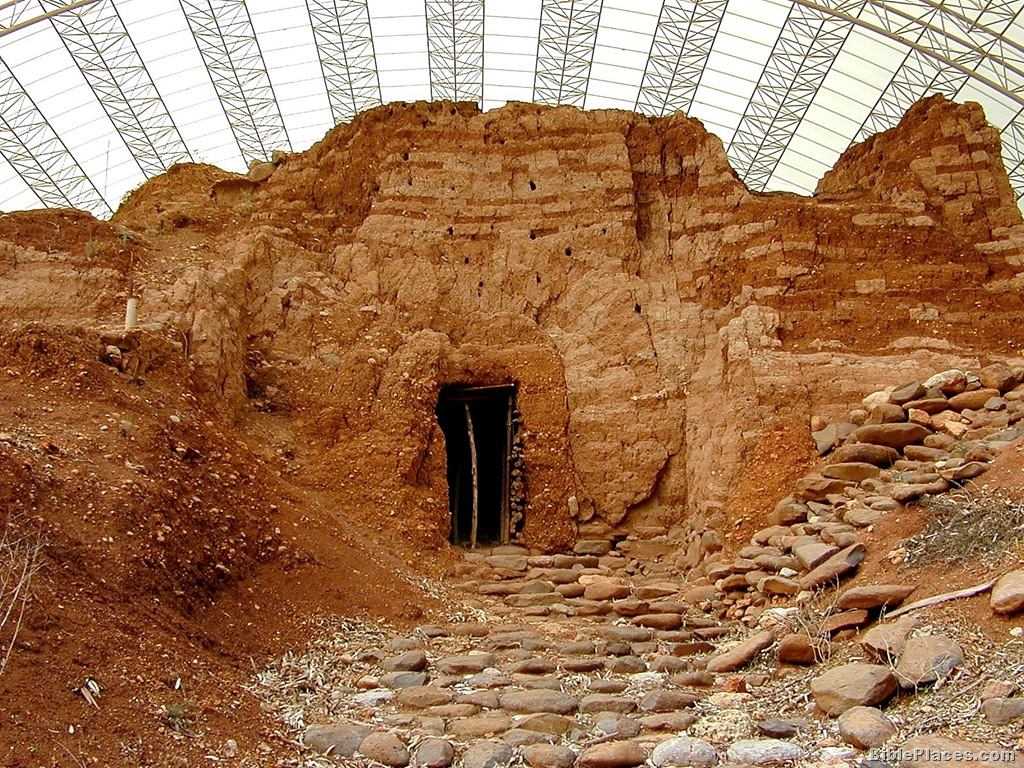
The Nature and National Parks Protection Authority yesterday opened “Abraham’s Gate” at Tel Dan in the north, for visits by the public.
The ancient structure from the Canaanite period of the Bronze Age is made of mud and is thought to have been built around 1750 B.C.E. The authority named the archaeological site for Abraham, the first patriarch of the Jewish people, indicating that it dates from the period of Abraham.
The gate was uncovered in 1979 but more recently underwent restoration. It is composed of three arches and constructed of sun-dried mud brick on a foundation of large basalt stones. The gate, which in ancient times stood seven meters tall, has been restored to its original height. It features two towers and a horizontal structure linking them below the arches, the oldest arches ever found in the Land of Israel.

HT: Joe Lauer

Dan Middle Bronze mudbrick gate2, tb011500 Middle Bronze gate before restoration (Jan 2000)

There is something important to this story, but it’s not what you might think.  What is exciting is that ancient Magdala is being excavated.  Perhaps that will increase our knowledge of this ancient city that was home to Mary Magdalene.  Perhaps it will result in the site being opened to visits by tourists.  Perhaps there will be silly sensational claims made before analysis is done – oh wait, that wish has already come true.  From the Telegraph, written by Nick Pisa in Rome:

Archaeologists have discovered vases of perfumed ointment which may have been used by Mary Magdalene to anoint the feet of Jesus.

This sentence should immediately clue you into the fact that this is a “made-for-TV” story, fashioned for maximum publicity without regard to truth.  You know this because:

1. It is quite incredible that of all the vases in the ancient world, the first ones the archaeologists find at this city are related to this biblical event.

2. Mary was from Magdala, but since there is no record that Jesus was ever in Magdala, his feet were not anointed there.  Perhaps, though, Mary carried the bottles back to her hometown.

3. Except that it’s hard to believe that Mary only poured some of the contents out and left the rest for archaeologists to find.

4. Most important to ignore in order to make this story fly is the fact that the Bible nowhere says that Mary Magdalene anointed Jesus’ feet.  A different Mary anointed him the week before his crucifixion (John 12:1-8).  And a sinful woman anointed him at the house of a Pharisee (Luke 7:36-50).  She is never named and Mary Magdalene is introduced by Luke two verses later (Luke 8:2) with no indication that this was the same woman.  Furthermore, the unnamed woman used an alabaster jar. 

Did the excavators find an alabaster jar?  Mary Magdalene did plan to anoint Jesus’ body one Sunday morning, but she failed in her attempt (Mark 16:1-8).

The Italian team have been digging for several months at the ancient Palestinian town of Magdala – from where Mary gets her name.

In Mary’s day, Magdala was in the district of Galilee.  Today, its ruins are in the state of Israel.  It was not then, and is not now, a Palestinian town, except for those who wish to see the Jewish nation replaced by an Arab one.

The archaeologists of the Franciscan academic society Studium Biblicum Franciscanum found the unopened vases dating to the first century AD conserved in mud at the bottom of a swimming pool in Magdala’s thermal complex….

Speaking of the discovery Father Stefano De Luca who is leading the dig, said: “The mud-filled condition of the site allowed us to find these truly extraordinary objects, which were intact and sealed and still contain greasy substances.

“We think these are balms and perfumes and if chemical analysis confirms this, they could be similar to those used by Mary Magdalene in the Gospels to anoint the feet of Christ.

I have a revolutionary idea.  Analyze the contents, and then tell us what they are.

“The discovery of these vases is very important. We have in our hands the cosmetic products from the time of Jesus. It’s very likely that the woman who anointed Christ’s feet used these products, or ones similar in organic composition and quality.”

Frankly, this story could have been written long before the excavations.  They already knew the site was inhabited in the 1st century A.D.  All they needed was to find some vases, any vases, and they could say that these were related to Mary.  And the reporters would come, and the donations would flow.

HT: Joe Lauer

Magdala from above, tb102702020 Magdala from west
UPDATE (12/12): An article in Italian is longer and includes a photograph.

From the Caspari Center Media Review:

A column in the Calcalist (December 3) surveyed the "Most popular sites in Israel visited by Christians." In first place, rather surprisingly, came the Western (Wailing) Wall: "Despite the fact that Christians have no religious connection to the Wall, its proximity to the Church of the Holy Sepulchre and the Via Dolorosa has made it one of the four sites everyone has to visit in Jerusalem." The Church of the Holy Sepulchre was second: "Although not all Christian denominations concur that Yeshu was buried here, this church in the heart of the Christian Quarter is of great importance . . ." Third was the Via Dolorosa, "along which Yeshu passed on his way to his crucifixion, stopping at nine places . . ." The fourth site was the Mount of Olives – "mentioned in the New Testament as the place whence Yeshu ascended to heaven and to which he will also return in the end times." In fifth place was Capernaum, where "after he left Nazareth, Yeshu transferred his activities . . . and also chose his apostles." The information was credited to the Ministry of Tourism, the statistics to the first half of 2008. Tourists visiting Kibbutz Ein Gev on the eastern shore of the Sea of Galilee will now be able to experience a "reconstruction" of one of Jesus’ miracles, according to a report in Israel HaYom (December 4). Having caught an enormous St. Peter’s fish (musht), the kibbutz’s veteran fisherman has decided to "preserve" it, put a gold coin in its mouth, and present it to tourists as a visual aid to Jesus’ catch of a "huge" fish, the proceeds from the sale of which he used to pay the border tax owed by his disciples.